---
title: Malia
author: Mark Cartwright
source: https://www.worldhistory.org/Malia/
format: machine-readable-alternate
license: Creative Commons Attribution-NonCommercial-ShareAlike (https://creativecommons.org/licenses/by-nc-sa/4.0/)
updated: 1970-01-01
---
# Malia
_Authored by [Mark Cartwright](https://www.worldhistory.org/user/markzcartwright/)_
Located near a fertile plain in northern [Crete](https://www.worldhistory.org/crete/) and with its own harbour, Malia was one of the major settlements and palaces of the [Minoan civilization](https://www.worldhistory.org/Minoan_Civilization/). Inhabited since [Neolithic](https://www.worldhistory.org/Neolithic/) times (6000 BCE) and with the first evidence of monumental [architecture](https://www.worldhistory.org/disambiguation/architecture/) dating to 2200 BCE, the site reached its greatest influence during the palatial periods of c. 1900 BCE to c. 1675 BCE. Following earthquakes and fires, the site became less influential and was finally abandoned c. 1250 BCE.
The original name of the settlement has been lost and the site derives its present name from the nearby modern village of Malia. Suggestions as to the original name are Milatos or Tarmara. In [Greek mythology](https://www.worldhistory.org/Greek_Mythology/), Malia's first king was [Sarpedon](https://www.worldhistory.org/Sarpedon/) (the son of [Zeus](https://www.worldhistory.org/zeus/) and [Europa](https://www.worldhistory.org/Europa/)), younger brother of Minos of [Knossos](https://www.worldhistory.org/knossos/).
Along with Knossos, [Phaistos](https://www.worldhistory.org/Phaistos/) and [Zakros](https://www.worldhistory.org/Zakros/), Malia was one of the most important [Minoan](https://www.worldhistory.org/disambiguation/Minoan/) settlements. The palace complex, covering some 7500 square metres, was perhaps the local administrative, commercial, political and religious centre. There is also extensive archaeological evidence surrounding the palace site, including a town, smaller palaces and a large cemetery. Finds of [gold](https://www.worldhistory.org/gold/) and [bronze](https://www.worldhistory.org/disambiguation/bronze/) objects, stone vases, extensive [pottery](https://www.worldhistory.org/pottery/), [metal](https://www.worldhistory.org/disambiguation/metal/), and ceramic workshops, large vases (*pithoi* and *[amphorae](https://www.worldhistory.org/Amphora/)*) and the presence of Malian seal stones throughout central Crete, strongly suggest Malia was a significant trading and commercial centre.
The palace complex was built in two stages. The first palace, built around 1900 BCE, was destroyed c. 1675 BCE, probably by fire and [earthquake](https://www.worldhistory.org/disambiguation/earthquake/). The second palace was built soon after, largely on the plan of the first. This palace was also destroyed, once again, probably by earthquake c. 1450 BCE. With the notable exception of the main courts, it is the remains of the second palace which are visible at the site today. The site has been excavated by the French Archaeological School from 1920 CE to the present and is regarded as a showcase site for modern conservation [archaeology](https://www.worldhistory.org/Archaeology/).
The splendid palaces included all of the principal features of Minoan palatial architecture such as a large central court, a [theatre](https://www.worldhistory.org/disambiguation/theatre/) or performance area, colonnades, light wells, rooms of two stories, storage magazines, and private rooms. The palaces were constructed using local sandstone and limestone blocks with many rooms being plastered and painted, including the floors.
[ 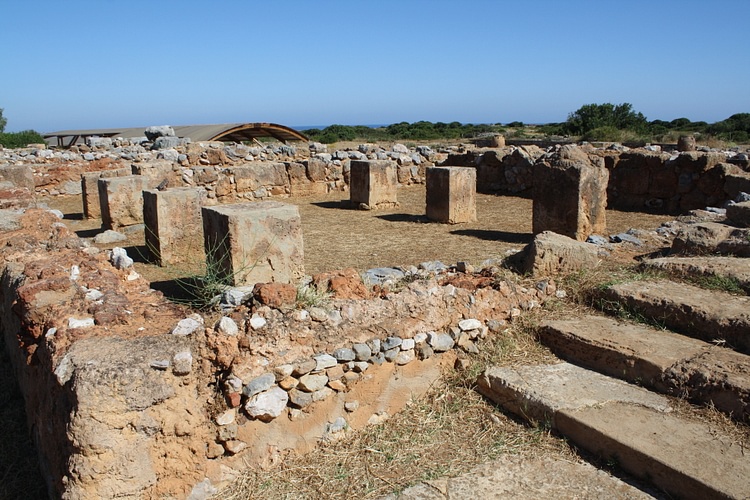 Malia, Crete Mark Cartwright (CC BY-NC-SA) ](https://www.worldhistory.org/image/378/malia-crete/ "Malia, Crete")Visible today are the large central court (48m x 23m and originally with porticoes on the north and west sides) with its central sacrificial hearth and four surviving monumental steps along its south side used as a theatre area, probably, as with the other Minoan palaces, for festivals, rituals and bull leaping games; 7 surviving steps of the monumental Grand Staircase; a 90cm diameter offering stone or *Kernos*; three, 4m wide circular pits used as grain silos, each with a central [column](https://www.worldhistory.org/column/) base to support the original roof; the Hypostyle Hall with 6 column bases still *in situ*; the Hypostyle Crypt with its benched walls suggesting its use as a meeting place; and various other halls, apartments and magazines including one room with a well-preserved stone toilet with drainage system.
Outstanding finds from the site include the celebrated gold bee pendant and ceremonial stone axe in the shape of a panther from the 17th century BCE. These now reside in the archaeological museum in Iraklion, Crete.
#### Editorial Review
This human-authored definition has been reviewed by our editorial team before publication to ensure accuracy, reliability and adherence to academic standards in accordance with our [editorial policy](https://www.worldhistory.org/static/editorial-policy/).
## Bibliography
- [Cline, E.H. *The Oxford Handbook of the Bronze Age Aegean.* Oxford University Press, USA, 2012.](https://www.worldhistory.org/books/0199873607/)
- Davaras, C. *Malia.* Hannibal, Athens
- [Hutchinson, R.W. *Prehistoric Crete.* Pelican / Penguin Books, 1963.](https://www.worldhistory.org/books/B001PT8R0U/)
## About the Author
Mark is WHE’s Publishing Director and has an MA in Political Philosophy (University of York). He is a full-time researcher, writer, historian and editor. Special interests include art, architecture and discovering the ideas that all civilizations share.
## Timeline
- **6000 BCE**: First habitation at [Malia](https://www.worldhistory.org/Malia/).
- **2200 BCE**: First monumental [architecture](https://www.worldhistory.org/disambiguation/architecture/) at [Malia](https://www.worldhistory.org/Malia/).
- **c. 1900 BCE - c. 1675 BCE**: First [Minoan](https://www.worldhistory.org/disambiguation/Minoan/) [palace](https://www.worldhistory.org/disambiguation/palace/) at [Malia](https://www.worldhistory.org/Malia/).
- **1675 BCE - 1450 BCE**: Second [Minoan](https://www.worldhistory.org/disambiguation/Minoan/) [palace](https://www.worldhistory.org/disambiguation/palace/) at [Malia](https://www.worldhistory.org/Malia/).
- **c. 1450 BCE**: [Earthquake](https://www.worldhistory.org/disambiguation/earthquake/) and fire ends the [Minoan](https://www.worldhistory.org/disambiguation/Minoan/) period at [Malia](https://www.worldhistory.org/Malia/).
- **c. 1250 BCE**: [Malia](https://www.worldhistory.org/Malia/) site abandoned.
## Cite This Work
### APA
Cartwright, M. (2012, May 16). Malia. *World History Encyclopedia*.
### Chicago
Cartwright, Mark. "Malia." *World History Encyclopedia*, May 16, 2012. .
### MLA
Cartwright, Mark. "Malia." *World History Encyclopedia*, 16 May 2012, .
## License & Copyright
Submitted by [Mark Cartwright](https://www.worldhistory.org/user/markzcartwright/ "User Page: Mark Cartwright"), published on 16 May 2012. The copyright holder has published this content under the following license: [Creative Commons Attribution-NonCommercial-ShareAlike](https://creativecommons.org/licenses/by-nc-sa/4.0/deed.en). This license lets others remix, tweak, and build upon this content non-commercially, as long as they credit the author and license their new creations under the identical terms. When republishing on the web a hyperlink back to the original content source URL must be included. Please note that content linked from this page may have different licensing terms.