---
title: Maeshowe: The Ancient Meadow Mound of Orkney
author: Joshua J. Mark
source: https://www.worldhistory.org/Maeshowe/
format: machine-readable-alternate
license: Creative Commons Attribution-NonCommercial-ShareAlike (https://creativecommons.org/licenses/by-nc-sa/4.0/)
updated: 2026-04-19
---
# Maeshowe: The Ancient Meadow Mound of Orkney
_Authored by [Joshua J. Mark](https://www.worldhistory.org/user/JPryst/)_
Maeshowe (pronounced `maze-ow' or `maze-oo') is a large [Neolithic](https://www.worldhistory.org/Neolithic/) chambered cairn, dating from between 3000-2800 BCE, in the Stenness parish of Orkney, [Scotland](https://www.worldhistory.org/disambiguation/Scotland/). According to Dr. Berit Sandnes, of Lund University, the name means "Meadow Mound" and comes from Old Scandinavian; the present location of both Maeshowe and the nearby site of the Maesquoy Standing Stones are thought to have originally been meadows.
The construction of the cairn, and the long passage leading into it, has led scholars to also designate the site a passage [grave](https://www.worldhistory.org/burial/) even though no significant human remains (only traces of bone fragments and a skull portion) have been found at the site. Maeshowe is located in proximity to many other famous Neolithic sites in Orkney such as the [Barnhouse Settlement](https://www.worldhistory.org/Barnhouse_Settlement/) and Barnhouse Stone, The Standing Stones of Stenness, The [Ness of Brodgar](https://www.worldhistory.org/Ness_of_Brodgar/), The Ring of Brodgar, The Watchstone, Cometstone, and The Unstan Cairn and, to the north-west, The Ring of Bookan and the village of [Skara Brae](https://www.worldhistory.org/Skara_Brae/).
### Discovery & Excavation
The site was first excavated in July 1861 by the antiquarian James Farrer, on the recommendation of Mr. David Balfour, known for his work at Skara Brae, and others who also worked at Skara Brae such as Mr. George Petrie. Citing Petrie's measurements, Farrer described the exterior of the cairn thusly (metrics added):
> The tumulus is about 92 feet (28 metres) in diameter, 36 feet (11 metres) high, and about 300 feet(91 metres) in circumference at the base. It is surrounded by a trench 40 feet (12 metres) wide, and varying in depth from 4 to 8 feet (1-2 metres). It is situated on the north side of the new road leading to Stromness from Kirkwall, being about 6 miles (9 km) from the former, and 9 (14 km) from the latter place. It is about 200 yards distant from the road and a mile and a half (2.4 km) from the Stones of Stenness. (guternberg.org)
Farrer found the entrance passage blocked with rubble and, apparently at the suggestion of Petrie, dug down through the top of the mound (a choice which has been criticized by archaeologists since). At this time the mound was conical in shape but, when the site was taken under government care in 1910, a concrete roof was added (in part to close the cavity made by Farrer) and the mound shaped to its present form.
Maeshowe is considered one of the finest examples of Neolithic [architecture](https://www.worldhistory.org/disambiguation/architecture/) and has given its name to similarly constructed tombs stretching from Papa Westray and Sanday islands in the north down through mainland Orkney. The cairn was declared a World Heritage site in 1999 and is presently under the care of Historic Scotland.
### Construction & Alignment
As with many Neolithic sites, Maeshowe is aligned to the midwinter solstice and the setting sun at that time of year brightly illuminates the entrance passage and main chamber. That the cairn was built on the site of a much older structure is attested to by the find of a socket hole near the mound which suggests a stone circle once stood at the location. The trench surrounding the cairn seems similar to that surrounding other henges such as the nearby Ring of Brodgar.
The monolith known as the Barnhouse Stone is aligned directly with the entrance passage of Maeshowe and, at the winter solstice, the sun sets over the top of that stone monument to then illuminate the cairn. It is possible that the Barnhouse Stone was originally erected to perform the same function with a henge that once stood on the Maeshowe site and, if so, the builders carefully constructed the cairn to align to the earlier site of Barnhouse (built circa 3300).
Alternately, it has been suggested, the Barnhouse Stone may have been erected during the construction of Maeshowe and the earlier structure at the site was a house or ritual site instead of a henge. Support for this theory comes from Structure Eight at the Barnhouse Settlement (built 2600 BCE) which seems to have been constructed for ritual purposes and, like Maeshowe, raised on a platform of clay.
It has been suggested that Structure Eight may have been raised to replace whatever structure originally occupied the Maeshowe location. Whatever the original building, the current cairn is so precisely aligned that, twenty-two days before and after the winter solstice, the sun sets and then reappears from nearby Hoy's Ward Hill (directly in line with the Barnhouse Stone) to create what investigators of the phenomenon call "Solar Flashings" – flashes of light thrown into the entrance passageway and the main chamber.
These flashes are not the prolonged illumination of the solstice and it has been suggested that the cairn was built purposefully to catch this light intermittently leading up to, and away from, midwinter; perhaps to symbolize the coming of warmer, brighter, days.
[ 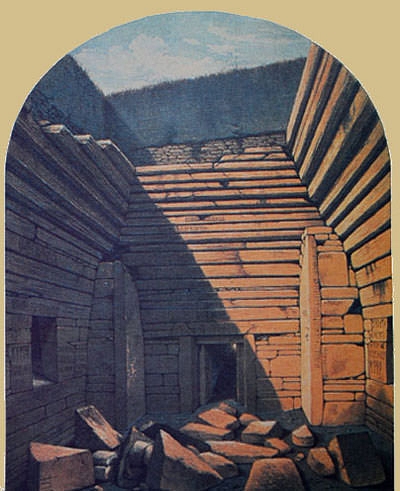 Maeshowe excavation 1861 Mr. Gibb (CC BY-SA) ](https://www.worldhistory.org/image/941/maeshowe-excavation-1861/ "Maeshowe excavation 1861")### Norse Associations & Treasure
The entrance passage, on the south-west side of the mound, runs 36 feet (11 metres) to the main chamber and includes the interesting feature of the so-called "blocking stone", a huge hewn rock which could be pulled from a recess in the [wall](https://www.worldhistory.org/wall/) to close off the passage, perhaps during rituals. The main chamber measures 13 feet (4.7 metres) with stone buttresses in the corners which once supported a corbelled roof, which the drawings of a Mr. Gibb of Aberdeen, who was a member of Farrer's 1861 expedition, show had fallen in before that time.
Runic inscriptions (the largest single grouping found so far in the world) as well as the engraving of a dragon are cut in the walls of this chamber and date to the 12th century when a band of Norsemen took refuge in the cairn during a winter storm. This same group may have carried off whatever valuables or remains were housed in the main chamber or the three smaller ones which branch off from it (to the east, north, and west).
The Orkeyinga [Saga](https://www.worldhistory.org/Saga/) (written circa 1230) describes the cairn being looted by the Norse Earl Harald Maddadarson and Ragnvald, Earl of More, sometime in the early 12th century. As there is much in the Orkneyinga which scholars now consider legendary, it cannot be said with certainty that these particular men, or any men, broke in and looted the [tomb](https://www.worldhistory.org/tomb/). Farrer certainly seemed to think they did, [writing](https://www.worldhistory.org/writing/) in 1862:
> \[The Cairn has\] undoubtedly been entered at some remote period, probably by the Northmen, who, as is well known, were not deterred by feelings either of [religion](https://www.worldhistory.org/religion/) or superstition, from opening and ransacking any place likely to repay them for their trouble. Whether they were the first to break into the building, or whether they found it in a state of comparative ruin, the natural result of great antiquity, can now only be matter of conjecture. (gutenberg. org)
Besides the testimony of the Orkneyinga Saga, the persistent claim that there were once valuables housed in the cairn is suggested by some of the runic graffiti which mentions a "great treasure" which was taken away from the site but, also, a great treasure buried close by the site. Whether there ever was any such treasure no one knows and the idea that Maeshowe once contained human remains, and attendant wealth for the afterlife, is pure speculation on the part of modern excavators based on these evidences and the excavators' assumptions of what the cairn may have once held.
The only artifacts discovered by the 1861 party were bones of horses and a part of a human skull. No physical evidence exists to support the claim of a great treasure in the building nor even that it was a tomb. Further, it has been noted, the word "treasure" could have easily meant something quite different to an ancient community than it does to a more modern one. The Grooved Ware pot, found in Structure Eight of the Barnhouse Settlement, contained fourteen pieces of flint, a type of stone highly valued in Orkney owing to its rarity, which would have been considered a "treasure."
### Conclusion
The fact that the "blocking stone" at Maeshowe had to be pulled into place from inside, not outside, the entrance passage, suggests that it was used to seal off the cairn during rituals of some kind and the midwinter solstice alignment further supports the function of the site as ceremonial in nature.
The location of the cairn, aligned to the Barnhouse Stone, in proximity to Structure Eight and, most significantly perhaps, to the recently excavated site of the Ness of Brodgar, which most certainly was a ritual complex, lends greater support to the theory that Maeshowe was used in this same capacity. As further excavation proceeds on the Ness of Brodgar, and surrounding areas which no doubt conceal more ancient structures, the original purpose of the cairn of Maeshowe may be better understood.
#### Editorial Review
This human-authored definition has been reviewed by our editorial team before publication to ensure accuracy, reliability and adherence to academic standards in accordance with our [editorial policy](https://www.worldhistory.org/static/editorial-policy/).
## Bibliography
- [Hadingham, E. *Circles and Standing Stones.* Walker & Co, 1975.](https://www.worldhistory.org/books/0802704638/)
- [Historic Scotland - Maeshowe Chambered Cairn Property Detail](http://www.historic-scotland.gov.uk/propertyresults/propertyoverview.htm?PropID=PL_205 "Historic Scotland - Maeshowe Chambered Cairn Property Detail"), accessed 1 Dec 2016.
- [Maes Howe](http://www.ancientworlds.net/aw/Article/670361 "Maes Howe"), accessed 1 Dec 2016.
- [Maeshowe and the Winter Solstice](http://www.orkneyjar.com/history/maeshowe/solstice.htm "Maeshowe and the Winter Solstice"), accessed 1 Dec 2016.
- [Maeshowe, Orkney's finest chambered cairn](http://www.orkneyjar.com/history/maeshowe/index.html "Maeshowe, Orkney's finest chambered cairn"), accessed 1 Dec 2016.
- [Notice of Runic Inscriptions Discovered during Recent Excavations in the Orkneys](http://www.gutenberg.org/files/34816/34816.txt "Notice of Runic Inscriptions Discovered during Recent Excavations in the Orkneys"), accessed 1 Dec 2016.
## About the Author
Joshua J. Mark is World History Encyclopedia's co-founder and Content Director. He was previously a professor at Marist College (NY) where he taught history, philosophy, literature, and writing. He has traveled extensively and lived in Greece and Germany.
- [Linkedin Profile](https://www.linkedin.com/pub/joshua-j-mark/38/614/339)
## Timeline
- **c. 3300 BCE - 2600 BCE**: [Neolithic](https://www.worldhistory.org/Neolithic/) site of [Barnhouse Settlement](https://www.worldhistory.org/Barnhouse_Settlement/) occupied.
- **c. 3300 BCE - 2600 BCE**: The [Barnhouse Settlement](https://www.worldhistory.org/Barnhouse_Settlement/) constructed and inhabited.
- **2600 BCE**: Structure Eight (so called) erected at [Barnhouse Settlement](https://www.worldhistory.org/Barnhouse_Settlement/) after village abandoned.
- **2600 BCE**: [Barnhouse Settlement](https://www.worldhistory.org/Barnhouse_Settlement/) abandoned and partially destroyed by inhabitants.
- **2600 BCE**: The building now known as Structure Eight raised in [Barnhouse Settlement](https://www.worldhistory.org/Barnhouse_Settlement/) after village is abandoned.
## Questions & Answers
### What is Maeshowe?
Maeshowe is a Neolithic chambered cairn in Orkney, Scotland.
### How old is Maeshowe?
Maeshowe dates to circa 3000-2800 BCE.
### What was the original purpose for Maeshowe?
The original purpose for Maeshowe is unknown but, as it is astronomically aligned, and has other features associated with religious ritual, it is understood to have been a sacred ritual site.
### When was Maeshowe first excavated?
Maeshowe was first excavated in 1861 by the antiquarian James Farrer.
## External Links
- [Maes Howe Burial Chamber](https://www.vikingeskibsmuseet.dk/en/professions/education/the-viking-age-geography/the-vikings-in-the-west/scotland/maes-howe-burial-chamber)
- [Maeshowe: The UK’s doorway to another world](https://www.bbc.com/travel/article/20231221-maeshowe-the-uks-doorway-to-another-world)
- [Maeshowe Chambered Cairn](https://www.orkney.com/listings/maeshowe-chambered-cairn)
- [Maeshowe – historic additions, incursions and the Norse runes – The Ness of Brodgar Project](https://www.nessofbrodgar.co.uk/maeshowe-runes/)
## Cite This Work
### APA
Mark, J. J. (2012, October 24). Maeshowe: The Ancient Meadow Mound of Orkney. *World History Encyclopedia*.
### Chicago
Mark, Joshua J.. "Maeshowe: The Ancient Meadow Mound of Orkney." *World History Encyclopedia*, October 24, 2012. .
### MLA
Mark, Joshua J.. "Maeshowe: The Ancient Meadow Mound of Orkney." *World History Encyclopedia*, 24 Oct 2012, .
## License & Copyright
Submitted by [Joshua J. Mark](https://www.worldhistory.org/user/JPryst/ "User Page: Joshua J. Mark"), published on 24 October 2012. The copyright holder has published this content under the following license: [Creative Commons Attribution-NonCommercial-ShareAlike](https://creativecommons.org/licenses/by-nc-sa/4.0/deed.en). This license lets others remix, tweak, and build upon this content non-commercially, as long as they credit the author and license their new creations under the identical terms. When republishing on the web a hyperlink back to the original content source URL must be included. Please note that content linked from this page may have different licensing terms.