---
title: Lysimachus
author: Donald L. Wasson
source: https://www.worldhistory.org/Lysimachus/
format: machine-readable-alternate
license: Creative Commons Attribution-NonCommercial-ShareAlike (https://creativecommons.org/licenses/by-nc-sa/4.0/)
updated: 2024-07-29
---
# Lysimachus
_Authored by [Donald L. Wasson](https://www.worldhistory.org/user/DWasson/)_
Lysimachus (c. 361-281 BCE) was one of [Alexander the Great](https://www.worldhistory.org/Alexander_the_Great/)'s trusted bodyguards and a member of his Companion Cavalry. Although he obtained Macedonian citizenship, his father was a Thessalian named Agathocles. After the [death of Alexander the Great](https://www.worldhistory.org/article/2366/death-of-alexander-the-great/) in 323 BCE, Lysimachus benefitted from his loyalty to the king by being rewarded with the strategically important province of Thrace, an area northeast of [Macedon](https://www.worldhistory.org/macedon/) along the Black Sea coast.
While he initially remained relatively uninvolved in the series of wars that immediately followed [Alexander](https://www.worldhistory.org/disambiguation/Alexander/)'s [death](https://www.worldhistory.org/disambiguation/Death/), he eventually sought to expand his land holdings and ultimately joined his fellow commanders in a [war](https://www.worldhistory.org/disambiguation/War/) against [Antigonus Monophthalmus](https://www.worldhistory.org/Antigonus_I/) (the One-Eyed) and his son [Demetrius I of Macedon](https://www.worldhistory.org/Demetrius_I_of_Macedon/). Success would follow but at a hefty price.
### Alexander's Bodyguard
Educated at the royal court in Pella, Lysimachus rose to become a prominent member of the king's entourage, one of his bodyguards or *somatophylax* by 328 BCE. Oddly enough, there was another Lysimachus in the entourage of Alexander. This second Lysimachus was one of the king's former tutors, better known, as one historian stated, for his sense of humor rather than hygiene. He called the young Alexander [Achilles](https://www.worldhistory.org/achilles/) while he referred to himself as Phoenix, Achilles' tutor. Although historians record that he accompanied the king on the invasion of [Persia](https://www.worldhistory.org/Persia/), his only appearance of note was at the siege of [Tyre](https://www.worldhistory.org/Tyre/).
There is some disagreement over the exact year of Lysimachus's birth. Some historians give the year as 361 BCE while others say he was born around 355 or 351 BCE in Pella, the capital of Macedon. The earlier date is more plausible. If he had been born in 355 BCE or later, he would have been too young to have accompanied the king to Persia as a bodyguard. Although early histories state that he accompanied the king in his war against the Persians and King [Darius](https://www.worldhistory.org/disambiguation/darius/), little is known about Lysimachus' participation before Hydaspes. Historians write of his involvement in Alexander's [battle](https://www.worldhistory.org/disambiguation/battle/) of the Hydaspes against King Porus - it was recorded that he crossed the river with the king - and the siege of the Indian [city](https://www.worldhistory.org/city/) of Sangala. Apparently, he was wounded at this siege. The historian [Arrian](https://www.worldhistory.org/Arrian/), in his *The Campaigns of Alexander*, wrote,
> Throughout the siege Alexander lost a little under 100 men; the number of wounded, however, was disproportionately large – over 1,000, among them being Lysimachus, of Alexander's personal guard, and other officers. (290)
For this bravery and loyalty to the king, he was rewarded with Thrace whose importance lay in its location adjacent to the Hellespont, the bridge between Asia and [Europe](https://www.worldhistory.org/europe/).
### Governor of Thrace
On June 10, 323 BCE, Alexander the Great died in [Babylon](https://www.worldhistory.org/babylon/). Historians, both past and present, argue over the exact cause, nevertheless, he died without naming a successor or heir, causing his [empire](https://www.worldhistory.org/empire/) to descend into chaos. Although the commander [Perdiccas](https://www.worldhistory.org/Perdiccas/) possessed the king's signet ring, arguments persisted and no consensus could be reached. While waiting for Alexander's son, the future Alexander IV, to come of age, the commanders divided the empire among themselves - [Ptolemy I](https://www.worldhistory.org/Ptolemy_I/) took [Egypt](https://www.worldhistory.org/egypt/), the elderly [Antigonus](https://www.worldhistory.org/disambiguation/Antigonus/) obtained parts of [Asia Minor](https://www.worldhistory.org/Asia_Minor/), the regent [Antipater](https://www.worldhistory.org/disambiguation/Antipater/) I retained Macedon and [Greece](https://www.worldhistory.org/greece/), and lastly, Lysimachus received Thrace. His fellow bodyguard Leonnatus accepted the province of [Phrygia](https://www.worldhistory.org/phrygia/), located across on the Asian side of the Hellespont - an arrangement that caused constant friction between the two.
[  Map of the Hellenistic Kingdoms after Alexander, c.301 BCE Simeon Netchev (CC BY-NC-ND) ](https://www.worldhistory.org/image/14355/map-of-the-hellenistic-kingdoms-after-alexander-c3/ "Map of the Hellenistic Kingdoms after Alexander, c.301 BCE")For the next three decades, alliances would be made and broken. Enemies became friends, and friends became enemies. The empire that Alexander had built would never be reunited. His mother, wife, and only son and heir would die on the orders of [Cassander](https://www.worldhistory.org/Cassander/), Antipater's son, never having sat on the throne.
Lysimachus' first duty upon his arrival in Thrace was to pacify the diverse Thracian tribes. Although the Thracians joined in the fight against Darius, they had always been a people antagonistic to both [Philip II](https://www.worldhistory.org/disambiguation/Philip_II/) and Alexander. The young ruler immediately established himself against the leader of a key Thracian dynasty, the Seuthes. Since the majority of Alexander's empire had been divided among his more prominent commanders, they busied themselves in what became known as the Wars of Succession or [Wars of the Diadochi](https://www.worldhistory.org/Wars_of_the_Diadochi/). Since they fought among themselves with little interest in either Thrace or Phrygia, Lysimachus realized his good fortune and avoided getting involved. In Thrace he was fairly safe from the intrigues and scheming of his fellow commanders - no one outside the province challenged him - at least for a while. He concentrated his efforts on establishing a strong power base, but at one point, in 315 BCE he was forced to suppress a revolt staged by one of the [cities](https://www.worldhistory.org/city/) along the Black Sea coast.
Eyeing the strategically important province for himself, the commander Antigonus who reigned over much of Asia Minor sent a small contingency to aid the city and provoke the local tribes. Finally, in 311 BCE, peace was achieved with Lysimachus remaining in control of the hostile city. This revolt would finally draw him into the conflict that he had so long sought to avoid. He formed an alliance with Cassander of Macedon, [Ptolemy](https://www.worldhistory.org/disambiguation/Ptolemy/), and Seleucus I. To safeguard the area and secure the Dardanelles, he promptly built a new city in 309 BCE, Lysimachia, on the Gallipoli peninsula.
### Family Affairs
From the time he was named ruler until his death in 281 BCE, Lysimachus used marriage to secure his position in Thrace and establish necessary beneficial alliances. After the commander Perdiccas, who would soon die at the hands of his own men, refused to marry Antipater's daughter Nicaea, the wise Thracian ruler married her in 321 BCE, securing an alliance with both Antipater and his son Cassander. They would have three children: one son, Agathocles, and two daughters. Lysimachus would later support his brother-in-[law](https://www.worldhistory.org/disambiguation/law/) against Polyperchon for the regency of Macedon and Greece. After the death of Nicaea, he chose to marry the daughter of Ptolemy I and his mistress [Berenice](https://www.worldhistory.org/disambiguation/Berenice/), [Arsinoe II Philadelphus](https://www.worldhistory.org/Arsinoe_II_Philadelphus/), around 300 BCE. It was a marriage he would regret. For reasons unknown (probably to secure the throne of Thrace for her own son), Arsinoe convinced her husband to kill his oldest son and heir Agathokles on the trumped-up charges of treason. The murder of the popular young commander caused an uproar among many of his fellow officers who chose to desert to the army of Seleucus, now the adversary of Ptolemy. After Lysimachus' death, she would marry her half-brother [Ptolemy II](https://www.worldhistory.org/Ptolemy_II_Philadelphus/), establishing the precedent of brother-sister marriages in Egypt.
### Wars of the Diadochi
Like many other commanders, Lysimachus assumed the title of king in 305 BCE. With the memory of Antigonus' recent attack fresh in his memory, the king set his expansion sights on Asia Minor. He allied with Seleucus and Cassander against the elderly Antigonus and his son Demetrius at the Battle of Ipsus in 301 BCE; a battle that would bring about both the defeat and death of Antigonus. According to the terms of peace, Lysimachus was rewarded with additional lands in Asia Minor to the south of the Taurus Mountains, Seleucus received [Syria](https://www.worldhistory.org/syria/), and Cassander's position was established securely in Macedon and Greece. According to many historians, the battle put an end to any hope of re-establishing Alexander's empire.
[ 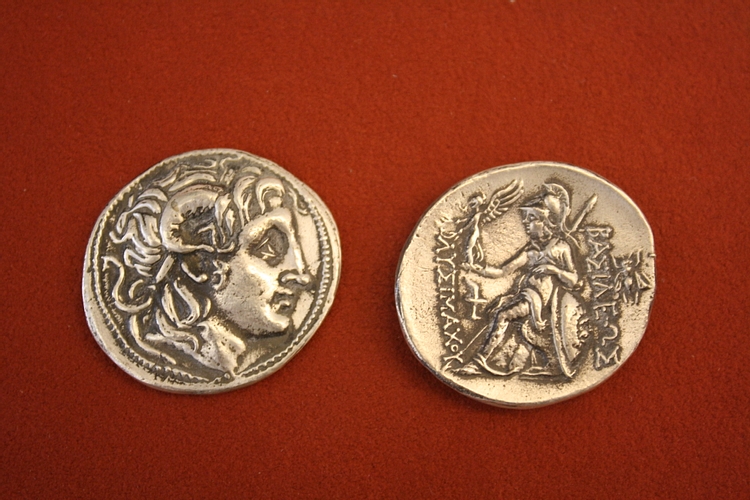 Thracian Silver Tetradrachm Mark Cartwright (CC BY-NC-SA) ](https://www.worldhistory.org/image/846/thracian-silver-tetradrachm/ "Thracian Silver Tetradrachm")The riches of the area around [Pergamon](https://www.worldhistory.org/pergamon/) along the [Mediterranean](https://www.worldhistory.org/disambiguation/mediterranean/) coast of Asia Minor helped Lysimachus to expand his territory further. After the death of Cassander in 297 BCE, he set his sights on Macedon. With the assistance of King [Pyrrhus](https://www.worldhistory.org/pyrrhus/) of Epirus, he moved across the border and forced Demetrius out. Demetrius and his army moved across the Hellespont and into Asia Minor, confronting the forces Seleucus. Unfortunately for the one-time ruler of Macedon, he was immediately captured only to die in captivity in 283 BCE. Lysimachus' hopes for expansion were temporarily halted when he was captured in 292 BCE by Dromichaites, the king of Getae. He was forced to not only buy his freedom but also surrender a portion of his Trans-Danubian territory. In 282 BCE his one-time ally Seleucus set his sights on Lysimachus's territory in Asia Minor. In 281 BCE the two armies met at Corupedium where the king of Thrace met his death. With no heir, his small piece of the empire would fall into disarray.
#### Editorial Review
This human-authored definition has been reviewed by our editorial team before publication to ensure accuracy, reliability and adherence to academic standards in accordance with our [editorial policy](https://www.worldhistory.org/static/editorial-policy/).
## Bibliography
- [Arrian. *The Campaigns of Alexander.* Penguin Classics, 1971.](https://www.worldhistory.org/books/0140442537/)
- [Bugh, G. *The Cambridge Companion to the Hellenistic World.* Cambridge University Press, 2006.](https://www.worldhistory.org/books/0521535700/)
- [Errington, R.M. *A History of the Hellenistic World\[Blackwell History of the Ancient World Ser.\].* Blackwell Publishing, 2008.](https://www.worldhistory.org/books/0631233881/)
- [Erskine, A. *A Companion to the Hellenistic World.* Wiley-Blackwell, 2005.](https://www.worldhistory.org/books/1405132787/)
- [Freeman, P. *Alexander the Great.* Simon & Schuster, 2011.](https://www.worldhistory.org/books/1416592814/)
- [Hornblower, S. *The Oxford Classical Dictionary.* Oxford University Press, 2012.](https://www.worldhistory.org/books/0199545561/)
- [Maclean Rogers, G. *Alexander.* Random House Trade Paperbacks, 2005.](https://www.worldhistory.org/books/0812972716/)
- R. S. Bagnal et.al. "Lysimachos." *Encyclopedia of Ancient History*, 2012.
- [Romm, J. *Ghost on the Throne.* Vintage, 2011.](https://www.worldhistory.org/books/0307456609/)
## About the Author
Donald has taught Ancient, Medieval and U.S. History at Lincoln College (Normal, Illinois)and has always been and will always be a student of history, ever since learning about Alexander the Great. He is eager to pass knowledge on to his students.
## Timeline
- **c. 361 BCE - 281 BCE**: Life of [Lysimachus](https://www.worldhistory.org/Lysimachus/).
- **328 BCE**: [Lysimachus](https://www.worldhistory.org/Lysimachus/) becomes one of [Alexander](https://www.worldhistory.org/disambiguation/Alexander/)'s bodyguards.
- **323 BCE**: [Death of Alexander the Great](https://www.worldhistory.org/article/2366/death-of-alexander-the-great/).
- **321 BCE**: [Lysimachus](https://www.worldhistory.org/Lysimachus/) marries [Antipater](https://www.worldhistory.org/disambiguation/Antipater/)'s daughter Nicaea.
- **c. 320 BCE**: [Ephesos](https://www.worldhistory.org/ephesos/) renamed Arsineia by [Lysimachus](https://www.worldhistory.org/Lysimachus/) following [Alexander the Great](https://www.worldhistory.org/Alexander_the_Great/)'s [death](https://www.worldhistory.org/disambiguation/Death/).
- **309 BCE**: [Lysimachus](https://www.worldhistory.org/Lysimachus/) founds the [city](https://www.worldhistory.org/city/) of Lysimachia to secure the Dardanelles.
- **305 BCE**: [Lysimachus](https://www.worldhistory.org/Lysimachus/) assumes the title of king.
- **301 BCE**: The [Battle](https://www.worldhistory.org/disambiguation/battle/) of Ipsus in central [Phrygia](https://www.worldhistory.org/phrygia/) where [Lysimachus](https://www.worldhistory.org/Lysimachus/) and [Seleucos I](https://www.worldhistory.org/Seleucos_I/) defeat [Antigonus I](https://www.worldhistory.org/Antigonus_I/) and [Demetrius I of Macedon](https://www.worldhistory.org/Demetrius_I_of_Macedon/).
- **c. 300 BCE**: [Lysimachus](https://www.worldhistory.org/Lysimachus/) marries [Arsinoe II](https://www.worldhistory.org/Arsinoe_II_Philadelphus/), the daughter of [Ptolemy I](https://www.worldhistory.org/Ptolemy_I/).
- **292 BCE**: [Lysimachus](https://www.worldhistory.org/Lysimachus/) is captured by Dromichaites, the king of Getae and forced to surrender Trans-Danubian territories.
- **284 BCE**: [Lysimachus](https://www.worldhistory.org/Lysimachus/) drives [Pyrrhus](https://www.worldhistory.org/pyrrhus/) out of [Macedon](https://www.worldhistory.org/macedon/).
- **281 BCE**: [Lysimachus](https://www.worldhistory.org/Lysimachus/) is defeated by [Seleucus I Nicator](https://www.worldhistory.org/Seleucos_I/) at Corupedium.
## Cite This Work
### APA
Wasson, D. L. (2016, July 05). Lysimachus. *World History Encyclopedia*.
### Chicago
Wasson, Donald L.. "Lysimachus." *World History Encyclopedia*, July 05, 2016. .
### MLA
Wasson, Donald L.. "Lysimachus." *World History Encyclopedia*, 05 Jul 2016, .
## License & Copyright
Submitted by [Donald L. Wasson](https://www.worldhistory.org/user/DWasson/ "User Page: Donald L. Wasson"), published on 05 July 2016. The copyright holder has published this content under the following license: [Creative Commons Attribution-NonCommercial-ShareAlike](https://creativecommons.org/licenses/by-nc-sa/4.0/deed.en). This license lets others remix, tweak, and build upon this content non-commercially, as long as they credit the author and license their new creations under the identical terms. When republishing on the web a hyperlink back to the original content source URL must be included. Please note that content linked from this page may have different licensing terms.