---
title: Lyre
author: Mark Cartwright
source: https://www.worldhistory.org/Lyre/
format: machine-readable-alternate
license: Creative Commons Attribution-NonCommercial-ShareAlike (https://creativecommons.org/licenses/by-nc-sa/4.0/)
updated: 2023-03-29
---
# Lyre
_Authored by [Mark Cartwright](https://www.worldhistory.org/user/markzcartwright/)_
The lyre was a stringed musical instrument played by the ancient Greeks. It was probably the most important and well-known instrument in the [Greek](https://www.worldhistory.org/disambiguation/greek/) world. The lyre was closely related to the other stringed instruments: the *chelys* which was made from a tortoise shell, the four-stringed *phorminx*, and the seven-stringed *[kithara](https://www.worldhistory.org/Kithara/)*. [Apollo](https://www.worldhistory.org/apollo/) and [Orpheus](https://www.worldhistory.org/Orpheus/) were the most famous lyre players.
### Greek Lyres in [Mythology](https://www.worldhistory.org/mythology/)
In [Greek mythology](https://www.worldhistory.org/Greek_Mythology/), all four instruments are often named interchangeably in various myths, and [Hermes](https://www.worldhistory.org/Hermes/) is generally credited with their invention. The messenger [god](https://www.worldhistory.org/God/) made the instrument from a tortoise shell, gut, and reeds, principally to help him steal 50 prize cattle from Apollo's sacred herd. Apollo discovered the theft and was only placated by Hermes' offer of the lyre. Apollo, from that point on, was considered the player *par excellence* of the lyre. Apollo also taught that other great mythical musician, Orpheus, how to play the instrument which would become his emblem. Orpheus was believed to be Thracian, which helped reinforce the belief that the lyre had its origins there. However, the invention of the seven-string version of the lyre is credited to Terpander of [Lesbos](https://www.worldhistory.org/lesbos/). Other mythical figures often seen with a lyre include [Eros](https://www.worldhistory.org/Eros/) and the [Muses](https://www.worldhistory.org/muse/).
### How Were Lyres Made?
The stringed instrument usually had two fixed upright arms (*pecheis*) or horns (*kerata*) and a crossbar (*zygos*) with tuning pegs (*kollopes*) of [bronze](https://www.worldhistory.org/disambiguation/bronze/), wood, ivory, or bone. Seven strings (*neurai* or *chordai*) of equal length but varying thickness (usually made from sheep gut) stretched between the crossbar and a fixed tailpiece (*chordotonon*) and were played by strumming or plucking by hand, usually using a plectrum made of wood, ivory, or [metal](https://www.worldhistory.org/disambiguation/metal/). Played sitting or standing, the instrument was held in the hand and sometimes supported with a carrying strap worn over the shoulder of the player. The majority of musicians who played the lyre were male, but some depictions in art, most notably the clay dancers from [Minoan](https://www.worldhistory.org/disambiguation/Minoan/) Palaikastro (1420-1300 BCE), do show a female lyre player. Certainly, musicians enjoyed special status as their distinctive costume of a long gown in Greek art shows. In addition, Minoan hieroglyphs had a unique symbol for musicians, and a [Linear B](https://www.worldhistory.org/Linear_B_Script/) tablet from [Thebes](https://www.worldhistory.org/disambiguation/Thebes/) (1250-1200 BCE) mentions lyre players as members of the [Mycenaean](https://www.worldhistory.org/Mycenaean_Civilization/) [palace](https://www.worldhistory.org/disambiguation/palace/) staff.
The lyre was played either alone or as an accompaniment to singing or lyric poetry at all manner of occasions such as official banquets, *symposia* (private drinking parties), religious ceremonies, funerals, and in musical competitions such as those held at the great Panathanaia, [Pythia](https://www.worldhistory.org/Pythia/), and Karneia festivals.
### Lyres in Greek Art
Greek lyres are frequently depicted in all forms of Greek art and the earliest examples date from the middle [Bronze Age](https://www.worldhistory.org/disambiguation/Bronze_Age/) (c. 2000 BCE) in the Cycladic and Minoan civilizations. At [Akrotiri](https://www.worldhistory.org/thera/) on [Thera](https://www.worldhistory.org/thera/), a [fresco](https://www.worldhistory.org/disambiguation/Fresco/) shows a small triangular lyre played by a blue monkey. At [Knossos](https://www.worldhistory.org/knossos/) on [Crete](https://www.worldhistory.org/crete/) a small alabaster lyre is decorated with a swan's head on each arm of the instrument. Slightly later, across the [Aegean](https://www.worldhistory.org/aegean/) in the 14th century BCE, lyres develop S-shaped arms and are frequently decorated with water-birds. Lyres were also used as decorative motifs on late [Minoan pottery](https://www.worldhistory.org/article/391/minoan-pottery/). A sarcophagus from Hagia Triada depicts a seven-string lyre, a [wall](https://www.worldhistory.org/wall/)-painting from Mycenaean [Pylos](https://www.worldhistory.org/Pylos/) has a five-string lyre and a *krater* from [Tiryns](https://www.worldhistory.org/tiryns/) depicts a three-string version. Decorated ivory fragments of lyres survive from [Mycenae](https://www.worldhistory.org/mycenae/). Lyres frequently appear on later [Greek pottery](https://www.worldhistory.org/Greek_Pottery/) - geometric, red- and [black-figure pottery](https://www.worldhistory.org/Black_Figure_Pottery/) - from the 8th century BCE. Interestingly, all lyre players depicted in Greek art are right-handed.
[ 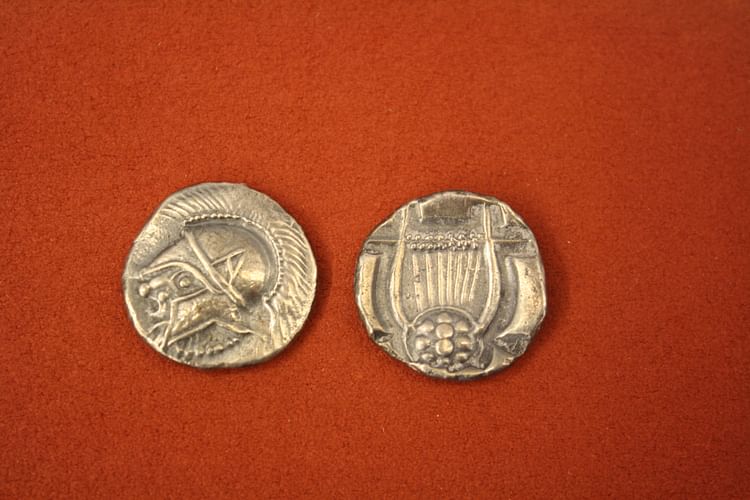 Calymna Silver Stater Mark Cartwright (CC BY-NC-SA) ](https://www.worldhistory.org/image/835/calymna-silver-stater/ "Calymna Silver Stater")A tortoise sound-box from the 5th century BCE survives, as do tuning pegs from the 6th century BCE. Several carved figures from the arms of lyres have survived, notably an inlaid ivory youth from [Samos](https://www.worldhistory.org/samos/) (c. 7th century BCE) and a woman with [sphinx](https://www.worldhistory.org/sphinx/) and swan from c. 600 BCE. Complete lyres survive from the [Hellenistic period](https://www.worldhistory.org/Hellenistic_Period/), a notable example being the bronze lyre from the Antikythera shipwreck.
### The Importance of Lyres in [Greek Culture](https://www.worldhistory.org/disambiguation/Greek_Culture/)
[Music](https://www.worldhistory.org/disambiguation/Music/), and specifically playing the lyre, was an integral part of Greek education. Even mythical figures enjoyed the benefits of a musical education; for example, [Achilles](https://www.worldhistory.org/achilles/) was taught to play the lyre by the wise [centaur](https://www.worldhistory.org/centaur/) Cheiron. [Plato](https://www.worldhistory.org/plato/) considered only the lyre or *kithara* as suitable instruments for musical education.
Several Greek [city](https://www.worldhistory.org/city/)-states (*[poleis](https://www.worldhistory.org/Polis/)*) also used a representation of the lyre on their coins. For example, the [silver](https://www.worldhistory.org/Silver/) stater of Calymna in Caria (600-550 BCE) had a tortoise shell lyre on its reverse side. Unsurprisingly, considering its association with Apollo, the silver drachma of [Delos](https://www.worldhistory.org/delos/) had a lyre on its reverse in the 6th century BCE. Coins of [Kos](https://www.worldhistory.org/Kos/) from the 2nd to 1st century BCE carried the head of Apollo on the obverse and a five-stringed lyre on the reverse. In the same period, coins of Thespiai - where there was a [temple](https://www.worldhistory.org/temple/) dedicated to Apollo and another to the Muses - carried a three-stringed lyre on their reverse sides.
#### Editorial Review
This human-authored definition has been reviewed by our editorial team before publication to ensure accuracy, reliability and adherence to academic standards in accordance with our [editorial policy](https://www.worldhistory.org/static/editorial-policy/).
## Bibliography
- Andrikou, E. (et al). *Gifts from the Muses.* Hellenic Ministry of Culture, Athens, 2004
- [Boardman, J. *Greek Sculpture.* Thames & Hudson, 1985.](https://www.worldhistory.org/books/0500201633/)
- Kotsanas, K. *The Musical Instruments of the Ancient Greeks.* Kotsanas, Pyrgos, 2012
- Tsangari, D. *Coins in the Ancient Greek World.* Alpha Bank, Athens, 2012
## About the Author
Mark is WHE’s Publishing Director and has an MA in Political Philosophy (University of York). He is a full-time researcher, writer, historian and editor. Special interests include art, architecture and discovering the ideas that all civilizations share.
## Timeline
- **2000 BCE**: The first examples of the [lyre](https://www.worldhistory.org/Lyre/) in the [Bronze Age Aegean](https://www.worldhistory.org/Bronze_Age_Aegean/) occur in the [Cyclades](https://www.worldhistory.org/Cyclades/) and on [Minoan](https://www.worldhistory.org/disambiguation/Minoan/) [Crete](https://www.worldhistory.org/crete/).
- **1420 BCE - 1300 BCE**: Clay dancing figures including a rare female [lyre](https://www.worldhistory.org/Lyre/) player are made in [Minoan](https://www.worldhistory.org/disambiguation/Minoan/) Palaikastro.
- **c. 1400 BCE**: Lyres across the [Aegean](https://www.worldhistory.org/aegean/) assume S-shaped arms and become more decoratively carved, most often with sculpted birds.
- **1250 BCE - 1200 BCE**: A [Linear B](https://www.worldhistory.org/Linear_B_Script/) tablet from [Greek](https://www.worldhistory.org/disambiguation/greek/) [Thebes](https://www.worldhistory.org/disambiguation/Thebes/) mentions [lyre](https://www.worldhistory.org/Lyre/) players as members of the royal [palace](https://www.worldhistory.org/disambiguation/palace/) staff.
- **600 BCE - 550 BCE**: The [silver](https://www.worldhistory.org/Silver/) stater [coin](https://www.worldhistory.org/coinage/) of Calymna in Caria depicts a tortoise shell [lyre](https://www.worldhistory.org/Lyre/) on its reverse side.
- **c. 550 BCE**: The [silver](https://www.worldhistory.org/Silver/) drachma of [Delos](https://www.worldhistory.org/delos/) depicts a [lyre](https://www.worldhistory.org/Lyre/) - symbolic of [Apollo](https://www.worldhistory.org/apollo/) - on its reverse side.
- **c. 100 BCE**: Coins of [Kos](https://www.worldhistory.org/Kos/) and Thespiai depict a [lyre](https://www.worldhistory.org/Lyre/) on their reverse side.
## Questions & Answers
### What is a lyre used for?
A lyre is a stringed musical instrument. It was used by the ancient Greeks to accompany singing or poetry.
### Where do lyres appear in Greek mythology?
Lyres appear in Greek mythology as an instrument played by the gods Hermes and Apollo, and by the Greek hero Orpheus. All three were famous as superb lyre players.
### Who is the greatest lyre player in Greek mythology?
The greatest lyre player in Greek mythology is Apollo, who went on to teach Orpheus, another famous player.
## External Links
- [Music and creativity in Ancient Greece - Tim Hansen](http://ed.ted.com/lessons/music-and-creativity-in-ancient-greece-tim-hansen)
## Cite This Work
### APA
Cartwright, M. (2012, December 16). Lyre. *World History Encyclopedia*.
### Chicago
Cartwright, Mark. "Lyre." *World History Encyclopedia*, December 16, 2012. .
### MLA
Cartwright, Mark. "Lyre." *World History Encyclopedia*, 16 Dec 2012, .
## License & Copyright
Submitted by [Mark Cartwright](https://www.worldhistory.org/user/markzcartwright/ "User Page: Mark Cartwright"), published on 16 December 2012. The copyright holder has published this content under the following license: [Creative Commons Attribution-NonCommercial-ShareAlike](https://creativecommons.org/licenses/by-nc-sa/4.0/deed.en). This license lets others remix, tweak, and build upon this content non-commercially, as long as they credit the author and license their new creations under the identical terms. When republishing on the web a hyperlink back to the original content source URL must be included. Please note that content linked from this page may have different licensing terms.