---
title: Luoyang: Ancient Chinese Capital
author: Mark Cartwright
source: https://www.worldhistory.org/Luoyang/
format: machine-readable-alternate
license: Creative Commons Attribution-NonCommercial-ShareAlike (https://creativecommons.org/licenses/by-nc-sa/4.0/)
updated: 2025-04-18
---
# Luoyang: Ancient Chinese Capital
_Authored by [Mark Cartwright](https://www.worldhistory.org/user/markzcartwright/)_
Luoyang (aka Loyang) was the capital [city](https://www.worldhistory.org/city/) of many ancient Chinese dynasties, a position it frequently swapped with [Chang'an](https://www.worldhistory.org/Chang'an/), usually whenever there was a change of dynasty. Located in the Henan province in the eastern part of [China](https://www.worldhistory.org/china/)'s central plain, the city was noted for its fine buildings, pleasure parks, and literary [culture](https://www.worldhistory.org/disambiguation/culture/), particularly regarding Confucian scholarship.
### On & Off Capital
The city of Luoyang is located at the confluence of the Luo and Yi Rivers in the Henan province of eastern-central China. Luoyang was thus perfectly positioned to control land and water transport throughout the region, an important fact considering tax collected from across the Chinese [empire](https://www.worldhistory.org/empire/) was usually in the form of grain. Consequently, Luoyang was always an important city throughout China's history, but it shone particularly when it was made capital of the Eastern [Zhou](https://www.worldhistory.org/Zhou_Dynasty/) (770-255 BCE), as capital again during the latter part of the [Han dynasty](https://www.worldhistory.org/Han_Dynasty/) (206 BCE - 220 CE), and as the seat of the Northern Wei government (386-535 CE). Luoyang was one of the three official capitals during the brief [Sui dynasty](https://www.worldhistory.org/Sui_Dynasty/) (581-618 CE), flourished as the second city and Eastern capital of the [Tang dynasty](https://www.worldhistory.org/Tang_Dynasty/) (618-907 CE), and was even briefly the capital of the new and ultimately unrealised [Zhou dynasty](https://www.worldhistory.org/Zhou_Dynasty/) declared by Empress [Wu Zetian](https://www.worldhistory.org/Wu_Zetian/) in 690 CE.
Luoyang most frequently competed with [Chang](https://www.worldhistory.org/disambiguation/Chang/)'an, located further to the west, to be the capital city of China with the latter perhaps enjoying a better strategic location to govern a wider China. In contrast, Luoyang's long history gave it the advantage in terms of prestige, with its greater tradition of culture - especially Confucian [literature](https://www.worldhistory.org/literature/), as well as belonging to a more economically powerful region.
### Layout & [Architecture](https://www.worldhistory.org/disambiguation/architecture/)
Luoyang was smaller than Chang'an but had a higher population density, over half a million in the [Han](https://www.worldhistory.org/Han_Dynasty/) period. This population was made up not only of locals but also workers, artisans, and officials from all over the Chinese empire and border regions. The city covered a rectangular area which was surrounded by high walls with access provided by 12 gates. The buildings were generally plainer than they were at Chang'an, and the city was more regularly laid out, once again reflecting the importance of Confucian thought at Luoyang and a corresponding distaste for ostentatious buildings or irregularities. Especially following the move of capital c. 23 CE, the Han emperor and government were keen to differentiate Luoyang from the capital of their predecessors during the Qin and earlier Han periods. The city was to [mark](https://www.worldhistory.org/disambiguation/Mark/) a new beginning, just as there had been with the move from Chang'an to Luoyang which marked the split of the Western and Eastern Zhou dynasties eight centuries earlier. The selection of Luoyang by the Northern Wei from 494 CE would similarly have political motives and indicated their enthusiastic embrace of all things Chinese. Luoyang would prove a useful symbol for several regimes, then, and the new Han capital was planned as it was for one more reason, as the historian M. E. Lewis here explains,
> A second, direct consequence of this emphasis on the capital as a political creation is an insistence on its artificiality. The walls, the gates, and the grid of streets all marked the imposition of human design upon the natural world. They represented hierarchy and control over a potentially unruly populace. This artifice was also expressed in the realms of fashion and taste, for which the ruler and his court were to be the ultimate sources and examplars. (100)
From the 7th century CE, under the Tang emperors, Luoyang was made even grander. There was no longer any reserve about giving the city the finest and most grandiose buildings possible. The city thrived and now boasted a population of around 2 million people. As with other Chinese [cities](https://www.worldhistory.org/city/), Luoyang was composed of distinct districts reserved for specific purposes and all laid out in a grid pattern separated by streets and avenues.
[ 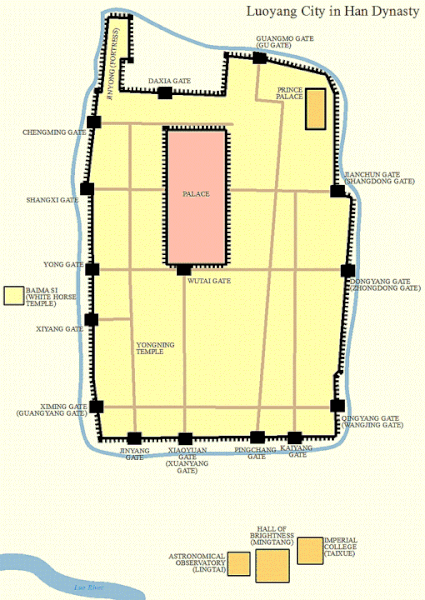 Map of Luoyang SY (CC BY-SA) ](https://www.worldhistory.org/image/7464/map-of-luoyang/ "Map of Luoyang")There were two royal palaces, each set within its walls and both aligned precisely on a north-south axis, areas for residence, artisan workshops, and various marketplaces. There was a large armoury, the state granary, various altars, a ritual hall, government buildings, the imperial stables, the Grand Academy of learning, a library with 370,000 scrolls, museums of great artworks, and a garrison of the imperial army. There were [Buddhist](https://www.worldhistory.org/buddhism/) temples and monasteries, synagogues, and mosques; such was the cultural diversity at one of the greatest cities in the world at that time. The following description of the city's pleasure gardens by the historian E. F. Fenollosa captures the splendour of the city:
> Great public gardens and museums gave recreation to the people. The private [palace](https://www.worldhistory.org/disambiguation/palace/) gardens were raised on mighty walled terraces, pavilion crowned, that enjoyed far prospect over lakes and bays - or sunk into cool shady wells where plum trees shot their scaly arms into the shape of dragons, and ancient pines had been trained to writhe like [serpents](https://www.worldhistory.org/disambiguation/Serpents/) through the interstices of water-worn stone. Great jars of hard paste [pottery](https://www.worldhistory.org/pottery/) covered with creamy glazes, and tiles of deeper hue, probably purple and yellow…gave brilliancy to the landscape architecture. Pavilions rose above granite and marble foundations in rainbow tier after tier: great banqueting halls, and blue [silk](https://www.worldhistory.org/Silk/) awnings, and heavy portieres shot with golden thread adding alike to the exalted coolness and to the aesthetic transitions. (164)
A truly cosmopolitan city, Luoyang's markets offered exotic goods from across the Chinese empire, [Japan](https://www.worldhistory.org/disambiguation/Japan/), and central Asia, which were brought via the [Silk Road](https://www.worldhistory.org/Silk_Road/) and ships sailing the Indian Ocean and the Persian Gulf. The marketplaces each had a tower where the market chief and his 36 staff could monitor the goings-on; markets were strictly regulated in terms of the quality of the goods on offer, their prices were standardised, and records were kept of all transactions. There were separate marketplaces for the sale of horses, one for [gold](https://www.worldhistory.org/gold/), and a large multipurpose square outside the city walls to the south.
### Destruction
Like other important cities, Luoyang suffered its fair share of destruction, particularly when there was a change of dynasty when flattening the capital of one's predecessors seemed to become a tradition. One notable sacking was by the warlord Dong Zhuo c. 189 CE who razed the city's wooden buildings. The lost virtues of the Han city were famously sung by the 3rd-century CE poet Cao Zhi, who imagines himself as an inhabitant returning to his old and now dilapidated capital:
> Climbing to the ridge of Beimang Mountain
> From afar I look down on Luoyang.
> Luoyang, how lonesome and still!
> Palaces and houses all burnt to ashes.
> Walls and fences all broken and gaping.
> Thorns and brambles rising to the sky.
> I do not see the old men;
> I only see the new youths.
> I turn aside, no straight road to walk.
> Waste fields, no longer ploughed.
> I have been away so long
> That I do not recognize the paths.
> Amidst the fields, how sad and desolate.
> A thousand miles without chimney smoke.
> Thinking of the house I lived in all those years.
> My emotions twisted, I cannot speak.
> (Lewis, 101)
During the fall of the Northern Wei state, the city was sacked again, this time by nomadic steppe hordes in 528 CE, when much of the court elite were executed. These attacks and others like it, particularly in the final, turbulent decades of the Tang dynasty, along with the predominance of wood, tiles, and dried mud in ancient [Chinese architecture](https://www.worldhistory.org/Chinese_Architecture/) have meant that very little remains today except the foundations with which archaeologists and historians can attempt to reconstruct the lost splendours of one of ancient Asia's greatest cities.
#### Editorial Review
This human-authored definition has been reviewed by our editorial team before publication to ensure accuracy, reliability and adherence to academic standards in accordance with our [editorial policy](https://www.worldhistory.org/static/editorial-policy/).
## Bibliography
- [Dawson, R. *The Chinese Experience.* Phoenix Press - Orion, 2017.](https://www.worldhistory.org/books/1898800499/)
- [Di Cosmo, N. *Military Culture in Imperial China.* Harvard University Press, 2011.](https://www.worldhistory.org/books/0674060725/)
- [Dillon, M. *China.* Routledge, 1998.](https://www.worldhistory.org/books/0700704396/)
- [Feng, L. *Early China.* Cambridge University Press, 2013.](https://www.worldhistory.org/books/052171981X/)
- [Fenollosa, E.F. *Epochs of Chinese and Japanese Art.* Stone Bridge Press, 2007.](https://www.worldhistory.org/books/1933330260/)
- [Lewis, M.E. *The Early Chinese Empires.* Belknap Press: An Imprint of Harvard University Press, 2010.](https://www.worldhistory.org/books/0674057341/)
- [Tregear, M. *Chinese Art.* Thames & Hudson, 1997.](https://www.worldhistory.org/books/0500202990/)
- [Twitchett, D. (ed). *The Cambridge History of China, Vol. 3.* Cambridge University Press, 1979.](https://www.worldhistory.org/books/0521214467/)
## About the Author
Mark is WHE’s Publishing Director and has an MA in Political Philosophy (University of York). He is a full-time researcher, writer, historian and editor. Special interests include art, architecture and discovering the ideas that all civilizations share.
## Timeline
- **c. 23 CE**: After the sack of [Chang'an](https://www.worldhistory.org/Chang'an/), Liu Xiu led his loyal officials to the [city](https://www.worldhistory.org/city/) of [Luoyang](https://www.worldhistory.org/Luoyang/), where the Chinese imperial capital was relocated.
- **184 CE**: A large peasant uprising known as the Yellow Turban Rebellion (sometimes referred to as the Yellow Scarves Rebellion) threatened the [city](https://www.worldhistory.org/city/) of [Luoyang](https://www.worldhistory.org/Luoyang/).
- **189 CE**: [Luoyang](https://www.worldhistory.org/Luoyang/), the [Han](https://www.worldhistory.org/Han_Dynasty/) capital, is sacked by the Chinese warlord Dong Zhuo.
- **190 CE**: [Luoyang](https://www.worldhistory.org/Luoyang/), the [Han](https://www.worldhistory.org/Han_Dynasty/) capital in [China](https://www.worldhistory.org/china/), is burned.
- **494 CE**: The Northern Wei select [Luoyang](https://www.worldhistory.org/Luoyang/) as their capital in [China](https://www.worldhistory.org/china/).
- **528 CE**: Steppe hordes attack the Chinese capital [Luoyang](https://www.worldhistory.org/Luoyang/).
## Cite This Work
### APA
Cartwright, M. (2017, October 20). Luoyang: Ancient Chinese Capital. *World History Encyclopedia*.
### Chicago
Cartwright, Mark. "Luoyang: Ancient Chinese Capital." *World History Encyclopedia*, October 20, 2017. .
### MLA
Cartwright, Mark. "Luoyang: Ancient Chinese Capital." *World History Encyclopedia*, 20 Oct 2017, .
## License & Copyright
Submitted by [Mark Cartwright](https://www.worldhistory.org/user/markzcartwright/ "User Page: Mark Cartwright"), published on 20 October 2017. The copyright holder has published this content under the following license: [Creative Commons Attribution-NonCommercial-ShareAlike](https://creativecommons.org/licenses/by-nc-sa/4.0/deed.en). This license lets others remix, tweak, and build upon this content non-commercially, as long as they credit the author and license their new creations under the identical terms. When republishing on the web a hyperlink back to the original content source URL must be included. Please note that content linked from this page may have different licensing terms.