---
title: Leprechaun
author: Mark Cartwright
source: https://www.worldhistory.org/Leprechaun/
format: machine-readable-alternate
license: Creative Commons Attribution-NonCommercial-ShareAlike (https://creativecommons.org/licenses/by-nc-sa/4.0/)
updated: 2023-03-29
---
# Leprechaun
_Authored by [Mark Cartwright](https://www.worldhistory.org/user/markzcartwright/)_
Leprechauns (also leprecauns or lepracauns) are figures in Irish folklore who guard hidden treasure. Regarded as small and incredibly agile male fairies or goblins, they most often guard a pot of [gold](https://www.worldhistory.org/gold/). Leprechauns live solitary lives and can be a source of mischief for the unwary. Leprechauns are infamous for being extremely difficult to catch or trap.
Even if a leprechaun is caught, the captor must keep them always within sight or they will not give away the location of their treasure, usually a crock of gold coins. Leprechauns share many characteristics with more ancient creatures from Irish-[Celtic](https://www.worldhistory.org/celt/) and wider European [mythology](https://www.worldhistory.org/mythology/), but since the 19th century CE, they have risen to the dominant position of being the most recognisable symbol of Irish folklore.
### Different Names for Leprechauns
The name leprechaun is a modern anglicized word based on different spellings of an older term used in various regions of [Ireland](https://www.worldhistory.org/disambiguation/Ireland/). For example, in Ulster the original term was *luchramán*, in Connacht *lúracán*, in Leinster *luprachán* (amongst others), and in Munster *lurgadán* (again, one of several possibilities). All of these words themselves derived from the medieval Middle Irish *lurchopán*, meaning 'small body'.
Leprechauns were part of the Irish oral tradition long before written folklore in the form of epic poems were written in the High Middle Ages. One of the many indicators of this is in place names. For example, Knocknalooricaun in County Waterford derives its name from 'hill of the leprechauns' and Poulaluppercadaun in County Kerry means 'pool of the leprechaun'. So, although leprechauns really hit the big time in the 19th century CE, they do go back much further than is often assumed, and certainly, their origins and essential characteristics can be traced back to many similar supernatural figures in ancient Celtic and medieval Irish folklore.
### The Origins of Leprechauns: [Lugh](https://www.worldhistory.org/Lugh/) & Water Sprites
According to some scholars, the word leprechaun comes from the ancient Irish-Celtic [god](https://www.worldhistory.org/God/) and cultural hero Lugh. Lugh was originally the god of the sun and light, and then he became a great warrior ruler of [ancient Ireland](https://www.worldhistory.org/Ancient_Ireland/). Lugh's stature (literally) diminished over time as the Christianization of [Europe](https://www.worldhistory.org/europe/) gathered pace. He was eventually transformed into *Lugh-chromain*, meaning 'stooping Lugh' as he now inhabited the underground world of *sidh* where all the other gods were relegated to as the people forgot their traditions and embraced new religions. Lugh thus becomes a sort of fairy craftsman, and from there, Lugh became 'leprechaun', the diminutive fairy-goblin in [medieval folklore](https://www.worldhistory.org/Medieval_Folklore/).
Leprechauns have another ancient source of inspiration, the small water sprites of Celtic mythology. These elves or fairies, known as *lúchoirp* or *luchorpáin*, first appear in Irish [literature](https://www.worldhistory.org/literature/) in the *Echtra Fergusa maic Léti* ('The Adventure of Fergus Son of Léte'), which dates to the 8th century CE. A number of mischievous sprites capture the hero Fergus while he is asleep, take away his sword and attempt to carry him over water. Fergus wakes up when one of his toes touches the water's surface, and he manages to grab three of the sprites. The sprites win their freedom by promising to teach Fergus their swimming skills.
### The Clúracán & Far Darrig
Other possible sources of inspiration for the leprechauns are the terrible monsters the *lupracánaig* who appear in the 12th century CE *Lebor Gábala* (“Book of Invasions'). Then there are the *clúracán* (or *cluricaune*), male spirits seen in wider European folklore who are said to haunt cellars. Living alone and often dressed in fine red clothes, the *clúracán* sometimes carries a purse full of [silver](https://www.worldhistory.org/Silver/) coins. A *clúracán* is small in size but large in appetite for his two favourite habits: smoking and drinking. He is said to be rather lazy, and his preferred residence is a well-stocked wine cellar where, even though he will partake himself of its finest vintages, he does, at least, scare away thieving servants. The *clúracán* shares similarities with the brownie of Scottish Gaelic folklore who lives in barns and does chores at night, although if slighted, he can break things like plates and spill milk.
Yet another antecedent is the *far darrig*, who is an ugly little fairy with a wrinkled old face. In some regions of Ireland, he is very tall while wherever he is regarded as being small he can, at least, change his size at will. He is very fond of practical jokes, but some of these can be lethal and hence he might be considered an evil leprechaun. The one good trait of a *far darrig* is that he can, if he so wishes, release people who become trapped in fairyland. Finally, the *mouros* of folklore from Celtic Galicia and Asturias (both in Spain) guard tombs and are associated with hidden treasure. As we shall see, the leprechauns borrowed features from all of these creatures in their rise towards dominance of Irish mythology and folklore as everyone's favourite fairy.
[ 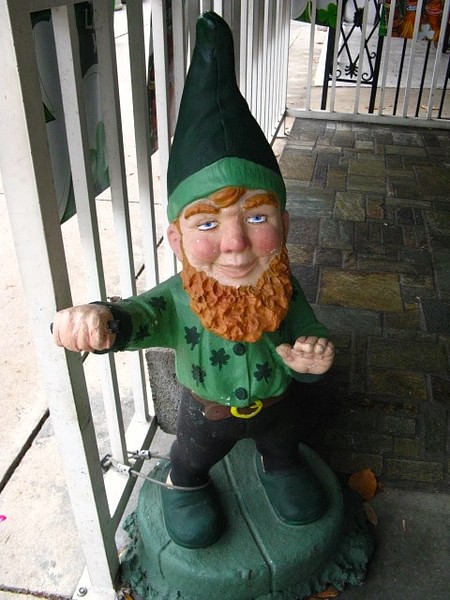 Modern Leprechaun Figure Clyde Robinson (CC BY) ](https://www.worldhistory.org/image/13379/modern-leprechaun-figure/ "Modern Leprechaun Figure")### What are the Characteristics of a Leprechaun?
Like their more ancient counterparts in Celtic mythology, leprechauns were thought of as diminutive figures with incredible agility. They are male fairies or goblins, they typically live solitary lives, and they usually appear in stories as the guardians of hidden treasure. On other occasions, they are helpful spirits in the home. Dressed in green or red, leprechauns are usually old, wrinkled, and ugly. Unlike the modern representation of a chirpy leprechaun, the more traditional version is often a little stern, gloomy, and sour-tempered. As the historian of Celtic mythology, J. Mackillop notes, "Ugly, and stunted with a face like a dried apple, the leprechaun may be querulous, sottish, and foul-mouthed" (1997, 297). He is also associated with [crafts](https://www.worldhistory.org/crafts/), particularly shoemaking.
The typical modern representation of a leprechaun as a little man sitting on a toadstool with a red beard and green hat comes from a mix of elements seen in wider European folklore and is not part of the traditional Irish leprechaun character.
Most tales involving a leprechaun follow a familiar pattern. A human spies one busy repairing some shoes and demands to know where his little pot of gold (sometimes called a crock of gold after the earthenware pot) or gold coins are. All the human has to do is keep his eye always on the leprechaun and he will be given the gold. There lies the problem, though. For leprechauns are nimble despite their age and prone to mischievous tricks. The leprechaun will try any means to distract his captor, but favourite techniques include playing on humanity's greed and their gullibility. The wily leprechaun is so successful in hanging on to his gold that the human who tried to gain it, in the end, usually only blames themselves for their own stupidity in not acquiring the pot of gold.
### An Enduring Figure in Mythology
After the medieval period, leprechauns became the favourites of many writers who elevated them to a position of such dominance that few other types of Irish goblins and fairies are now widely known, despite the fact that these are many and often much more remarkable than leprechauns. In particular, T. Crofton Croker in his *Fairy Legends and Traditions of the South of Ireland* (first published in 1825 CE) and other works, ensured that leprechauns eclipsed all other fairy-goblin figures in Irish folklore. The ball just kept rolling with authors such as William Allingham [writing](https://www.worldhistory.org/writing/) his celebrated poem *Lepracaun* around 1870 CE. Even Hollywood got in on the act with the 1968 CE musical *Finian's Rainbow* starring Fred Astaire. The film was itself an adaptation of a successful stage musical but, despite being nominated for several Academy Awards and Golden Globes, found hitting the winner's jackpot as elusive as the leprechaun's very own crock of gold.
#### Editorial Review
This human-authored definition has been reviewed by our editorial team before publication to ensure accuracy, reliability and adherence to academic standards in accordance with our [editorial policy](https://www.worldhistory.org/static/editorial-policy/).
## Bibliography
- [Ellis, Peter Berresford. *The Mammoth Book of Celtic Myths and Legends.* Constable & Robinson Ltd, 2003.](https://www.worldhistory.org/books/1841192481/)
- [MacKillop, James. *A Dictionary of Celtic Mythology .* Oxford University Press, 2017.](https://www.worldhistory.org/books/0198804849/)
- [MacKillop, James. *Myths and Legends of the Celts.* Penguin UK, 2006.](https://www.worldhistory.org/books/0141017945/)
- [Maier, Bernhard. *Dictionary of Celtic Religion and Culture .* BOYE6, 2000.](https://www.worldhistory.org/books/0851156606/)
## About the Author
Mark is WHE’s Publishing Director and has an MA in Political Philosophy (University of York). He is a full-time researcher, writer, historian and editor. Special interests include art, architecture and discovering the ideas that all civilizations share.
## Questions & Answers
### What does leprechaun mean in Irish?
In medieval Middle Irish, 'leprechaun' (lurchopán), means 'small body'.
### What powers do leprechauns have?
Leprechauns have several powers including tremendous agility which makes them almost impossible to catch. A leprechaun can help in the home and often guards a pot of gold.
### What creature is a leprechaun?
A leprechaun is a mythical creature from Ireland, usually described as a male fairy or goblin. They are usually very small old men but they are very agile and capable of great trickery.
## External Links
- [A "Wee" History of the Leprechaun, a Character from Irish Folklore](https://mymodernmet.com/what-is-a-leprechaun/)
## Cite This Work
### APA
Cartwright, M. (2021, February 04). Leprechaun. *World History Encyclopedia*.
### Chicago
Cartwright, Mark. "Leprechaun." *World History Encyclopedia*, February 04, 2021. .
### MLA
Cartwright, Mark. "Leprechaun." *World History Encyclopedia*, 04 Feb 2021, .
## License & Copyright
Submitted by [Mark Cartwright](https://www.worldhistory.org/user/markzcartwright/ "User Page: Mark Cartwright"), published on 04 February 2021. The copyright holder has published this content under the following license: [Creative Commons Attribution-NonCommercial-ShareAlike](https://creativecommons.org/licenses/by-nc-sa/4.0/deed.en). This license lets others remix, tweak, and build upon this content non-commercially, as long as they credit the author and license their new creations under the identical terms. When republishing on the web a hyperlink back to the original content source URL must be included. Please note that content linked from this page may have different licensing terms.