---
title: Kykeon
author: Joshua J. Mark
source: https://www.worldhistory.org/Kykeon/
format: machine-readable-alternate
license: Creative Commons Attribution-NonCommercial-ShareAlike (https://creativecommons.org/licenses/by-nc-sa/4.0/)
updated: 1970-01-01
---
# Kykeon
_Authored by [Joshua J. Mark](https://www.worldhistory.org/user/JPryst/)_
Kykeon (from the [Greek](https://www.worldhistory.org/disambiguation/greek/) “to mix, stir”) was a beverage of water and barley (sometimes flavored with mint or thyme) popular among the working, 'lower' class of ancient [Greece](https://www.worldhistory.org/greece/). In [Homer](https://www.worldhistory.org/homer/)'s *Illiad* it is described as a mixture of water, barley, herbs and ground goat cheese (Book XI) and the drink is also mentioned in the *[Odyssey](https://www.worldhistory.org/Odyssey/)* Book X when the sorceress [Circe](https://www.worldhistory.org/Circe/) uses it, mixed with honey, to make her potion.
Kykeon is most famous, however, for its use in the Rites of [Demeter](https://www.worldhistory.org/demeter/) at the [city](https://www.worldhistory.org/city/) of [Eleusis](https://www.worldhistory.org/Eleusis/) where it was used by initiates to experience the mystery of [death](https://www.worldhistory.org/disambiguation/Death/) and rebirth in the ritual which came to be known as The Eleusinian Mysteries. This mixture, however, differed significantly from the common drink in that it had psychoactive properties, most likely caused by the fungus Ergot on the barley gathered around Eleusis, which allowed initiates in the Mysteries to reach a fuller understanding of their purpose in life and to shed their fear of death; as testimonials from ancient writers who participated in the Mysteries attest.
In the time of the [Roman Empire](https://www.worldhistory.org/Roman_Empire/) Kykeon was still a popular drink made from water, wine, honey and barley with various herbs added to individual taste. This common drink, however, was regarded in much the same way a person in the modern day would consider soft drinks. The kykeon which was brewed for the Eleusinian Mysteries was held in much higher esteem because the ritual itself was so important to the people.
### Kykeon & the Mysteries
Prior to the coming of [Rome](https://www.worldhistory.org/Rome/), the only road in ancient Greece which was not a goat path was the Sacred Way which led from [Athens](https://www.worldhistory.org/Athens/) to the city of Eleusis, site of the Rites of Demeter. This ritual, which was observed every year, commemorated the goddess Demeter's search for her missing daughter [Persephone](https://www.worldhistory.org/persephone/) and initiated communicants into an esoteric knowledge of the meaning of life and death. Kykeon was so important to this ritual that the two families who owned the land the barley grew on at Eleusis became quite wealthy and were held in high regard. Because initiates into the Mysteries were sworn to secrecy, no one knows what went on once they entered the underground [temple](https://www.worldhistory.org/temple/) of the Telesterion at Eleusis but it is known that, prior to their descent, they ritually bathed and purified themselves and then drank a cup of kykeon which had been freshly prepared from the local barley. In going down into the earth after this preparation, the communicants were re-enacting the journey of Persephone into the underworld and, like her story in the myth, they sought re-birth.
[ 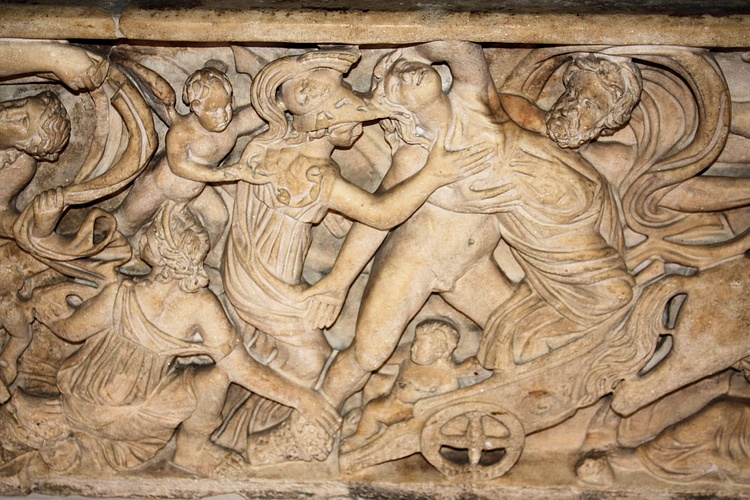 Persephone Sarcophagus (Detail) Jennifer Brown (CC BY-NC-SA) ](https://www.worldhistory.org/image/2197/persephone-sarcophagus-detail/ "Persephone Sarcophagus (Detail)")### The Myth Behind the Mysteries
According to the myth of Demeter and Persephone, the earth-goddess and her daughter were tending flowers in a field when the [god](https://www.worldhistory.org/God/) [Hades](https://www.worldhistory.org/Hades/), looking up from his realm in the underworld, saw the girl and wanted her. When Demeter was distracted, Hades opened up the earth and took Persephone down into the darkness. Demeter, frantic to find her missing daughter, asked the king of the gods, [Zeus](https://www.worldhistory.org/zeus/), for help but he claimed he had no knowledge of Persephone's whereabouts. The mother then began to search for her daughter across the land (a journey similar in many respects to the [Egyptian](https://www.worldhistory.org/disambiguation/Egyptian/) tale of the goddess [Isis](https://www.worldhistory.org/isis/) and her quest to find her missing husband [Osiris](https://www.worldhistory.org/osiris/)) until she came to rest by a well at Eleusis. In order to remain unnoticed, Demeter had disguised herself as an old woman and the daughters of the queen of the city, visiting the well, invited her back to the [palace](https://www.worldhistory.org/disambiguation/palace/) to be interviewed for the position of nurse-maid for their much younger brother. Demeter accepted this position and cared for the young prince but, having recently lost a child herself, she wanted to make sure nothing would ever happen to him and so placed him nightly in celestial flames to make him immortal. The queen found her doing this one night and, understandably horrified at seeing her son thrust into flames, lashed out at Demeter. The goddess then revealed herself in all her rage and glory but decided not to punish the people for their queen's affrontery if they would build a temple in Demeter's honor in the city. The people readily agreed and, after giving them the gifts and knowledge of argiculture, she continued on her way.
Persephone, meanwhile, lingered in the underworld with Hades. Demeter was so distraught that she neglected her duties as goddess of nature and trees failed to produce fruit and crops failed and the land withered. First the animals began to die and then the people died after them. The gods were no longer receiving their accustomed sacrifices and offerings and so Zeus sent his messenger [Hermes](https://www.worldhistory.org/Hermes/) down to Hades ordering him to release Persephone. Hades had fallen in love with the girl, however, and so tricked her into eating a pomegranate. She ate only a few seeds but the unbreakable [law](https://www.worldhistory.org/disambiguation/law/) was that, if one ate of the land of the dead, one remained in the land of the dead. Since she had only eaten a little, however, she was freed to return to her mother for six months but, for the other six, she had to return to Hades. When Persephone was with her mother, the earth was bright and warm and gave forth food but, when she went back to the underworld and Demeter became depressed, the earth was cold and and dark and nothing would grow. The story thus explained the [seasons](https://www.worldhistory.org/Horae/) but also emphasized the concept of a life after death and the cyclic nature of all living things. The Greeks understood their gods were at work all around them because they could see the daily proof of the god's existence through the budding of the trees in spring or the falling leaves in autumn.
[  Seated Demeter Figurine Mark Cartwright (CC BY-NC-SA) ](https://www.worldhistory.org/image/621/seated-demeter-figurine/ "Seated Demeter Figurine")### Kykeon & Enlightenment
The Rites of Demeter were more than just a `fall festival' however; the re-enactment of Demeter's search for her missing daughter and the mysterious rite which took place in the underground temple at Eleusis radically changed the lives of those who participated in it. Once communicants had taken their cup of kykeon and were led into the underground temple, it is thought that perhaps an officiant recited the tale of Demeter and Persephone, or acted it out, or perhaps the communicants themselves took part in acting out the story. As the secret of the Mysteries was well kept by those who participated, no one who did not participate ever knew what went on there. It is known, however, that virtually every ancient writer, thinker, ruler, or builder whose name we know today, from the beginnings of the Rites in c.1500 BCE until they were shut down and outlawed by the Christian emperor Theodosius in 392 CE, was an initiate into the Eleusinian Mysteries.
### Significance to Initiates
[Plato](https://www.worldhistory.org/plato/), among the many others, mentions the mysteries specifically in his dialogue of the *Phaedo* claiming that only those who have been initiated may dwell with the gods. It has been suggested, since the *Phaedo* deals with the immortality of the soul, that Plato meant only the initiated will enjoy a rewarding afterlife. In the context of the dialogue, however, it seems more likely that he meant that only the initiates had an understanding of the most important matters in life while they lived. Other ancient writers, such as [Plutarch](https://www.worldhistory.org/plutarch/), would support this interpretation of the line. He wrote that, after being initiated, he lost the fear of death and recognized himself as an immortal soul. The psychoactive ingredient of the ergot in the kykeon, combined with the ritual in the underground Telesterion, produced a life-changing event in the communicants. The Rites of Demeter had an incredible importance for those who participated in them and kykeon was the key which opened the mind of the people to the secrets of their gods.
#### Editorial Review
This human-authored definition has been reviewed by our editorial team before publication to ensure accuracy, reliability and adherence to academic standards in accordance with our [editorial policy](https://www.worldhistory.org/static/editorial-policy/).
## Bibliography
- [Eleusinian mysteries](http://www.pantheon.org/articles/e/eleusinian_mysteries.html "Eleusinian mysteries"), accessed 1 Dec 2016.
- [Eliade, M. *History of Religious Ideas, Volume 1.* University Of Chicago Press, 1981.](https://www.worldhistory.org/books/0226204014/)
- [Hamilton, E. *Mythology.* Back Bay Books, 2000.](https://www.worldhistory.org/books/0316223336/)
- [Jowett, B. Translator. *Plato's Phaedo.* Oxford, Clarendon Press, 1911.](https://www.worldhistory.org/books/B002WU43Q8/)
- [Palmer, B. *Bullfinch s Mythology.* Mentor Book, 1962.](https://www.worldhistory.org/books/B000MHYOE4/)
## About the Author
Joshua J. Mark is World History Encyclopedia's co-founder and Content Director. He was previously a professor at Marist College (NY) where he taught history, philosophy, literature, and writing. He has traveled extensively and lived in Greece and Germany.
- [Linkedin Profile](https://www.linkedin.com/pub/joshua-j-mark/38/614/339)
## Timeline
- **c. 1500 BCE**: Beginning of the Eleusinian Mysteries.
- **392 CE**: Christian Emperor Theodosius outlaws the Eleusinian Mysteries and closes the site.
## External Links
- [Greek Popular Religion: The Religion of Eleusis](http://www.sacred-texts.com/cla/gpr/gpr07.htm)
- [Golden Bough Chapter 44. Demeter and Persephone.](http://www.sacred-texts.com/pag/frazer/gb04400.htm)
## Cite This Work
### APA
Mark, J. J. (2009, September 02). Kykeon. *World History Encyclopedia*.
### Chicago
Mark, Joshua J.. "Kykeon." *World History Encyclopedia*, September 02, 2009. .
### MLA
Mark, Joshua J.. "Kykeon." *World History Encyclopedia*, 02 Sep 2009, .
## License & Copyright
Submitted by [Joshua J. Mark](https://www.worldhistory.org/user/JPryst/ "User Page: Joshua J. Mark"), published on 02 September 2009. The copyright holder has published this content under the following license: [Creative Commons Attribution-NonCommercial-ShareAlike](https://creativecommons.org/licenses/by-nc-sa/4.0/deed.en). This license lets others remix, tweak, and build upon this content non-commercially, as long as they credit the author and license their new creations under the identical terms. When republishing on the web a hyperlink back to the original content source URL must be included. Please note that content linked from this page may have different licensing terms.