---
title: Kremlin
author: Liana Miate
source: https://www.worldhistory.org/Kremlin/
format: machine-readable-alternate
license: Creative Commons Attribution-NonCommercial-ShareAlike (https://creativecommons.org/licenses/by-nc-sa/4.0/)
updated: 2024-01-25
---
# Kremlin
_Authored by [Liana Miate](https://www.worldhistory.org/user/lianamiate/)_
The Kremlin is a fortified complex located in the centre of Moscow, Russia, which is made up of towers, high walls, palaces, and cathedrals. Construction of the Kremlin began as early as the 12th century. As one of Russia's most famous landmarks, it has played a crucial part in Russia's history as the main seat of Russian royalty and government.
Built on the Borovitsky Hill and surrounded by the Red Square, the Moskva River, and the [Alexander](https://www.worldhistory.org/disambiguation/Alexander/) Gardens, the Kremlin is hidden behind high walls and spread over 28 hectares (70 acres). It is a glittering reminder of Russia's splendour with its rich marble, red walls, white stone, and colourful tiles. It remains an enduring symbol of Russia's long history, with its walls bearing witness to coronations, funerals, executions, and political intrigue. It has been burnt down, destroyed, and rebuilt many times throughout history. The history of the Kremlin can be split into three main time periods: the original wooden Kremlin, the Renaissance Kremlin, and the modern Kremlin.
### Foundation
The first Kremlin was constructed in 1156, during the reign of Prince Yuri Dolgoruky (l. 1099-1157). The wooden structure was built in a strategic location on top of the Borovitsky Hill, rising 145 metres (475 ft) above sea level and overlooking the Moskva and the Neglinnaya rivers (the latter is now underground). The Moskva River flowed into Russia's major waterways, including the Volga River and the Caspian Sea, making it the crossroads between the north and south of Russia.
The first Kremlin was surrounded by a 5-metre (16 ft) deep moat and an oak [wall](https://www.worldhistory.org/wall/). Inside the walls were the homes of the priests, the merchants and the princely estate. It was spread out over 3 hectares (almost 8 acres).
### Ivan I of Moscow
Prince Ivan Danilovich Kalita (Ivan I of Moscow, r. 1325-1340) was the first significant ruler of Moscow who made major changes to the Kremlin. Ivan I of Moscow was an ally of the [Mongol](https://www.worldhistory.org/Mongol_Empire/) [Golden Horde](https://www.worldhistory.org/Golden_Horde/), giving him power and protection. He used his wealth to transform Moscow into a grand [city](https://www.worldhistory.org/city/). He built the Cathedral of the Assumption (1326/1327), the Church of St. John of the Ladder to the Bell Tower (1329), the Cathedral of the Saviour of the Forest (1330), and the Cathedral of the Archangel (1333). He also replaced the walls of the Kremlin with solid oak. Towers of up to 13 metres (43 ft) were raised, and gates were created.
The Kremlin functioned like a small town and became Moscow's political and economic centre. During Ivan I's reign, it was known as the *grad* (the city). The wealthy were able to build grand homes inside its walls, alongside the [palace](https://www.worldhistory.org/disambiguation/palace/) and the cathedrals. Although the Kremlin was growing in size and splendour, it was still a fortress constructed primarily out of wood, which posed a significant threat, and it did not take long for the walls to decay.
[  Bird's-Eye View of the Kremlin Georgy Nadezhdin / TASS photo chronicle (CC BY) ](https://www.worldhistory.org/image/18346/birds-eye-view-of-the-kremlin/ "Bird's-Eye View of the Kremlin")### Prince Dmitry Donskoi
Prince Dmitry Donskoi (r. 1359-1389) was the grandson of Ivan I of Moscow. During his reign, the Kremlin was destroyed and rebuilt, which encouraged Dmitry to replace the wooden walls and towers with white stone in 1367. The new walls were built beyond the old walls, increasing the size of the fortress. A new moat was dug, the walls were increased to up to 7 metres (23 ft) tall, battlements were put in place, and artillery was placed on the ramparts.
The new Kremlin was completed in 1368 and quickly faced an invasion from the Lithuanian army under the leadership of Prince Algirdas (r. 1345-1377). The first siege lasted only three days, with the Lithuanian army becoming overwhelmed by the Kremlin's imposing structure. They returned in 1370 but again failed to breach the walls of the Kremlin. However, they did manage to burn part of the town outside the Kremlin. This second attack quickly ended with a truce, and the Kremlin was once again spared any real damage.
### The Fall of the Kremlin in 1382
In 1382, the Kremlin faced its first real threat from the Mongol Golden Horde and the Khan Tokhtamysh (r. 1379-1380). Prince Dmitry fled Moscow as the Golden Horde approached. The Kremlin withstood three days of siege – an impressive show of resistance against 30,000 trained men.
In the end, the Kremlin's fall was the result of trickery. The princes of Suzdal from the Principality of Vladimir-Suzdal had sided with Khan Tokhtamysh and the Golden Horde. They persuaded the people in the Kremlin that the Golden Horde's feud was with Dmitry and not the people of Moscow. Believing this lie, the gates of the Kremlin were opened, and the Golden Horde struck. They sacked and burned the Kremlin and killed or enslaved thousands. Dmitry returned to the Kremlin, extended its walls and defences, and rebuilt buildings in stone.
[  Cathedral of the Archangel, Moscow Ludvig14 (CC BY-SA) ](https://www.worldhistory.org/image/18350/cathedral-of-the-archangel-moscow/ "Cathedral of the Archangel, Moscow")### The Italian Kremlin
By the 15th century, many buildings found in the Kremlin had decayed and fallen into disrepair. Fires, an [earthquake](https://www.worldhistory.org/disambiguation/earthquake/) and the elements had taken their toll on the structures that were not built to last. During his reign, Ivan III ([Ivan the Great](https://www.worldhistory.org/Ivan_III_of_Russia/), r. 1462-1505) undertook the great project of rebuilding the Kremlin. He wanted Moscow to represent the power of Russia, a city that was being referred to as the 'Third [Rome](https://www.worldhistory.org/Rome/)'. During the Renaissance, the talent of Italian architects was widely admired all over [Europe](https://www.worldhistory.org/europe/), and in 1474, Ivan III sent a group of representatives to [Italy](https://www.worldhistory.org/italy/) to employ an Italian architect.
Ridolfo Fioravanti (l. c. 1415/1420 to c. 1486), an architect, engineer, and expert in military fortifications from Bologna, was brought back to Moscow. His talents were in high demand, but Ridolfo decided that Moscow would be the best place to showcase the full extent of his work.
Fioravanti ordered that bricks be used in the Kremlin to strengthen the already-existing limestone structures and introduced the use of [metal](https://www.worldhistory.org/disambiguation/metal/) spades and a pulley system to the builders. His buildings were a pale cream colour, giving it an elegant look. Fioravanti's most famous work was the Dormition Cathedral (Assumption Cathedral), which was consecrated in 1479 and is considered one of Moscow's most sacred cathedrals. After Fioravanti's [death](https://www.worldhistory.org/disambiguation/Death/), more architects and engineers were brought over from Italy.
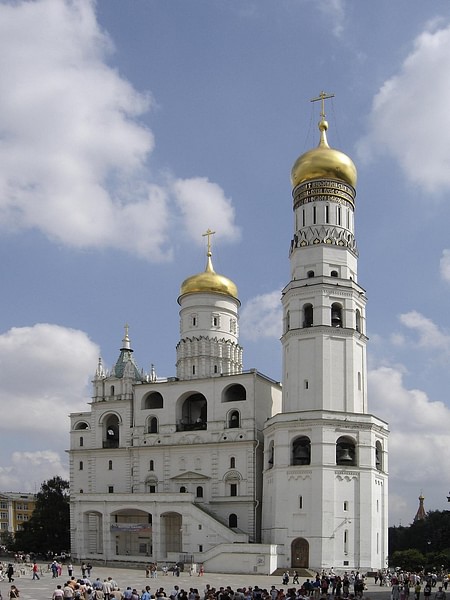
In 1480, the architect Marco Ruffo (Marco Fryazin) arrived in Moscow and worked on the Grand Ducal Palace (1514) and the beautiful Chamber of Facets (Palace of Facets), the royal dining hall. At the request of Ivan III, Aloisio the New (commonly identified as Aloisio Lamberti da Montagnana) began construction on the new Cathedral of the Archangel (1508), the future [burial](https://www.worldhistory.org/burial/) place of many royals. However, Ivan III died three years before it was completed and never got to see the end result, which was a beautiful red brick and white stone building. The Ivan the Great Bell Tower was completed in 1508 by architect Bon Fryazin and is the tallest structure in the Kremlin, playing a crucial role in the defences of the Kremlin as its central watchtower.
[  Ivan the Great Bell Tower Gérard Janot (CC BY-SA) ](https://www.worldhistory.org/image/18347/ivan-the-great-bell-tower/ "Ivan the Great Bell Tower")The most famous Italian architect to work on the Kremlin was Pietro Antonio Solari (l. c. 1445-1493), who arrived in Moscow in 1490 to continue the work of Fioravanti. Solari built the Konstantino-Eleninskaya Tower and the Borovitskaya Tower in 1490. In 1491, Solari completed the most important towers and entrance gates found in the Kremlin (the Frolov and the Nikolsky). Solari also completed the main line of walls and the Palace of Facets (1492). His last project was the Corner Arsenal Tower (Sobakina), in which he included a water reservoir that is still working today. Before his death, Solari recommended that his replacement be Alevisio da Carcano, who created a moat connecting the Moskva and Neglinnaya Rivers in 1508.
Ivan III's successor, Vasili III of Russia (r. 1505-1533), continued using Italian architects to build a second line of walls and towers. By 1538, the wooden walls had been replaced by brick walls, seven gates and 13 towers. The Kremlin became a forbidding maze of walls and towers, whose defences and layout were kept secret from foreigners, despite most of it being constructed by Italian architects and engineers.
### The Kremlin Under Ivan the Terrible
Ivan IV of Russia (Ivan the Terrible, r. 1547-1584) was the first Russian ruler to formally be crowned as [tsar](https://www.worldhistory.org/Tsar/). During his rule, the modern form of the Kremlin began to take place. The roads were cobbled, the Tsar's Palace was renovated and extended, and the Cathedral of the Annunciation (1489) had nine domes on its roof. The Kremlin was fast becoming a fortress for the tsars and their closest confidantes, with Ivan IV taking property from merchants and nobles and giving them to his loyal supporters instead.
[  Konstantino-Eleninskaya Tower, Moscow A.Savin, Wikipedia (CC BY-SA) ](https://www.worldhistory.org/image/18352/konstantino-eleninskaya-tower-moscow/ "Konstantino-Eleninskaya Tower, Moscow")### The Kremlin During the Time of Troubles
The Time of Troubles (1598-1612) began with the death of Tsar Feodor I of Russia (r. 1584-1598), who left no heirs. What followed was over a decade of death and destruction as the throne was fought over. The boyars (Russian nobles) were trapped behind the high walls of the Kremlin, and the Kremlin was seized by foreign forces, with the surrounding buildings in Moscow being burned to ashes.
Eventually, famine and disease befell the city of Moscow, including those in the Kremlin, which soon became a symbol of destruction and death.
### The Romanovs & the Kremlin
Mikhail I Romanov (r. 1613-1645) was the first Romanov tsar. His reign began soon after the Time of Troubles ended, and the Kremlin walls were still covered in soot, and rubble blocked its streets. Gates were broken, and the moat was filled with debris. Mikhail I raised taxes so urgent repairs could be made. The Palace of Facets was hastily repaired so Mikhail I could have his coronation there. Once again, workers were brought from abroad to work on the Kremlin as local workers and materials were in short supply.
The most notable building project during Mikhail's reign was the Terem Palace (1630s), built with brick by a team of Russian builders. It was a grand building with intricate carvings, bright colours, glazed windows and a gilded roof. The Terem Palace became the primary residence of the tsars during the 17th century.
[  Palace of Facets Pillar polikliet (CC BY-SA) ](https://www.worldhistory.org/image/18349/palace-of-facets-pillar/ "Palace of Facets Pillar")[Peter I of Russia](https://www.worldhistory.org/Peter_the_Great/) was the tsar of Russia from 1682 to 1721 and Russian emperor from 1721 to 1725. During his reign, the Kremlin was looked upon as an old-fashioned fortress with multiple issues. It had been whitewashed to invoke its original look and was no longer as striking or distinctive looking. Peter I was restless and often travelled to his hunting estate at Preobrazhenskoye. However, he regularly returned to the Kremlin to carry out matters of state. Peter I built a new city called St. Petersburg, which became the new Russian capital in 1713. The Kremlin remained a royal residence but was soon looked upon as an old relic.
Empress Elizabeth of Russia (r. 1741-1762) employed her favourite architect, Francesco Bartolomeo Rastrelli (l. 1700-1771), to build a Winter Palace (1749) in the Kremlin. This Winter Palace was wooden and a less opulent version of the one in St. Petersburg (1754), which was also constructed by Rastrelli.
[Catherine II of Russia](https://www.worldhistory.org/Catherine_the_Great/) ([Catherine the Great](https://www.worldhistory.org/Catherine_the_Great/), r. 1762-1796) was not a fan of Moscow or the Kremlin; however, she knew its importance to the Russian people and chose to have her coronation there. In 1770, Catherine created a plan for restoring the Kremlin's main cathedrals. [Catherine II](https://www.worldhistory.org/Catherine_the_Great/) chose Russian architect Vasily Bazhenov (l. 1737-1799) to transform the Kremlin into a place worthy of the Russian [Empire](https://www.worldhistory.org/empire/). Being inspired by St. Peter's Basilica in Rome and having grown up around the Kremlin, he was inspired to make major changes.
Bazhenov's vision included a new grand palace, parade grounds, and marble tiles. To make way for this venture, old buildings in the Kremlin had to come down, including the original Nameless Tower, the Taynitskaya Tower, the Armoury, and a cathedral that was dedicated to martyrs. Bazhenov tested his work on miniature models, which drew crowds of admirers. All construction work was put on hold when a [plague](https://www.worldhistory.org/disambiguation/plague/) hit Moscow in 1771 and did not resume until 1772. He strengthened and repaired the three main cathedrals and the bell tower of Ivan the Great. The foundation stone for his palace was laid down. Doric columns representing Asia, Europe, [Africa](https://www.worldhistory.org/disambiguation/africa/) and America were laid in each corner of the planned palace layout.
However, the construction of the palace soon ran into trouble. Catherine was losing interest and even missed the dedication and laying of the ceremonial bricks, and funding was running dangerously low. Ultimately, Bazhenov's lasting legacy in the Kremlin was his miniature palace models. He never did get to build his grand palace in the Kremlin.
At the end of the 18th century, the construction of the Kremlin was passed over to the architect Matvey Fyodorovich Kazakov (l. 1738-1812), who put a Gothic touch on the Senate and government structures. Another architect, Ivan Vasilyevich Egotov (l. 1756-1815), constructed the final Armoury, which later became the first Russian history museum.
[  Dormition Cathedral, Moscow Daniel Kruczynski (CC BY-SA) ](https://www.worldhistory.org/image/18348/dormition-cathedral-moscow/ "Dormition Cathedral, Moscow")### [Napoleon](https://www.worldhistory.org/disambiguation/Napoleon/) Attacks the Kremlin
By the 19th century, the Kremlin was a symbol of Russian splendour and glory. In 1812, [Napoleon Bonaparte](https://www.worldhistory.org/Napoleon_Bonaparte/)'s (r. 1804-1815) army entered Russia, defeated Field Marshal Mikhail Kutuzov's (l. 1745-1813) men, and took the Kremlin. He stayed in the Kremlin for one day before a fire spread once again through Moscow. Fire surrounded the Kremlin, and Napoleon retreated through a tunnel that ended on the banks of the Moskva River.
He stayed in the Petrovsky Palace in Moscow until the fires had been put out. He then returned to the Kremlin and decided to make it his residence and court. As winter approached, food became more challenging to find. Napoleon and his men retreated once again, but not before Napoleon ordered the Kremlin to be destroyed. The Palace of the Facets was set on fire, and barrels of gunpowder were placed around the towers and walls. The gunpowder became damp, and the attempt to destroy the Kremlin, like [Napoleon's invasion of Russia](https://www.worldhistory.org/Napoleon's_Invasion_of_Russia/), was mostly a failure. Some of the walls and towers were damaged, and the Vodovzvodnaya Tower was brought down. A Russian soldier stated, "So long as the bells chime, the Kremlin endures."
[  Emperor Napoleon in His Study at the Tuileries Jacques-Louis David (Public Domain) ](https://www.worldhistory.org/image/13626/emperor-napoleon-in-his-study-at-the-tuileries/ "Emperor Napoleon in His Study at the Tuileries")The architect Fyodor Sokolov (l. 1752-1824) was hired to rebuild the Kremlin. It took 20 years before the Kremlin was restored to its former splendour.
### Notable Structures in the Kremlin
Over the years, various towers, cathedrals, churches, and palaces have been constructed in the Kremlin. These include
**Towers**
- The Tainitskaya Tower (the Secret Tower), completed in 1485
- The Beklemishevskaya Tower (Beklemishev's Tower), completed in 1488
- The Vodovzvodnaya Tower (the Water-Supplying Tower), completed in 1488
- The Konstantino-Eleninskaya Tower (St. [Constantine](https://www.worldhistory.org/disambiguation/Constantine/) and Helena Tower), completed in 1490
- The Borovitskaya Tower (the Hill or Forest Tower), completed in 1490
- The Spasskaya Tower (the Saviour Tower), completed in 1491
- The Nikolskaya Tower (the St. Nicholas Tower), completed in 1491
- The Komendantskaya (the Commandmant's Tower), completed in 1495
- The Nabatnaya Tower (the Alarm Tower), completed in 1495
- The Oruzheynaya Tower (Armory Tower), completed in 1495
- The Troitskaya Tower (the [Trinity](https://www.worldhistory.org/Trinity/) Tower), completed in 1499
- Ivan the Great Bell Tower, completed in 1508
**Cathedrals & Churches**
- The Church of the Nativity of the Theotokos, consecrated in 1394
- The Dormition Cathedral (Assumption Cathedral), consecrated in 1479
- The Church of the Deposition of the Robe, consecrated in 1485
- The Cathedral of the Annunciation, consecrated in 1489
- The Cathedral of the Archangel, consecrated in 1508
- The Cathedral of Vasily the Blessed (Saint Basil's Cathedral), consecrated in 1561
- The Church of the Twelve Apostles, consecrated in 1656
**Palaces**
- The Palace of Facets, completed in 1492
- Terem Palace, completed in 1636
- The Grand Kremlin Palace, completed in 1849
- The State Kremlin Palace, completed in 1961
[  Grand Kremlin Palace, Moscow Ed Yourdon (CC BY-SA) ](https://www.worldhistory.org/image/18351/grand-kremlin-palace-moscow/ "Grand Kremlin Palace, Moscow")### The Kremlin Today
The Kremlin is one of Russia's most famous and visited landmarks. It has played an integral part in Russia's royal, political, religious, and defence history, and today, it remains the centre of the Russian government, with the Grand Kremlin Palace becoming the official residence of the Russian President in 2023.
The Kremlin still remains a fortress in every sense of the word. Its tight security is overseen by a Russian Commandment and the Kremlin Regiment (Presidential Regiment), and there are strict security protocols set in place to protect this historical landmark, such as GPS jamming systems and protection from the Moscow Air Defence Region. Despite all the security, tourists are allowed to visit the Kremlin, with thousands of visitors being attracted each year to the imposing fortress with its golden domes, red walls, towers, and multi-coloured roofs. The Kremlin has seen the best and worst parts of Russian history and will no doubt continue to play an essential part in Russia's future.
#### Editorial Review
This human-authored definition has been reviewed by our editorial team before publication to ensure accuracy, reliability and adherence to academic standards in accordance with our [editorial policy](https://www.worldhistory.org/static/editorial-policy/).
## Bibliography
- Arthur Voyce. *The Moscow Kremlin: Its History, Architecture and Art Treasures.* University of California Press Berkeley and Los Angeles, 1954
- [Catherine Merridale. *Red Fortress.* Allen Lane, 2013.](https://www.worldhistory.org/books/1846140374/)
- [Charles River Editors. *The Moscow Kremlin’s Most Famous Landmark.* Charles River Editors, 2015.](https://www.worldhistory.org/books/B00VR2L33I/)
- [Galeotti, Mark & Spedaliere, Donato. *The Moscow Kremlin’s Fortified Heart .* Osprey Publishing, 2022.](https://www.worldhistory.org/books/B09WQWL7XJ/)
## About the Author
Liana is the Social Media Editor for Ancient History Encyclopedia. She holds a Bachelor of Arts Degree with a major in ancient Greece, Rome & Late Antiquity. She is particularly passionate about Rome and Greece, and anything to do with mythology or wo
- [Linkedin Profile](https://www.linkedin.com/in/lian)
## Timeline
- **1156 CE**: The first [Kremlin](https://www.worldhistory.org/Kremlin/) is constructed during the reign of Prince Yuri Dolgoruky.
- **1326 CE**: The Cathedral of the Assumption is completed.
- **1329 CE**: The Church of St. John of the Ladder to the Bell Tower is completed.
- **1330 CE**: The Cathedral of the Saviour of the Forest is completed.
- **1333 CE**: The Cathedral of the Archangel is completed.
- **1367 CE**: The [Kremlin](https://www.worldhistory.org/Kremlin/)'s wooden walls and towers are rebuilt with white stone.
- **1368 CE**: The new [Kremlin](https://www.worldhistory.org/Kremlin/) is completed during the reign of Prince Dmitry Donskoi.
- **1368 CE**: The [Kremlin](https://www.worldhistory.org/Kremlin/) is invaded by a Lithuanian army, but the army quickly retreats.
- **1370 CE**: The Lithuanian army returns to take the [Kremlin](https://www.worldhistory.org/Kremlin/) but retreats once again.
- **1382 CE**: The [Kremlin](https://www.worldhistory.org/Kremlin/) is destroyed by Khan Tokhtamysh and his [Golden Horde](https://www.worldhistory.org/Golden_Horde/).
- **1474 CE**: Italian architect Ridolfo Fioravanti arrives in Moscow to work on the [Kremlin](https://www.worldhistory.org/Kremlin/).
- **1479 CE**: The Dormition Cathedral (Assumption Cathedral) is completed and consecrated.
- **1490 CE**: The Konstantino-Eleninskaya Tower and the Borovitskaya Tower are completed.
- **1491 CE**: The Frolov and the Nikolsky gates and towers are completed.
- **1492 CE**: The [Palace](https://www.worldhistory.org/disambiguation/palace/) of Facets is completed.
- **1508 CE**: The [Ivan the Great](https://www.worldhistory.org/Ivan_III_of_Russia/) Bell Tower is completed.
- **1514 CE**: The Grand Ducal [Palace](https://www.worldhistory.org/disambiguation/palace/) is completed.
- **1538 CE**: The [Kremlin](https://www.worldhistory.org/Kremlin/) grows to have seven gates and 13 towers.
- **1598 CE - 1612 CE**: The Time of Troubles takes place in Russia.
- **1636 CE**: Terem [Palace](https://www.worldhistory.org/disambiguation/palace/) is completed.
- **1712 CE**: St. Petersburg becomes the new capital [city](https://www.worldhistory.org/city/) of Russia.
- **1771 CE - 1772 CE**: Moscow goes through the [plague](https://www.worldhistory.org/disambiguation/plague/).
- **1812 CE**: [Napoleon Bonaparte](https://www.worldhistory.org/Napoleon_Bonaparte/) takes up residence in the [Kremlin](https://www.worldhistory.org/Kremlin/) and then destroys it when he leaves.
## Questions & Answers
### Why is the Kremlin so famous?
The Kremlin has been the centre of Russian politics and royalty for hundreds of years. It is one of Russia's most popular landmarks.
### How old is the Kremlin?
The original Kremlin was first built in the 12th century. Since then, buildings, walls, and towers have been destroyed and rebuilt multiple times.
### Can you visit the Kremlin?
Yes, the Kremlin is one of the most popular tourist attractions in Russia. There are companies who can help you organise a tour.
### Does the Russian President live in the Kremlin?
Yes, the Grand Kremlin Palace became the official residence of the Russian President in 2023.
## Cite This Work
### APA
Miate, L. (2024, January 25). Kremlin. *World History Encyclopedia*.
### Chicago
Miate, Liana. "Kremlin." *World History Encyclopedia*, January 25, 2024. .
### MLA
Miate, Liana. "Kremlin." *World History Encyclopedia*, 25 Jan 2024, .
## License & Copyright
Submitted by [Liana Miate](https://www.worldhistory.org/user/lianamiate/ "User Page: Liana Miate"), published on 25 January 2024. The copyright holder has published this content under the following license: [Creative Commons Attribution-NonCommercial-ShareAlike](https://creativecommons.org/licenses/by-nc-sa/4.0/deed.en). This license lets others remix, tweak, and build upon this content non-commercially, as long as they credit the author and license their new creations under the identical terms. When republishing on the web a hyperlink back to the original content source URL must be included. Please note that content linked from this page may have different licensing terms.