---
title: Kos
author: Mark Cartwright
source: https://www.worldhistory.org/Kos/
format: machine-readable-alternate
license: Creative Commons Attribution-NonCommercial-ShareAlike (https://creativecommons.org/licenses/by-nc-sa/4.0/)
updated: 1970-01-01
---
# Kos
_Authored by [Mark Cartwright](https://www.worldhistory.org/user/markzcartwright/)_
Kos (Cos) is a [Greek](https://www.worldhistory.org/disambiguation/greek/) island in the south-east [Aegean](https://www.worldhistory.org/aegean/), part of the Dodecanese (ancient Sporades) group which prospered in antiquity due to its location on [trade](https://www.worldhistory.org/disambiguation/trade/) routes between [Egypt](https://www.worldhistory.org/egypt/), [Syria](https://www.worldhistory.org/syria/), [Cyprus](https://www.worldhistory.org/cyprus/), and [Anatolia](https://www.worldhistory.org/Asia_Minor/). Settled from the [Bronze Age](https://www.worldhistory.org/disambiguation/Bronze_Age/), the island was controlled by a long list of powers over the centuries. One of Kos' most famous sons was the celebrated physician [Hippocrates](https://www.worldhistory.org/Hippocrates/), who created a school of [medicine](https://www.worldhistory.org/disambiguation/medicine/) on the island in the 5th century BCE. Kos particularly flourished both politically and culturally in the 4th century BCE, after which it became a free [city](https://www.worldhistory.org/city/) as part of the [Roman Empire](https://www.worldhistory.org/Roman_Empire/).
### [Bronze](https://www.worldhistory.org/disambiguation/bronze/) Age Kos
In [Greek mythology](https://www.worldhistory.org/Greek_Mythology/), Eurypylos is mentioned as the king of Kos and contributor to the Greek army involved in the [Trojan War](https://www.worldhistory.org/Trojan_War/) of [Homer](https://www.worldhistory.org/homer/)'s *[Iliad](https://www.worldhistory.org/iliad/)*. In the same book we are told that [Hera](https://www.worldhistory.org/Hera/) removed [Hercules](https://www.worldhistory.org/hercules/) to the island when he was trying to return home after his sacking of [Troy](https://www.worldhistory.org/troy/). The first archaeological evidence of settlements on Kos confirms an even earlier Bronze Age presence (3rd millennium BCE) with [burial](https://www.worldhistory.org/burial/) jars and [metal](https://www.worldhistory.org/disambiguation/metal/) objects such as daggers being excavated. Middle Bronze Age finds also demonstrate an influence from [Minoan](https://www.worldhistory.org/disambiguation/Minoan/) [Crete](https://www.worldhistory.org/crete/) and contact with Egypt.
The first large settlements, such as Serayia (Seraglio), have fortification walls and tholos tombs dating to the [Mycenaean period](https://www.worldhistory.org/Mycenaean_Civilization/) (1600-1200 BCE). The island was, no doubt, selected as a useful stopping point on the ancient [Mediterranean](https://www.worldhistory.org/disambiguation/mediterranean/) trade routes between the [Levant](https://www.worldhistory.org/levant/), Egypt, and Anatolia. Kos was also one of the most fertile Aegean islands. Kos-made [pottery](https://www.worldhistory.org/pottery/) was traded with other islands and has been discovered at Trianda and [Akrotiri](https://www.worldhistory.org/thera/) on [Thera](https://www.worldhistory.org/thera/). Following the collapse of the [Mycenaean civilization](https://www.worldhistory.org/Mycenaean_Civilization/) in the late Bronze Age, the island was next occupied by Doric settlers from mainland [Greece](https://www.worldhistory.org/greece/), probably [Epidaurus](https://www.worldhistory.org/epidaurus/). The Serayia cemetery, in use from c. 1050 BCE, dates to this period. It was last used c. 750 BCE, indicating a new cultural influence had arrived.
### [Archaic](https://www.worldhistory.org/disambiguation/Archaic/) & Classical Kos
From the [Archaic period](https://www.worldhistory.org/Archaic_Period/) the island came under control of various powers – first [Persia](https://www.worldhistory.org/Persia/), then [Halicarnassos](https://www.worldhistory.org/halicarnassus/), and finally [Athens](https://www.worldhistory.org/Athens/). The most important [cities](https://www.worldhistory.org/city/) on the island were Astypalaea, Cos Meropis, and Halasarna. In the 5th century BCE, the great physician Hippocrates was born on the island where he founded a school of medicine which became famed throughout the Greek world. From this period, Kos also became a noted exporter of wine and minted its own [coinage](https://www.worldhistory.org/coinage/), perhaps the most famous example of which are the [silver](https://www.worldhistory.org/Silver/) tridrachmas which depict a discus thrower (*discobolus*). In the [battle of Salamis](https://www.worldhistory.org/Battle_of_Salamis/) between Greek and Persian forces, Kos supplied several ships to the Persian cause, in an island fleet commanded by [Artemisia I of Caria](https://www.worldhistory.org/Artemisia_I_of_Caria/). According to [Herodotus](https://www.worldhistory.org/herodotus/), the tyrant Kadmos gave the people of the island control of government c. 480 BCE.
[ 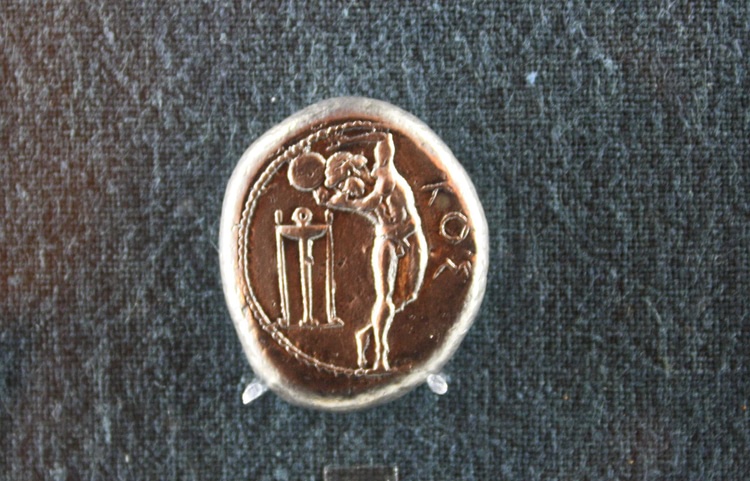 Tridrachm, Kos Mark Cartwright (CC BY-NC-SA) ](https://www.worldhistory.org/image/3746/tridrachm-kos/ "Tridrachm, Kos")Kos subsequently came under the control of Athens and became a tribute-paying member of the [Delian League](https://www.worldhistory.org/Delian_League/). This offered no particular protection to the island as Kos was sacked by the Spartan general Astyochus in 412 BCE after he took advantage of the disorder caused by a recent and devastating [earthquake](https://www.worldhistory.org/disambiguation/earthquake/). According to [Thucydides](https://www.worldhistory.org/Thucydides/), the Athenian general [Themistocles](https://www.worldhistory.org/Themistocles/) responded by building fortifications on the island in 411 BCE. In 366 BCE all the cities of Kos joined together to form a single political entity. A new city was, consequently, founded on the north-east coast, then fortified, and a harbor created. Mausolus, ruler of Caria, invaded the island in the 350s BCE. In 332 BCE Amphoterus, admiral of [Alexander the Great](https://www.worldhistory.org/Alexander_the_Great/), took possession of the island.
### [Hellenistic](https://www.worldhistory.org/Hellenic_World/) & [Roman](https://www.worldhistory.org/disambiguation/Roman/) Kos
Following the Successor Wars after [Alexander](https://www.worldhistory.org/disambiguation/Alexander/)'s [death](https://www.worldhistory.org/disambiguation/Death/), Kos regained its independence, established a democratic government and constitution, and became an ally of the [Ptolemy](https://www.worldhistory.org/disambiguation/Ptolemy/) dynasty based at [Alexandria](https://www.worldhistory.org/alexandria/). Kos exported wine, olive oil, and [silk](https://www.worldhistory.org/Silk/) to cities across the Aegean and the Black Sea. Its long-lasting trade and cultural ties with Egypt are illustrated by the fact that [Ptolemy II](https://www.worldhistory.org/Ptolemy_II_Philadelphus/) was born on the island and [Cleopatra](https://www.worldhistory.org/disambiguation/cleopatra/) II sent her treasury to Kos c. 102 BCE. A period of cultural activity expressed itself in such figures as the influential Kos poet and scholar Philitas (born c. 340 BCE) and his contemporary the poet Herodas. In 242 BCE the island's games held in honour of [Asclepius](https://www.worldhistory.org/Asclepius/) were given Panhellenic status, like those at other sacred sites such as [Delphi](https://www.worldhistory.org/delphi/) and [Olympia](https://www.worldhistory.org/Olympia/). Records describe athletes coming from over 50 different cities to participate, and those were just the winner lists.
[ 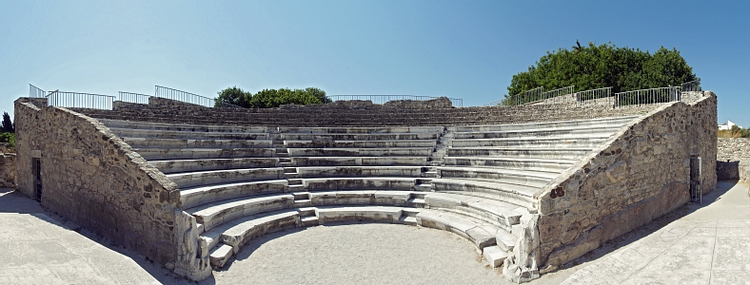 Odeion of Kos kallerna (CC BY-SA) ](https://www.worldhistory.org/image/4944/odeion-of-kos/ "Odeion of Kos")When [Rome](https://www.worldhistory.org/Rome/) began to expand its [empire](https://www.worldhistory.org/empire/) from the 2nd century BCE, Kos was made a free city (*civitas libera*). With the fall of the [Roman Republic](https://www.worldhistory.org/Roman_Republic/) Kos became a part of the province of Asia. Emperor [Claudius](https://www.worldhistory.org/claudius/) granted Kos *immunitas* (immunity from tax or imperial decree) and the island was one again made a free city in the 1st century CE. In late antiquity the island had merely tributary status again.
### The Asclepeion
The island today has substantial archaeological remains from all the periods of its history. These include the [agora](https://www.worldhistory.org/agora/) and [gymnasium](https://www.worldhistory.org/Gymnasium/) from the Classical periods, and from Hellenistic times, a [temple](https://www.worldhistory.org/temple/) and altar of [Dionysos](https://www.worldhistory.org/Dionysos/). The Roman period of Kos is represented by baths, a gymnasium, houses, villas – many with their surviving mosaics -, and an early Christian basilica. By far the most significant remains are from the large Asclepeion complex for which the island was most famous in antiquity.
The Asclepeion is situated four kilometres outside the city and dates from the 4th to 2nd century BCE. It was built on an older site sacred to [Apollo](https://www.worldhistory.org/apollo/) Cyparissius (referring to the cypress groves in the area), who was, of course, the father of Asclepius, the Greek [god](https://www.worldhistory.org/God/) of medicine. Initially, the site had only a modest altar but it developed over the years, next with a small Ionic temple built and dedicated to Asclepius, and then, under the auspices of king Eumenes II of [Pergamon](https://www.worldhistory.org/pergamon/) in the 2nd century BCE, a large Doric temple was built to Asclepius which copied the design of his temple at Epidaurus.
[ 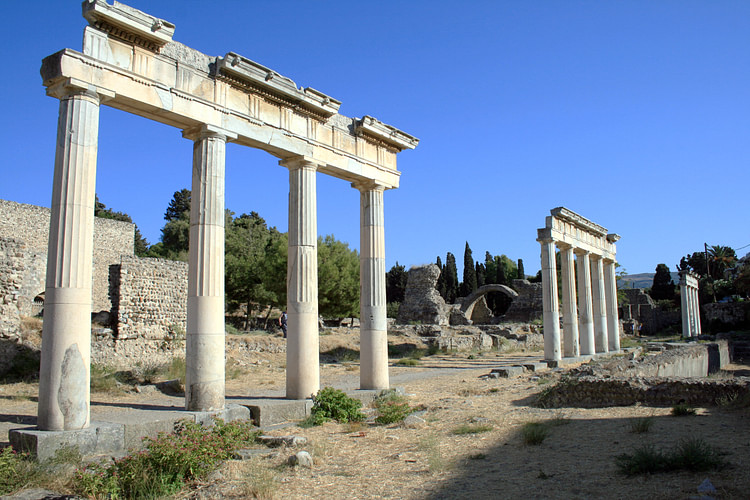 The Hellenistic Gymnasium, Kos Karelj (Public Domain) ](https://www.worldhistory.org/image/4946/the-hellenistic-gymnasium-kos/ "The Hellenistic Gymnasium, Kos")The complex eventually spread over three distinct but connected terraces to better perform its function as a place where visitors from across the Aegean could seek health remedies. Facilities included latrines and baths (1st century CE), temples, a library, fountains, and stoas (open colonnaded buildings) as well as features common to sacred areas such as monumental gates (*[propylaea](https://www.worldhistory.org/Propylaea/)*), *exedra* (a curved seating area), and rooms for patients and priests. In the 2nd century CE, the Romans built a large temple dedicated to Apollo whose reconstructed columns have been re-stood today. In the 3rd century CE another thermal baths was added to the site, which continued to function into the 5th century CE. In the 6th century CE a Christian church was built in place of the pagan temple, and in medieval times the Knights of St. John reused many blocks of masonry for their castle. The site was rediscovered and excavated from the early 20th century CE, first by a German and then an Italian team of archaeologists.
#### Editorial Review
This human-authored definition has been reviewed by our editorial team before publication to ensure accuracy, reliability and adherence to academic standards in accordance with our [editorial policy](https://www.worldhistory.org/static/editorial-policy/).
## Bibliography
- [Ananiadis, D. *Ancient Greece - Temples & Sanctuaries.* Toubis Editions, 2016.](https://www.worldhistory.org/books/9605409291/)
- Bagnall, R. et al. *The Encyclopedia of Ancient History.* Wiley-Blackwell, 2012
- [Cline, E.H. *The Oxford Handbook of the Bronze Age Aegean.* Oxford University Press, 2012.](https://www.worldhistory.org/books/0199873607/)
- [Herodotus. *The Landmark Herodotus Publisher.* 2016.](https://www.worldhistory.org/books/B004OP2S8E/)
- [Homer. *The Iliad.* Penguin Classics, 1998.](https://www.worldhistory.org/books/0140275363/)
- [Hornblower, S. *The Oxford Classical Dictionary.* Oxford University Press, 2012.](https://www.worldhistory.org/books/0199545561/)
- [Kinzl, H. *A Companion to the Classical Greek World.* Wiley-Blackwell, 2010.](https://www.worldhistory.org/books/1444334123/)
- [Thucydides. *The Landmark Thucydides.* Free Press, 1998.](https://www.worldhistory.org/books/0684827905/)
## About the Author
Mark is WHE’s Publishing Director and has an MA in Political Philosophy (University of York). He is a full-time researcher, writer, historian and editor. Special interests include art, architecture and discovering the ideas that all civilizations share.
## Timeline
- **3000 BCE - 2000 BCE**: First human presence recorded on [Kos](https://www.worldhistory.org/Kos/).
- **1600 BCE - 1200 BCE**: The [Mycenaean](https://www.worldhistory.org/Mycenaean_Civilization/) settlement of Serayia flourishes on [Kos](https://www.worldhistory.org/Kos/).
- **c. 480 BCE**: The Tyrant Kadmos permits the establishment of democratic government on [Kos](https://www.worldhistory.org/Kos/).
- **412 BCE**: The Spartan general Astyochus sacks [Kos](https://www.worldhistory.org/Kos/).
- **411 BCE**: The Athenian general [Themistocles](https://www.worldhistory.org/Themistocles/) builds fortifications on [Kos](https://www.worldhistory.org/Kos/).
- **c. 350 BCE**: Mausolus, ruler of Caria, invades [Kos](https://www.worldhistory.org/Kos/).
- **c. 350 BCE**: The Ascelpeion is built on [Kos](https://www.worldhistory.org/Kos/).
- **c. 340 BCE**: The [Greek](https://www.worldhistory.org/disambiguation/greek/) poet and scholar Philitas is born on [Kos](https://www.worldhistory.org/Kos/).
- **332 BCE**: Amphoterus, admiral of [Alexander the Great](https://www.worldhistory.org/Alexander_the_Great/), takes possession of [Kos](https://www.worldhistory.org/Kos/).
- **242 BCE**: The games held in honour of [Asclepius](https://www.worldhistory.org/Asclepius/) on [Kos](https://www.worldhistory.org/Kos/) are given Panhellenic status.
- **c. 102 BCE**: [Cleopatra](https://www.worldhistory.org/disambiguation/cleopatra/) II of [Egypt](https://www.worldhistory.org/egypt/) sends her treasury to [Kos](https://www.worldhistory.org/Kos/).
- **c. 100 BCE**: Coins of [Kos](https://www.worldhistory.org/Kos/) and Thespiai depict a [lyre](https://www.worldhistory.org/Lyre/) on their reverse side.
## Cite This Work
### APA
Cartwright, M. (2016, April 18). Kos. *World History Encyclopedia*.
### Chicago
Cartwright, Mark. "Kos." *World History Encyclopedia*, April 18, 2016. .
### MLA
Cartwright, Mark. "Kos." *World History Encyclopedia*, 18 Apr 2016, .
## License & Copyright
Submitted by [Mark Cartwright](https://www.worldhistory.org/user/markzcartwright/ "User Page: Mark Cartwright"), published on 18 April 2016. The copyright holder has published this content under the following license: [Creative Commons Attribution-NonCommercial-ShareAlike](https://creativecommons.org/licenses/by-nc-sa/4.0/deed.en). This license lets others remix, tweak, and build upon this content non-commercially, as long as they credit the author and license their new creations under the identical terms. When republishing on the web a hyperlink back to the original content source URL must be included. Please note that content linked from this page may have different licensing terms.