---
title: Kofun
author: Mark Cartwright
source: https://www.worldhistory.org/Kofun/
format: machine-readable-alternate
license: Creative Commons Attribution-NonCommercial-ShareAlike (https://creativecommons.org/licenses/by-nc-sa/4.0/)
updated: 1970-01-01
---
# Kofun
_Authored by [Mark Cartwright](https://www.worldhistory.org/user/markzcartwright/)_
*Kofun* (old tumuli) are large artificial mound tombs built in [ancient Japan](https://www.worldhistory.org/Ancient_Japan/) for the ruling elite between the 3rd and 7th century CE. Many measure several hundred metres across, are surrounded by a moat, and, besides containing valuable [bronze](https://www.worldhistory.org/disambiguation/bronze/) and iron goods, they were protected by terracotta figurines called *[haniwa](https://www.worldhistory.org/Haniwa/)*. The goods within the tombs illustrate the increasing prosperity of ancient [Japan](https://www.worldhistory.org/disambiguation/Japan/) as the rulers of Yamato traded both materials and ideas with neighbouring states. The mounds have given their name to the [Kofun Period](https://www.worldhistory.org/Kofun_Period/) of Japanese history which covers c. 250 to 538 CE.
### Location
*Kofun* tombs are spread over the Kinai region of Japan which includes the important sites of [Nara](https://www.worldhistory.org/Nara/), Kyoto, and Osaka. The idea of large [burial](https://www.worldhistory.org/burial/) mounds probably spread from contemporary [China](https://www.worldhistory.org/china/) and [Korea](https://www.worldhistory.org/Korea/) where they were also built for burying elite members of society. The earliest mounds were built in the southern plain of Nara, then they appear on the western slopes of the hills above Nara, and finally, they are concentrated on the eastern shores facing the Inland Sea (Sea of Japan). The practice of building *kofun* eventually spread throughout Japan so that the islands boast some 20,000 burial mounds known today.
### Design
Many early *kofun* were constructed to include natural mounds which were then developed to increase their size. From the 5th century CE, it was more common for *kofun* to be constructed on flat ground. The earlier examples, from c. 250 CE, are circular but later *kofun* follow a pattern and have a keyhole form design. Inside the earth mound is a stone-lined chamber in which was placed the body of the deceased. Many tombs are surrounded by a moat or shallow canal.
The smallest *kofun* are around 15 metres in diameter, many of the 140 in the Kibi area are over 27 metres high and 335 metres long, while the largest of all *kofun* can cover over 80 acres. One giant *kofun* is that of Emperor Ojin (r. 270-310 CE) which is 415 metres long and stands 35 metres tall. Another of the biggest tombs is that of Emperor Nintoku, Ojin's successor, which is also located in the modern Osaka Prefecture. It is 823 metres long and is surrounded by three moats. Nintoku traditionally reigned in the 4th century CE (313-399 CE) and his *kofun* is said to have taken 20 years to complete, but the mound has never been excavated.
The largest interior [tomb](https://www.worldhistory.org/tomb/) belongs to the Miyajidake *kofun* which is believed to contain the remains of Munakata no kimi Tokuzen. The chamber measures over 22 metres in length and is built of stone slabs which are 4.8 metres tall.
[ 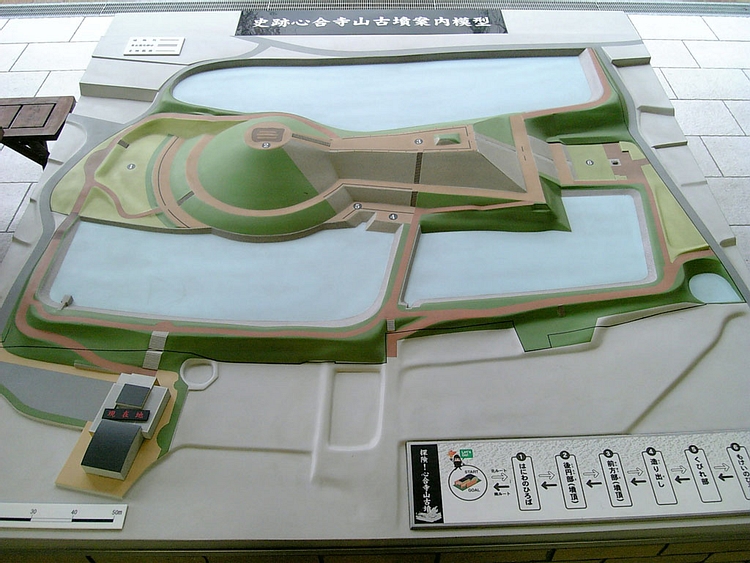 Shionjiyama Kofun Model Author Kansai explorer (GNU FDL) ](https://www.worldhistory.org/image/6579/shionjiyama-kofun-model/ "Shionjiyama Kofun Model")Another construction technique for the interior chamber is seen in the 3rd-century CE Nakayam Otsuka *kofun* near Kurozuka. This chamber is 7.5 metres long and 1.4 metres wide with 1.5 metre thick walls built up of small concave andesite stones. The walls rise vertically to a height of half a metre and then the stones overlap progressively inwards to create a corbelled roof two metres high. The floor is of hardened clay (in other mounds it is made from pebbles) and the deceased was placed inside a wooden coffin which had largely disintegrated by the time of excavation. The chamber was covered in alternating layers of sandy and clay soil and then covered in a layer of hemp cloth which was dyed with bands of red and black. This inner mound was then covered with more earth to create an even larger mound. As with many other tombs, the slopes of the outer earth mound contained an almost one-metre-thick layer of stones, perhaps to better provide drainage and protect the interior chamber from the elements.
The prodigious labour needed to construct *kofun* and the finds within them suggest that they were the burial mounds of the societal elite, perhaps at first only the chiefs and their immediate family. That the individuals thus honoured included non-chiefs is suggested by the smaller scale of *kofun* built from the 6th century CE. *Kofun* disappear from the 7th century CE, perhaps indicating the increased influence of [Buddhism](https://www.worldhistory.org/buddhism/) and the practice of cremation rather than burial. *Kofun* had been an easily visible display of power and wealth, but this function was now served by the elite funding the construction and upkeep of [Buddhist](https://www.worldhistory.org/buddhism/) temples.
[  Haniwa Warrior James Blake Wiener (CC BY-NC-SA) ](https://www.worldhistory.org/image/6524/haniwa-warrior/ "Haniwa Warrior")### Artefacts
The tombs contained valuable [grave](https://www.worldhistory.org/burial/) goods such as bronze weapons (swords, spears, and arrowheads) and mirrors. Also common are *magatama*, the comma-shaped jewels or polished precious stones, common to both Japan and Korea, which may symbolise life and fertility. From the 5th century CE, there are iron goods - weapons, armour, agricultural tools - saddles and horse-trappings such as ornate bridles and horse masks, which indicate a [culture](https://www.worldhistory.org/disambiguation/culture/) where warrior horse riders may have dominated society. [Pottery](https://www.worldhistory.org/pottery/) and gilt-bronze crowns, gilt-bronze shoes, [gold](https://www.worldhistory.org/gold/) and [silver](https://www.worldhistory.org/Silver/) ornaments, and jewellery all display an influence from ancient Korea and China, and the greater prosperity of rulers following Japan's increased contact and [trade](https://www.worldhistory.org/disambiguation/trade/) with their East Asian neighbours. One tomb at Takamatsuzuka, south of Nara plain, has [wall](https://www.worldhistory.org/wall/)-paintings similar to those found in Korean tumuli.
Placed on top of the tombs in rows and around their perimeters were ceramic figurines known as *haniwa*. These are made of terracotta and may take the form of humans, animals, houses, and simple plain cylinders. They measure anywhere from 1 to 1.5 metres in height. Their function is not known, but a role as guardians of the *kofun* - either for the spirit of the interred or to protect the living from that same spirit seems likely. Visible from a great distance they may have simply marked the territory of the tomb as sacred.
This content was made possible with generous support from the [Great Britain Sasakawa Foundation](http://www.gbsf.org.uk/?utm_source=ancient.eu&utm_medium=link&utm_campaign=ancient.eu).
#### Editorial Review
This human-authored definition has been reviewed by our editorial team before publication to ensure accuracy, reliability and adherence to academic standards in accordance with our [editorial policy](https://www.worldhistory.org/static/editorial-policy/).
## Bibliography
- [Ashkenazi, M. *Handbook of Japanese Mythology.* Oxford University Press, 2008.](https://www.worldhistory.org/books/0195332628/)
- [Beasley, W.G. *The Japanese Experience A Short History of Japan.* University of California, 1999.](https://www.worldhistory.org/books/B000ORKKBI/)
- [Cali, J. *Shinto Shrines.* Latitude 20, 2012.](https://www.worldhistory.org/books/0824837134/)
- Edward-Kidder Jr., J. "The Fujinoki Tomb and Its Grave-Goods
." *Monumenta Nipponica,*, Vol. 54, No. 1 (Spring, 1999), pp. 75-110.
- Edwards, W. "Event and Process in the Founding of Japan: The Horserider Theory in Archeological Perspective." *The Journal of Japanese Studies*, Vol. 9, No. 2 (Summer, 1983), pp. 265-95.
- Edwards, W. "Mirrors on Ancient Yamato: The Kurozuka Kofun Discovery and the Question of Yamatai." *Monumenta Nipponica*, Vol. 54, No. 1 (Spring, 1999), pp. 75-110.
- [Henshall, K. *Historical Dictionary of Japan to 1945.* Scarecrow Press, 2013.](https://www.worldhistory.org/books/0810878712/)
- [Mason, R.H.P. *A History of Japan.* Tuttle Publishing, 1997.](https://www.worldhistory.org/books/080482097X/)
- [Scott Littleton, C. *Understanding Shinto.* Duncan Baird Publishers, 2002.](https://www.worldhistory.org/books/1903296757/)
## About the Author
Mark is WHE’s Publishing Director and has an MA in Political Philosophy (University of York). He is a full-time researcher, writer, historian and editor. Special interests include art, architecture and discovering the ideas that all civilizations share.
## Timeline
- **c. 300 CE - c. 700 CE**: [Haniwa](https://www.worldhistory.org/Haniwa/) terracotta figurines are placed outside Japanese mound tombs or [kofun](https://www.worldhistory.org/Kofun/).
- **366 CE**: [Japan](https://www.worldhistory.org/disambiguation/Japan/) establishes diplomatic relations with [Korea](https://www.worldhistory.org/Korea/).
- **413 CE - 478 CE**: Japanese kings send ambassadors and tribute to [China](https://www.worldhistory.org/china/).
## External Links
- [Kofun Period (ca. 300–710) | Essay | The Metropolitan Museum of Art | Heilbrunn Timeline of Art History](https://www.metmuseum.org/toah/hd/kofu/hd_kofu.htm)
## Cite This Work
### APA
Cartwright, M. (2017, May 03). Kofun. *World History Encyclopedia*.
### Chicago
Cartwright, Mark. "Kofun." *World History Encyclopedia*, May 03, 2017. .
### MLA
Cartwright, Mark. "Kofun." *World History Encyclopedia*, 03 May 2017, .
## License & Copyright
Submitted by [Mark Cartwright](https://www.worldhistory.org/user/markzcartwright/ "User Page: Mark Cartwright"), published on 03 May 2017. The copyright holder has published this content under the following license: [Creative Commons Attribution-NonCommercial-ShareAlike](https://creativecommons.org/licenses/by-nc-sa/4.0/deed.en). This license lets others remix, tweak, and build upon this content non-commercially, as long as they credit the author and license their new creations under the identical terms. When republishing on the web a hyperlink back to the original content source URL must be included. Please note that content linked from this page may have different licensing terms.