---
title: Kofukuji
author: Mark Cartwright
source: https://www.worldhistory.org/Kofukuji/
format: machine-readable-alternate
license: Creative Commons Attribution-NonCommercial-ShareAlike (https://creativecommons.org/licenses/by-nc-sa/4.0/)
updated: 1970-01-01
---
# Kofukuji
_Authored by [Mark Cartwright](https://www.worldhistory.org/user/markzcartwright/)_
Kofukuji is a [Buddhist](https://www.worldhistory.org/buddhism/) [temple](https://www.worldhistory.org/temple/) which was founded in 669 CE and relocated to its present location in [Nara](https://www.worldhistory.org/Nara/), [Japan](https://www.worldhistory.org/disambiguation/Japan/) in 710 CE. It was the main Buddhist temple of the influential [Fujiwara clan](https://www.worldhistory.org/Fujiwara_Clan/) during the [Heian Period](https://www.worldhistory.org/Heian_Period/) (794-1185 CE). The temple's five-storey pagoda has become a symbol of the [city](https://www.worldhistory.org/city/) which was the capital of Japan in the 8th century CE. Kofukuji is listed as a UNESCO World Heritage Site.
### Historical Overview
Kofukuji temple was founded at Yamashina-dera in 669 CE but when the capital was moved to Nara in 710 CE during the reign of Empress Gemmei (r. 707-715 CE), the temple was relocated, too, buildings and all. Kofukuji, whose name means 'Temple of Happiness', became one of the [cities](https://www.worldhistory.org/city/) most important temples and, at its height, boasted over 150 buildings. It was dedicated to the Hosso sect of [Buddhism](https://www.worldhistory.org/buddhism/), which had been introduced to Japan from [China](https://www.worldhistory.org/china/) c. 650 CE by the Japanese monk Dosho.
Kofukuji was the *ujidera* or main Buddhist family temple of the powerful [Fujiwara](https://www.worldhistory.org/Fujiwara_Clan/) clan, many of whose members reigned as regents and held other important government positions during the Heian Period. The monastery complex gained revenue from a designated Fujiwara estate in Bizen province and flourished, becoming a major political player in its own right as the historian G. Sansom explains,
> It is symbolic of the dominant position of the clan that their monastery, the Kofukuji, was so powerful that for a time no governor was appointed to Yamato province, because this would have interfered with the almost plenary power of the Abbot of the Kofukuji. (153)
With this wealth, the monastery, like several others in [ancient Japan](https://www.worldhistory.org/Ancient_Japan/), was able to maintain a private army of armed retainers (*sohei*) recruited from trainee monks and local mercenaries. This force allowed the Kofukuji monks to protect their landed interests and ensure their continued dominant position as an influential monastery in Japanese politics by blocking roads, obstructing emissaries, and generally making a nuisance of themselves. Indeed, by 1006 CE the complex had 3,000 armed men at its disposal, and in 1081 CE the Kofukuji army attacked rival monasteries on Mount Hiyei and Miidera, burning down the latter and looting it. In 1113 CE it is reputed that Kofukuji was able to send a 20,000-man army against its great rival monastery [Enryakuji](https://www.worldhistory.org/Enryakuji/) at [Heiankyo](https://www.worldhistory.org/Heiankyo/) (Kyoto), the new capital after Nara, following a dispute over the appointment of an administrator of a Kofukuji branch temple.
[ 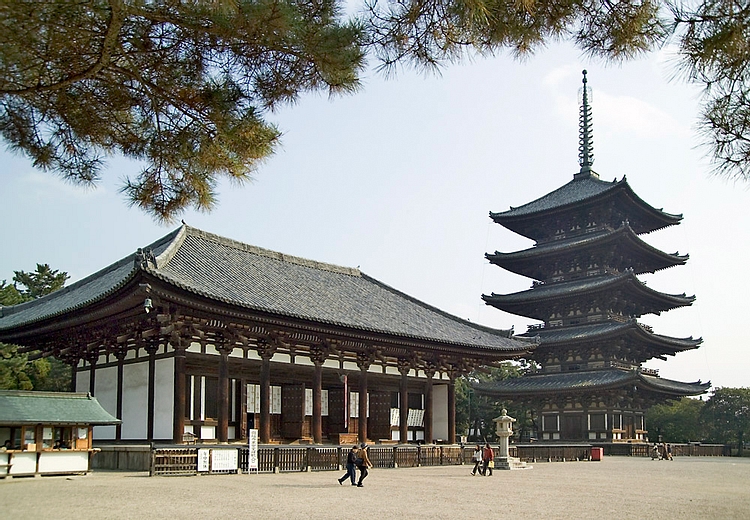 Kofukuji Temple, Nara Fg2 (Public Domain) ](https://www.worldhistory.org/image/6762/kofukuji-temple-nara/ "Kofukuji Temple, Nara")As the Fujiwara clan lost their stranglehold on power to rival clans such as the Taira and Minamoto, the complex suffered large-scale destruction in the first year of the [Genpei War](https://www.worldhistory.org/Genpei_War/) (1180-1185 CE). A Taira army led by Shigehira, fifth son of Taira clan leader Kiyomori, had attacked the monastery for supporting their rivals, the Minamoto. Rebuilding work began almost immediately afterwards, but during the medieval period the site, no longer an important religious centre, was attacked several times by marauding bands of [samurai](https://www.worldhistory.org/Samurai/) warriors.
The monastery was also important in Japanese [theatre](https://www.worldhistory.org/disambiguation/theatre/) development as Kofukuji hosted the first recorded performance of Okina, a form of No theatre, when three monks performed a series of dances. The three priests represented three old men known as Chichi-no-jo, Okina, and Samban Sarugaku, characters associated with the [Buddha](https://www.worldhistory.org/Siddhartha_Gautama/), Monju, and Miroku respectively.
It was not until 1881 CE that a full restoration project began at the complex and it is still ongoing with the Central Main Hall expected to be finished by 2018 CE.
### Architectural Highlights
Kofukuji once had three main halls, but today only the eastern one survives. The East Main Hall (Tokondo) was built in 1415 CE on the site of earlier versions, the first being constructed during the reign of Emperor Shomu (r. 724-749 CE). The emperor was said to have built the hall in an attempt to cure his ill aunt, which is why the building today contains a statue of Yakushi Nyorai, the Buddha of healing. Other sculptures within today's version include four guardian figures, the Shitenno of the four cardinal directions. Each figure is carved from a single tree trunk.
[ 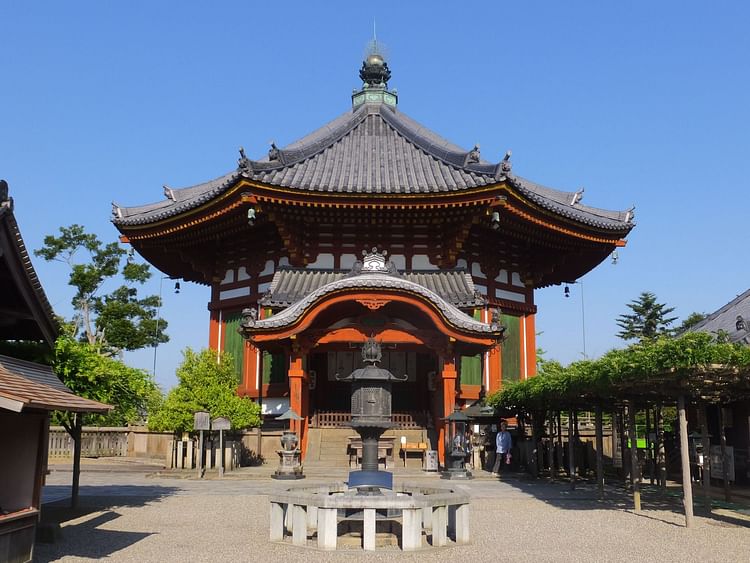 Southern Octagonal Hall, Kofukuji tak1701d (CC BY-SA) ](https://www.worldhistory.org/image/6763/southern-octagonal-hall-kofukuji/ "Southern Octagonal Hall, Kofukuji")The impressive five-storey pagoda which stands next to the East Main Hall dates to 1426 CE, built after a fire destroyed several of its predecessors, the first of which was built in 725 CE. Today's version, built copying plans of the original structure, stands 50 metres (164 ft) high, which makes it the second tallest pagoda in Japan. It is built entirely of wood and without the use of nails. The exterior is painted red and the interior left plain.
Inside the pagoda on the ground floor are several important sculptures representing Yakushi, Shaka, Amida, and Miroku Buddhas. These figures are shown in triads arranged around the central [column](https://www.worldhistory.org/column/) of the building. Today, the Kofukuji pagoda has become the iconic symbol of modern Nara.
Other important structures at the site include the two distinctive octagonal halls which are usually closed to the public but do contain more Buddhist [sculpture](https://www.worldhistory.org/disambiguation/Sculpture/). The Northern Octagonal Hall (Hokuendo) was first built in 721 CE, while today's version dates to 1210 CE. It was erected in honour of Fujiwara no Fuhitio, one of the temple's founders. The Southern Octagonal Hall (Nanendo), first built in 813 CE but with the present version dating to 1741 CE, figures as a stopping point on the famous pilgrimage route which takes in 33 temple sites across western Japan.
Finally, there are the Treasure House (Kokuhokan), the Oyuya bath house, and a second, smaller pagoda. There is also a museum building which contains many fine examples of ancient Buddhist art including a [bronze](https://www.worldhistory.org/disambiguation/bronze/) head of Yakushi Nyorai and a celebrated wood and lacquer statue of a six-armed Ashura.
This content was made possible with generous support from the [Great Britain Sasakawa Foundation](http://www.gbsf.org.uk/?utm_source=ancient.eu&utm_medium=link&utm_campaign=ancient.eu).
#### Editorial Review
This human-authored definition has been reviewed by our editorial team before publication to ensure accuracy, reliability and adherence to academic standards in accordance with our [editorial policy](https://www.worldhistory.org/static/editorial-policy/).
## Bibliography
- [Beasley, W.G. *The Japanese Experience.* University of California Press, 2000.](https://www.worldhistory.org/books/0520225600/)
- [Dougill, J. *Japan's World Heritage Sites.* Tuttle Publishing, 2014.](https://www.worldhistory.org/books/4805312858/)
- [Henshall, K. *Historical Dictionary of Japan to 1945.* Scarecrow Press, 2013.](https://www.worldhistory.org/books/0810878712/)
- [Keene, D. *Seeds in the Heart.* Columbia University Press, 1999.](https://www.worldhistory.org/books/0231114419/)
- [Sansom, G. *A History of Japan to 1334.* Stanford University Press, 1958.](https://www.worldhistory.org/books/0804705232/)
- [Tsuda, N. *A History of Japanese Art.* Tuttle Publishing, 2009.](https://www.worldhistory.org/books/4805310316/)
- [Whitney Hall, J. *The Cambridge History of Japan, Vol. 2.* Cambridge University Press, 1999.](https://www.worldhistory.org/books/0521223539/)
## About the Author
Mark is WHE’s Publishing Director and has an MA in Political Philosophy (University of York). He is a full-time researcher, writer, historian and editor. Special interests include art, architecture and discovering the ideas that all civilizations share.
## Cite This Work
### APA
Cartwright, M. (2017, June 22). Kofukuji. *World History Encyclopedia*.
### Chicago
Cartwright, Mark. "Kofukuji." *World History Encyclopedia*, June 22, 2017. .
### MLA
Cartwright, Mark. "Kofukuji." *World History Encyclopedia*, 22 Jun 2017, .
## License & Copyright
Submitted by [Mark Cartwright](https://www.worldhistory.org/user/markzcartwright/ "User Page: Mark Cartwright"), published on 22 June 2017. The copyright holder has published this content under the following license: [Creative Commons Attribution-NonCommercial-ShareAlike](https://creativecommons.org/licenses/by-nc-sa/4.0/deed.en). This license lets others remix, tweak, and build upon this content non-commercially, as long as they credit the author and license their new creations under the identical terms. When republishing on the web a hyperlink back to the original content source URL must be included. Please note that content linked from this page may have different licensing terms.