---
title: Kiyomizu-dera
author: Mark Cartwright
source: https://www.worldhistory.org/Kiyomizu-dera/
format: machine-readable-alternate
license: Creative Commons Attribution-NonCommercial-ShareAlike (https://creativecommons.org/licenses/by-nc-sa/4.0/)
updated: 1970-01-01
---
# Kiyomizu-dera
_Authored by [Mark Cartwright](https://www.worldhistory.org/user/markzcartwright/)_
Kiyomizu-dera, otherwise known as the '[Temple](https://www.worldhistory.org/temple/) of the Pure Water Spring', is a [Buddhist](https://www.worldhistory.org/buddhism/) temple in Kyoto, [Japan](https://www.worldhistory.org/disambiguation/Japan/). The site is famous for its impressive viewing platform, three-storey Koyasu pagoda and the medicinal pure waters of the Otowa Spring. Kiyomizu-dera is Kyoto's most popular tourist attraction, the Main Hall is an official National Treasure of Japan and the complex is listed by UNESCO as a World Heritage Site.
### Foundation & Key Features
The Kiyomizu-dera temple is located on Mt. Otowa, part of the eastern hills on the outskirts of Kyoto. The temple belongs to the Buddhist Kita-Hosso sect and was founded in 778 CE by Enchin Shonin some 16 years before [Heiankyo](https://www.worldhistory.org/Heiankyo/) (the former name of Kyoto) was itself established as the new capital of Japan. Enchin Shonin was a priest from [Nara](https://www.worldhistory.org/Nara/), the capital of Japan from 710 to 784 CE, who claimed to have received a vision which directed him to the exact location of a spring, the Otowa spring which gives its name to the site. Even today, many visitors consider the waters of the spring to have magical properties and the three branches of it are each given a romantic association: health, longevity, and exam success. No wonder, then, that Kiyomizu is popular with both young and old, but if the reader visits in person and wishes to take the waters, remember that one should drink from one stream only, so choose wisely.
In 798 CE, the military leader of Japan, Sakanoue Tamuramaro, embellished the site with a large hall which was reassembled from its former position in the [palace](https://www.worldhistory.org/disambiguation/palace/) of [Emperor Kammu](https://www.worldhistory.org/Emperor_Kammu/) (r. 781-806 CE). Kammu had decided to leave his old capital of Nara because of the overly strong influence the Buddhist monasteries had on the government there, and it was for this reason that the emperor permitted the building of new temples at Heiankyo only on the [city](https://www.worldhistory.org/city/)'s periphery. In any case, the southern monasteries continued to be influential and there was a particular and long-standing rivalry between the [Kofukuji](https://www.worldhistory.org/Kofukuji/) temple of Nara and the Kiyomizu-dera, the latter being, at least officially, a subsidiary of the former.
[ 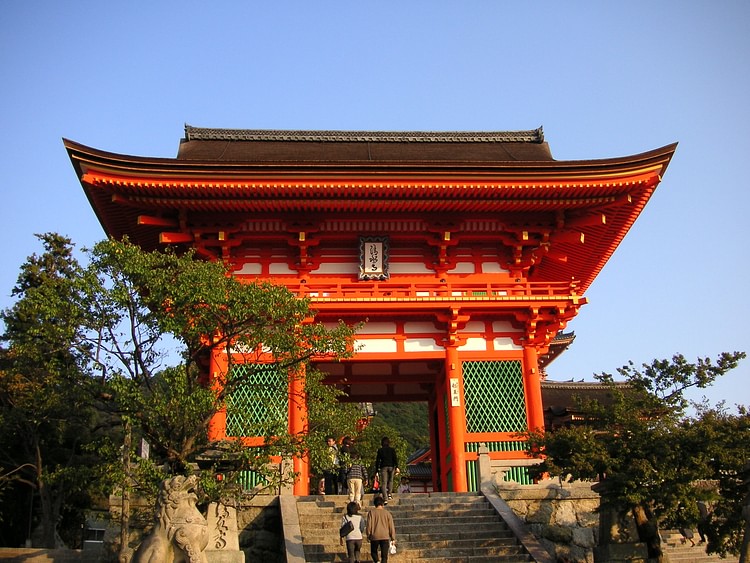 Niomon Gate, Kiyomizu-dera Todd (CC BY-NC-SA) ](https://www.worldhistory.org/image/10668/niomon-gate-kiyomizu-dera/ "Niomon Gate, Kiyomizu-dera")The temple complex is set in woodlands and entered via the monumental red and white Niomon Gate which, flanked by two massive statues of Buddhist guardian kings, was built in the 15th century CE. Next to it is the Sanjunoto pagoda. There is an additional gate at the west side of the estate, the Saimon Gate, which dates to the Momoyama Period (1568-1600 CE) and which is an official National Treasure of Japan. Within the wooded complex are the Hondo or Main Hall; a secondary hall similar in design to the Hondo, the Okunoin Hall; the Jishu Shrine and the Jeju-in garden which recreates famous landscape features mentioned in classic [literature](https://www.worldhistory.org/literature/). Another hall, the Zuiguido Hall, is kept completely dark inside and is meant to represent the womb of [Buddha](https://www.worldhistory.org/Siddhartha_Gautama/)'s mother so that walking through it is a metaphor for one's spiritual rebirth.
One of the highlights of Kiyomizu-dera is the Koyasu, an impressive three-storey pagoda complete with spire, which was designed to house sacred texts and relics. Built between 1607 and 1633 CE, it is an excellent example of Momoyama [architecture](https://www.worldhistory.org/disambiguation/architecture/). The structure is another National Treasure of Japan and is particularly associated with granting trouble-free childbirth for those who visit it. Finally, Kiyomizu-dera is also the home of a famous statue of the bodhisattva of compassion Kannon (aka Kwannon or Guanyin in Chinese). The remarkable figure has ten heads, 1,000 arms, and is credited to Kiyomizu-dera's founder Enchin. Being classified as a 'hidden Buddha' or *hibutsu*, the figure is only displayed to the public every 33 years.
### The Hondo
The Hondo, yet another National Treasure of Japan, is 58 metres (190 ft) long with its rectangular floor plan being built on a nine by seven ratio. There is an entrance porch, two wings, and the interior is divided into two distinct areas: the inner and outer sanctuary which contain religious [sculpture](https://www.worldhistory.org/disambiguation/Sculpture/) and paintings respectively. The walls are open in the middle portion so that one can walk right through the building. The hall has an irregular shingle roof of Japanese cypress (*hinoki*) bark and not the usual tiles, which is a recognition of its former status as an imperial building.
Perched on a cliff edge, the temple's Main Hall has a large viewing platform that provides a panorama westwards of Kyoto. Stretching out and above a steep slope so that it is 13 metres (40 ft) above ground level, the platform is supported from below by 139 huge wooden pillars with crossbeams and, built using traditional Japanese techniques, it uses no nails. Known as the *Butai* or Dance Stage because it once hosted musical performances, the platform has a more sinister side. The giddying precipice tempted many monks to suicide in the Edo Period (1603-1868 CE) as they thought that throwing oneself off the platform and into the abyss somehow earned one spiritual merit. 234 leapers are recorded but, amazingly, only 15% of them died, the rest being saved by the trees below cushioning the fall. Prohibited since 1872 CE, the practice has given rise to a popular Japanese expression, 'to jump off the Kiyomizu stage' which means 'take the plunge.'
[ 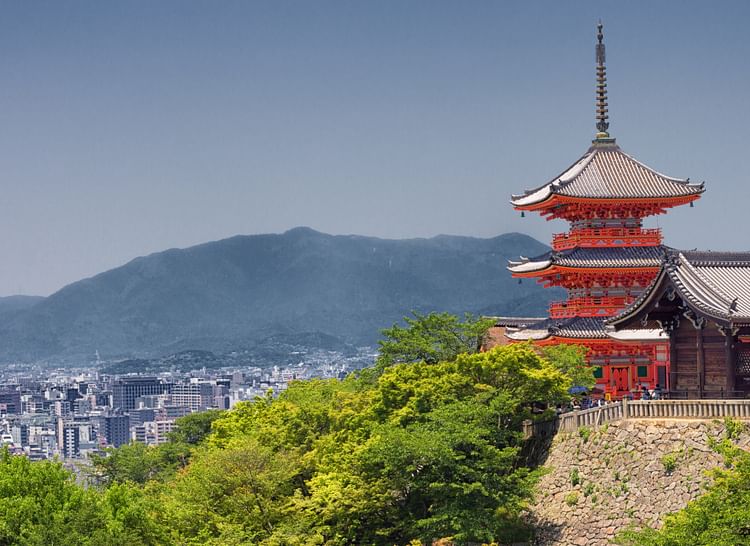 Koyasu Pagoda, Kiyomizu-dera Ray in Manila (CC BY) ](https://www.worldhistory.org/image/10667/koyasu-pagoda-kiyomizu-dera/ "Koyasu Pagoda, Kiyomizu-dera")Next to the Hondo, but not officially a part of it, is the Jishu Jinja, a guardian shrine and sacred to a deity that oversees romantic matchmaking. To gain favour from the spirit one must walk between two stones which are set 18 metres (59 feet) apart. If one can do this with one's eyes closed then one will find one's perfect partner.
### Later History
The temple was famously captured in a painting by the celebrated artist Tosa Mitsunobu at the very end of his career during the Eisho Period (1504-1520 CE). The work, titled *Kiyomizu-dera Engi* ('*Illustrated History of Kiyomizu-dera Temple*'), is mounted as a horizontal handscroll or *makimono* in three pieces and today resides in the Tokyo Imperial Household Museum.
[ 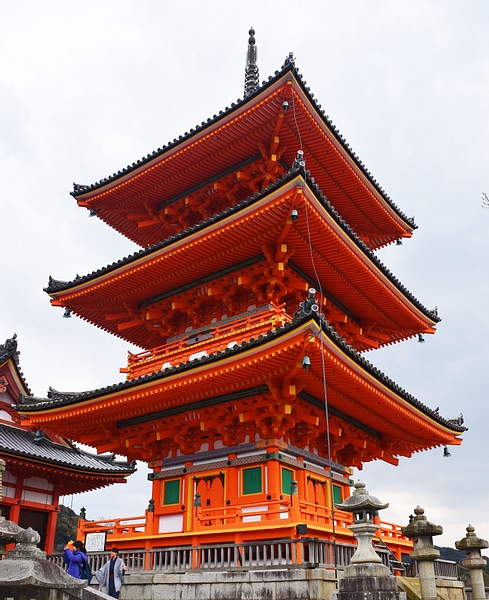 Pagoda at Kiyomizu-dera Temple James Blake Wiener (CC BY-NC-SA) ](https://www.worldhistory.org/image/7890/pagoda-at-kiyomizu-dera-temple/ "Pagoda at Kiyomizu-dera Temple")Disaster struck, as it so often has to many of Japan's ancient wooden buildings, when a fire destroyed the temples and main hall of Kiyomizu in 1629 CE. Work began to restore the site in 1633 CE under the auspices of the [Shogun](https://www.worldhistory.org/Shogun/) [Tokugawa Iemitsu](https://www.worldhistory.org/Tokugawa_Iemitsu/) (r. 1623-1651 CE). As an extra bonus, the Koyasu pagoda was added to the already impressive collection of buildings. In 2003 CE the Niomon Gate was renovated to its former glory, and in 2017 CE the platform pillars of the Hondo were restored.
This content was made possible with generous support from the [Great Britain Sasakawa Foundation](http://www.gbsf.org.uk/?utm_source=ancient.eu&utm_medium=link&utm_campaign=ancient.eu).
#### Editorial Review
This human-authored definition has been reviewed by our editorial team before publication to ensure accuracy, reliability and adherence to academic standards in accordance with our [editorial policy](https://www.worldhistory.org/static/editorial-policy/).
## Bibliography
- [Dougill, J. *Japan's World Heritage Sites.* Tuttle Publishing, 2014.](https://www.worldhistory.org/books/4805312858/)
- [Huffman, J.L. *Japan in World History.* Oxford University Press, 2010.](https://www.worldhistory.org/books/0195368088/)
- [Sansom, G. *A History of Japan to 1334.* Stanford University Press, 1958.](https://www.worldhistory.org/books/0804705232/)
- [Tsuda, N. *A History of Japanese Art.* Tuttle Publishing, 2009.](https://www.worldhistory.org/books/4805310316/)
## About the Author
Mark is WHE’s Publishing Director and has an MA in Political Philosophy (University of York). He is a full-time researcher, writer, historian and editor. Special interests include art, architecture and discovering the ideas that all civilizations share.
## Timeline
- **778 CE**: The [Buddhist](https://www.worldhistory.org/buddhism/) [Kiyomizu-dera](https://www.worldhistory.org/Kiyomizu-dera/) [temple](https://www.worldhistory.org/temple/) is built at [Heiankyo](https://www.worldhistory.org/Heiankyo/) (Kyoto).
## Cite This Work
### APA
Cartwright, M. (2019, May 24). Kiyomizu-dera. *World History Encyclopedia*.
### Chicago
Cartwright, Mark. "Kiyomizu-dera." *World History Encyclopedia*, May 24, 2019. .
### MLA
Cartwright, Mark. "Kiyomizu-dera." *World History Encyclopedia*, 24 May 2019, .
## License & Copyright
Submitted by [Mark Cartwright](https://www.worldhistory.org/user/markzcartwright/ "User Page: Mark Cartwright"), published on 24 May 2019. The copyright holder has published this content under the following license: [Creative Commons Attribution-NonCommercial-ShareAlike](https://creativecommons.org/licenses/by-nc-sa/4.0/deed.en). This license lets others remix, tweak, and build upon this content non-commercially, as long as they credit the author and license their new creations under the identical terms. When republishing on the web a hyperlink back to the original content source URL must be included. Please note that content linked from this page may have different licensing terms.