---
title: Kinkakuji
author: Mark Cartwright
source: https://www.worldhistory.org/Kinkakuji/
format: machine-readable-alternate
license: Creative Commons Attribution-NonCommercial-ShareAlike (https://creativecommons.org/licenses/by-nc-sa/4.0/)
updated: 2025-11-27
---
# Kinkakuji
_Authored by [Mark Cartwright](https://www.worldhistory.org/user/markzcartwright/)_
Kinkakuji [Temple](https://www.worldhistory.org/temple/) in Kyoto, [Japan](https://www.worldhistory.org/disambiguation/Japan/), more formally referred to as Rokuon-ji or 'Deer Garden Temple' and otherwise known as 'The Temple of the Golden Pavilion', was first built in 1397 CE. Originally the retirement residence of the [shogun](https://www.worldhistory.org/Shogun/) Ashikaga Yoshimitsu (r. 1368-1394/5 CE), it was converted into a Rinzai Zen [Buddhist](https://www.worldhistory.org/buddhism/) temple following Yoshimitsu's [death](https://www.worldhistory.org/disambiguation/Death/) in 1408 CE, a function it still performs today. Kinkakuji was designated by UNESCO as a World Heritage Site in 1994 CE and is an official National Special Historic Site of Japan and listed as a Special Place of Scenic Beauty.
### Ashikaga Yoshimitsu
The temple, located in the hilly Kitayama district of north-west Kyoto (formerly known as [Heiankyo](https://www.worldhistory.org/Heiankyo/)) was conceived as the retirement retreat for the shogun Ashikaga Yoshimitsu (l. 1358-1408 CE). The shogun acquired the land from the statesman Saionji Kintsune, who had built his own villa on this site of outstanding natural beauty. The new [palace](https://www.worldhistory.org/disambiguation/palace/) complex, which boasted 13 buildings, was completed in 1397 CE and the shogun took early retirement in 1394/5 CE in order to pursue the arts in his vast new home. Ashikaga Yoshimitsu became a great patron of the arts, and Kinkakuji saw a flourishing of such [crafts](https://www.worldhistory.org/crafts/) as sword-making and ceramics. The site also saw the birth of [Noh theatre](https://www.worldhistory.org/Noh_Theatre/). Collectively, all of these artistic endeavours became known as Kitiyama [Culture](https://www.worldhistory.org/disambiguation/culture/).
#### Book Promotion
[  ](https://amzn.to/4isZ4B5 "The Forsaken 14th Century")### The Forsaken 14th Century
by World History Encyclopedia WHE's first book takes a truly global outlook and introduces readers to the different cultures that survived, thrived, and fell amid adversity in the 14th century. Filled with in-depth text written by WHE authors, many exclusive maps, and plenty of illustrations, The Forsaken 14th Century takes you on a global journey from the nomads of the Mongol Empire to the Black Death in Europe, the booming trade on the Swahili Coast to the Aztecs and the Māori settlements in New Zealand. [Learn More](https://amzn.to/4isZ4B5)
.sponsor.book img.key_art {
box-shadow: none !important;
}
.button_container {
margin-top: 1em;
}
.sponsor.book h3 {
text-transform: none;
margin-top: 0px;
margin-bottom: 15px;
font-family: "Libre Baskerville", "Palatino Linotype", "Book Antiqua", Palatino, serif;
}
.sponsor_message {
margin-left: 190px;
font-family: Karla, Arial, Helvetica, sans-serif;
line-height: 140%;
min-height: 200px;
}
.sponsor.book {
padding: 20px;
margin: 25px 0px;
background-color: #f3f3f3;
}
.sponsor.book .key_art {
margin-top: 0px;
margin-bottom: 10px;
float: left;
}
.sponsor h4 {
font-weight: bold;
text-transform: uppercase;
color: #000;
margin-bottom: 10px;
margin-top: 0px;
font-family: Karla,Arial,Helvetica,sans-serif;
font-size: 13px;
padding: 0;
}
.sponsor_book_author {
color: #999;
margin: -10px 0px 20px;
}
@media (max-width: 1199px) {
.sponsor.book .key_art {
float: none;
width: 100%;
}
.sponsor.book .sponsor_message {
margin-left: 0px;
}
.sponsor.book h3 {
margin-top: 20px;
margin-bottom: 10px;
}
}
@media (max-width: 767px) {
}
Ashikaga Yoshimitsu may have retired but he continued to pull the strings of Japanese government, and he attracted many illustrious visitors to his retreat, notably Emperor Gokomatsu (r. 1392-1412 CE). The former shogun had made it known that he wished, upon his death, for the site to be converted into a Rinzai Zen Buddhist temple, which it was in 1408 CE. The temple was then renamed Rokuon-ji after *Rokoun-in-den*, the former shogun's posthumous religious title, with its first abbot being Muso-kokushi.
### The Golden Pavilion
The Golden Pavilion is so called because it is lavishly covered in gold foil. There is an association between gold and Pure Land Buddhism where the former is considered to represent spiritual purity. Further, the Buddhist paradise is thought to abound with gilded pavilions. [Kukai](https://www.worldhistory.org/Kukai/) (774-835 CE), the celebrated scholar monk and saint who founded Shingon Buddhism once said, "There are no fixed heavens and hells. If you do good, gold and [silver](https://www.worldhistory.org/Silver/) pavilions immediately appear" (quoted in Dougill, 2017, p. 115). Unkind commentators suggest the ostentatious covering might also have something to do with Ashikaga Yoshimitsu's high opinion of himself and a wish to demonstrate his great wealth; he did, after all, receive letters from the [Ming Dynasty](https://www.worldhistory.org/Ming_Dynasty/) Emperor as 'the king of Japan', even after he had retired as shogun. The Golden Pavilion is the only surviving building from the original 14th-century CE estate.
[  Kyoto's Kinkakuji Temple Compound James Blake Wiener (CC BY-NC-SA) ](https://www.worldhistory.org/image/7884/kyotos-kinkakuji-temple-compound/ "Kyoto's Kinkakuji Temple Compound")The pavilion is an interesting mix of three distinct Japanese architectural styles. The first or ground floor is in the palace architectural style (*shinden-zukuri*) of the [Heian period](https://www.worldhistory.org/Heian_Period/) (794-1185 CE). This floor has a front viewing area, verandah, and rear fishing deck while its walls are of plain wood and white plaster. Inside is a large reception area and statues of both [Buddha](https://www.worldhistory.org/Siddhartha_Gautama/) and a seated Ashikaga Yoshimitsu wearing priest's robes. The middle floor is in the *buke-zukuri* or [samurai](https://www.worldhistory.org/Samurai/) residential style and has a space for meetings, the Buddha Hall. The hall contains a shrine to Kanon, the Bodhisattva of mercy and compassion and the ceiling and walls are decorated with painted birds, clouds, and musical instruments. The third and top floor has the bell-shaped windows which are typical of the Zen architectural style, *zenshu-butsuden*. Both the second- and third-floor exteriors are built of lacquered wood covered with gold leaf, while the interior of the third floor is given the same lavish decoration. Originally containing a statue of Amida and 25 bodhisattvas, the top floor now houses sacred relics of the Buddha. The top floor gives an admirable view of Mt. Kinugasa.
[ 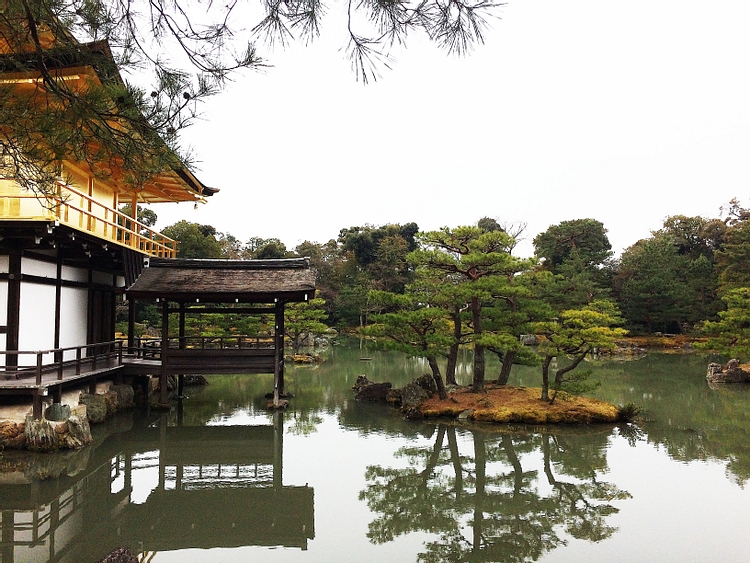 Side View of Kinkakuji Temple James Blake Wiener (CC BY-NC-SA) ](https://www.worldhistory.org/image/7885/side-view-of-kinkakuji-temple/ "Side View of Kinkakuji Temple")The roof of the pavilion has a [pyramid](https://www.worldhistory.org/pyramid/) form and is today covered in shingles of hinoki wood but it once had gilded Chinese tiles to match the sheen of the upper two stories. The roof apex has a [bronze](https://www.worldhistory.org/disambiguation/bronze/) figure of a phoenix, a symbol of divine favour, virtue, and harmony. The bird fortuitously survived the devastating 1950 CE fire because it was being repaired at the time. The whole shimmering Golden Pavilion is reflected in the waters of the adjacent pond garden, the Kyokochi Pond, which was originally filled with lotus plants and so the whole scene was designed to represent the Buddhist vision of paradise.
### Restorations
The Golden Pavilion managed to survive the ravages of the Onin [War](https://www.worldhistory.org/disambiguation/War/) (1467-1477 CE), although other buildings at the complex were destroyed. It was less fortunate in the fire of 1565 CE and, after being rebuilt in the 19th century CE, there was another blaze in 1950 CE, this one deliberately set off by a disgruntled novice monk, which totally destroyed the building. The latter tragedy was captured in [literature](https://www.worldhistory.org/literature/) in the *Temple of the Golden Pavilion* (*Kinkakuji*), a 1956 CE novel by Mishima. In the book, the priest is driven to destroy the pavilion because of its perfection: "When people concentrate on the idea of beauty, they are, without realising it, confronted with the darkest thoughts that exist in this world" (quoted in Dougill, 2017, p114). Painstakingly restored to its former glory, the Golden Pavilion was ready for visitors again from 1955 CE. In 1984 CE the Golden Pavilion was spruced up and three years later given an extra-thick layer of gold foil to make it even more gold than ever before.
### The Gardens
The gardens and pine woods at Kinkakuji are a fine example of the landscapes of the [Muromachi Period](https://www.worldhistory.org/Muromachi_Period/) (1333-1573 CE) which invite the walker to explore winding paths that open into constantly shifting perspectives of the gardens as a whole. As in other such gardens built by the Japanese aristocracy, many areas were specifically designed to recall famous landscape scenes from Japanese and [Chinese literature](https://www.worldhistory.org/Chinese_Literature/). An example is the line of four stones in the Kyokochi Pond which represent the famous image of four boats sailing off to the mythical Isles of the [Immortals](https://www.worldhistory.org/disambiguation/immortals/). The larger of the complex's two ponds also has ten islands, the biggest of which is contoured to represent Japan. There are two freshwater springs which feed the ponds and are used in the tea ceremonies on the site. One of these, the Ryumon Taki (Carp Rock), has a large pointed stone on which the water falls, and this represents the carp in Chinese legend which attempts to climb a waterfall in order to become a dragon. The legend is taken as a metaphor for a monk's struggle to achieve enlightenment.
Dotted around the gardens are many stones, selected and donated by supporters of the temple's founder for their aesthetic qualities and often given names and particular histories. There are several additional buildings, too, such as the abbot's residence, the Sekkatei Teahouse ('Place of Evening Beauty') which was built in the [Edo period](https://www.worldhistory.org/Edo_Period/) (1603-1868 CE) and the temple hall which contains a 9th-century CE statue attributed to Kukai. The figure, appropriately enough, is of Fudo-myo (aka Acala) who is a Buddhist deity and considered the chief protector of shrines and temples.
This content was made possible with generous support from the [Great Britain Sasakawa Foundation](http://www.gbsf.org.uk/?utm_source=ancient.eu&utm_medium=link&utm_campaign=ancient.eu).
#### Editorial Review
This human-authored definition has been reviewed by our editorial team before publication to ensure accuracy, reliability and adherence to academic standards in accordance with our [editorial policy](https://www.worldhistory.org/static/editorial-policy/).
## Bibliography
- [Beasley, W.G. *The Japanese Experience.* University of California Press, 1999.](https://www.worldhistory.org/books/0520220501/)
- [Deal, W.E. *Handbook to Life in Medieval and Early Modern Japan.* Oxford University Press, 2007.](https://www.worldhistory.org/books/0195331265/)
- Dougill, J. *Japan’s World Heritage Sites.* Tuttle Publishing, 2014
- [Dougill, J. *Zen Gardens and Temples of Kyoto.* Tuttle Publishing, 2017.](https://www.worldhistory.org/books/480531401X/)
- [Fenellosa, E.F. *Epochs of Chinese and Japanese Art.* Stone Bridge Press, 2007.](https://www.worldhistory.org/books/1933330260/)
- [Henshall, K. *Historical Dictionary of Japan to 1945.* Scarecrow Press, 2013.](https://www.worldhistory.org/books/0810878712/)
- [Tsuda, N. *A History of Japanese Art.* Tuttle Publishing, 2009.](https://www.worldhistory.org/books/4805310316/)
- [Yamamura, K. (ed). *The Cambridge History of Japan, Vol. 3.* Cambridge University Press, 1990.](https://www.worldhistory.org/books/0521223547/)
## About the Author
Mark is WHE’s Publishing Director and has an MA in Political Philosophy (University of York). He is a full-time researcher, writer, historian and editor. Special interests include art, architecture and discovering the ideas that all civilizations share.
## Timeline
- **1397 CE**: The [Kinkakuji](https://www.worldhistory.org/Kinkakuji/) or 'Golden Pavilion' is built in [Heiankyo](https://www.worldhistory.org/Heiankyo/) (Kyoto) by the [shogun](https://www.worldhistory.org/Shogun/) Ashikaga Yoshimitsu.
## Cite This Work
### APA
Cartwright, M. (2019, May 15). Kinkakuji. *World History Encyclopedia*.
### Chicago
Cartwright, Mark. "Kinkakuji." *World History Encyclopedia*, May 15, 2019. .
### MLA
Cartwright, Mark. "Kinkakuji." *World History Encyclopedia*, 15 May 2019, .
## License & Copyright
Submitted by [Mark Cartwright](https://www.worldhistory.org/user/markzcartwright/ "User Page: Mark Cartwright"), published on 15 May 2019. The copyright holder has published this content under the following license: [Creative Commons Attribution-NonCommercial-ShareAlike](https://creativecommons.org/licenses/by-nc-sa/4.0/deed.en). This license lets others remix, tweak, and build upon this content non-commercially, as long as they credit the author and license their new creations under the identical terms. When republishing on the web a hyperlink back to the original content source URL must be included. Please note that content linked from this page may have different licensing terms.