---
title: Kaupang
author: James Blake Wiener
source: https://www.worldhistory.org/Kaupang/
format: machine-readable-alternate
license: Creative Commons Attribution-NonCommercial-ShareAlike (https://creativecommons.org/licenses/by-nc-sa/4.0/)
updated: 2023-03-14
---
# Kaupang
_Authored by [James Blake Wiener](https://www.worldhistory.org/user/jbw288/)_
Kaupang was a Norwegian [Viking Age](https://www.worldhistory.org/collection/29/the-viking-age/) town with a seasonal emporium established around c. 780 CE and abandoned around c. 950 CE. Kaupang is located on the western side of Oslofjord (Viksfjord) in what is the present-day southeastern county Vestfold, Norway with maritime access to the Skagerrak. Although it was much smaller than other [Viking](https://www.worldhistory.org/Vikings/) towns in Sweden and Denmark - namely, [Birka](https://www.worldhistory.org/Birka/) and [Hedeby](https://www.worldhistory.org/Hedeby/) - Kaupang was of economic importance to Norwegian and Danish [Vikings](https://www.worldhistory.org/Vikings/) who raided and traded with Western [Europe](https://www.worldhistory.org/europe/) and the British Isles. Kaupang can thus lay claim to being the oldest town in Norway, and it is likely the same place as “Sciringesheal” or “Skiringssal” (Old Norse: Skíringssalr), which was visited by the Norwegian seafarer and writer Ohthere of Hålogaland in the 9th century CE.
### Rise of Kaupang
Kaupang aptly takes its name from the Old Norse “Kaupangr” which means "marketplace" or “town.” Kaupang is located in what is the present-day municipality of Tjølling. It is situated 5km (3 miles) southeast of the modern town of Larvik and about 140 km (88 miles) from Norway's capital Oslo. In early medieval times, Kaupang covered an area of roughly 5 hectares (12.5 acres).
The origins of Kaupang's foundation are shrouded in mystery as there is a lack of definitive textual sources pertaining to Kaupang, unlike Hedeby and Birka. Nonetheless, there is evidence at Kaupang that demonstrates a centralized power organizing the activities in Kaupang, in ways similar to Hedeby and Birka, by the beginning of the 9th century CE. Vestfold was arguably the wealthiest and most fertile region in Viking Age Norway, and Frankish Annals from c. 813 CE reveal that Danish kings fought for control over this region around the beginning of the 9th century CE. One of Kaupang's jetties dates to c. 803 CE, and some scholars have suggested that King Sigfred (r. 770-804 CE) or King Godfred of Denmark (r. 804-810 CE) might have founded or encouraged settlement at Kaupang to enhance their influence and political power in Norway.
### Kaupang as a Mercantile Town
Houses, graves, shops, storage units, and piers all attest to Kaupang's role as a center of trade between Norway and the outside world. The first plots and structures were demarcated and erected at Kaupang sometime between 780-800 CE. While it was initially believed that occupation of Kaupang was correlated with the opening and closing of seasonal markets, recent archaeological research from 2000-2007 CE by the Norwegian archaeologist Dagfinn Skre has shown that Kaupang was inhabited year-round. (Nonetheless, some houses of the excavated houses at Kaupang appear to have lacked hearths, which indicates periodic or seasonal inhabitation.) Despite evidence for brisk international trade at Kaupang, the town curiously appears not to have been fortified, which is in striking contrast to Birka and Hedeby. The shifting maritime conditions in and around Kaupang perhaps helped protect the settlement from [piracy](https://www.worldhistory.org/Piracy/) and invading forces. Kaupang was populated primarily by merchants, but agricultural tools used by farmers have been found in Kaupang's graves, which suggests that Kaupang's population likely included some farmers as well. Some structures demonstrate the presence of local craft production at Kaupang too. There is, additionally, evidence that some of those who lived in Kaupang were responsible for melting down [silver](https://www.worldhistory.org/Silver/) and other materials for resale and export abroad.
[ 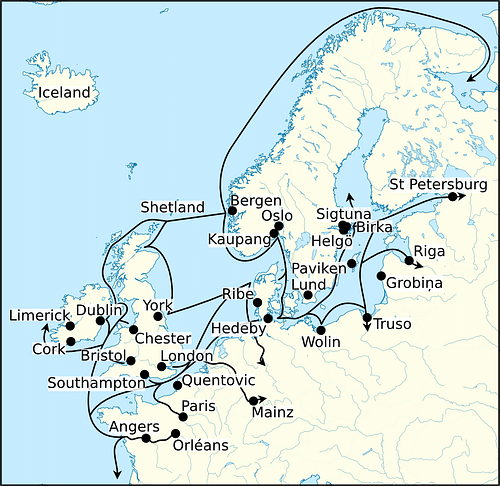 Viking Age Trade Routes in North-West Europe Brianann MacAmhlaidh (CC BY-SA) ](https://www.worldhistory.org/image/9284/viking-age-trade-routes-in-north-west-europe/ "Viking Age Trade Routes in North-West Europe")At its height around c. 875 CE, Kaupang had between 400-1000 inhabitants. Kaupang's [grave](https://www.worldhistory.org/burial/) sites have long been an object of interest to archaeologists. The family graves in and around Kaupang date mostly from a century-long period, lasting from c. 840-940 CE. Many of the goods found in these graves came from Western Europe and the British Isles. Ceramic objects from Denmark are also common in these graves. There are other gravesites around Kaupang, including a cremation cemetery, and several boat burials, which might have belonged to affluent Danish merchants.
Among the items discovered at Kaupang include German wine in Rhenish [pottery](https://www.worldhistory.org/pottery/) (replete with glass drinking horns), Wendish (Slavic) honey, whetstones from elsewhere in Norway, Danish ceramics, Frankish or Frisian clothes, in addition to Frankish and Anglo-[Saxon](https://www.worldhistory.org/Saxons/) book mounts and Irish jewelry. The unearthing of walrus tusks and fragments of soapstone provides proof that Kaupang was also connected to more northerly Viking trade routes that extended up into remote, Arctic regions. A number of foreign coins - Anglo-Saxon, Frankish, Danish, North African, Central Asian, and Arab - have been found at Kaupang, demonstrating the interconnectedness of Kaupang with other Viking emporia.
### Decline of Kaupang & [Archaeology](https://www.worldhistory.org/Archaeology/)
The decline of Kaupang as a place of trade and commerce mirrors that of Birka and Hedeby - there was a sudden growth and [urbanization](https://www.worldhistory.org/urbanization/) of other towns in close proximity. There is a noticeable, sharp drop in artifacts after the second quarter of the 10th century CE, which strongly correlates to the decline and the abandonment of human activity and inhabitation of Kaupang. Some scholars believe that Kaupang's decline is the result of the rapid growth of nearby Tønsberg, Norway in the middle of the 10th century CE, which in turn became the center of Norwegian trade with Scandinavia and Western Europe. The town of Skien - located 38 km (24 miles) to the northwest of Kaupang with access to the Frierfjord - rose rapidly after c. 1000 CE, gaining wealth through the export of iron and whetstones from northern Norway to Western Europe.
[ 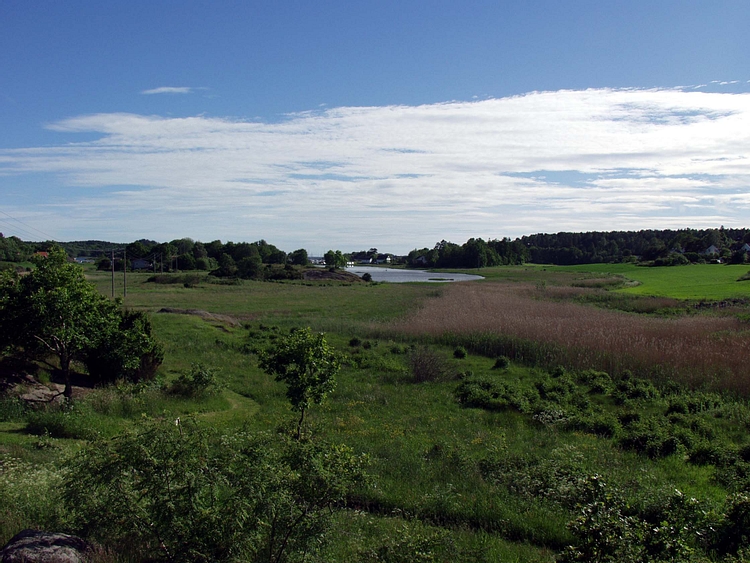 Kaupang J.P.Fagerback (Copyright) ](https://www.worldhistory.org/image/9420/kaupang/ "Kaupang")Kaupang's abandonment might additionally be explained by a decline in trading links with Denmark, in particular, the town of Hedeby, or be the result of fluctuating sea-levels. It is known that the sea level around Kaupang dropped at some point within the Viking Age, and Kaupang had better connections to the sea over a thousand years ago than it does at the present time. The current water level at nearby Larvik is roughly 3 m (10 ft) below where it was in Viking times. The Norwegian archaeologist Charlotte Blindheim proved this during her excavations of Viking era graves near Larvik and Sandefjord between 1950-1957 CE.
Archaeological excavations in and around Kaupang began in 1867 CE by the Norwegian archaeologist Nicolay Nicolaysen (1817-1911 CE), but it was only between 1956-1967 CE that the first extensive excavations were undertaken of Kaupang's graves and a few other structures. At the present, archaeologists have excavated and researched less than 3% of the 40,000 square meters (9.9 acres) that comprises Kaupang. About 1400 square meters (15069 square feet) have been excavated in total.
#### Editorial Review
This human-authored definition has been reviewed by our editorial team before publication to ensure accuracy, reliability and adherence to academic standards in accordance with our [editorial policy](https://www.worldhistory.org/static/editorial-policy/).
## Bibliography
- [Hansen, De Gitte. *Everyday Products in the Middle Ages.* Oxbow Books, 2015.](https://www.worldhistory.org/books/1782978054/)
- [Kaupang Viking Town -- Visit Norway](https://www.visitnorway.com/listings/kaupang-viking-town/177404/ "Kaupang Viking Town -- Visit Norway"), accessed 19 Mar 2020.
- [Parker, Philip. *The Northmen's Fury.* Vintage, 2015.](https://www.worldhistory.org/books/0099551845/)
- [Richards, Julian D. *The Vikings.* Oxford University Press, 2005.](https://www.worldhistory.org/books/0192806076/)
- [Roesdahl, Else. *The Vikings.* Penguin Books, 2018.](https://www.worldhistory.org/books/0141984767/)
- [Seaver, Kristen. *The Last Vikings.* I.B.Tauris, 2015.](https://www.worldhistory.org/books/1784530573/)
- [Why Did the Viking Trading Town of Kaupang Totally Disappear? -- ThorNews](https://thornews.com/2016/02/21/why-did-the-viking-trading-town-of-kaupang-totally-disappear/ "Why Did the Viking Trading Town of Kaupang Totally Disappear? -- ThorNews"), accessed 19 Mar 2020.
## About the Author
James Blake Wiener has a particular interest in cross-cultural exchange and world history. He is a co-founder of World History Encyclopedia and formerly was its Communications Director.
- [Linkedin Profile](https://www.linkedin.com/in/jameswiener)
## Timeline
- **780 CE - 950 CE**: The commercial [Viking](https://www.worldhistory.org/Vikings/) centre at [Kaupang](https://www.worldhistory.org/Kaupang/) thrives.
## Cite This Work
### APA
Wiener, J. B. (2018, November 09). Kaupang. *World History Encyclopedia*.
### Chicago
Wiener, James Blake. "Kaupang." *World History Encyclopedia*, November 09, 2018. .
### MLA
Wiener, James Blake. "Kaupang." *World History Encyclopedia*, 09 Nov 2018, .
## License & Copyright
Submitted by [James Blake Wiener](https://www.worldhistory.org/user/jbw288/ "User Page: James Blake Wiener"), published on 09 November 2018. The copyright holder has published this content under the following license: [Creative Commons Attribution-NonCommercial-ShareAlike](https://creativecommons.org/licenses/by-nc-sa/4.0/deed.en). This license lets others remix, tweak, and build upon this content non-commercially, as long as they credit the author and license their new creations under the identical terms. When republishing on the web a hyperlink back to the original content source URL must be included. Please note that content linked from this page may have different licensing terms.