---
title: Kalash Culture
author: Dr. Muhammad Kashif Ali
source: https://www.worldhistory.org/Kalasha/
format: machine-readable-alternate
license: Creative Commons Attribution-NonCommercial-ShareAlike (https://creativecommons.org/licenses/by-nc-sa/4.0/)
updated: 1970-01-01
---
# Kalash Culture
_Authored by [Dr. Muhammad Kashif Ali](https://www.worldhistory.org/user/Muhammad_Kashif_Ali/)_
The Kalash people, also called *Kafir* (Non-believer), Black Robe and *Siah Posh,* live in the three sub-valleys of Kalash; Bumboret, Rumbor and Birir, in the modern-day District Chitral, Pakistan. The Kalasha are ancient tribe of Pakistan and they have their own way of life, their own [religion](https://www.worldhistory.org/religion/), language, rituals and their own identity. This part of Pakistan is considered to be a well preserved ethnic and cultural museum. Owing to this value, Kalasha [culture](https://www.worldhistory.org/disambiguation/culture/) has been listed by UNESCO for consideration as World Heritage Site.
The Kalasha culture is unique and tourist come from all over the world here to see the beauty of this unique culture. Each year a many historians, anthropologists, sociologists and photographers from all over the world focus the Kalasha society. The numerical strength of the Kalasha people is about only 4,000 (as estimated in 2010).
The history of Kalasha is disputed. Today many hypothesises appear about the origin of the Kalasha tribe of Chitral. Until now two major hypothesises have been strongly developed about the origin of the Kalasha: Indo-[Aryan](https://www.worldhistory.org/Aryan/) origin and [Greek](https://www.worldhistory.org/disambiguation/greek/) origin. The hypothesis of Indo-Aryan origin is supported by George Morgenstierne, R.C.F. Schomberg Karl Jettmar and Peter Parkes. While other hypothesis give the impression that the Kalasha are relatively recent newcomers or Greeks in origin. This hypothesis was formulated by H. Siiger and is supported by two French anthropologists, Jeans Yves Loude and Viviane Lievre.
Captain John Wood wrote a book *A Personal Narrative of a Journey to the Source of the River [Oxus](https://www.worldhistory.org/Oxus/) by the Route of the Indus, Kabul and Badakhshan,* published in 1841. Captain Wood, although, did not visit the Kafiristan (land of Kafirs) but he collected valuable information of the region; ethnicity and society. He hardly believed that the Kafirs people are European breed. He puts a new idea that the Kafirs people had linkage with the Tajiks of Badakhshan.
Saifullah Jan, a Kalasha spokesman, revealed the tradition of the Kalasha history that the first homeland of the Kalasha people was Tsyam (and no one knows where is this Tsyam on the globe) where from their forefather Shalak Shah came to Chitral with an army. At Chitral four sons were born to Shalak Shah. He had divided Chitral among his four sons. There is a historical gap regarding what happened after Shalak Shah, no body knows.
[ 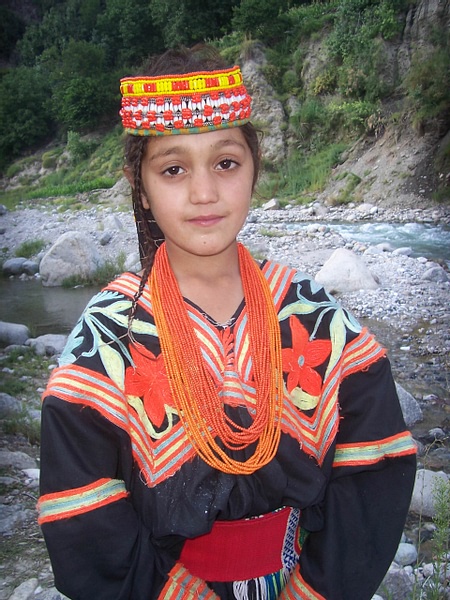 Kalasha People Dr. Muhammad Kashif Ali (Copyright) ](https://www.worldhistory.org/image/894/kalasha-people/ "Kalasha People")In recent times DNA tests were made to examine the Greek origin of the Kalasha. The Pakistani genetic scientist Dr. Qasim Ayub concluded through the DNA tests the Kalasha people do not have Greek origin. However they believed that the Kalasha belong to the Aryan stock. Now, “there is a consensus today that they are of the Indo-Aryan stock having migrated to Afghanistan maybe a couple of thousand years back.”
“Most anthropologists consider the Kalasha religion to be polytheistic, because it has many deities.” Their major deities are:
- Sajigor
- Mahandeo
- Balumain
- Dezalik
- Ingaw
- Jestak
There are two types of religious events in Kalasha society. The first kind may be considered as having a religious ceremony as well as festivities while other events are only religious in nature, without dancing and singing. The Kalasha observe many festivals in a year, their major festivals are:
- **Joshi**, celebrated in May to welcome the spring
- **Uchaw**, observed in late August to ensure good crops of wheat
- **Pul/Poh**, observed September, only in the Birir Valley
- **Chaumos**, observed in December for more than two weeks, it is the grand festival of the Kalasha tribe and it is celebrated to welcome New Year
Today, the Kalasha community is in transition, under the pressure of modernization and seems this beautiful culture will vanish, if it is not preserved by international and national agencies and governments.
#### Editorial Review
This human-authored definition has been reviewed by our editorial team before publication to ensure accuracy, reliability and adherence to academic standards in accordance with our [editorial policy](https://www.worldhistory.org/static/editorial-policy/).
## Bibliography
- [http://www.unescap.org/ttdw/Publications/TPTS\_pubs/pub\_1425\_tor.pdf](http://www.unescap.org/ttdw/Publications/TPTS_pubs/pub_1425_tor.pdf "http://www.unescap.org/ttdw/Publications/TPTS_pubs/pub_1425_tor.pdf"), accessed 1 Dec 2016.
- Ayub, Q et al. "Investigation of the Greek Ancestry of Populations from Northern Pakistan." *Human Genetics*, No. 5 Vol. 114, Apr. 2004, pp. 484-485.
- Ali, M.K. *Cultural Transitions in Kalash Valley (1947-2006).* M.Phil Thesis, University of the Punjab, Lahore., 2010
- Lines, M. *The Kalasha people of North-Western Pakistan.* Peshawar: Emjay Books International, 1996, 35.
- Marx, E. "How We Lost Kafiristan." *Representations*, No 67 Summer 1999, pp. 48-49.
- Scott Robertson, G. *The Kafir of the Hindukush.* Lahore: Sang-e-Meel Publications, 1995, 161-162.
## About the Author
Ethno-historian focusing in mountain communities of Pakistan like Kalasha, Kho, Shin, Hunzakut, Balti etc, teaching history in university and PhD in ethno-history of the Kalasha people of Chitral-Pakistan.
- [Facebook Profile](https://www.facebook.com/https://facebook.com/kashif)
- [X/Twitter Profile](https://twitter.com/https://twitter.com/kashifthegi)
- [Linkedin Profile](https://www.linkedin.com/https://www.linkedin.com/in/muh)
## External Links
- [Kalasha: The Sole Pagan Tribe of Pakistan](http://kalashapeople.blogspot.com/)
## Cite This Work
### APA
Ali, D. M. K. (2011, December 21). Kalash Culture. *World History Encyclopedia*.
### Chicago
Ali, Dr. Muhammad Kashif. "Kalash Culture." *World History Encyclopedia*, December 21, 2011. .
### MLA
Ali, Dr. Muhammad Kashif. "Kalash Culture." *World History Encyclopedia*, 21 Dec 2011, .
## License & Copyright
Submitted by [Dr. Muhammad Kashif Ali](https://www.worldhistory.org/user/Muhammad_Kashif_Ali/ "User Page: Dr. Muhammad Kashif Ali"), published on 21 December 2011. The copyright holder has published this content under the following license: [Creative Commons Attribution-NonCommercial-ShareAlike](https://creativecommons.org/licenses/by-nc-sa/4.0/deed.en). This license lets others remix, tweak, and build upon this content non-commercially, as long as they credit the author and license their new creations under the identical terms. When republishing on the web a hyperlink back to the original content source URL must be included. Please note that content linked from this page may have different licensing terms.