---
title: Jerash
author: James Blake Wiener
source: https://www.worldhistory.org/Jerash/
format: machine-readable-alternate
license: Creative Commons Attribution-NonCommercial-ShareAlike (https://creativecommons.org/licenses/by-nc-sa/4.0/)
updated: 2025-10-06
---
# Jerash
_Authored by [James Blake Wiener](https://www.worldhistory.org/user/jbw288/)_
Jerash (aka Gerasa, Gerash or Gerasha) is the capital and the largest [city](https://www.worldhistory.org/city/) of the Jerash Governorate in [Jordan](https://www.worldhistory.org/Jordan/), but in ancient times it was one of the wealthiest and most cosmopolitan [cities](https://www.worldhistory.org/city/) in the ancient [Near East](https://www.worldhistory.org/Near_East/). Settled by humans as early as the [Neolithic period](https://www.worldhistory.org/Neolithic/) (c. 7500-5500 BCE) and founded as a [Hellenistic](https://www.worldhistory.org/Hellenic_World/) city in the 2nd century BCE, Jerash is today noted for its fine [Roman](https://www.worldhistory.org/disambiguation/Roman/) and [Byzantine](https://www.worldhistory.org/disambiguation/Byzantine/) ruins, which rank among the largest and best preserved in the world. Jerash is located 48 km (30 miles) north of Amman - the capital of Jordan - and 40 km (25 miles) south of Irbid, Jordan. Jerash is one of the most visited sites in Jordan after the [Nabataean](https://www.worldhistory.org/Kingdom_of_Nabatea/) city of Petra.
### Geography & Early History
The area in and around Jerash is quite fertile and has access to water year-round thanks to an ancient reservoir. The ruins of Jerash sit at an altitude of 500 m (1640,42), giving the city impressive views over the surrounding low-lying areas, and the city's weather is relatively temperate compared to nearby Amman. The fertile rolling hills and valleys around Jerash have sustained human settlement and inhabitation for at least 6500 years, and the landscape around the ruined city is surrounded by olive trees, plum trees, fig trees, wheat, eucalyptus, various shrub trees, and cedar trees. The hills around Jerash provided good pasture for livestock as well throughout history, and iron ore mining in the Ajloun area provided further incentive for human settlement.
It is entirely possible that a small Macedonian garrison once existed in or near what is now Jerash around c. 332 BCE, and there are some traditions that associate the establishment of a colony by [Alexander the Great](https://www.worldhistory.org/Alexander_the_Great/) (r. 336-323 BCE) or his general [Perdiccas](https://www.worldhistory.org/Perdiccas/) (c. 355-320 BCE) in the region, but this has not been substantiated by archaeological excavation. The founding of Jerash, as a city, likely occurred around c. 175-164 BCE under the reign of Antiochus IV Epiphanes (r. 175-164 BCE) of the [Seleucid Empire](https://www.worldhistory.org/Seleucid_Empire/). Jerash grew rapidly during this time, as the city was blessed with natural resources. Jerash also stood at the nexus of [trade](https://www.worldhistory.org/disambiguation/trade/) and communications between Damascus and Petra, as well as the trade routes running north and westwards towards the [Mediterranean](https://www.worldhistory.org/disambiguation/mediterranean/) ports of [Tyre](https://www.worldhistory.org/Tyre/) and Joppa (Jaffa) in what are now present-day Lebanon and [Israel](https://www.worldhistory.org/disambiguation/Israel/), respectively. The Seleucids built temples dedicated to [Zeus](https://www.worldhistory.org/zeus/), [Hera](https://www.worldhistory.org/Hera/), [Apollo](https://www.worldhistory.org/apollo/), [Poseidon](https://www.worldhistory.org/poseidon/), [Artemis](https://www.worldhistory.org/artemis/), and Nemesis in Jerash.
[Seleucid](https://www.worldhistory.org/Seleucid_Empire/) rule over Jerash was brief, and after the [death](https://www.worldhistory.org/disambiguation/Death/) of Antiochus VII Sidetes (r.) in 129 BCE in [battle](https://www.worldhistory.org/disambiguation/battle/) against the Parthians, Jerash fell under the control of a series of successive, warlord-kings who ruled the city until 102 BCE. The chief beneficiaries of the power vacuum following the collapse of the Seleucids [Empire](https://www.worldhistory.org/empire/) were the Jews who quickly established their own kingdom with [Jerusalem](https://www.worldhistory.org/jerusalem/) as their capital under the rule of the Hasmonean dynasty (140 BCE-37 BCE). The Hasmonean Kingdom reached its apex under the rule of the warrior king [Alexander](https://www.worldhistory.org/disambiguation/Alexander/) Jannaeus (r. 103-76 BCE) who besieged and conquered Jerash at the turn of the 2nd century BCE. The Hasmonean Kingdom would control Jerash until 63 BCE, and their lasting legacy to the city was the establishment of a Jewish colony as well as the facilitation of stronger trading ties between Jerash and the coastal cities under Jewish control.
[ 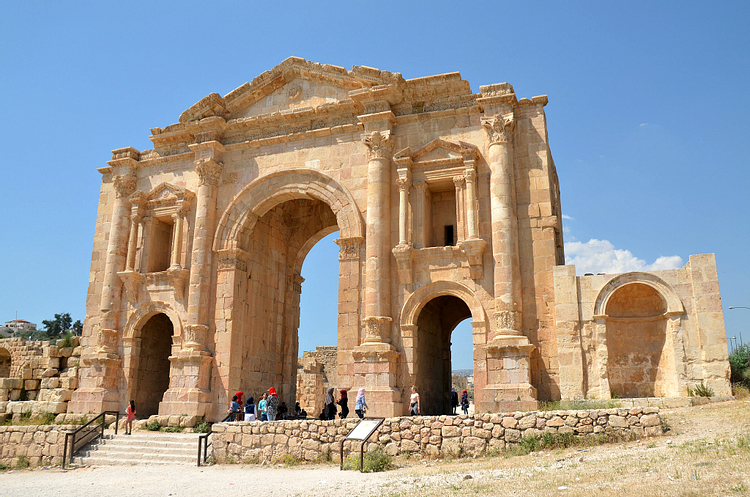 Arch of Hadrian, Jerash Carole Raddato (CC BY-SA) ](https://www.worldhistory.org/image/9352/arch-of-hadrian-jerash/ "Arch of Hadrian, Jerash")In 63 BCE, as a result of [Pompey](https://www.worldhistory.org/pompey/)'s Settlement in the East, Jerash (to the Romans: Gerasa) became part of the Decapolis, a group of ten semi-autonomous cities located in the Roman province of [Syria](https://www.worldhistory.org/syria/), which lasted from 63 BCE to 106 CE. Each of these cities retained a measurable degree of freedom but relied on [Rome](https://www.worldhistory.org/Rome/) for its defense and some matters were the prerogative of the Roman legate of Syria. The Romans defeated the Parthians in Syria in 38 BCE, and Jerash entered into a period of immense Nabataean influence in the 1st century CE, due to the wealth of Nabataean cities like Petra (in Jordan), Mada'in Saleh (in Saudi [Arabia](https://www.worldhistory.org/Arabia/)), Bosra (in Syria), and Avdat (in Israel). Archaeologists have uncovered Nabataean coins and Nabataean art throughout Jerash, and there are also many inscriptions invoking Nabataean gods in Jerash as well. A [temple](https://www.worldhistory.org/temple/) dedicated to the Nabataean [god](https://www.worldhistory.org/God/) Pakidas is located near the one dedicated to the [Greek](https://www.worldhistory.org/disambiguation/greek/) goddess Artemis. The Roman-Jewish historian [Josephus](https://www.worldhistory.org/Flavius_Josephus/) makes mention of Jerash in the 1st century CE, as a rich city populated by both Syrians and Jews. Moreover, Jerash is recorded in the [New Testament](https://www.worldhistory.org/New_Testament/) of the [Bible](https://www.worldhistory.org/bible/) as "the region of the Gerasenes" ([Mark](https://www.worldhistory.org/disambiguation/Mark/) 5:1; Luke 8:26).
### Roman & Byzantine Golden Age
Jerash's “Golden Age” dates from the reign of the [Roman Emperor](https://www.worldhistory.org/Roman_Emperor/) [Trajan](https://www.worldhistory.org/trajan/) (98-117 CE) who incorporated the city of Jerash into the new Roman province of Arabia in 106 CE. Located in close proximity to the province's capital of Bosra, Jerash profited from its prime location at the axes of several trade routes. Trajan, himself, is partially responsible for Jerash's boom in growth as he ordered the construction of new roads, including the *Via Nova Traijana* (Trajan's New Road), which connected Bosra to the Red Sea gateway city of Ailaon, which is located on the Gulf of 'Aqaba. Most of the structures one sees at Jerash date from the second century CE. The Roman Emperor [Hadrian](https://www.worldhistory.org/hadrian/) (117-138 CE) stayed in Jerash during the winter of 129 CE, and this extended sojourn was celebrated with the construction of a [triumphal arch](https://www.worldhistory.org/Triumphal_Arch/) that is known as "Hadrian's Arch." Jerash's wealth enabled an ambitious program of public works to be undertaken, including the construction of a new Temple of Artemis in the middle of the second century CE. Jerash's population is estimated to have been somewhere between 10,000-25,000 around c. 175 CE.
[ 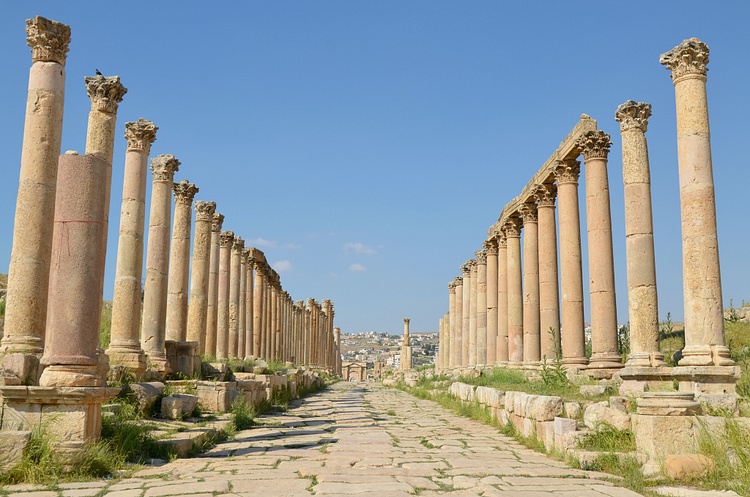 Colonnaded Street, Jerash Carole Raddato (CC BY-SA) ](https://www.worldhistory.org/image/9355/colonnaded-street-jerash/ "Colonnaded Street, Jerash")Although Jerash became a Roman *colonia* - it was called Aurealia Antoniniana - during the reign of Emperor [Marcus Aurelius](https://www.worldhistory.org/Marcus_Aurelius/) Antoninus (r. 121-180 CE), Jerash did not completely escape the travails of the tumultuous 3rd century CE. Pressure from the Persian Sassanians and the Palmyrenes interrupted trade and the flow of commerce between Jerash and the wider Mediterranean Basin. Arab tribes raided the area in and around Jerash too, which hampered economic growth and the construction of new structures. Under the reign of Emperor [Diocletian](https://www.worldhistory.org/Diocletian/) (r. 284-305 CE), Jerash's fortunes were restored and there is evidence of reconstruction work.
Jerash flourished under the rule of the Byzantine Empire as well, but it is unknown when [Christianity](https://www.worldhistory.org/christianity/) arrived in the city. Jerash was the residence of a bishopric - a bishop named Exeresius from Jerash attended the Council of Selucia in 359 CE - and the city contained 15 churches by c. 600 CE. Many of these churches once contained exquisite mosaics that were later damaged by the invading Arab armies as well as earthquakes in the region. The oldest church is Jerash's cathedral, which dates from the late 4th century CE. The latest Christian inscription found at Jerash is dated to c. 611 CE and is located in the Bishop Genesios Church.
[ 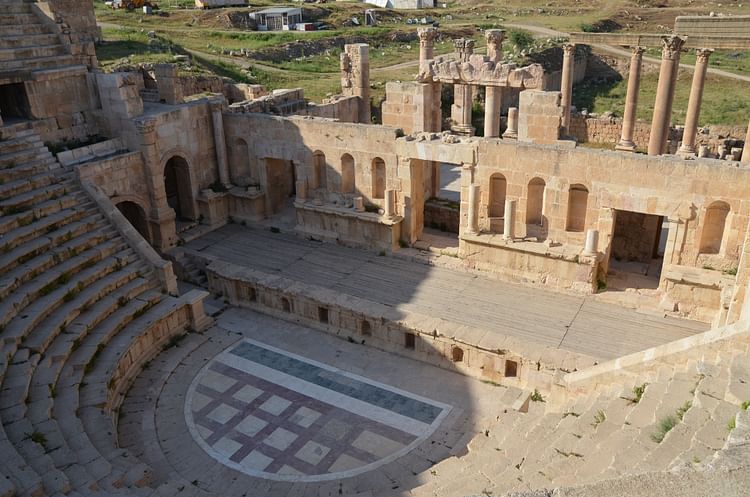 The North Theatre, Jerash Carole Raddato (CC BY-SA) ](https://www.worldhistory.org/image/9353/the-north-theatre-jerash/ "The North Theatre, Jerash")Public monuments continued to be erected while Jerash was under Byzantine rule; most notably, the Baths of Flaccus, which were constructed around c. 454-455 CE and renovated in 584 CE. The city appears to have flourished under the reign of Emperor Justinian (r. 527-565 CE). It is known that Jerash's Hippodrome remained in use, but other monumental structures were increasingly converted for storage purposes or used as stables. Nonetheless, the Byzantines built a special theater and pool around c. 535 CE for the Maiumas water festival. It seems likely that the citizens of Jerash retained a strong taste for pageantry even after their gradual conversion to Christianity: St. Epiphanius of [Salamis](https://www.worldhistory.org/disambiguation/Salamis/) (c. 310-403 CE), provides an account from the late 4th century CE that mentions the citizens of Jerash commemorating [Jesus Christ](https://www.worldhistory.org/Jesus_Christ/)'s miracle at Cana with a special wine festival.
### Later History & [Archaeology](https://www.worldhistory.org/Archaeology/)
The Persian Sassanians captured, plundered, and occupied Jerash between 614-630 CE. Jerash was so weakened by the time the armies of the Arabs arrived in 636 CE that they surrendered immediately. Although Jerash endured under the [Umayyad Caliphate](https://www.worldhistory.org/Umayyad_Dynasty/) (661-750 CE), it was a much smaller and more humble city. Jerash's wealthiest citizens likely moved to Damascus, the seat of the [Umayyad](https://www.worldhistory.org/Umayyad_Dynasty/) government, and the city greatly suffered from their departure. As new trade routes bypassed the region around Jerash altogether, the city entered a period of steep decline. When the [Abbasid Caliphate](https://www.worldhistory.org/Abbasid_Dynasty/) (750-1258 CE) relocated the capital from Damascus to Baghdad in 750 CE, Jerash was dealt yet another blow, being so far removed from the new center of governance and patronage. A series of earthquakes made Jerash uninhabitable over the first couple of centuries of the Early Middle Ages. By the time the medieval chronicler and prelate William of Tyre (c. 1130-1186 CE) visited Jerash, he wrote that the city was long since abandoned and in ruins.
Jerash's archaeological remains, despite the ravages of time, remain very well preserved, and there have been frequent excavations of the city since the 1920s and 1930s CE. Much is still yet to be excavated and unearthed, and Jerash's importance is just beginning to be understood and better appreciated.
#### Editorial Review
This human-authored definition has been reviewed by our editorial team before publication to ensure accuracy, reliability and adherence to academic standards in accordance with our [editorial policy](https://www.worldhistory.org/static/editorial-policy/).
## Bibliography
- [Decapolis -- Livius](http://www.livius.org/articles/place/decapolis/ "Decapolis -- Livius"), accessed 19 Oct 2018.
- [French, Carole. *Jordan.* Bradt Travel Guides, 2012, 131-136.](https://www.worldhistory.org/books/1841623989/)
- [Gerasa (Jerash) -- Livius](http://www.livius.org/articles/place/gerasa-jerash/ "Gerasa (Jerash) -- Livius"), accessed 19 Oct 2018.
- [Gerash -- Kingdom of Jordan](http://www.jerash.gov.jo/ "Gerash -- Kingdom of Jordan"), accessed 19 Oct 2018.
- [Gerash -- Kingdom of Jordan](http://www.jerash.gov.jo/ "Gerash -- Kingdom of Jordan"), accessed 19 Oct 2018.
- [Josephus, Flavius. *The great Roman-Jewish war.* Harper, 1960.](https://www.worldhistory.org/books/B0007DML4I/)
- [Parker, Philip. *The Empire Stops Here.* Pimlico, 2010.](https://www.worldhistory.org/books/1845950038/)
- [Ring, Trudy Noelle Watson, Paul Schellinger (eds.). *Middle East and Africa.* Routledge, 2018, 363-368.](https://www.worldhistory.org/books/B01FKT8ZJ8/)
- [Warren, Glen and Bowersock, Peter Brown, Oleg Grabar. *Late Antiquity.* Belknap Press: An Imprint of Harvard University Press, 1999, 523.](https://www.worldhistory.org/books/0674511735/)
## About the Author
James Blake Wiener has a particular interest in cross-cultural exchange and world history. He is a co-founder of World History Encyclopedia and formerly was its Communications Director.
- [Linkedin Profile](https://www.linkedin.com/in/jameswiener)
## Timeline
- **c. 175 BCE - 164 BCE**: Foundation of [Hellenistic](https://www.worldhistory.org/Hellenic_World/) [Jerash](https://www.worldhistory.org/Jerash/) in [Jordan](https://www.worldhistory.org/Jordan/).
- **129 BCE - 102 BCE**: [Jerash](https://www.worldhistory.org/Jerash/) in [Jordan](https://www.worldhistory.org/Jordan/), is ruled by successive warlord-kings.
- **c. 99 BCE - 63 BCE**: [Jerash](https://www.worldhistory.org/Jerash/) in [Jordan](https://www.worldhistory.org/Jordan/) is ruled by the Hasmonean Kingdom.
- **63 BCE**: [Jerash](https://www.worldhistory.org/Jerash/) in [Jordan](https://www.worldhistory.org/Jordan/) becomes part of the [Roman](https://www.worldhistory.org/disambiguation/Roman/) province of [Syria](https://www.worldhistory.org/syria/).
- **106 CE**: [Jerash](https://www.worldhistory.org/Jerash/) in [Jordan](https://www.worldhistory.org/Jordan/) becomes part of the [Roman](https://www.worldhistory.org/disambiguation/Roman/) province of [Arabia](https://www.worldhistory.org/Arabia/).
- **129 CE - 130 CE**: [Roman emperor](https://www.worldhistory.org/Roman_Emperor/) [Hadrian](https://www.worldhistory.org/hadrian/) visits [Jerash](https://www.worldhistory.org/Jerash/) in [Jordan](https://www.worldhistory.org/Jordan/), a visit commemorated by a [triumphal arch](https://www.worldhistory.org/Triumphal_Arch/).
- **454 CE**: The [Roman Baths](https://www.worldhistory.org/Roman_Baths/) of Flaccus at [Jerash](https://www.worldhistory.org/Jerash/) in [Jordan](https://www.worldhistory.org/Jordan/) are constructed.
- **c. 535 CE**: A new [theatre](https://www.worldhistory.org/disambiguation/theatre/) is built at [Byzantine](https://www.worldhistory.org/disambiguation/Byzantine/) [Jerash](https://www.worldhistory.org/Jerash/) in [Jordan](https://www.worldhistory.org/Jordan/).
- **600 CE**: [Jerash](https://www.worldhistory.org/Jerash/) in [Jordan](https://www.worldhistory.org/Jordan/) has 15 churches.
- **c. 611 CE**: Last Chrisitan inscription at [Jerash](https://www.worldhistory.org/Jerash/), [Jordan](https://www.worldhistory.org/Jordan/).
- **636 CE**: [Jerash](https://www.worldhistory.org/Jerash/) in [Jordan](https://www.worldhistory.org/Jordan/) is conquered by the Arabs.
## External Links
- [Gerasa (Jerash) – following hadrian photography](https://followinghadrianphotography.com/2017/05/09/gerasa/)
- [Yale University Art Gallery: Gerasa Collection](https://www.jstor.org/site/yaleuniversitylibrary/yuag-gerasa-collection/)
## Cite This Work
### APA
Wiener, J. B. (2018, October 18). Jerash. *World History Encyclopedia*.
### Chicago
Wiener, James Blake. "Jerash." *World History Encyclopedia*, October 18, 2018. .
### MLA
Wiener, James Blake. "Jerash." *World History Encyclopedia*, 18 Oct 2018, .
## License & Copyright
Submitted by [James Blake Wiener](https://www.worldhistory.org/user/jbw288/ "User Page: James Blake Wiener"), published on 18 October 2018. The copyright holder has published this content under the following license: [Creative Commons Attribution-NonCommercial-ShareAlike](https://creativecommons.org/licenses/by-nc-sa/4.0/deed.en). This license lets others remix, tweak, and build upon this content non-commercially, as long as they credit the author and license their new creations under the identical terms. When republishing on the web a hyperlink back to the original content source URL must be included. Please note that content linked from this page may have different licensing terms.