---
title: Isthmia
author: Jenni Irving
source: https://www.worldhistory.org/Isthmia/
format: machine-readable-alternate
license: Creative Commons Attribution-NonCommercial-ShareAlike (https://creativecommons.org/licenses/by-nc-sa/4.0/)
updated: 1970-01-01
---
# Isthmia
_Authored by [Jenni Irving](https://www.worldhistory.org/user/jenni.irving/)_
Isthmia is a genitive noun with the meaning 'of the Isthmus.' It generally refers to the site that held the famous Isthmian Games near [Corinth](https://www.worldhistory.org/corinth/) on the Isthmus. A natural assembly place for many Greeks and travellers. Isthmia in Antiquity was one of [Greece](https://www.worldhistory.org/greece/)'s large Panhellenic sanctuaries and played host to the Isthmian Games (founded in 584 BCE) and hence held a special importance throughout the [Greek](https://www.worldhistory.org/disambiguation/greek/) and [Roman](https://www.worldhistory.org/disambiguation/Roman/) periods, with its athletic and religious festivals coming second in significance only to [Olympia](https://www.worldhistory.org/Olympia/).
The site is often associated with the events and matters of Corinth due to its close proximity and because it was administered by the [city-state](https://www.worldhistory.org/Polis/) of Corinth and was a natural place for the sanctuary considering its place near the Isthmus and the many travellers that passed through on land and at ports. For instance, the Macedonians brought an army through the Isthmus in 225/4 BCE to face another Achaian force trying to take Corinth. Due to its location, armies would frequently march through it with often disastrous consequences to the site and its [temple](https://www.worldhistory.org/temple/).
Even after the Isthmia had been abandoned between the late 7th century and 11th century CE, the Isthmus continued to be an important medieval and early modern strategic location. The sanctuary was primarily dedicated to the worship of Poseidon with a large Doric temple to Poseidon being built around 700 BCE which was later replaced around 465 BCE with a newer larger temple complex. The temple of Poseidon was re-discovered in 1952 CE by Oscar Broneer.
Unfortunately, by the year 400 CE with the force of [Christianity](https://www.worldhistory.org/christianity/), the sanctuary and the games at Isthmia had been abandoned. In its current state, the site of Isthmia includes The Sanctuary of Poseidon, an Upper sanctuary, [Roman Bath](https://www.worldhistory.org/Roman_Baths/) (Including a beautiful [mosaic](https://www.worldhistory.org/Mosaic/) floor), Greek Pool and fortress and Hexamilion (A [wall](https://www.worldhistory.org/wall/) constructed in the reign of Theodosiius II across the Isthmus), as well as an eastern field which still warrants investigation. Excavations have been carried out by The Ohio State University and the University of Chicago. The Roman Bath at Isthmia was constructed around the mid-second century CE and it most often the focus of Isthmia in the current day.
[ 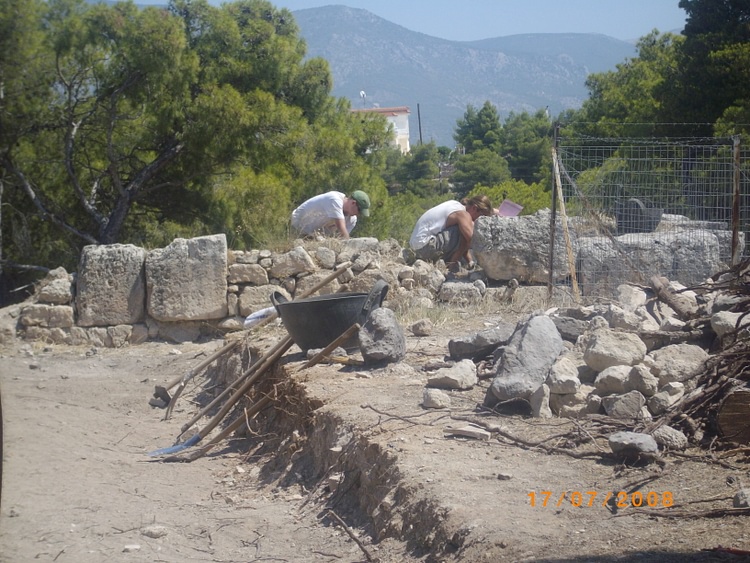 Excavations at side of Roman bath J.Irving 2008 (Copyright) ](https://www.worldhistory.org/image/244/excavations-at-side-of-roman-bath/ "Excavations at side of Roman bath")Artefacts in the form of [pottery](https://www.worldhistory.org/pottery/), walls and cement floors indicate that the area was used at least as late as the [Byzantine](https://www.worldhistory.org/disambiguation/Byzantine/) era despite being abandoned as a bath in the late fourth century CE. An extremely elaborate structure, the Bath contained vaulted ceiling, sculptures, marble walls, and most obviously a huge Italian style monochrome mosaic accompanied by colossal statue bases and evidence of [sculpture](https://www.worldhistory.org/disambiguation/Sculpture/) in what would most likely have been the [great hall](https://www.worldhistory.org/Great_Hall/) of the complex. Among an array of rooms, pools and furnaces is also highly sophisticated drainage systems and heating systems, with the drainage systems still in sufficient working order in the present day. The Roman Bath was built over a Greek structure; with the mosaic covering what was before hand a Greek pool.
#### Editorial Review
This human-authored definition has been reviewed by our editorial team before publication to ensure accuracy, reliability and adherence to academic standards in accordance with our [editorial policy](https://www.worldhistory.org/static/editorial-policy/).
## Timeline
- **c. 700 BCE**: Sanctuary of [Poseidon](https://www.worldhistory.org/poseidon/) built at [Isthmia](https://www.worldhistory.org/Isthmia/).
- **c. 584 BCE**: Isthmian Games founded as a Panhellenic games and festival.
- **465 BCE**: New [Temple](https://www.worldhistory.org/temple/) to [Poseidon](https://www.worldhistory.org/poseidon/) built at [Isthmia](https://www.worldhistory.org/Isthmia/).
- **225 BCE**: Macedonians bring an army across the Isthmus to face another Achaian force trying to take [Corinth](https://www.worldhistory.org/corinth/).
- **c. 150 CE**: [Roman Bath](https://www.worldhistory.org/Roman_Baths/) built at [Isthmia](https://www.worldhistory.org/Isthmia/).
- **c. 600 CE - c. 1000 CE**: [Isthmia](https://www.worldhistory.org/Isthmia/) abandoned.
## External Links
- [OSU Excavations at Isthmia](https://isthmia.osu.edu/)
## Cite This Work
### APA
Irving, J. (2011, April 28). Isthmia. *World History Encyclopedia*.
### Chicago
Irving, Jenni. "Isthmia." *World History Encyclopedia*, April 28, 2011. .
### MLA
Irving, Jenni. "Isthmia." *World History Encyclopedia*, 28 Apr 2011, .
## License & Copyright
Submitted by [Jenni Irving](https://www.worldhistory.org/user/jenni.irving/ "User Page: Jenni Irving"), published on 28 April 2011. The copyright holder has published this content under the following license: [Creative Commons Attribution-NonCommercial-ShareAlike](https://creativecommons.org/licenses/by-nc-sa/4.0/deed.en). This license lets others remix, tweak, and build upon this content non-commercially, as long as they credit the author and license their new creations under the identical terms. When republishing on the web a hyperlink back to the original content source URL must be included. Please note that content linked from this page may have different licensing terms.