---
title: Isocrates
author: Athanasios Fountoukis
source: https://www.worldhistory.org/Isocrates/
format: machine-readable-alternate
license: Creative Commons Attribution-NonCommercial-ShareAlike (https://creativecommons.org/licenses/by-nc-sa/4.0/)
updated: 2022-10-17
---
# Isocrates
_Authored by [Athanasios Fountoukis](https://www.worldhistory.org/user/foufoufou/)_
Isocrates (436-338 BCE) was an ancient Athenian rhetorician, characterized as one of the most prominent orators of his time, even though it appears that he restricted himself to [writing](https://www.worldhistory.org/writing/) speeches and not orating them himself. His most notable works such as *Against the Sophists*, *Antidosis*, *Panegyricus*, *To Philip*, and *Panathenaicus* ensured his recognition in both ancient and contemporary audiences.
### Early Life & Influences
Isocrates was born in [Athens](https://www.worldhistory.org/Athens/) five years before the start of the [Peloponnesian War](https://www.worldhistory.org/Peloponnesian_War/) (431-404 BCE). His early life was certainly affected by the armed conflict, although his family's wealth could have provided a cushion to cope with the difficulties that an Athenian citizen could have faced. Indeed, if one can trust the tradition, his father, Theodorus was an [aulos](https://www.worldhistory.org/Aulos/) or flute manufacturer and was the proud owner of an apparently successful workshop.
The first engagement of Isocrates with rhetoric must have emerged from his interactions with a handful of renowned teachers such as Tisias (c. 5th century BCE), who was considered one of the founders of the vocal art of rhetoric. In addition, his probable association with sophists such as Prodicus of Ceos (c. 465-395 BCE) and [Gorgias](https://www.worldhistory.org/Gorgias/) (483-375 BCE) as well as the oligarch Theramenes (d. c. 404 BCE) must have compiled his prospective civic beliefs. Isocrates eventually married Plathane, the offspring of another sophist, Hippias (late 5th century BCE). Finally, as the ancient testimonies reveal, his family's legacy continued with the adoption of Aphareus (4th century BCE), his wife's son by her former marriage.
### Career
The Peloponnesian [War](https://www.worldhistory.org/disambiguation/War/) revealed to Isocrates a temporary line of work in speechwriting as a *logographos*. He provided speeches to other citizens, as it was customary in classical Athens that the Athenian law court's (*dikasteria*) speeches would be written by specialists. *Trapeziticus*, *Special Plea against Callimachus*, and *Aegineticus,* among others, are considered to represent such prestigious but undoubtedly manipulative speeches. This practice revealed also the privileges that a wealthy citizen had at the expense of poorer Athenians. Hiring the best and justifiably the most overpriced logographer would certainly have given a more compelling argument in court.
Nevertheless, Isocrates' fame did not emerge from this line of work, he preferred to offer his *logoi* (speeches, discourses) to people as a teacher of rhetoric, even though he would rather refer to it as [philosophy](https://www.worldhistory.org/philosophy/). That is why, in 390 BCE, he pioneered a school, in which his aristocratic political beliefs induced a clash of interests with another demagogue, the famous anti-Macedonian [Demosthenes](https://www.worldhistory.org/Demosthenes/) (c. 384-322 BCE). Furthermore, Isocrates' beliefs imparted through his school also created quarrels with other prominent figures of [Greek philosophy](https://www.worldhistory.org/Greek_Philosophy/) such as [Plato](https://www.worldhistory.org/plato/) (428/427-348/347 BCE) and later [Aristotle](https://www.worldhistory.org/aristotle/) (384-322 BCE).
[ 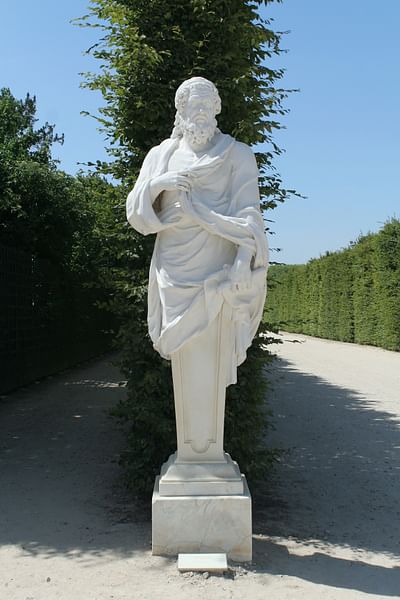 Statue of Isocrates Coyau (CC BY-SA) ](https://www.worldhistory.org/image/16398/statue-of-isocrates/ "Statue of Isocrates")Isocrates justified the change of his profession towards education, as a way to make up for his financial losses after the war. It seems that he delved greatly into Athenian civic matters, as he managed to collect a substantial fortune that placed him among the 1200 richest Athenians. With the accumulated wealth, he invested in the Athenian navy, which earned him the title of *trierarch*. Besides presenting himself as the benefactor of Athens, Isocrates aspired to be a moral educator and differentiated himself from others who exploited public speaking to enrich themselves. Apparently, it was nobler for him to raise a fortune through education. Furthermore, he received heavy criticism when he described "the common perception of discourse as predominantly oral" by renouncing "the spoken word as a political medium" (Mirhady and Too, 6). Isocrates justified this notion as he admitted that his absence of courage was held responsible for his incapability to speak publicly. However, the promotion of his self-interest can perhaps be excused by the excess of his honesty.
Based on the traditional narratives, he was the mentor of several respected historical figures such as Nicocles, the king of [Salamis](https://www.worldhistory.org/disambiguation/Salamis/) (374/3-361 BCE); he developed a friendship with Nicocles' father Evagoras (411-374 BCE), the former king of the Cypriot [city](https://www.worldhistory.org/city/). The Athenian general Timotheus (d. 354 BCE) and the orators Hyperides (c. 390-322 BCE), Andortion (b. between 415 and 405, d. after 346 BCE), and Isaeus (4th century BCE) were also among his students. Additionally, he inspired and tutored prominent historians such as Theopompus (c. 380-315 BCE) and Ephorus of Cyme (c. 400-330 BCE). The decline of Timotheus' political prestige in the 350s BCE coincided with Isocrates' withdrawal from pedagogy at the age of 85. According to ancient reports, when he learned about [Philip II of Macedon](https://www.worldhistory.org/Philip_II_of_Macedon/)'s victory at the [Battle of Chaeronea](https://www.worldhistory.org/Battle_of_Chaeronea/) in 338 BCE, the Athenian rhetorician died after intentionally starving himself. This testimony is contradicted by his last letter *To Philip*, in which he asked the Macedonian king to lead the [Greek](https://www.worldhistory.org/disambiguation/greek/) forces against the mighty [Persian Empire](https://www.worldhistory.org/disambiguation/Persian_Empire/).
[  The Tomb of Isocrates Daderot (Public Domain) ](https://www.worldhistory.org/image/16396/the-tomb-of-isocrates/ "The Tomb of Isocrates")Isocrates interacted with the greater [Hellenic](https://www.worldhistory.org/greece/) community mostly via writing. By maintaining his distance from the period's oratory, he was able to examine more significant political matters, particularly those pertaining to Athens' dominance over the Greek city-states. Furthermore, his works reflected his hope for the unity of the Greek [city-state](https://www.worldhistory.org/Polis/) in the face of the imminent danger posed by the [Achaemenid Empire](https://www.worldhistory.org/Achaemenid_Empire/) as well as the urgency of strong and able leadership.
Although Isocrates has received little attention in the modern study of philosophy, some contemporary academics claim that the Athenian intellectual influenced [Cicero](https://www.worldhistory.org/Cicero/) (106-43 BCE), whose writings on rhetoric have been the subject of the most attention and research up to the present day. Perhaps for this reason, he was well-known as a political writer in antiquity and the Renaissance, and according to Cicero, he was the greatest rhetorician tutor of his day.
### Works
In total, 60 works have been associated with Isocrates, but in the modern day, only 30 are credited to him. The dates given for his works are approximate.
1. *To Demonicus* (c. 374-370 BCE)
2. *To Nicocles* (c. 374 BCE)
3. *Nicocles* (c. 372-365 BCE)
4. *Panegyricus* (c. 380 BCE)
5. *To Philip* (c. 346 BCE)
6. *Archidamus* (c. 366 BCE)
7. *Areopagiticus* (c. 357 BCE)
8. *On the Peace* (c. 355 BCE)
9. *Evagoras* (c. 370-365 BCE)
10. *Encomium of [Helen](https://www.worldhistory.org/disambiguation/Helen/)* (c. 370 BCE)
11. *Busiris* (c. 391-385 BCE)
12. *Panathenaicus* (c. 342-339 BCE)
13. *Against the Sophists* (c. 390 BCE)
14. *Plataicus* (c. 373-371 BCE)
15. *Antidosis* (c. 354-353 BCE)
16. *On the Team of Horses* (c. 397-396 BCE)
17. *Trapeziticus* (c. 393 BCE)
18. *Special Plea against Callimachus* (c. 402 BCE)
19. *Aegineticus* (c. 391-390 BCE)
20. *Against Lochites* (c. 394 BCE)
21. *Against Euthynus, without Witnesses* (c. 403 BCE)
22. *To Dionysius* (c. 368 BCE)
23. *To Philip I* (c. 342 BCE)
24. *To [Philip II](https://www.worldhistory.org/disambiguation/Philip_II/)* (c. 338 BCE)
25. *To [Antipater](https://www.worldhistory.org/disambiguation/Antipater/)* (c. 340 BCE)
26. *To [Alexander](https://www.worldhistory.org/disambiguation/Alexander/)* (c. 342 BCE)
27. *To the Children of Jason* (c. 359 BCE)
28. *To Timotheus* (c. 345 BCE)
29. *To the Rulers of the Mytileneans* (c. 350 BCE)
30. *To Archidamus* (c. 356 BCE)
### Style
The works of Isocrates remain distinctive due to his different literary styles. While his prose could reveal an elegant and attractive tone, one can notice the influence of Gorgias' style. In one of his works *Against the Sophists,* he emphasises the importance of a "superior natural ability," and while he describes the literary devices one should follow for a successful speech, his characteristic long “periodic sentences” are enhanced with a clear sense of structure and rationale due to the use of well-balanced clauses:
> the necessary forms for each subject, to mix them with each other and arrange them suitably, and then, not to mistake the circumstances but embellish the entire speech properly with considerations and to speak the words rhythmically and musically.
> *Against the Sophists (13.16 –17)*
Isocrates' writing style is defined by the lack of hiatus, the repetition of vowels in two words that follow each other. These characteristics among other factors create additional difficulties for modern translations. Additionally, these peculiarities can alienate the interest of the modern audience as his prose tends to be seen as more foreign and less direct. Readers may at times witness a certain arrogance in his texts, nevertheless, we must always consider how common this tendency was in antiquity.
[ 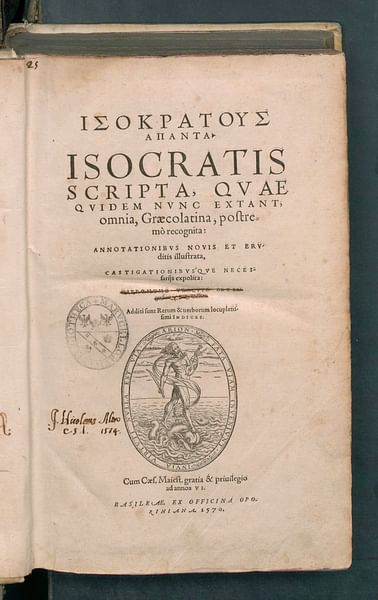 The Works of Isocrates Hieronymus Wolf (Public Domain) ](https://www.worldhistory.org/image/16399/the-works-of-isocrates/ "The Works of Isocrates")Isocrates preferred to name his practice philosophy and expressions of *logos* instead of rhetoric. Modern scholars think that this evasion could have been intentional aiming to separate his ideas from that of Plato, who used *rhetorike* to criticize the tutoring of public speaking. Thus, Isocrates attempted to use the term *philosophia* to designate his teachings to indirectly oppose Plato.
#### Editorial Review
This human-authored definition has been reviewed by our editorial team before publication to ensure accuracy, reliability and adherence to academic standards in accordance with our [editorial policy](https://www.worldhistory.org/static/editorial-policy/).
## Bibliography
- [Mirhady, David C. & Too, Yun Lee. *Isocrates I (The Oratory of Classical Greece, vol. 4; Michael.* University of Texas Press, 2000.](https://www.worldhistory.org/books/0292752385/)
- [Papillon, Terry L. *Isocrates II .* University of Texas Press, 2004.](https://www.worldhistory.org/books/0292702469/)
- [Too, Yun Lee. *The Rhetoric of Identity in Isocrates.* Cambridge University Press, 2009.](https://www.worldhistory.org/books/0521124522/)
## About the Author
A historian, who acquired a BA degree in History and Ethnology in Greece, and an MA degree in Ancient History in the Netherlands. He is fascinated by the ancient history of maritime and nomadic cultures.
## Timeline
- **c. 465 BCE - 395 BCE**: Life of Prodicus of Ceos.
- **436 BCE - 388 BCE**: Life of [Isocrates](https://www.worldhistory.org/Isocrates/).
- **411 BCE - 374 BCE**: Reign of Evagoras, king of [Salamis](https://www.worldhistory.org/disambiguation/Salamis/).
- **c. 404 BCE**: [Death](https://www.worldhistory.org/disambiguation/Death/) of the oligarch Theramenes.
- **c. 400 BCE - 330 BCE**: Life of the historian Ephorus of Cyme.
- **390 BCE**: Foundation of the school of [Isocrates](https://www.worldhistory.org/Isocrates/).
- **c. 390 BCE - 322 BCE**: Life of the orator Hyperides.
- **c. 384 BCE - 322 CE**: Life of Athenian statesman [Demosthenes](https://www.worldhistory.org/Demosthenes/).
- **c. 380 BCE - 315 BCE**: Life of the historian Theopompus.
- **c. 374 BCE - 361 BCE**: Reign of Nicocles, king of [Salamis](https://www.worldhistory.org/disambiguation/Salamis/).
- **354 BCE**: [Death](https://www.worldhistory.org/disambiguation/Death/) of the Athenian general Timotheus.
## Questions & Answers
### What was Isocrates known for?
Isocrates was known for being an ancient Athenian rhetorician, characterized as one of the most prominent orators of his time.
### What did Isocrates teach?
Isocrates taught rhetoric by offering his logoi (speeches, discourses) to people.
### How did Isocrates define rhetoric?
Isocrates preferred to call what we now consider rhetoric philosophy.
### Is Isocrates a sophist?
Isocrates did not classify himself as a sophist, in particular, he addressed his thoughts to them in one of his speeches, Against the Sophists.
## Cite This Work
### APA
Fountoukis, A. (2022, October 17). Isocrates. *World History Encyclopedia*.
### Chicago
Fountoukis, Athanasios. "Isocrates." *World History Encyclopedia*, October 17, 2022. .
### MLA
Fountoukis, Athanasios. "Isocrates." *World History Encyclopedia*, 17 Oct 2022, .
## License & Copyright
Submitted by [Athanasios Fountoukis](https://www.worldhistory.org/user/foufoufou/ "User Page: Athanasios Fountoukis"), published on 17 October 2022. The copyright holder has published this content under the following license: [Creative Commons Attribution-NonCommercial-ShareAlike](https://creativecommons.org/licenses/by-nc-sa/4.0/deed.en). This license lets others remix, tweak, and build upon this content non-commercially, as long as they credit the author and license their new creations under the identical terms. When republishing on the web a hyperlink back to the original content source URL must be included. Please note that content linked from this page may have different licensing terms.