---
title: Aytap
author: Joshua J. Mark
source: https://www.worldhistory.org/Iotape/
format: machine-readable-alternate
license: Creative Commons Attribution-NonCommercial-ShareAlike (https://creativecommons.org/licenses/by-nc-sa/4.0/)
updated: 1970-01-01
---
# Aytap
_Authored by [Joshua J. Mark](https://www.worldhistory.org/user/JPryst/)_
Aytap is the modern name for the ancient [city](https://www.worldhistory.org/city/) of Iotapa (sometimes given as Iotape and Iotape Philadelphos) in [Cilicia](https://www.worldhistory.org/Cilicia/). The city's ruins are located in southern [Turkey](https://www.worldhistory.org/Asia_Minor/) near modern day Alanya (ancient Coracesium). The city was founded in 52 CE by Antiochus IV of [Commagene](https://www.worldhistory.org/Commagene/) (l. c. 17 - c. 72 CE, r. 38-72 CE). He established and named the city for his sister-wife and queen Julia Iotapa (r. 38-52 CE). The region of Rough Cilicia (known by the Romans as Cilicia Aspera) was formerly part of the kingdom of [Archelaus](https://www.worldhistory.org/disambiguation/Archelaus/) of Cilicia (l. c. 8-38 CE), a distant relative of Antiochus IV. After Archelaus' [death](https://www.worldhistory.org/disambiguation/Death/), the [Roman emperor](https://www.worldhistory.org/Roman_Emperor/) [Caligula](https://www.worldhistory.org/Caligula/) (r. 37-41 CE), who was on good terms with Antiochus IV, gave him Cilicia Aspera as a gift.
Antiochus IV built the mountain city of Antiochus ad Cragum, starting c. 42 CE, and founded two others, Germanicopolis (modern-day Ermenek) – in honor of his benefactor Caligula whose regnal name was Gaius [Julius Caesar](https://www.worldhistory.org/Julius_Caesar/) [Augustus](https://www.worldhistory.org/augustus/) [Germanicus](https://www.worldhistory.org/Germanicus/) – and Neronias (Irenopolis), which was favored by the emperor [Nero](https://www.worldhistory.org/Nero/) (r. 54-68 CE). The dates for the founding of these [cities](https://www.worldhistory.org/city/) are unknown, but construction most likely took place around the same time or shortly after the work at Iotapa. Iotapa would later be a famous mint during the [Roman Empire](https://www.worldhistory.org/Roman_Empire/) up through the [Crisis of the Third Century](https://www.worldhistory.org/Crisis_of_the_Third_Century/) (235-284 CE) after which it vanishes from the historical record.
### Early History of Cilicia
Human habitation in Cilicia dates back to the [Neolithic Period](https://www.worldhistory.org/Neolithic/) when nomadic tribes roamed the region. By c. 2500 BCE, the area was inhabited by the Luwians and [Hatti](https://www.worldhistory.org/hatti/) who may have been indigenous. The region was taken by the [Akkadian Empire](https://www.worldhistory.org/akkad/) who controlled it between c. 2334-2083 BCE and then was conquered by the [Hittites](https://www.worldhistory.org/hittite/) who held it c. 1700-1200 BCE.
[  The Regions of Ancient Anatolia Emok (CC BY-SA) ](https://www.worldhistory.org/image/253/the-regions-of-ancient-anatolia/ "The Regions of Ancient Anatolia")From the region's earliest recorded mention, Cilicia is referenced as comprising two distinct regions: “Smooth Cilicia” of the fertile lowlands and “Rough Cilicia” of the mountains and rocky coast. The future city of Iotapa would be built in Rough Cilicia by the sea, an area which seems to have remained sparsely inhabited, if at all, during most of the region's early history.
The [Hittite](https://www.worldhistory.org/hittite/) [Empire](https://www.worldhistory.org/empire/) fell, in part, due to incursion by a coalition of various nationalities known as the [Sea Peoples](https://www.worldhistory.org/Sea_Peoples/) who were active in the [Mediterranean](https://www.worldhistory.org/disambiguation/mediterranean/) c. 1276-1178 BCE. Nothing is known of the Sea Peoples' origin (even their name is a 19th-century CE construct) except that they came from the sea and caused significant destruction and chaos throughout the Mediterranean region. They are credited with sacking Cilician cities such as [Tarsus](https://www.worldhistory.org/Tarsus/) and [Troy](https://www.worldhistory.org/troy/) and caused Ancient [Egypt](https://www.worldhistory.org/egypt/) considerable trouble from the reign of Rameses II (r. 1279-1213 BCE) to Rameses III (r. 1186-1155 BCE).
After the fall of the Hittite Empire, Cilicia briefly returned to the Hatti until the Assyrian Empire took it c. 700-612 BCE and then the Persians between 547-333 BCE. [Alexander the Great](https://www.worldhistory.org/Alexander_the_Great/) conquered Cilicia in 333 BCE, and it was part of his empire until his death in 323 BCE when it was divided between two of his generals who established the [Seleucid](https://www.worldhistory.org/Seleucid_Empire/) and Ptolemaic empires.
The [Seleucid Empire](https://www.worldhistory.org/Seleucid_Empire/), which held Rough Cilicia, first began to falter under Antiochus III (r. 222-187 BCE) who was defeated by [Rome](https://www.worldhistory.org/Rome/) in 190 BCE. Rome now had rights in the region but seems to have largely ignored it to pursue other interests. The weakening government, whose power vacuum Rome failed to fill, encouraged the development of [piracy](https://www.worldhistory.org/Piracy/) in Cilicia, giving birth to the famous Cilician pirates. These pirates found the natural harbors of Rough Cilicia perfect hiding places, and the bays of the future site of Iotapa would have been ideal harbors for them. There is evidence they were acquainted with the nearby harbor port of Aunesis at [Hamaxia](https://www.worldhistory.org/Hamaxia/) and so it is reasonable to conclude they would have known this spot as well.
### Cilician Pirates & Rome
Not all the Cilician Pirates were from Cilicia. Crews of brigands from as far away as [Crete](https://www.worldhistory.org/crete/) used the bays, ports, and harbors of Cilicia to hide from authorities and resupply their ships. Some scholars, however, have pointed out that among the various nationalities that made up the Sea Peoples are the tribes of the Danuna (linked to the Cilician city of Adana) and the Tursha who were also of [Asia Minor](https://www.worldhistory.org/Asia_Minor/) so there may have been a significant number of Cilicians who continued the practices of the Sea Peoples down through the centuries.
By 103 BCE, Rome finally took note of Cilicia when the pirates began seriously disrupting [trade](https://www.worldhistory.org/disambiguation/trade/) in the Mediterranean. That year, Rome launched a land campaign and conquered Smooth Cilicia in an effort at combatting piracy. Smooth and Rough Cilicia were at this time known by the Romans as Cilicia Pedias and Cilicia Trachea respectively. Between 78-74 BCE, Rome launched another campaign against Cilicia Trachea and conquered the Isaurians of the mountain regions but neither of these military victories did anything to combat piracy.
[ 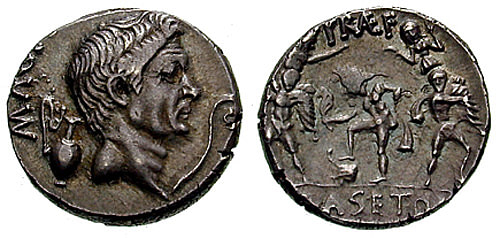 Coin of Pompey the Great Carlomorino (CC BY-SA) ](https://www.worldhistory.org/image/1036/coin-of-pompey-the-great/ "Coin of Pompey the Great")[Pompey the Great](https://www.worldhistory.org/pompey/) (l. c. 108-48 BCE) was in the region leading his armies against [Mithridates VI](https://www.worldhistory.org/Mithridates_VI/) (r. 120-63 BCE) of Pontus and turned his attention to the pirates because Mithridates VI was employing them against Rome. In 67 BCE, at the [Battle](https://www.worldhistory.org/disambiguation/battle/) of Korakesion (also known as Coracesium and so close to the site of Iotapa), [Pompey](https://www.worldhistory.org/pompey/) defeated the pirates, relocated those who surrendered, and then divided Cilicia into six districts with Cilicia Pedias now known as [Cilicia Campestris](https://www.worldhistory.org/Cilicia_Campestris/) and Cilicia Trachea becoming Cilicia Aspera.
### Antiochus IV & Iotapa
After Pompey's involvement in the region, Cilicia became a regular participant in the affairs of Rome. [Mark Antony](https://www.worldhistory.org/Mark_Antony/) (l. 83-30 BCE) and [Cleopatra VII](https://www.worldhistory.org/Cleopatra_VII/) (l. c. 69-30 BCE) began their political and romantic relationship at the city of Tarsus in Cilicia and [Antony](https://www.worldhistory.org/Mark_Antony/) would later give [Cleopatra](https://www.worldhistory.org/disambiguation/cleopatra/) tracts of land in Cilicia Aspera, including the timber-rich city of Hamaxia which would supply the wood for her ships at the [Battle of Actium](https://www.worldhistory.org/Battle_of_Actium/) in 31 BCE.
Antony and Cleopatra were defeated at Actium by [Octavian](https://www.worldhistory.org/augustus/) (the future Augustus [Caesar](https://www.worldhistory.org/disambiguation/caesar/), r. 27 BCE - 14 CE) who joined Cilicia to [Syria](https://www.worldhistory.org/syria/) as the [Roman](https://www.worldhistory.org/disambiguation/Roman/) province of Syria-Cilicia Phoenice in 27 CE. Augustus' successor [Tiberius](https://www.worldhistory.org/Tiberius/) (r. 14-37 CE) also took an interest in the region and especially the Kingdom of Cappadocia north of Cilicia. Cappadocia was a client kingdom ruled by Archelaus of Cappadocia (r. 36 BCE - 17 CE) who was on good terms with Rome but less so with his subjects. Tiberius plotted to kill him, but Archelaus died in his own time, and his kingdom was absorbed as a Roman province. His son Archelaus of Cilicia was given Cilicia Aspera as a concession to the family's loyalty to Rome.
The Armenian royal family of Cappadocia was related to the royal family of the nearby Kingdom of Commagene ruled at that time by Antiochus III Epiphanes (r. 12 BCE - 17 CE), father of Antiochus IV of Commagene. At the same time that Tiberius absorbed Cappadocia, he also annexed Commagene into the Roman province of Syria-Cilicia. Antiochus IV was too young to protest and was sent to Rome along with his sister Iotapa, where they were raised as Romans and granted [Roman citizenship](https://www.worldhistory.org/article/859/roman-citizenship/).
Antiochus IV and Iotapa, as royals, moved in the best circles in Rome and were embraced by the prominent Antonia Minor (l. 31 BCE - 37 CE), daughter of [Mark](https://www.worldhistory.org/disambiguation/Mark/) Antony and [Octavia Minor](https://www.worldhistory.org/Octavia_Minor/) (l. 69 - 11 BCE), the sister of Augustus. Antonia Minor introduced Antiochus and Iotapa to her grandson Caligula, and they became friends. In 38 CE, once Caligula was emperor, he returned Commagene to Antiochus IV along with all the money the region had brought into Rome as a province since 17 CE (a considerable sum) as well as the lands which had formerly belonged to his relative Archelaus of Cilicia. Shortly afterwards, however, Caligula either had a change of heart or the two friends had a falling out because Caligula took back his gift, and Antiochus IV would not get it back until 41 CE under the reign of [Claudius](https://www.worldhistory.org/claudius/) (r. 41-54 CE).
### [Antiochia ad Cragum](https://www.worldhistory.org/Antiochia_ad_Cragum/) & Iotapa Philadelphos
At some point, Antiochus IV and Iotapa were married (although they were full brother and sister) and had three children: Gaius [Julius](https://www.worldhistory.org/disambiguation/Julius/) Archelaus Antiochus Epiphanes (l. 38-92 CE), Callinicus (l. 1st century CE), Julia Iotapa (l. c. 45-96 CE). C. 42 CE, Antiochus IV began construction of [Antiochia](https://www.worldhistory.org/Antiochia/) ad Cragum (in the modern-day district of Gazipasa). No expense appears to have been spared on the construction of Antiochia ad Cragum (“Antioch of the Cliffs”), which had a large [temple](https://www.worldhistory.org/temple/), [agora](https://www.worldhistory.org/agora/) (market), and the greatest and most impressive bath complex in the region. The Great Bath was decorated with the largest [mosaic](https://www.worldhistory.org/Mosaic/) yet discovered in the region and the city, located high on a mountain plateau overlooking the Mediterranean, must have been among the most impressive of its day.
[ 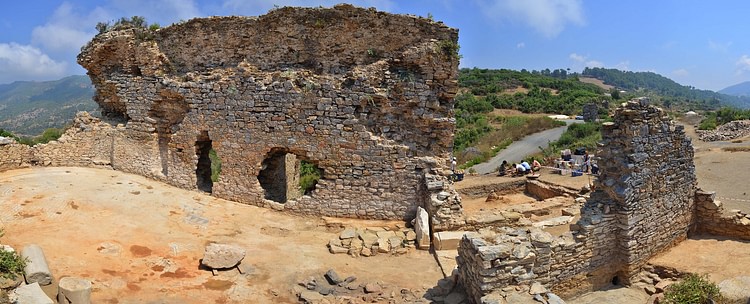 Bath Complex at Antiochia ad Cragum orientalizing (CC BY-NC-ND) ](https://www.worldhistory.org/image/11030/bath-complex-at-antiochia-ad-cragum/ "Bath Complex at Antiochia ad Cragum")Julia Iotapa died in 52 CE, almost certainly while construction on Antiochia ad Cragum was ongoing. Antiochus IV honored his sister-wife's memory with a city dedicated to her name, which would be just as illustrious as his complex in the mountains, 25 miles (41 km) down the coast near the city of Coracesium. Based on the ruins found at the site in the present day, Iotapa lacked nothing by way of luxury or natural beauty.
It was constructed on a peninsula between two symmetrical bays on the Mediterranean with an [acropolis](https://www.worldhistory.org/Acropolis/) and thick walls as defense. The city had baths, a temple, a sewer system, a main street and agora, and frescoes in various areas. There was also a necropolis of ornate tombs and statuary as well as other statues and inscriptions which suggest a city of opulence on par with Antiochia ad Cragum. The city quickly became known for its mint which produced coins dedicated to Antiochus IV, Iotapa, and their two sons as well as the Roman emperors (Nero and then [Vespasian](https://www.worldhistory.org/Vespasian/)) and would continue to mint coins after the reigns of these two.
It is possible that the land the city was built on was originally an island. The historian [Flavius Josephus](https://www.worldhistory.org/Flavius_Josephus/) (l. 37-100 CE), in his *Antiquities of the Jews* (18.5.4), claims that, when Emperor Vespasian (r. 69-79 CE) united Cilicia Campestris with Cilicia Aspera in 74 CE, he left an island to be independently ruled by Julia Iotapa, the daughter of Antiochus IV of Commagene, and her husband Gaius Julius [Alexander](https://www.worldhistory.org/disambiguation/Alexander/) (l. 1st century CE) of the Kingdom of Cetis. This island is often interpreted as Elaioussa Sebaste (also known as Elaiussa Sebaste, Mersin province, modern-day Turkey), but it would make more sense for it to have been Iotapa, which had been built for young Julia Iotapa's mother and had already been in the family.
### Problems with Rome
In 72 CE, shortly after Vespasian became emperor, Antiochus IV was denounced by one Lucius Junius Casennius Paetus, (governor of Syria 70-72 CE) who claimed the king was plotting to overthrow the emperor. Although Antiochus IV had always proved himself a loyal friend to Rome, Vespasian believed Paetus and gave him leave to attack Antiochus IV at Antiochia ad Cragum while, at the same time, deposing Antiochus and dissolving the Kingdom of Commagene.
[ 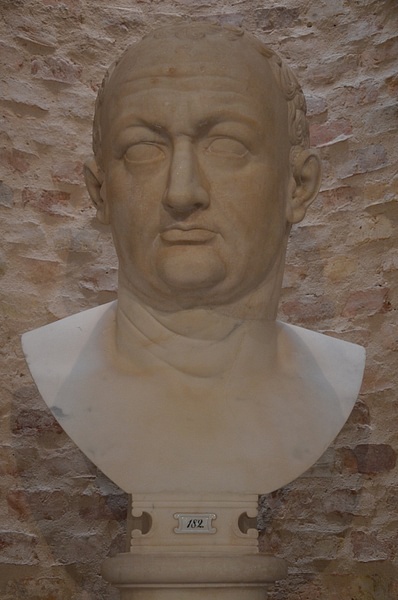 Roman Emperor Vespasian, Neues Museum Carole Raddato (CC BY-SA) ](https://www.worldhistory.org/image/2517/roman-emperor-vespasian-neues-museum/ "Roman Emperor Vespasian, Neues Museum")Paetus marched on Antiochia ad Cragum but what happened next is unknown. Some sources suggest Antiochus sons fought Paetus while others seem to indicate nothing happened and Antiochus IV simply left the field. Whatever went on there remains a mystery, but it is known that sometime later in the same year Antiochus IV and his two sons and daughter were in Rome where they were received with respect and Antiochus IV was given a residence. Nothing is known of the fate of Paetus after his march on the city.
### Conclusion
The region once governed by Antiochus IV was taken as a Roman province and united with the rest of Cilicia by Vespasian in 74 CE. As noted, Iotapa at this time may have remained independent under Julia Iotapa and her husband. It is not mentioned in the historical records until the reign of [Trajan](https://www.worldhistory.org/trajan/) (r. 98-117 CE) when it is again cited as a mint producing a significant number of coins. It would continue in this capacity through the reign of the emperor [Valerian](https://www.worldhistory.org/valerian/) (r. 253-260 CE). The city disappears from any records during the latter part of the Crisis of the Third Century in Rome (also known as the Imperial Crisis) and was abandoned at some point, probably after an [earthquake](https://www.worldhistory.org/disambiguation/earthquake/) had damaged the city beyond repair.
Modern Aytap is 1.5 miles (2.5 km) from Alanya and is a popular tourist attraction. Online sites and brochures regularly praise the bays of Aytap for swimming and the ruins for some holiday exploration and photo ops while giving little space to the history of the location or the people who once lived there. The great walls, the temple, and baths are in ruins now, but once upon a time it was a majestic city built by a king to honor the memory of his departed wife and visitors should approach the site with the respect it deserves.
#### Editorial Review
This human-authored definition has been reviewed by our editorial team before publication to ensure accuracy, reliability and adherence to academic standards in accordance with our [editorial policy](https://www.worldhistory.org/static/editorial-policy/).
## Bibliography
- [Bryce, T. *The Kingdom of the Hittites.* Oxford University Press, 2006.](https://www.worldhistory.org/books/0199281327/)
- [Flavius Josephus. *The Works of Flavius Josephus.* David McKay Co, 2019.](https://www.worldhistory.org/books/B00CPSAPIC/)
- [Grant, M. *Readings in the Classical Historians.* Scribner, 1993.](https://www.worldhistory.org/books/0684192454/)
- [Grant, M. *The Climax of Rome.* Weidenfeld, 1993.](https://www.worldhistory.org/books/0297813919/)
- [Hoff, M. C. & Townsend, R. F. *Rough Cilicia: New Historical and Archaeological Approaches.* Oxbow Books, 2013.](https://www.worldhistory.org/books/1842175181/)
- [Mellor, R. *The Historians of Ancient Rome.* Routledge, 2012.](https://www.worldhistory.org/books/0415527163/)
- [Peters, F. E. *The Harvest of Hellenism.* Barnes & Noble Books, 1996.](https://www.worldhistory.org/books/0760701296/)
- [Steadman, S. R. & McMahon G. *The Archaeology of Anatolia: Recent Discoveries 2011-2014.* Cambridge Scholars Publishing, 2015.](https://www.worldhistory.org/books/1443878154/)
- [Stiebing Jr, W. H. *Ancient Near Eastern History and Culture.* Pearson Higher Education, 2008.](https://www.worldhistory.org/books/032142297X/)
- [Strabo. *Strabo's Geography.* Harvard University Press, 1930.](https://www.worldhistory.org/books/0674992660/)
## About the Author
Joshua J. Mark is World History Encyclopedia's co-founder and Content Director. He was previously a professor at Marist College (NY) where he taught history, philosophy, literature, and writing. He has traveled extensively and lived in Greece and Germany.
- [Linkedin Profile](https://www.linkedin.com/pub/joshua-j-mark/38/614/339)
## Timeline
- **52 CE**: Iotapa ([Aytap](https://www.worldhistory.org/Iotape/)) founded by Antiochus IV of [Commagene](https://www.worldhistory.org/Commagene/) in honor of his late wife Julia Iotapa.
- **c. 52 CE - c. 72 CE**: Iotapa ([Aytap](https://www.worldhistory.org/Iotape/)) mints coins dedicated to Antiochus IV of [Commagene](https://www.worldhistory.org/Commagene/) and his family.
- **98 CE - 260 CE**: Iotapa ([Aytap](https://www.worldhistory.org/Iotape/)) mints coins from the reign of [Trajan](https://www.worldhistory.org/trajan/) through the reign of [Valerian](https://www.worldhistory.org/valerian/).
- **235 CE - 284 CE**: Iotapa ([Aytap](https://www.worldhistory.org/Iotape/)) disappears from historical record during the [Roman](https://www.worldhistory.org/disambiguation/Roman/) [Crisis of the Third Century](https://www.worldhistory.org/Crisis_of_the_Third_Century/).
## Cite This Work
### APA
Mark, J. J. (2019, August 13). Aytap. *World History Encyclopedia*.
### Chicago
Mark, Joshua J.. "Aytap." *World History Encyclopedia*, August 13, 2019. .
### MLA
Mark, Joshua J.. "Aytap." *World History Encyclopedia*, 13 Aug 2019, .
## License & Copyright
Submitted by [Joshua J. Mark](https://www.worldhistory.org/user/JPryst/ "User Page: Joshua J. Mark"), published on 13 August 2019. The copyright holder has published this content under the following license: [Creative Commons Attribution-NonCommercial-ShareAlike](https://creativecommons.org/licenses/by-nc-sa/4.0/deed.en). This license lets others remix, tweak, and build upon this content non-commercially, as long as they credit the author and license their new creations under the identical terms. When republishing on the web a hyperlink back to the original content source URL must be included. Please note that content linked from this page may have different licensing terms.