---
title: Ino
author: Liana Miate
source: https://www.worldhistory.org/Ino/
format: machine-readable-alternate
license: Creative Commons Attribution-NonCommercial-ShareAlike (https://creativecommons.org/licenses/by-nc-sa/4.0/)
updated: 2023-07-19
---
# Ino
_Authored by [Liana Miate](https://www.worldhistory.org/user/lianamiate/)_
Ino is a princess of [Thebes](https://www.worldhistory.org/disambiguation/Thebes/) and the wife of King Athamas of Boeotia in [Greek mythology](https://www.worldhistory.org/Greek_Mythology/). She helped to raise [Dionysos](https://www.worldhistory.org/Dionysos/), the [god](https://www.worldhistory.org/God/) of wine, but the most famous myth associated with her is her descent into madness and the tragic fate of her family.
After being driven insane and jumping off a cliff with her son Melicertes, Ino and her son were rescued by her grandmother [Aphrodite](https://www.worldhistory.org/Aphrodite/) and the sea god [Poseidon](https://www.worldhistory.org/poseidon/), who transformed them both into the sea goddess Leucothea and the sea god Palaemon. In [Homer](https://www.worldhistory.org/homer/)'s (c. 750 BCE) *[Odyssey](https://www.worldhistory.org/Odyssey/)*, Leucothea famously rescued the [Greek](https://www.worldhistory.org/disambiguation/greek/) hero [Odysseus](https://www.worldhistory.org/odysseus/) after Poseidon sent down a mighty storm.
### Family
Ino is the daughter of King [Cadmus](https://www.worldhistory.org/Cadmus/) of Thebes and Harmonia, the goddess of harmony. Her siblings include Autonoë, Agave, Polydorus, and Semele, the mother of Dionysos. Ino had two sons with King Athamas, Learchus and Melicertes. Although King Cadmus and Harmonia were loved by the gods, their descendants were doomed to live cursed lives.
### Ino & Dionysos
According to Apollodorus (c. 180 BCE), the god Hermes brought a newborn Dionysos to Ino and Athamas so they could take care of him. Hermes persuaded them to raise him as a female. [Hera](https://www.worldhistory.org/Hera/) was angered that Ino was taking care of Dionysos and sent Tisiphone, one of the [Furies](https://www.worldhistory.org/Furies/), to drive Ino and Athamas mad. After Ino and Athamas were driven mad, [Zeus](https://www.worldhistory.org/zeus/) took Dionysos to the Nysian nymphs. Other versions of the myth state that the Nysian nymphs raised Dionysos first and then passed him on to Ino and Athamas.
Another tradition states that Semele and a baby Dionysos were placed into a chest by her father Cadmus and sent out to sea. The chest came ashore at Prasiae (Brasiai), where it was discovered that Semele had died. Ino passed by the chest during her travels, found her nephew alive and well, and took him to care for him, raising him in a nearby cave.
[ ![Dionysos Mosaic [Detail]](https://www.worldhistory.org/img/r/p/750x750/884.jpg?v=1746856867) Dionysos Mosaic \[Detail\] Mark Cartwright (CC BY-NC-SA) ](https://www.worldhistory.org/image/884/dionysos-mosaic-detail/ "Dionysos Mosaic [Detail]")### The [Death](https://www.worldhistory.org/disambiguation/Death/) of Pentheus
Pentheus was Agave's son and the nephew of Ino, who met a horrific end at the hands of his own mother and his aunts Ino and Autonoë, who murdered him in a Dionysiac frenzy after Pentheus failed to worship Dionysos. The story of Pentheus' violent death is found in [Euripides](https://www.worldhistory.org/Euripides/)' (c. 484-407 BCE) [Greek tragedy](https://www.worldhistory.org/Greek_Tragedy/), the *[Bacchae](https://www.worldhistory.org/Bacchae/).*
> "Mother," he said, "I am your child, Pentheus, son of Echion.
> Mother, pity me! Don't kill me Mother.
> I made mistakes, but I am still your child."
> But she was foaming at the mouth, her eyes
> rolled all around; her mind was mindless now.
> Held by the god, she paid the man no heed.
> She grabbed his left arm just below the elbow:
> wedging her foot against the victim's ribs
> she ripped his shoulder off - not by mere force;
> the god made easy everything they touched.
> On his right arm worked Ino, ripping flesh;
> Autonoe and the mob of maenads gripped him,
> screaming as one.
> (Euripides, *Bacchae*, 1119-1131)
### Descent into Madness
The story of how Ino and Athamas are driven to madness differs depending on the author and source. According to [Ovid](https://www.worldhistory.org/ovid/) (43 BCE to 17 CE) in his *Metamorphoses*, on the orders of Hera, Tisiphone, one of the Furies, threw two snakes and a venomous potion at Ino and Athamas, which turned them insane. Ino threw herself off a cliff into the sea with her son Melicertes in her arms, while Athamas hit their other son, Learchus, against a [wall](https://www.worldhistory.org/wall/) until he died. Aphrodite, the grandmother of Ino, asked Poseidon to save her granddaughter and transform Ino and her son into sea creatures.
Apollodorus goes into more background detail in his version of the myth. He writes that before his marriage to Ino, King Athamas had two children with the cloud goddess Nephele. Ino hated her stepchildren and devised a plan to get rid of them. She arranged to have the crops fail, making Athamas consult the Delphic Oracle. Ino intercepted his messenger and bribed him to say that the only way to ensure that the crops would grow once again was to sacrifice Athamas' son Phrixus. Athamas prepared to sacrifice his son, but Nephele swooped down and rescued him and his sister Helle. Apollodorus also writes that after being driven to madness by Hera, Ino threw Melicertes into a boiling cauldron before jumping into the sea with him. Meanwhile, a delusional Athamas hunted down Learchus, believing that he was a deer.
[ 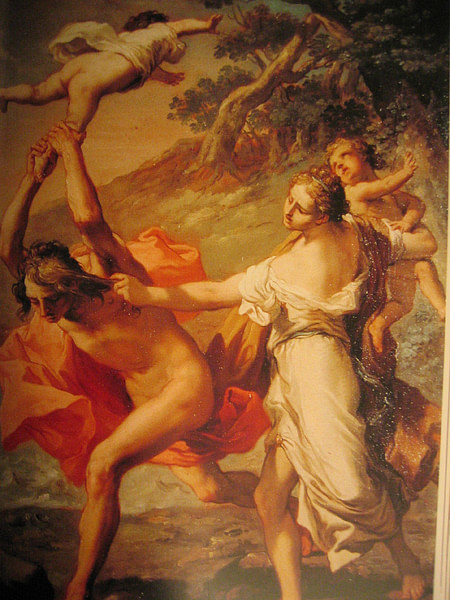 Athamas Kills the Son of Ino by Gaetano Gandolfi Gaetano Gandolfi (Public Domain) ](https://www.worldhistory.org/image/17626/athamas-kills-the-son-of-ino-by-gaetano-gandolfi/ "Athamas Kills the Son of Ino by Gaetano Gandolfi")Another version has King Athamas being exiled from Boeotia and building a community in [Thessaly](https://www.worldhistory.org/disambiguation/Thessaly/). He married the Thessalian princess Themisto, and together they had Erythrius, Leucon, Schoenus, and Ptous. Themisto wanted to get rid of the children of Athamas and Ino but accidentally ended up killing her own children. Athamas went insane and killed his and Ino's son Learchus resulting in Ino throwing herself into the sea.
### Ino's Apotheosis
After Ino became insane and jumped off a cliff with her younger son Melicertes in her arms, Aphrodite took pity on her granddaughter and pleaded with Poseidon to save them. Poseidon transformed Ino into a sea goddess who became known as Leucothea ("the white goddess") and Melicertes into a sea god known as Palaemon.
The followers of Ino had followed her footprints to the edge of the cliff. Knowing that she was most likely dead, they cried out in grief for the doomed House of Cadmus. They also cursed Hera for her cruelty, and several of them threatened to follow Ino into the sea. Hera's response was to transform this group of mourners into seagulls who still fly over the Ionian Sea today.
[  Leucothea by Jean Jules Allasseur Jastrow (Public Domain) ](https://www.worldhistory.org/image/17625/leucothea-by-jean-jules-allasseur/ "Leucothea by Jean Jules Allasseur")### The Rescue of Odysseus
The most famous myth associated with Leucothea is her rescue of the Greek hero Odysseus. A huge storm had been sent by Poseidon and battered Odysseus, who was clinging to the raft he had made. Leucothea emerged from the waves and instructed Odysseus to abandon his raft and swim.
> Ino, a mortal woman once with human voice and called
> Leucothea now she lives in the sea's salt depths,
> esteemed by all the gods as she deserves .
> She pitied Odysseus, tossed, tormented so-
> she broke from the waves like a shearwater on the wing,
> lit on the wreck and asked him kindly, "Ah poor man,
> why is the god of earthquakes so dead set against you?
> Strewing your way with such a crop of troubles!
> But he can't destroy you, not for all his anger.
> Just do as I say. You seem no fool to me.
> Strip off those clothes and leave your craft
> for the winds to hurl, and swim for it now, you must,
> strike out with your arms for landfall there,
> Phaeacian land where destined safety waits."
> (Homer, *Odyssey*, 5.366-380).
Leucothea handed Odysseus her scarf, which she told him was immortal, and warned him to throw it back into the sea once he had reached land. He swam fiercely and eventually reached the land of the Phaeacians with further help from [Athena](https://www.worldhistory.org/athena/).
[  Odysseus Mark Cartwright (CC BY-NC-SA) ](https://www.worldhistory.org/image/1201/odysseus/ "Odysseus")### Worship
Ino and Leucothea were both widely worshipped all over [Greece](https://www.worldhistory.org/greece/). In his *Description of Greece*, [Pausanias](https://www.worldhistory.org/disambiguation/Pausanias/) (c. 115 to c. 180 CE) writes that in Attica, on the road to the Prytaneion (government meeting place), a mound was dedicated to Ino with olive trees growing on it. He states that the people of [Megara](https://www.worldhistory.org/disambiguation/Megara/) were the only people in Greece who believed that Ino washed up on their shores and that they were the first ones to call her Leucothea and offer sacrifices to her. The people of Attica also believed that the Molourian Rock was sacred to both Leucothea and her son Palaemon.
[ 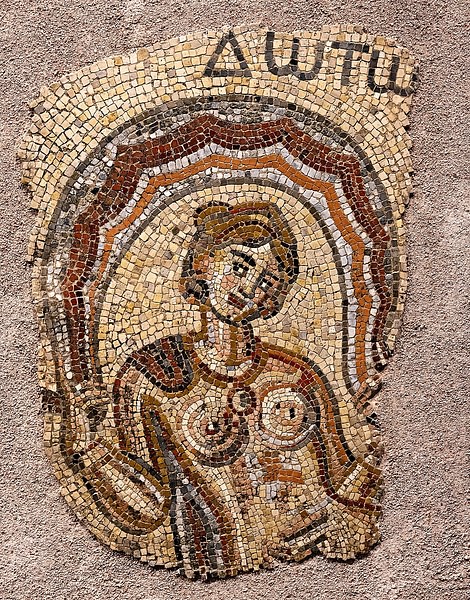 Mosaic Fragment of Ino Didier Descouens (CC BY-SA) ](https://www.worldhistory.org/image/17623/mosaic-fragment-of-ino/ "Mosaic Fragment of Ino")In [Corinth](https://www.worldhistory.org/corinth/), a statue of Leucothea could be found in the [Temple](https://www.worldhistory.org/temple/) of Palaemon, along with a statue of Poseidon. On the road to Lechaion in Corinth were sculptures of Hermes, Leucothea, Poseidon, and Palaemon on a dolphin. In Laconia, a small lake was called Ino's Water by the locals, where they threw loaves of barley bread into the water during Ino's Festival. If the bread stayed in the water, it was good luck to whoever threw it in, but if it floated to the top, it meant bad luck. On the road to Thalamai was a sanctuary and an oracle of Ino. The oracles were revealed to people in dreams by Ino. In Leuctra, there was a statue of Ino.
Leucothea also has an Orphic Hymn dedicated to her, where she is referred to as a revered goddess and as the greatest saviour of mortals.
> I call upon Leukothea,
> daughter of Kadmos, revered goddess,
> mighty nurturer
> of fair-wreathed Dionysos.
> Hearken, O goddess,
> O mistress of the deep-bosomed sea,
> you delight in waves,
> you are the greatest savior to mortals,
> on you depends the unsteady heave
> of seafaring ships,
> you alone save men
> from wretched death at sea,
> men to whom you swiftly come
> as welcome savior.
> O divine lady,
> come to the aid
> of well-benched ships,
> do kindly save them,
> bring upon the sea
> a fair tail wind to the initiates.
> (*The Orphic Hymns: Orphic Hymn to Leukothea*, 74.1-11).
#### Editorial Review
This human-authored definition has been reviewed by our editorial team before publication to ensure accuracy, reliability and adherence to academic standards in accordance with our [editorial policy](https://www.worldhistory.org/static/editorial-policy/).
## Bibliography
- [Apollodorus & Hard, Robin. *The Library of Greek Mythology.* Oxford University Press, 2008.](https://www.worldhistory.org/books/0199536325/)
- [Athanassakis, Apostolos N. & Wolkow, Benjamin M. *The Orphic Hymns.* Johns Hopkins University Press, 2013.](https://www.worldhistory.org/books/1421408821/)
- [Dixon-Kennedy, Mike. *Encyclopedia of Greco-Roman Mythology.* ABC-CLIO, 1998.](https://www.worldhistory.org/books/1576070948/)
- [Giesecke, Annette & Tierney, Jim. *Classical Mythology A to Z& Goddesses, Heroes & Heroines, Nymphs, Spirits, Monsters..* Black Dog & Leventhal, 2020.](https://www.worldhistory.org/books/0762470011/)
- [Graves, Robert. *The Greek Myths\[May 15, 2018\] Graves, Robert.* Viking, 2018.](https://www.worldhistory.org/books/0241982359/)
- [Hard, Robin. *The Routledge Handbook of Greek Mythology.* Routledge, 2003.](https://www.worldhistory.org/books/0415478901/)
- [Homer & Robert Fagles & Bernard Knox. *The Odyssey.* Penguin Classics, 1999.](https://www.worldhistory.org/books/0140268863/)
- [Ovid & Raeburn, David & Feeney, Denis. *Metamorphoses.* Penguin Classics, 2004.](https://www.worldhistory.org/books/014044789X/)
- [Pausanias & Newberry, John & Levi, Peter & Levi, Peter. *Guide to Greece, Vol. 2.* Penguin Classics, 1984.](https://www.worldhistory.org/books/014044226X/)
- [Pausanias & Peter Levi. *Guide to Greece, Vol. 1.* Penguin Classics, 1984.](https://www.worldhistory.org/books/0140442251/)
- [Roman, Assistant Professor of Classics Luke & Roman, Monica. *Encyclopedia of Greek and Roman Mythology.* Facts on File, 2010.](https://www.worldhistory.org/books/0816072426/)
- [Sophocles & Aeschylus & Euripides & Lefkowitz, Mary & Romm, James. *The Greek Plays.* Modern Library, 2017.](https://www.worldhistory.org/books/0812983092/)
## About the Author
Liana is the Social Media Editor for Ancient History Encyclopedia. She holds a Bachelor of Arts Degree with a major in ancient Greece, Rome & Late Antiquity. She is particularly passionate about Rome and Greece, and anything to do with mythology or wo
- [Linkedin Profile](https://www.linkedin.com/in/lian)
## Questions & Answers
### What is Ino the goddess of?
Ino was originally born as a princess of Thebes and was then transformed into a sea goddess (Leucothea) by Poseidon when she died.
### Why did Ino go mad?
Ino and her husband Athamas were driven mad by Hera after they helped to raise Dionysos.
### Who is Leucothea?
Leucothea is a sea goddess who was once the mortal princess Ino.
### Who is Leucothea in the Odyssey?
Leucothea is a sea goddess who rescues the hero Odysseus in the Odyssey.
## Cite This Work
### APA
Miate, L. (2023, July 13). Ino. *World History Encyclopedia*.
### Chicago
Miate, Liana. "Ino." *World History Encyclopedia*, July 13, 2023. .
### MLA
Miate, Liana. "Ino." *World History Encyclopedia*, 13 Jul 2023, .
## License & Copyright
Submitted by [Liana Miate](https://www.worldhistory.org/user/lianamiate/ "User Page: Liana Miate"), published on 13 July 2023. The copyright holder has published this content under the following license: [Creative Commons Attribution-NonCommercial-ShareAlike](https://creativecommons.org/licenses/by-nc-sa/4.0/deed.en). This license lets others remix, tweak, and build upon this content non-commercially, as long as they credit the author and license their new creations under the identical terms. When republishing on the web a hyperlink back to the original content source URL must be included. Please note that content linked from this page may have different licensing terms.