---
title: Inari
author: Mark Cartwright
source: https://www.worldhistory.org/Inari/
format: machine-readable-alternate
license: Creative Commons Attribution-NonCommercial-ShareAlike (https://creativecommons.org/licenses/by-nc-sa/4.0/)
updated: 1970-01-01
---
# Inari
_Authored by [Mark Cartwright](https://www.worldhistory.org/user/markzcartwright/)_
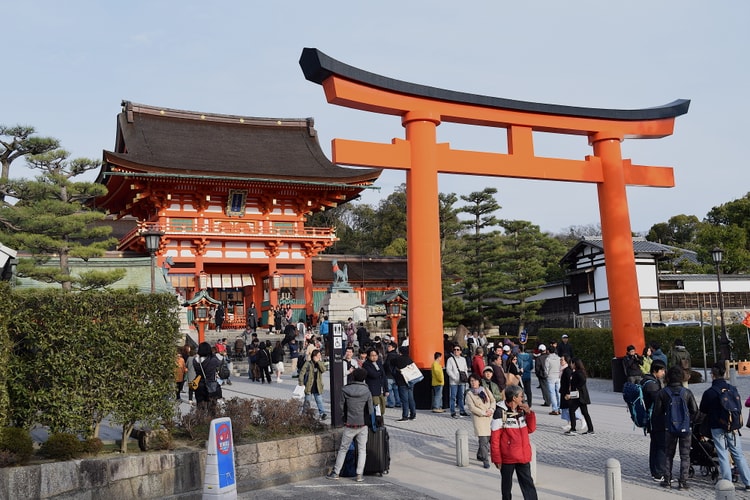
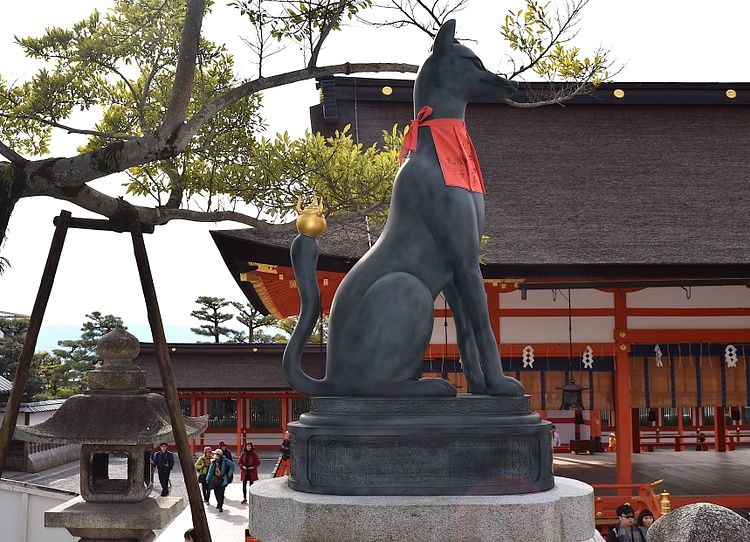
Inari is the [Shinto](https://www.worldhistory.org/Shinto/) [god](https://www.worldhistory.org/God/) of rice, the protector of food, and bringer of prosperity. He has over 40,000 shrines dedicated to him large and small across [Japan](https://www.worldhistory.org/disambiguation/Japan/), the oldest and most important of which is the Fushimi Inari Shrine near Kyoto with its famous red *torii gates and fox statues in honour of the animal which is considered the god's messenger and guardian.
### Names
Inari's name derives from *ine*, meaning rice seedling and so his name can be translated as 'rice carrier'. The rice god may go by another name, that of Ta-no-[kami](https://www.worldhistory.org/Kami/) or 'the god of the paddy field'. He is sometimes called Susshe Inari (Success Inari) or Manzoku Inari (Fulfillment Inari). Yet another title is Ukanomitama-no-kami, meaning 'the god of nourishment'. Inari is also closely associated with the ancient rice or food goddess Ukemochi okami. Another association and one typical of the crossover of divine figures in Shinto and Japanese [Buddhism](https://www.worldhistory.org/buddhism/) is Daikiniten/Daikokuten (from the [Hindu](https://www.worldhistory.org/hinduism/) Dakini), the [Buddhist](https://www.worldhistory.org/buddhism/) god of the kitchen and the Five Grains, which include, of course, rice. In Buddhism, the god is considered a disciple of the [Buddha](https://www.worldhistory.org/Siddhartha_Gautama/) and he may also be known as Inari Daimyojin.
### Spread of the Cult
According to legend, Inari was first worshipped on Mount Inari from the 8th century CE following a discovery by a man called Hata no Irogu. One day Irogu was practising his archery skills using sticky rice cakes (*mochi*) as targets. One shot hit directly through a cake which then magically transformed into a white dove. Irogu followed the flight of the bird which eventually landed on a peak of Mt. Inari called Mitsumine, and there he found rice growing and so began the worship of Inari as a spirit or Shinto *kami*.
As the god of rice, the staple food of [ancient Japan](https://www.worldhistory.org/Ancient_Japan/) and so vital to the lives of all people from the lowly farmer to the emperor himself, Inari, unsurprisingly would become one of the major figures of Shinto. Festivals and rituals involving rice and rice farming, especially in the periods of sowing and harvest, have been practised ever since rice cultivation was introduced into southern Japan during the [Yayoi Period](https://www.worldhistory.org/Yayoi_Period/) (300 BCE - 250 CE). Given the food's importance, Inari's cult, thus, reached all corners of the Japanese islands and he acquired all manner of other attributes, too. Regarded as the bringer of prosperity in general, the protector of food, finder of lost property, protector of lovers and married couples, patron of swordsmiths, friend of merchants, traders, and artisans, and all round general problem solver.
Inari's cult spread from that of a purely local deity in the 9th century CE when the famous scholar monk and founder of Shingon Buddhism in Japan, [Kukai](https://www.worldhistory.org/Kukai/), aka Kobo Daishi (774-835 CE), made the god the guardian of the [To-ji](https://www.worldhistory.org/To-ji/) [temple](https://www.worldhistory.org/temple/) in [Heiankyo](https://www.worldhistory.org/Heiankyo/) (Kyoto), then the capital of Japan. Kukai had claimed to have met an old man carrying rice on the Inari mountain and he considered it a meeting with the god himself. When the emperor fell seriously ill, it was only by giving Inari a high court rank that he ensured his recovery.
[  Torii, Fushimi Inari Shrine James Blake Wiener (CC BY-NC-SA) ](https://www.worldhistory.org/image/6690/torii-fushimi-inari-shrine/ "Torii, Fushimi Inari Shrine")During the [Edo Period](https://www.worldhistory.org/Edo_Period/) (1603-1868 CE) Inari took on an association with commerce and thus came to represent wealth and prosperity. This developed further as Japan's [economy](https://www.worldhistory.org/disambiguation/economy/) grew and life became more commercialised so that, by the [Meiji Period](https://www.worldhistory.org/Meiji_Period/) (1868-1912 CE), Inari was considered the *kami* of finance and industry, a position he still holds for many today. Consequently, Inari shrines are still very much in use and also appear in miniaturised form in such places as market squares and the roofs of office blocks.
### The Fox
In art the god is sometimes represented with a beard, he wears court clothes, carries a sack of rice, sometimes a flaming jewel which grants wishes, and may hold a key to a granary. Very often he is riding a white fox, the animal regarded as Inari's messenger and guardian. For this reason, Inari became the *yashikigami* or household deity of warriors in the medieval period as they too were imagined to ride foxes.
Many Inari shrines have fox sculptures, often wearing red bibs for good luck and holding a key to a rice granary in their mouths. Each shrine also has a symbolic hole in one of its perimeter walls to allow Inari's fox messenger ease of entry and exit. Worshippers frequently leave an offering for the fox at Inari shrines, typically *inari-zushi*, which is cooked rice wrapped in fried tofu and soaked in a sweet rice liquor. It is hoped that pleased with this offering the fox will only pass on good things about the worshipper to his master and thus ensure a favourable response from the god for whatever is being asked for.
[  Fox Statue, Fushimi Inari Shrine James Blake Wiener (CC BY-NC-SA) ](https://www.worldhistory.org/image/6692/fox-statue-fushimi-inari-shrine/ "Fox Statue, Fushimi Inari Shrine")### Fushimi Inari
Inari is one of the most popular deities in Japan, and he has thousands of shrines across the country, especially in rural areas, but it is the Fushimi Inari Taisha temple complex near Kyoto which is the oldest, largest and the most important. Aside from being the headquarters of Inari worship, the Fushimi shrine is also famous for the large number of red gates (*torii*) of all sizes at the site, which are donated by the faithful looking for the god to favour them (starting price around 3000 US dollars at the time of [writing](https://www.worldhistory.org/writing/)). The paths at the complex have over 5,000 *torii,* and they are placed so close together as to almost form covered walkways.
The Fushimi Inari shrine was founded in 711 CE by the Hata clan and moved from its original location on the top of Mt. Inari to its present location lower down in the 9th century CE. Like several other Shinto shrines, it was administered by Buddhist monks until the formal separation of the two religions in 1873 CE. The large round stone outside the main temple represents the presence (*shintai*) of Inari and is flanked by a large pair of fox sculptures. The main building was, unfortunately, destroyed by fire in 1468 CE during the Onin Wars (1467-1477 CE), but it was rebuilt in 1499 CE and has since been regularly restored. The Fushimi shrine is a popular visitor attraction all year round but especially in the New Year for the Hatsumode festival and at the beginning of February for the Hatsuuma Taisai festival.
This content was made possible with generous support from the [Great Britain Sasakawa Foundation](http://www.gbsf.org.uk/?utm_source=ancient.eu&utm_medium=link&utm_campaign=ancient.eu).
#### Editorial Review
This human-authored definition has been reviewed by our editorial team before publication to ensure accuracy, reliability and adherence to academic standards in accordance with our [editorial policy](https://www.worldhistory.org/static/editorial-policy/).
## Bibliography
- [Ashkenazi, M. *Handbook of Japanese Mythology.* Oxford University Press, 2008.](https://www.worldhistory.org/books/0195332628/)
- [Cali, J. *Shinto Shrines.* Latitude 20, 2012.](https://www.worldhistory.org/books/0824837134/)
- [Hackin, J. *Asiatic Mythology.* Thomas Y. Crowell Company, 1963.](https://www.worldhistory.org/books/B000HTLNIC/)
- [Henshall, K. *Historical Dictionary of Japan to 1945.* Scarecrow Press, 2013.](https://www.worldhistory.org/books/0810878712/)
- [Scott Littleton, C. *Understanding Shinto.* Duncan Baird Publishers, 2002.](https://www.worldhistory.org/books/1903296757/)
## About the Author
Mark is WHE’s Publishing Director and has an MA in Political Philosophy (University of York). He is a full-time researcher, writer, historian and editor. Special interests include art, architecture and discovering the ideas that all civilizations share.
## Timeline
- **711 CE**: The Fushimi [Inari](https://www.worldhistory.org/Inari/) shrine, dedicated to the [Shinto](https://www.worldhistory.org/Shinto/) rice [god](https://www.worldhistory.org/God/) Inari, is founded near Kyoto.
## Cite This Work
### APA
Cartwright, M. (2017, May 23). Inari. *World History Encyclopedia*.
### Chicago
Cartwright, Mark. "Inari." *World History Encyclopedia*, May 23, 2017. .
### MLA
Cartwright, Mark. "Inari." *World History Encyclopedia*, 23 May 2017, .
## License & Copyright
Submitted by [Mark Cartwright](https://www.worldhistory.org/user/markzcartwright/ "User Page: Mark Cartwright"), published on 23 May 2017. The copyright holder has published this content under the following license: [Creative Commons Attribution-NonCommercial-ShareAlike](https://creativecommons.org/licenses/by-nc-sa/4.0/deed.en). This license lets others remix, tweak, and build upon this content non-commercially, as long as they credit the author and license their new creations under the identical terms. When republishing on the web a hyperlink back to the original content source URL must be included. Please note that content linked from this page may have different licensing terms.