---
title: Horae
author: Liana Miate
source: https://www.worldhistory.org/Horae/
format: machine-readable-alternate
license: Creative Commons Attribution-NonCommercial-ShareAlike (https://creativecommons.org/licenses/by-nc-sa/4.0/)
updated: 2023-03-29
---
# Horae
_Authored by [Liana Miate](https://www.worldhistory.org/user/lianamiate/)_
The Horae (*Horai*, sing. *Hora*) were the personification and goddesses of the seasons and the hours and, later on, were regarded as goddesses of order and justice in [Greek mythology](https://www.worldhistory.org/Greek_Mythology/). They were the daughters of [Zeus](https://www.worldhistory.org/zeus/) and the Titaness [Themis](https://www.worldhistory.org/Themis/) and were usually three in number. However, their names and numbers differ depending on the source.
They were closely associated with the [Graces](https://www.worldhistory.org/Graces/), the [Fates](https://www.worldhistory.org/Fates/), and the goddess [Aphrodite](https://www.worldhistory.org/Aphrodite/) and guarded the gates of Olympus. They were considered benevolent and kind, often bringing good things to the gods and humankind, and were connected to everything good and beautiful in nature. In art, they were often depicted as beautiful maidens in threes, carrying produce from different seasons. The English word 'hour' is derived from the [Greek](https://www.worldhistory.org/disambiguation/greek/) and Latin *hora*.
### Parentage & Names
As mentioned by [Hesiod](https://www.worldhistory.org/hesiod/) (c. 700 BCE) in his *[Theogony](https://www.worldhistory.org/Theogony/),* the Horae were the daughters of Zeus and the Titaness Themis:
> And shining Themis was his second wife.
> She bore the Horae: Order, blooming Peace,
> And Justice, who attend the works of men.
> (Hesiod, *Theogony*, 900-903).
Depending on the source, the names and number of the Horae differ, although most sources, including Hesiod, Pseudo-Apollodorus (c. 1st or 2nd century CE), and *The Orphic Hymns* list the Horae as being named Eunomia (Lawfulness), Eirene or Irene (Peace), and Dike or Dice (Justice). Other authors, including [Pausanias](https://www.worldhistory.org/disambiguation/Pausanias/) (c. 115 to c. 180 CE) and Pseudo-Hyginus (Gaius [Julius](https://www.worldhistory.org/disambiguation/Julius/) Hyginus) (c. 64 BCE to 17 CE), gave their names as Carpo (Fruit), Auxo (Growth), and Thallo (Blooming) or Europia (Abundance), Pherusa (Substance), and Orthosie (Prosperity).
### Goddesses of the Seasons
As the personification and goddesses of the seasons, the Horae were considered the giver of seasons (especially of Spring and Autumn). [Homer](https://www.worldhistory.org/homer/) (c. 750 BCE) referred to them as the Olympian deities of the weather. Three Horae are specifically linked with the seasons: Thallo (the Hora of Spring), Carpo (the Hora of Autumn), and Auxo (the Hora of Summer). The courses of the seasons were symbolically described by the dance of the Horae accompanied by the singing of the [Muses](https://www.worldhistory.org/muse/) and the [lyre](https://www.worldhistory.org/Lyre/)-playing of [Apollo](https://www.worldhistory.org/apollo/).
The Hora of Spring (Thallo) accompanied [Persephone](https://www.worldhistory.org/persephone/) on her annual journey from the underworld to Earth, which symbolised the coming of spring. The Hora of Spring carried flowers, while Summer held corn, and Autumn was laden with grapes and other fruits. Flowers, freshness, and fragrance were associated with the Horae, and even inanimate objects took on a charm of their own, thanks to the Horae. As they promoted the health and prosperity of everything that grew, they adopted the role of protectress of the youth and newly-born gods. They caused fruit and flowers to grow after they showered them with their life-giving streams.
In [Ovid](https://www.worldhistory.org/ovid/)'s (43 BCE to 17 CE) *Metamorphoses*, [Helios](https://www.worldhistory.org/Helios/) (Phoebus) sat on a throne of emeralds surrounded by the personification of the Day, Month, and Year, as well as the Horaes (Hours), and Spring with flowers, Summer with an ear of corn, Autumn with the juice of grapes and aged Winter.
[ 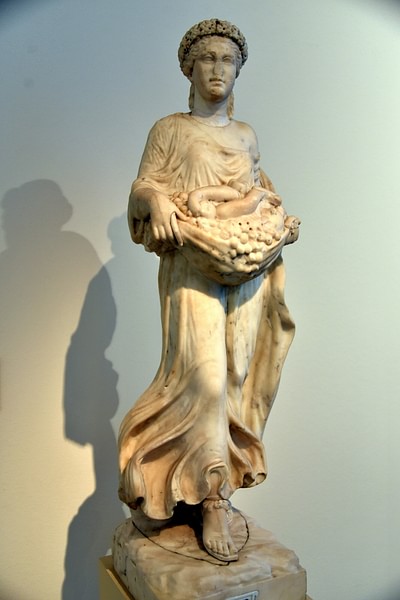 Statuette of a Hora of Autumn Osama Shukir Muhammed Amin (Copyright) ](https://www.worldhistory.org/image/11383/statuette-of-a-hora-of-autumn/ "Statuette of a Hora of Autumn")Interestingly enough, the number of Horae representing the seasons originally ranged from two to three in most classical sources instead of the expected four. This is because the ancient Greeks mainly recognised spring, summer, and autumn as the proper seasons, while winter was viewed as a time of sleep and [death](https://www.worldhistory.org/disambiguation/Death/). Only later on did the Hora representing winter become accepted.
### Goddesses of Order & Justice
In later times, the Horae were also viewed as the goddesses of order and justice with the influence they had on the seasons and nature being transferred to human life. Hesiod described them as providing peace, justice, and good laws to a state and named them the appropriate Eunomia (Lawfulness and Good Order), Dike (Justice), and Eirene (Peace) – a direct connection to the concepts of the natural order. Each Hora had a specific function: Eunomia looked after state life; Dike protected the interests of humankind, and Eirene, the most lighthearted of the three, ensured that there was peace on earth.
> Justice is dragged out of the way by men
> Who judge dishonestly and swallow bribes,
> A struggling sound is heard; then she returns
> Back to the [city](https://www.worldhistory.org/city/) and the homes of men,
> Rapped in a mist and weeping, and she brings
> Harm to the crooked men who drove her out.
> But when the judges of a town are fair
> To foreigner and citizen alike,
> Their city prospers and her people bloom;
> Since Peace is in the land, her children thrive;
> Zeus never marks them out for cruel [war](https://www.worldhistory.org/disambiguation/War/).
> (Hesiod, *[Works and Days](https://www.worldhistory.org/Works_and_Days/)*, 221-233).
Just as the different seasons required some order, the Horae provided order and justice to civilised communities.
### Guardians of the Heavens & Time
The Horae stood at the gates to Olympus and admitted those who had the right to enter, welcoming back gods from a heroic mission or task. They also saw off the gods as they left the [palace](https://www.worldhistory.org/disambiguation/palace/). As mentioned in Homer's *[Iliad](https://www.worldhistory.org/iliad/)*, the Horae let [Hera](https://www.worldhistory.org/Hera/) in the groaning gates of Olympus. When they opened the gates, it revealed a dense darkness.
They also presided over the divisions of time. Every morning, they fastened the celestial horses to the magnificent [chariot](https://www.worldhistory.org/chariot/) of Helios and unyoked them after the sun had retreated to rest.
[  Apollo with the Hours Georg Friedrich Kersting (Public Domain) ](https://www.worldhistory.org/image/17237/apollo-with-the-hours/ "Apollo with the Hours")### Nurses & Attendants of the Gods
Ancient writers Menander (c. 342-291 BCE) and Alcaeus of Mytilene (c. 620 BCE) state that the Horae were nurses, with Philostratus the Elder (c. 170-247/250 CE) [writing](https://www.worldhistory.org/writing/) that they nursed the baby [Hermes](https://www.worldhistory.org/Hermes/). Pausanias also mentions that the Horae raised Hera.
In the *Homeric Hymn to Aphrodite*, after Aphrodite was born, the Horae welcomed her, clothed her in ambrosial garments, crowned her in [gold](https://www.worldhistory.org/gold/), and placed [copper](https://www.worldhistory.org/copper/) and gold jewellery in her ears and around her neck – the same jewellery the Horae wore whenever they went to their father's house. They then led Aphrodite to the gods, who had gathered to welcome Aphrodite and admire her beauty. In the *Homeric Hymn to Pythian Apollo*, the Graces and cheerful Horae dance with Aphrodite, [Hebe](https://www.worldhistory.org/Hebe/), and Harmonia, holding each other by the wrist.
[  Dionysos & the Horae Jastrow (Public Domain) ](https://www.worldhistory.org/image/6237/dionysos--the-horae/ "Dionysos & the Horae")*The Orphic Hymn to the Horae* and the *Orphic Hymn to Persephone* describe the Horae as being companions to Persephone. Along with the Fates, and Graces, they led her back up to the light of spring from the underworld, where they then formed a solemn dance. They are also companions to the rustic [god](https://www.worldhistory.org/God/) [Pan](https://www.worldhistory.org/Pan/), according to the *Orphic Hymn to Pan.* The Horae made a crown for [Pandora](https://www.worldhistory.org/Pandora/) out of spring flowers. At her wedding, [Ariadne](https://www.worldhistory.org/Ariadne/) gave [Theseus](https://www.worldhistory.org/Theseus/) a wreath that had initially been a gift from the Horae.
In Nonnus' *Dionysiaca*, the Horae became the midwives of [Dionysos](https://www.worldhistory.org/Dionysos/). After Dionysos was born from Zeus' thigh, the Horae crowned him with an ivy garland. The role of nurse and attendant to the gods was a somewhat surprising role for the Horae, as the role of nurses was usually delegated to the lower class and not traditionally given to the [immortals](https://www.worldhistory.org/disambiguation/immortals/). It shows the relatively low ranking of the Horae in regard to the other deities.
### The Horae, the Graces & the Fates
The Horae have long been associated with the other triads of goddesses that are found in Greek [mythology](https://www.worldhistory.org/mythology/): the Graces (the Charites), goddesses who were responsible for bestowing beauty upon the world, and the Fates (the [Moirai](https://www.worldhistory.org/Fates/)), who control a person's lifespan. Although these groups of goddesses are relatively minor figures compared to the other, more prominent deities, they influence characters, events, fate, luck, and the weather. They often have significant interactions with different gods and goddesses. Their actions are repeated over seasons and the cycle of life and death.
[  The Three Moirai Johann Gottfried Schadow (Public Domain) ](https://www.worldhistory.org/image/16813/the-three-moirai/ "The Three Moirai")### Worship
The Horae had an Orphic Hymn dedicated to them.
> Seasons, daughters of Themis,
> daughters of Lord Zeus,
> Eunomia and Dike
> And thrice-blessed Eirene,
> pure spirits of Spring,
> of blossoming meadows,
> you are found in every colour, in all scents
> wafted by the breezes.
> Ever-blooming, revolving, and sweet-faced,
> O Seasons,
> you cloak yourselves with the dew
> of luxuriant flowers.
> At play you are companions
> Of holy Persephone, when the Fates
> and the Graces in circling dances
> come forth to the light,
> Pleasing Zeus
> and their mother, giver of fruits.
> Come to the new initiates
> and their holy and reverent rites,
> bring perfect seasons
> for the growth of goodly fruit.
> (*The Orphic Hymns: To the Seasons*, 43.1-10)
In the *Description of [Greece](https://www.worldhistory.org/greece/)*, Pausanias writes that the Horae were worshipped in [Corinth](https://www.worldhistory.org/corinth/), where a sanctuary to them could be found. Sculptures of the Seasons by the sculptor Endoios were found at the entrance to the Shrine of [Athena](https://www.worldhistory.org/athena/) in Achaia (Achaea). There were cults to the Seasons located in [Athens](https://www.worldhistory.org/Athens/). In Lakonia (Laconia), sculptures of two Horae stood alongside two Graces in front of a throne. They are also represented on an altar along with other gods and goddesses from Greek mythology.
In Hera's [temple](https://www.worldhistory.org/temple/) in [Olympia](https://www.worldhistory.org/Olympia/), a [sculpture](https://www.worldhistory.org/disambiguation/Sculpture/) of the Seasons by Smilis of Aigina stood next to statues of Zeus and Hera, who were seated on thrones. Their mother, Themis, stood alongside them. There was also an altar dedicated to the Seasons located in Olympia. Another one of Hera's temples near [Mycenae](https://www.worldhistory.org/mycenae/) featured a statue of the goddess wearing a crown that was adorned with the Seasons and the Graces.
#### Editorial Review
This human-authored definition has been reviewed by our editorial team before publication to ensure accuracy, reliability and adherence to academic standards in accordance with our [editorial policy](https://www.worldhistory.org/static/editorial-policy/).
## Bibliography
- [Athanassakis, Apostolos N. & Wolkow, Benjamin M. *The Orphic Hymns.* Johns Hopkins University Press, 2013.](https://www.worldhistory.org/books/1421408821/)
- [Berens, E. M. *Myths and Legends of Ancient Greece and Rome.* SMK Books, 2013.](https://www.worldhistory.org/books/1617209902/)
- [Bremmer, Jan N. *The World of Greek Religion and Mythology.* Mohr Siebrek Ek, 2020.](https://www.worldhistory.org/books/316154451X/)
- [Graves, Robert. *The Greek Myths\[May 15, 2018\] Graves, Robert.* Viking, 2018.](https://www.worldhistory.org/books/0241982359/)
- [Green, Tamara M. *The Greek & Latin Roots of English.* Rowman & Littlefield Publishers, 2020.](https://www.worldhistory.org/books/1538128632/)
- [Hesiod & Theognis & Wender, Dorothea & Wender, Dorothea. *Hesiod and Theognis .* Penguin Classics, 1976.](https://www.worldhistory.org/books/0140442839/)
- [Homer & Richardson, Nicholas & Cashford, Jules & Richardson, Nicholas. *Homeric Hymns .* Penguin Classics, 2003.](https://www.worldhistory.org/books/0140437827/)
- [Homer & Robert Fagles & Bernard Knox. *The Iliad.* Penguin Classics, 1998.](https://www.worldhistory.org/books/0140275363/)
- [Luke Roman & Monica Roman. *Aphrodite to Zeus& Roman Mythology .* Checkmark Books, 2011.](https://www.worldhistory.org/books/0816083630/)
- [NONNUS, DIONYSIACA BOOK 9 - Theoi Classical Texts Library](https://www.theoi.com/Text/NonnusDionysiaca9.html "NONNUS, DIONYSIACA BOOK 9 - Theoi Classical Texts Library"), accessed 24 Mar 2023.
- [Ovid & Raeburn, David & Feeney, Denis. *Metamorphoses .* Penguin Classics, 2004.](https://www.worldhistory.org/books/014044789X/)
- [Pausanias & Newberry, John & Levi, Peter & Levi, Peter. *Guide to Greece, Vol. 2.* Penguin Classics, 1984.](https://www.worldhistory.org/books/014044226X/)
- [Pausanias & Peter Levi. *Guide to Greece, Vol. 1.* Penguin Classics, 1984.](https://www.worldhistory.org/books/0140442251/)
- [Smith, William & Anthon, Charles. *A New Classical Dictionary Of Greek And Roman Biography, Mythology And Geography..* Kessinger Publishing, LLC, 2010.](https://www.worldhistory.org/books/1163441465/)
## About the Author
Liana is the Social Media Editor for Ancient History Encyclopedia. She holds a Bachelor of Arts Degree with a major in ancient Greece, Rome & Late Antiquity. She is particularly passionate about Rome and Greece, and anything to do with mythology or wo
- [Linkedin Profile](https://www.linkedin.com/in/lian)
## Questions & Answers
### Who were the Horae?
The Horae were the personification and goddesses of the seasons, time and order, and justice.
### How many Horae were there?
Depending on the source, the Horae differed in numbers, however, three was the most common number according to authors like Hesiod.
### What do the Horae represent?
Depending on the source: Eunomia (Lawfulness), Eirene or Irene (Peace), and Dike or Dice (Justice). Or Carpo (Fruit), Auxo (Growth), and Thallo (Blooming) or Europia (Abundance), Pherusa (Substance), and Orthosie (Prosperity).
## Cite This Work
### APA
Miate, L. (2023, March 29). Horae. *World History Encyclopedia*.
### Chicago
Miate, Liana. "Horae." *World History Encyclopedia*, March 29, 2023. .
### MLA
Miate, Liana. "Horae." *World History Encyclopedia*, 29 Mar 2023, .
## License & Copyright
Submitted by [Liana Miate](https://www.worldhistory.org/user/lianamiate/ "User Page: Liana Miate"), published on 29 March 2023. The copyright holder has published this content under the following license: [Creative Commons Attribution-NonCommercial-ShareAlike](https://creativecommons.org/licenses/by-nc-sa/4.0/deed.en). This license lets others remix, tweak, and build upon this content non-commercially, as long as they credit the author and license their new creations under the identical terms. When republishing on the web a hyperlink back to the original content source URL must be included. Please note that content linked from this page may have different licensing terms.