---
title: Hoenir
author: Irina-Maria Manea
source: https://www.worldhistory.org/Hoenir/
format: machine-readable-alternate
license: Creative Commons Attribution-NonCommercial-ShareAlike (https://creativecommons.org/licenses/by-nc-sa/4.0/)
updated: 1970-01-01
---
# Hoenir
_Authored by [Irina-Maria Manea](https://www.worldhistory.org/user/irinamaria.manea/)_
Hoenir or Hönir (Old Norse: Hœnir or Hønir) is a very shadowy [god](https://www.worldhistory.org/God/) figure in [Norse mythology](https://www.worldhistory.org/Norse_Mythology/), who joins the gods [Loki](https://www.worldhistory.org/Loki/) and [Odin](https://www.worldhistory.org/odin/) on a couple of occasions in the old texts. He seems to have attributes of creation and prophecy, and his name might advert a bond with birds, possibly birds of omen.
### Mentions in the Poetic & Prose [Edda](https://www.worldhistory.org/Edda/)
We can infer very little from the remaining sources, but Hoenir is involved in at least one major mythological moment, namely the shaping of the first human beings, Ask and Embla, from two pieces of driftwood by bestowing essential gifts upon them. The myth is recounted in the *Völuspá* (*Prophecy of the Seeress)*, the first poem in the mythological collection the *Poetic Edda*, in stanzas 17-18:
> They had no breath,
> they had no soul,
> they had neither hair nor voice,
> nor a good appearance.
> Odin gave them breath,
> Hoenir gave them a soul,
> Lodur / Loki gave them hair
> and a good appearance.
Here we have the first example of this trio of gods – Odin, Loki, Hoenir – completing each other's deeds and capacities. Interestingly, Hoenir endows human beings with *óð* (accusative of *óðr*), a fascinating term that could mean mind, wit, sense, or inspiration as a noun and mad, frantic, or inspired as an adjective. It is the basic word from which the name Odin stems, so we cannot help wondering if there once existed a stronger link between the two, especially if the word refers to poetry. As for Loki as the other member of the party, in a poem named *Háleygjatal* preserved only in bits quoted in other works such as Icelandic chieftain and author Snorri's poetic treaty *Skáldskaparmál* – part of the *Prose Edda* – Odin is described as Lodur's friend, which reinforces the idea that Lodur from the passage in the *Poetic Edda* most likely is the same character, Loki.
On the other hand, in the first part of his *Prose Edda* called *Gylfaginning* (*The Deluding of Gylfi*) dealing with various aspects of Norse myth such as the creation and destruction of the world, Snorri wrote down a similar story but left Hoenir out of it. In his version, the creators seem to be the sons of Borr, namely Odin, Vili, and Vé. Vili gives them understanding and motion, thus leaving open the question of his equivalence to Hoenir. Or perhaps Snorri merely recorded another mythological tradition, as there was no true canon.
Return briefly to the *Völuspá*, when asked about [Ragnarök](https://www.worldhistory.org/Ragnarok/), the twilight of the gods, the seeress usually mentions second-generation gods among the survivors, such as Odin's sons [Vidar](https://www.worldhistory.org/Vidar/) and [Baldr](https://www.worldhistory.org/Baldr/), or [Thor](https://www.worldhistory.org/Thor/)'s sons Magni and Modi. However, the text adds Hoenir to the list, speaking of his skills in casting lots (*hlautvið -* twigs dipped in blood and shaken), which he will perform after the fields start growing again and the gods return.
Then Hoenir will be able
to choose his prophecies
and the two brothers,
the sons of the Two-Fold (Odin)
will dwell in the heavens.
Do you want to know more, Allfather?
(stanza 63)
These divination skills might lead one to think of a priestly function. Snorri, however, leaves Hoenir out of his account of Ragnarök.
[  After Ragnarök Emil Doepler (Public Domain) ](https://www.worldhistory.org/image/14602/after-ragnarok/ "After Ragnarök")### Other Sources
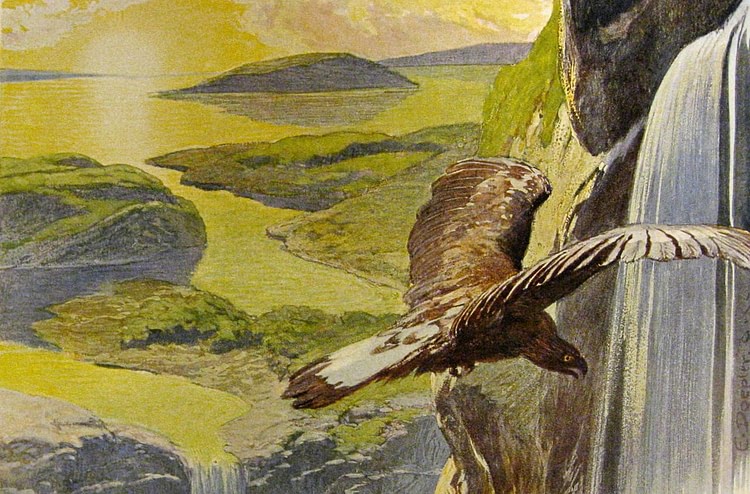
Besides Odin, a few clues hint at an important connection to Loki as well. In an old skaldic poem – skalds being composers honouring the deeds of patrons or tackling broader topics in verses with complicated metre and heavy figurative speech – called "Autumn-Long" (Old Norse: *Haustlǫng*) written by Thjodolf of Hvin in the 9th century, Loki is described as "Hoenir's friend" and "the tester of Hoenir's mind." In the first 13 stanzas, the mythologically rich poem recounts the encounter of the same trio – Odin, Loki, and Hoenir – with the [giant](https://www.worldhistory.org/Giants/) Thjazi, shaped like an eagle. As they are trying to cook some ox meat, the bird desires part of the meal to which Loki reacts by hitting it with his staff, which gets stuck, and the eagle flies off with him. In exchange for his retrieval, Thjazi demands [Idunn](https://www.worldhistory.org/Idunn/), a goddess of youth. Once more, we can notice the enigmatic nature of Hoenir, as it is Loki who dominates the mythical scenes.
In the *Reginsmál* (*The Lay of Regin*) is another context where Hoenir appears in this group of three divinities, a piece which belongs to the heroic tradition in the *Poetic Edda*, namely a series of poems dealing with the material which in the late 13th century would become the [Saga](https://www.worldhistory.org/Saga/) of the Volsungs. This legendary saga deals among other things with the hero Sigurd, who after killing the dragon Fafnir becomes the owner of the cursed treasure including the ring Andvaranaut, which will eventually bring him to his doom. After the [death](https://www.worldhistory.org/disambiguation/Death/) of his father Sigmund and his mother's marriage into another royal family, Sigurd gets a teacher called Regin while at court, who convinces him to pursue the treasure after telling him his otherworldly story. His father Hreidmar had three sons, himself, a skilled metalworker, Otr, an otter-shaped fisherman, and Fafnir, the fiercest. One day out fishing, the gods Odin, Loki, and Hoenir kill Otr in his animal shape, skinning and eating him. After demanding compensation by filling the skin with [gold](https://www.worldhistory.org/gold/), Loki goes after the gold of the dwarf Andvari to pay Hreidmar. Fafnir will eventually turn into a dragon after killing his father and amassing all the cursed treasure. In the prose prologue of the poem *Reginsmál* these events are briefly mentioned, yet we get nothing more than the god's name in the trio of gods who commit the crime.
[  Giant Thiassi Kidnapping Idunn Harry George Theaker (Public Domain) ](https://www.worldhistory.org/image/14599/giant-thiassi-kidnapping-idunn/ "Giant Thiassi Kidnapping Idunn")In the *Ynglinga Saga –* the mythological prehistory of Snorri's chronicle of the Norwegian kings where the kings trace their lineage back to the Swedish Ynglings, in their turn descended from the gods – Snorri mentions that in the exchange of hostages that occurs between the two main families of gods, the Æsir and the Vanir, as a pledge of goodwill, Hoenir is sent from the Æsir to the Vanir along with Mimir. As they realise they were cheated because Hoenir only relies on the counsel of Mimir thus being unsuitable as a chieftain, they behead Mimir and send him back to Odin. By preserving the head of this wise creature, Odin gains access to secret knowledge, a skill indirectly made possible by Hoenir. It appears that Hoenir might have returned among the Æsir, as the *Gylfaginning* mentions that the god Njord is exchanged for Hoenir in the settlement, and in another section of Snorri's *Edda,* he also takes part in a banquet of the Æsir. Furthermore, the story in the *Ynglinga Saga* is quite different from the one in the *Prose Edda*, the latter probably sticking closer to the mythical 'originals'.
A rather exotic occurrence of Hoenir can be found not in an Icelandic source but in a Faroese ballad from a 19th-century manuscript and probably dating back to the Middle Ages. *A Tale of Loki* (*Loka Táttur*) presents the story of a man who loses a bet with a giant, who then claims his son. To avoid this tragedy, the farmer resorts to the standard trio of Odin, Loki, and Hoenir. After Odin fails to hide him as a grain in a field, Hoenir turns him into a feather on a swan's head but calls the boy back as he sees the giant wrenching the swan's head. The boy is finally saved by Loki's cunning intervention.
In most of these mythological fragments, Hoenir seems well-connected with Loki and Odin, yet the underlying reasons evade us. It might be that since Loki is always the cunning, talkative, and active one, Hoenir might be used as a contrast, to embody another principle – perhaps the silent, feeble, passive nature.
### A Curious Name
Lastly, the root of Hoenir's name reminds us of chickens. If *høna* is "hen," could Hoenir (Hønir in other spellings) be the "gatherer of hens"? In the description of the apocalypse in the *Völuspá,* we encounter roosters heralding its beginnings. Or could it rather mean the "slayer of hens"? In this case, we could speculate about the metaphor for a hawk, a bird associated with Odin and Loki. Furthermore, Snorri suggests in his poetic treaty, the *Skáldskaparmál,* to use metaphors (*kenningar*) such as Odin's companion, long-foot, swift god, or mud-king in reference to Hoenir. These metaphors regarding motion stand in harmony with the fact that, in the creation myth, he offers humans sense or motion. By giving them a soul, they become moving, alive.
All in all, there are more unanswered than answered questions: Why is he the mud-king (*aurkonungr*)? *Aurr* is not only wet clay, it is also the purling water with foam of the well of Urd at the roots of the world-tree Yggdrassil, the well where the [Norns](https://www.worldhistory.org/Norns/) sat and decided the fate of humans and gods. This could hint at the god's fortune-telling abilities. And the long foot? Long legs and walking in mud leads us to think of storks, so birds again, birds that many times occur as companions of gods and bearers of omens. One of [Zeus](https://www.worldhistory.org/zeus/)' nicknames is the swan-like god of heaven, making us wonder about the higher role of Hoenir and its fading away over time.
#### Editorial Review
This human-authored definition has been reviewed by our editorial team before publication to ensure accuracy, reliability and adherence to academic standards in accordance with our [editorial policy](https://www.worldhistory.org/static/editorial-policy/).
## Bibliography
- Hildebrand, K. (ed.), Bellows, H. (tr.). *Old Norse Poetic Edda Diglot.* Melbourne, 2011
- Jonsson, F. (ed.). *De gamle Eddadigte .* G.E.C. Gads Forlag, Copenhagen, 1932
- [Lindow, John. *Norse Mythology.* Oxford University Press, 2002.](https://www.worldhistory.org/books/0195153820/)
- [Sturluson, Snorri & Faulkes, Anthony. *Edda.* Viking Society for Northern Research, 2005.](https://www.worldhistory.org/books/0903521644/)
- [Sturluson, Snorri. *Heimskringla.* Viking Society for Northern Research, 1970.](https://www.worldhistory.org/books/0903521946/)
## About the Author
A curious and open mind, fascinated by the past. Historian with a keen interest in Norse myth and the Viking Age, as well as history teacher and language instructor. Originally from Bucharest, Romania, now residing in Hesse, Germany.
- [Facebook Profile](https://www.facebook.com/irinaskuld)
- [Linkedin Profile](https://www.linkedin.com/in/irinamariamanea/)
## Cite This Work
### APA
Manea, I. (2022, January 12). Hoenir. *World History Encyclopedia*.
### Chicago
Manea, Irina-Maria. "Hoenir." *World History Encyclopedia*, January 12, 2022. .
### MLA
Manea, Irina-Maria. "Hoenir." *World History Encyclopedia*, 12 Jan 2022, .
## License & Copyright
Submitted by [Irina-Maria Manea](https://www.worldhistory.org/user/irinamaria.manea/ "User Page: Irina-Maria Manea"), published on 12 January 2022. The copyright holder has published this content under the following license: [Creative Commons Attribution-NonCommercial-ShareAlike](https://creativecommons.org/licenses/by-nc-sa/4.0/deed.en). This license lets others remix, tweak, and build upon this content non-commercially, as long as they credit the author and license their new creations under the identical terms. When republishing on the web a hyperlink back to the original content source URL must be included. Please note that content linked from this page may have different licensing terms.