---
title: Hermes: The Messenger of the Olympian Gods
author: Mark Cartwright
source: https://www.worldhistory.org/Hermes/
format: machine-readable-alternate
license: Creative Commons Attribution-NonCommercial-ShareAlike (https://creativecommons.org/licenses/by-nc-sa/4.0/)
updated: 2025-04-18
---
# Hermes: The Messenger of the Olympian Gods
_Authored by [Mark Cartwright](https://www.worldhistory.org/user/markzcartwright/)_
Hermes was the ancient [Greek](https://www.worldhistory.org/disambiguation/greek/) [god](https://www.worldhistory.org/God/) of [trade](https://www.worldhistory.org/disambiguation/trade/), wealth, luck, fertility, [animal husbandry](https://www.worldhistory.org/Animal_Husbandry/), sleep, language, thieves, and travel. One of the cleverest and most mischievous of the [12 Olympian gods](https://www.worldhistory.org/collection/58/the-12-olympian-gods/), Hermes was their herald and messenger. In that position, he came to symbolise the crossing of boundaries in his role as a guide between the two realms of gods and humanity.
Hermes was known for his impish behaviour and curiosity. He invented the [lyre](https://www.worldhistory.org/Lyre/), the [alphabet](https://www.worldhistory.org/alphabet/), and dice. The latter explains why the god was beloved by gamblers. Hermes was the patron of shepherds and invented the [panpipes](https://www.worldhistory.org/Panpipes/) they used to call their flock. To the Romans, the god was known as Mercury.
### Origins & Family
Hermes has a very long history, being mentioned in the [Linear B](https://www.worldhistory.org/Linear_B_Script/) tablets of the [Mycenaean civilization](https://www.worldhistory.org/Mycenaean_Civilization/), at its height from the 15th to 13th century BCE. Such tablets have been discovered at [Pylos](https://www.worldhistory.org/Pylos/), [Thebes](https://www.worldhistory.org/disambiguation/Thebes/), and [Knossos](https://www.worldhistory.org/knossos/). With origins, then, as an Arcadian fertility god who had a special love for the [Peloponnese](https://www.worldhistory.org/Peloponnese/), the ancient Greeks believed Hermes was the son of [Zeus](https://www.worldhistory.org/zeus/) and the [nymph](https://www.worldhistory.org/nymph/) Maia (daughter of the [Titan](https://www.worldhistory.org/Titan/) [Atlas](https://www.worldhistory.org/Atlas/)) and that he was born on Mt. Cyllene in Arcadia. In [mythology](https://www.worldhistory.org/mythology/), Hermes was also the father of the pastoral god [Pan](https://www.worldhistory.org/Pan/) and Eudoros (with Polymele), one of the leaders of the Myrmidons, although the god was not given a wife in any Greek myth. The idea that Hermes represented movement is reflected in his role as the leader of both the Nymphs and [Graces](https://www.worldhistory.org/Graces/) (Charites).
### Hermes & the Gods
Noted for his impish character and constant search for amusement, Hermes was one of the more colourful gods in [Greek mythology](https://www.worldhistory.org/Greek_Mythology/). While still a baby, he stole his half-brother [Apollo](https://www.worldhistory.org/apollo/)'s herd of 50 sacred cattle from Pieria, cleverly reversing their hoofmarks by adding bark shoes to make it difficult to follow their tracks. Hermes, therefore, became associated with thieves and he managed to keep the stolen herd of cattle until the satyrs finally discovered it in a cave in Arcadia. After a hearing before Zeus and the Olympian gods, Hermes was permitted to hold on to the herd (now down to 48 as he had already sacrificed two of them) if he gave Apollo his lyre. The episode illustrates the god's link with both physical and moral boundaries and crossing them, and may have a basis in historical events, as here described by the famed expert on Greek mythology Robert Graves:
> A tradition of cattle raids made by the crafty Messenians on their neighbours, and of a treaty by which these were discontinued, seems to have been mythologically combined with an account of how the barbarous Hellenes took over and exploited, in the name of their adopted god Apollo, the Creto-Helladic civilizations which they found in Central and Southern [Greece](https://www.worldhistory.org/greece/). (66)
[ 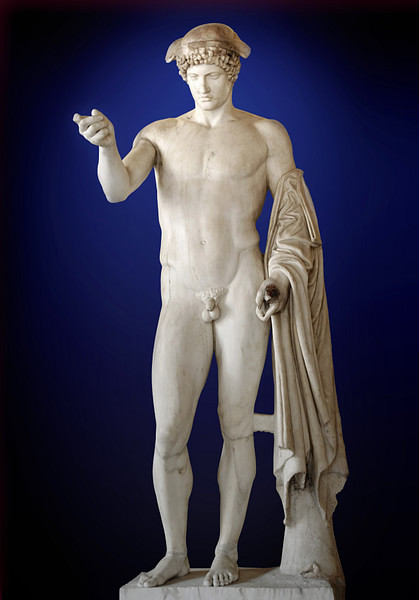 Hermes Ludovisi Marie-Lan Nguyen (CC BY-SA) ](https://www.worldhistory.org/image/713/hermes-ludovisi/ "Hermes Ludovisi")As messenger and herald, particularly for Zeus, Hermes is involved in many mythological episodes. Perhaps most celebrated was his killing of the many-eyed (some accounts say 100-eyed) monster [Argos](https://www.worldhistory.org/argos/) on the orders of Zeus in order to free Io. Hermes also freed [Ares](https://www.worldhistory.org/Ares/) from his year-long imprisonment in a cauldron by the twin [Giants](https://www.worldhistory.org/Giants/) Otus and Ephialtes. One of his most famous regular roles was as a leader of souls to the river Styx in the underworld, where the boatman [Charon](https://www.worldhistory.org/Charon/) would take them to [Hades](https://www.worldhistory.org/Hades/). Hermes was also known as something of a trickster, stealing at one time or another Poseidon's trident, Artemis' arrows, and Aphrodite's girdle.
### Hermes & the Heroes
Hermes figures in the [Trojan War](https://www.worldhistory.org/Trojan_War/) of the [Mycenaean period](https://www.worldhistory.org/Mycenaean_Civilization/), as told by [Homer](https://www.worldhistory.org/homer/) in the *[Iliad](https://www.worldhistory.org/iliad/)*. Although in one lengthy passage he acts as counsellor and guide to the Trojan King Priam in his attempt to reclaim the body of his fallen son Hector, Hermes actually supports the Achaeans in the Trojan [War](https://www.worldhistory.org/disambiguation/War/). The god is most often described by Homer as 'Hermes the guide, slayer of Argos' and 'Hermes the kindly'. Hermes gives particular help to [Odysseus](https://www.worldhistory.org/odysseus/), especially on his long return voyage to Ithaca (as told in Homer's *[Odyssey](https://www.worldhistory.org/Odyssey/)*), for example, giving him an antidote to the spells of [Circe](https://www.worldhistory.org/Circe/). Another hero helped by the god was [Perseus](https://www.worldhistory.org/Perseus/), Hermes giving him an unbreakable sword or sickle (*harpe*) of adamantine and guiding him to the three Graeae who would reveal the location of [Medusa](https://www.worldhistory.org/Medusa/).
### What did Hermes Invent?
Hermes was credited with inventing fire, the alphabet, dice (actually knucklebones) - and so he was worshipped by gamblers in his capacity as god of luck and wealth, and musical instruments, in particular, the lyre - made from a tortoiseshell by the god. Hermes was regarded as the patron of thieves and shepherds thanks to his invention of the pan pipes (syrinx). He was the patron of travellers, and stone pillars (*hermae*) with a phallus symbol were often to be seen set up along roadsides to act as guides and offer good fortune to those who passed. *Hermae* were particularly set up at boundaries, reminding of the god's role as a messenger between the gods and humanity, as well as his function as a guide for the dead into the next life. In addition, Hermes was regarded as the patron of the home, and people often built small marble stelai in front of their doors in his honour.
[  Pheneos Silver Stater Mark Cartwright (Copyright) ](https://www.worldhistory.org/image/821/pheneos-silver-stater/ "Pheneos Silver Stater")Famous for his diplomatic skills, he was also regarded as the patron of languages and rhetoric. Orators regarded the god who transferred words from sender to receiver as their patron, as did interpreters (another group of boundary-crossers) and, even today, the study and interpretation of texts carries his name: hermeneutics. In the [Hellenistic period](https://www.worldhistory.org/Hellenistic_Period/), the god was often associated with gymnasia and seen as the protector of youths. Finally, the god's Latin name, Mercury, is, of course, the name of a planet, naturally, the fastest one to orbit the sun.
### Cults Dedicated to Hermes
Hermes was honoured just about everywhere in ancient Greece but especially in the Peloponnese at Mt. Cyllene and such [city](https://www.worldhistory.org/city/)-states as Megalopolis, [Corinth](https://www.worldhistory.org/corinth/) and Argos. [Athens](https://www.worldhistory.org/Athens/) had one of the oldest cults to the god where the *Hermaia* festival for young boys was held annually. [Delos](https://www.worldhistory.org/delos/), Tanagra, and the [Cyclades](https://www.worldhistory.org/Cyclades/) were other places where Hermes was especially popular. Finally, the god had a noted sanctuary on [Crete](https://www.worldhistory.org/crete/) at Kato Symi where young men about to become full citizens engaged in a two-month-long rite where they spent time cultivating homosexual relations with older men in the mountains thereabouts. Another *Hermaia* festival on Crete permitted slaves to temporarily take the part of their masters. Once again, Hermes' association with crossing boundaries of all kinds is evident here.
[  Hermes Kriophoros Carole Raddato (CC BY-NC-SA) ](https://www.worldhistory.org/image/6066/hermes-kriophoros/ "Hermes Kriophoros")### How is Hermes Represented in Art?
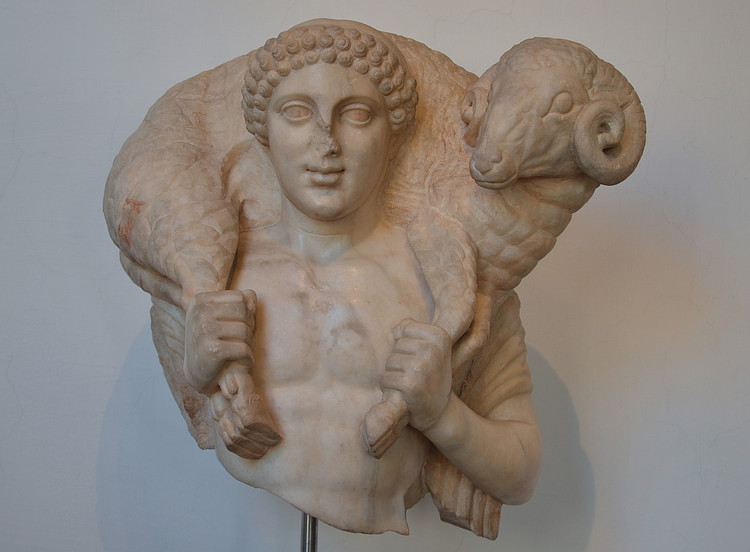
In ancient Greek [Archaic](https://www.worldhistory.org/disambiguation/Archaic/) and Classical art, Hermes is depicted holding the *kerykeion* or caduceus staff (signifying his role as a herald, the stick is either cleft or with an open figure of 8 at the top), wearing winged sandals (symbolic of his role as a messenger), a long tunic or leopard skin, sometimes also a winged cap (*petasos*), and occasionally with a lyre. He may also carry a ram in a nod to his role as patron of shepherds, especially in Boeotian and Arcadian art. In his association with youths, the god was often portrayed as abeardless youth holding the infant [Hercules](https://www.worldhistory.org/hercules/) or [Achilles](https://www.worldhistory.org/achilles/). At the same time, his association with trade is evidenced in the seals of Delos where he carries a purse. Perhaps the most celebrated depiction of Hermes in Greek art is the magnificent statue by Praxiteles (c. 330 BCE) which once stood in the [temple](https://www.worldhistory.org/temple/) of [Hera](https://www.worldhistory.org/Hera/) at [Olympia](https://www.worldhistory.org/Olympia/) and now resides in the archaeological museum of the site.
#### Editorial Review
This human-authored definition has been reviewed by our editorial team before publication to ensure accuracy, reliability and adherence to academic standards in accordance with our [editorial policy](https://www.worldhistory.org/static/editorial-policy/).
## Bibliography
- Bagnall, R. (ed). *The Encyclopedia of Ancient History.* Wiley-Blackwell, 2012
- Carabatea, M. *Greek Mythology.* Pergamos, Peania, 2007
- [Carpenter, T.H. *Art and Myth in Ancient Greece.* Thames & Hudson, 2012.](https://www.worldhistory.org/books/B000EQ2DA0/)
- [Graves, R. *The Greek Myths.* Penguin Classics, 2012.](https://www.worldhistory.org/books/0143106716/)
- [Graziosi, B. *The Gods of Olympus.* Picador, 2015.](https://www.worldhistory.org/books/1250062349/)
- [Hornblower, S. *The Oxford Classical Dictionary.* Oxford University Press, 2012.](https://www.worldhistory.org/books/0199545561/)
- [National Geographic. *National Geographic Essential Visual History of World Mythology.* National Geographic, 2008.](https://www.worldhistory.org/books/142620373X/)
## About the Author
Mark is WHE’s Publishing Director and has an MA in Political Philosophy (University of York). He is a full-time researcher, writer, historian and editor. Special interests include art, architecture and discovering the ideas that all civilizations share.
## Timeline
- **c. 330 BCE**: Statue of [Hermes](https://www.worldhistory.org/Hermes/) sculpted by Praxiteles.
## Questions & Answers
### What is Hermes the god known for?
Hermes is known as one of the 12 Olympian gods and is their herald and messenger, particularly for Zeus. Hermes is known for inventing many things such as the lyre, alphabet, and dice.
### How is Hermes shown in art?
Hermes is usually shown in art with either a winged helmet or winged sandals. The wings signify his role as the messenger of the Olympian gods.
### What powers does Hermes have?
Hermes is known for his great speed which made him ideal to be the messenger of the gods. He is also a bit of a trickster and he symbolised boundaries of all kinds, perhaps even the boundary between the gods and humanity.
## External Links
- [Hermes (Greek deity) | Royal Academy of Arts](https://www.royalacademy.org.uk/art-artists/name/hermes-greek-deity)
- [Mercury/Hermes - Fitzwilliam Museum - Cambridge](https://fitzmuseum.cam.ac.uk/explore-our-collection/highlights/context/subjects/mercuryhermes)
## Cite This Work
### APA
Cartwright, M. (2019, August 28). Hermes: The Messenger of the Olympian Gods. *World History Encyclopedia*.
### Chicago
Cartwright, Mark. "Hermes: The Messenger of the Olympian Gods." *World History Encyclopedia*, August 28, 2019. .
### MLA
Cartwright, Mark. "Hermes: The Messenger of the Olympian Gods." *World History Encyclopedia*, 28 Aug 2019, .
## License & Copyright
Submitted by [Mark Cartwright](https://www.worldhistory.org/user/markzcartwright/ "User Page: Mark Cartwright"), published on 28 August 2019. The copyright holder has published this content under the following license: [Creative Commons Attribution-NonCommercial-ShareAlike](https://creativecommons.org/licenses/by-nc-sa/4.0/deed.en). This license lets others remix, tweak, and build upon this content non-commercially, as long as they credit the author and license their new creations under the identical terms. When republishing on the web a hyperlink back to the original content source URL must be included. Please note that content linked from this page may have different licensing terms.