---
title: Hera
author: Mark Cartwright
source: https://www.worldhistory.org/Hera/
format: machine-readable-alternate
license: Creative Commons Attribution-NonCommercial-ShareAlike (https://creativecommons.org/licenses/by-nc-sa/4.0/)
updated: 2023-03-30
---
# Hera
_Authored by [Mark Cartwright](https://www.worldhistory.org/user/markzcartwright/)_
Hera ([Roman](https://www.worldhistory.org/disambiguation/Roman/) name: [Juno](https://www.worldhistory.org/Juno/)) is the wife of [Zeus](https://www.worldhistory.org/zeus/) and queen of the ancient [Greek](https://www.worldhistory.org/disambiguation/greek/) gods. Hera represented the ideal woman, was the goddess of marriage and the family, and protectress of [women](https://www.worldhistory.org/disambiguation/women/) in childbirth. Hera was always faithful to Zeus but she was famous for her jealous and vengeful nature, principally aimed against her husband's lovers and their illegitimate children.
### Family Relations
In [Greek mythology](https://www.worldhistory.org/Greek_Mythology/), Hera was the daughter of [Cronus](https://www.worldhistory.org/Cronus/) and [Rhea](https://www.worldhistory.org/Rhea/), and mother of [Ares](https://www.worldhistory.org/Ares/) ([god](https://www.worldhistory.org/God/) of [war](https://www.worldhistory.org/disambiguation/War/)), [Hebe](https://www.worldhistory.org/Hebe/) (goddess of youth), and [Eileithyia](https://www.worldhistory.org/Eileithyia/) (goddess of childbirth), all with Zeus. Hera also gave birth alone to [Hephaistos](https://www.worldhistory.org/Hephaistos/) (god of metallurgy) in retaliation for Zeus' similarly single-handed birth of [Athena](https://www.worldhistory.org/athena/). However, Hera threw Hephaistos from Mount Olympus because of his ugliness, and crashing to earth, the god became lame. In other accounts, Hephaistos was thrown from the heavens by Zeus precisely because of his lameness. In any case, Hephaistos held a grudge against his mother and even imprisoned her in a special throne. Hera was only released from the device by promising her son the hand of [Aphrodite](https://www.worldhistory.org/Aphrodite/) in marriage.
### The Infidelities of Zeus
Hera constantly battled with her husband's infidelity and she often took swift revenge. [Leto](https://www.worldhistory.org/Leto/) was so punished through Hera promising to curse any land that gave the pregnant goddess refuge. Only after months of wanderings could Leto find a place ([Delos](https://www.worldhistory.org/delos/)) to give birth to her son, the god [Apollo](https://www.worldhistory.org/apollo/). Even then, Hera had her daughter Eileithyia prolong the labour to nine months.
In various versions, a very popular myth involved Hera, Zeus, and Io. In some accounts, the queen of the gods turned Io, who was one her own priestesses and a former princess of [Argos](https://www.worldhistory.org/argos/), into a cow to deter Zeus' advances, but in other versions, it was Zeus who turned the girl into a white cow, either to secretly rendezvous with her or to persuade Hera that he was not really interested in Io. However, Hera discovered their courting, took custody of the cow. and set the one- hundred-eyed Argos to guard her. Zeus then employed [Hermes](https://www.worldhistory.org/Hermes/) to lull Argos to sleep and kill him. In memory, Hera then set his 100 eyes on the wings of a bird - the peacock. Finally, not to be outdone, the Greek goddess sent a gadfly to continually pester the unfortunate Io.
Other victims of Hera's jealousy were Semele, who was tricked by Hera into asking Zeus to reveal himself in all his godly splendour and the sight immediately destroyed her. Callisto was another of Zeus' lovers who caught the wrath of Hera as she was turned into a bear and hunted by [Artemis](https://www.worldhistory.org/artemis/). Zeus, in pity, later made her into a constellation, the Bear.
Hera went to great lengths to revenge herself for Zeus' infidelity with Alkmene, principally focussing her wrath on their son [Hercules](https://www.worldhistory.org/hercules/). Hera delayed his birth so that his cousin Eurystheus could claim the throne of [Tiryns](https://www.worldhistory.org/tiryns/), sent two snakes to kill the infant while he slept, caused the hero to become mad and kill his own wife and children, and had Eurystheus set the hero his twelve labours, which being so dangerous, she hoped they would be fatal. She also set the Hydra of Lerna against the inhabitants of Hercules' home town and set the [Amazons](https://www.worldhistory.org/amazon/) against the hero when he went in search of the girdle of [Hippolyta](https://www.worldhistory.org/Hippolyta/). Hera was also responsible for some of the fierce monsters Hercules had to fight - the lion which terrorized [Nemea](https://www.worldhistory.org/nemea/) and the Ladon dragon which protected the goddess' sacred apple trees, a wedding gift from [Gaia](https://www.worldhistory.org/Gaia/). Another [pan](https://www.worldhistory.org/Pan/)-[Hellenic](https://www.worldhistory.org/greece/) hero though, who did receive Hera's favour, was Jason, of the [Golden Fleece](https://www.worldhistory.org/Golden_Fleece/) fame. The hero had helped the goddess unknowingly when she was disguised as an old woman and wanted to cross a dangerous river, and she promised to be always at hand in any hour of need.
[  Elis Silver Stater Mark Cartwright (CC BY-NC-SA) ](https://www.worldhistory.org/image/819/elis-silver-stater/ "Elis Silver Stater")Finally, two more victims of the queen of gods were [Ixion](https://www.worldhistory.org/Ixion/), who was tied to an ever-spinning wheel down in [Hades](https://www.worldhistory.org/Hades/) as punishment for his attempted seduction of Hera, and Tityos, who was punished for the same indiscretion by being chained to a rock and having his liver eaten daily by a vulture.
### The [Trojan War](https://www.worldhistory.org/Trojan_War/)
Hera was a major protagonist in the story of the Trojan War as told in [Homer](https://www.worldhistory.org/homer/)'s *[Iliad](https://www.worldhistory.org/iliad/)*. The goddess supports the Achaeans and frequently schemes with other deities to bring the downfall of [Troy](https://www.worldhistory.org/troy/), as she never forgave the Trojan prince [Paris](https://www.worldhistory.org/disambiguation/paris/) for choosing Aphrodite above her as the most beautiful goddess. In the *Iliad*, Hera mentions three [cities](https://www.worldhistory.org/city/) particularly dear to her - Argos, [Sparta](https://www.worldhistory.org/sparta/), and [Mycenae](https://www.worldhistory.org/mycenae/) (or Mykene). We are also told that as a child she was raised by Ocean and Tethys whilst Zeus battled with Cronos. Homer most often describes Hera as 'white-armed', 'ox-eyed', and 'Hera of Argos'. [Hesiod](https://www.worldhistory.org/hesiod/), in his *[Theogony](https://www.worldhistory.org/Theogony/)*, similarly describes Hera as: 'of Argos' and more frequently as 'golden-sandaled'.
### Sites Sacred to Hera
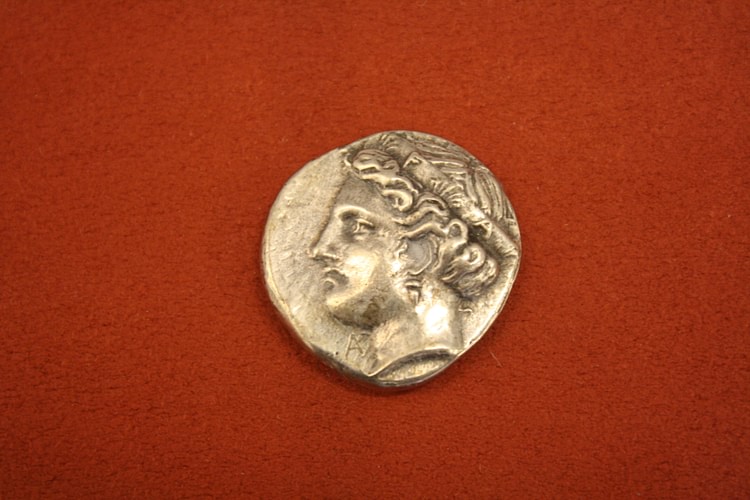
Hera was a major figure in the [Greek religion](https://www.worldhistory.org/Greek_Religion/). She was the patron of Argos, which possessed a sanctuary to the goddess from the mid-8th century BCE. She also had a [temple](https://www.worldhistory.org/temple/) dedicated to her at [Olympia](https://www.worldhistory.org/Olympia/) (650-600 BCE), and Tiryns was an important cult centre to the goddess in the 7th century BCE. The island of [Samos](https://www.worldhistory.org/samos/), in some accounts the birthplace of the goddess, had been a centre for cult worship of the Greek goddess as far back as the [Mycenaean period](https://www.worldhistory.org/Mycenaean_Civilization/) in the mid-2nd millennium BCE, and a major centre was created from the 8th century BCE which prospered right into the Roman period. Hera was greatly esteemed at Elis, where coins depicted the goddess in the 5th and 4th century BCE. Across [Greece](https://www.worldhistory.org/greece/), sporting competitions for women, the *Heraia*, were held in Hera's honour, as were annual marriage festivals (*hierogamy*) when couples re-enacted the marriage of Zeus and Hera.
[  Temple of Hera, Selinus Mark Cartwright (CC BY-NC-SA) ](https://www.worldhistory.org/image/2600/temple-of-hera-selinus/ "Temple of Hera, Selinus")### How was Hera Represented in Art?
As one of the most important deities, Hera was, naturally, a prominent figure in ancient Greek art, particularly on Attic red- and [black-figure pottery](https://www.worldhistory.org/Black_Figure_Pottery/). However, without any specific attributes she is often hard to distinguish from other goddesses. She is most often seated on a throne and sometimes wears a crown (*polos*), holds a royal sceptre, and wears a bridal veil. On occasion she is also depicted holding a pomegranate, a traditional symbol of fertility. Other associations include the peacock - symbol of pride - and the cuckoo, the form Zeus first took when he courted Hera - both of which the goddess reportedly kept as pets on Mount Olympus - and finally, with the lily flower.
### Hera as Roman Juno
In Roman [culture](https://www.worldhistory.org/disambiguation/culture/) the goddess lived on as Juno, although she principally represented the good family and faithful marriage attributes of Hera rather than the jealous avenger of infidelity. Juno was one of the most important Roman gods along with [Jupiter](https://www.worldhistory.org/jupiter/) and [Minerva](https://www.worldhistory.org/Minerva/); indeed she was also the patron of [Rome](https://www.worldhistory.org/Rome/) itself. The annual *Matronalia* was a festival held in her honour in June, the month which carried her name and the period regarded as the most auspicious time to get married in Roman culture.
#### Editorial Review
This human-authored definition has been reviewed by our editorial team before publication to ensure accuracy, reliability and adherence to academic standards in accordance with our [editorial policy](https://www.worldhistory.org/static/editorial-policy/).
## Bibliography
- Anonymous. *Ancient Greece Temples And Sanctuaries.* Toubis, Athens, 2010
- Carabatea, M. *Greek Mythology.* Pergamos, Peania, 1997
- [Carpenter, T.H. *Art and Myth in Ancient Greece.* Thames & Hudson, 2012.](https://www.worldhistory.org/books/B000EQ2DA0/)
- [Hesiod. *Hesiod.* Loeb Classical Library, 2007.](https://www.worldhistory.org/books/0674996224/)
- [Homer. *The Iliad.* Penguin Classics, 1998.](https://www.worldhistory.org/books/0140275363/)
- Hope Moncrieff, A.R. *Classical Mythology.* Senate, London, 1994
- [National Geographic. *National Geographic Essential Visual History of World Mythology.* National Geographic, 2008.](https://www.worldhistory.org/books/142620373X/)
## About the Author
Mark is WHE’s Publishing Director and has an MA in Political Philosophy (University of York). He is a full-time researcher, writer, historian and editor. Special interests include art, architecture and discovering the ideas that all civilizations share.
## Timeline
- **c. 700 BCE**: [Greek](https://www.worldhistory.org/disambiguation/greek/) poet [Hesiod](https://www.worldhistory.org/hesiod/) writes his *[Theogony](https://www.worldhistory.org/Theogony/)* and *[Works and Days](https://www.worldhistory.org/Works_and_Days/)*.
- **650 BCE - 600 BCE**: Heraion, [temple](https://www.worldhistory.org/temple/) dedicated to [Hera](https://www.worldhistory.org/Hera/) built at [Olympia](https://www.worldhistory.org/Olympia/).
- **570 BCE - 560 BCE**: A large [temple](https://www.worldhistory.org/temple/) is built and dedicated to [Hera](https://www.worldhistory.org/Hera/) on [Samos](https://www.worldhistory.org/samos/).
- **570 BCE - 530 BCE**: The Doric [Temple](https://www.worldhistory.org/temple/) of [Hera](https://www.worldhistory.org/Hera/) is built at [Metapontum](https://www.worldhistory.org/Metapontum/), [Magna Graecia](https://www.worldhistory.org/Magna_Graecia/).
- **c. 550 BCE**: The [Temple](https://www.worldhistory.org/temple/) of [Hera](https://www.worldhistory.org/Hera/) I is built at [Paestum](https://www.worldhistory.org/Paestum/).
- **c. 520 BCE**: A new [temple](https://www.worldhistory.org/temple/) is built and dedicated to [Hera](https://www.worldhistory.org/Hera/) on [Samos](https://www.worldhistory.org/samos/) during the reign of [Polycrates](https://www.worldhistory.org/Polycrates/).
- **c. 460 BCE**: The [temple](https://www.worldhistory.org/temple/) of [Hera](https://www.worldhistory.org/Hera/) II is built at [Paestum](https://www.worldhistory.org/Paestum/).
## Questions & Answers
### What is Hera a goddess of?
Hera is the Greek goddess of marriage, the family, and childbirth.
### Is Zeus In Love With Hera?
Zeus seems to love Hera in Greek mythology since the couple remained together but Zeus was infamous for his many affairs and illegitimate children.
### Who Suffered from the Vengeance of Hera?
Many of Zeus' lovers and illegitimate children suffered the revenge of Hera, Zeus' wife. Hera promised to curse any land that gave refuge to Leto, she turned Io into a cow, and she transformed Callisto into a bear. Hera became a major obstacle for Hercules, sending many strange creatures to battle the hero.
## Cite This Work
### APA
Cartwright, M. (2012, September 10). Hera. *World History Encyclopedia*.
### Chicago
Cartwright, Mark. "Hera." *World History Encyclopedia*, September 10, 2012. .
### MLA
Cartwright, Mark. "Hera." *World History Encyclopedia*, 10 Sep 2012, .
## License & Copyright
Submitted by [Mark Cartwright](https://www.worldhistory.org/user/markzcartwright/ "User Page: Mark Cartwright"), published on 10 September 2012. The copyright holder has published this content under the following license: [Creative Commons Attribution-NonCommercial-ShareAlike](https://creativecommons.org/licenses/by-nc-sa/4.0/deed.en). This license lets others remix, tweak, and build upon this content non-commercially, as long as they credit the author and license their new creations under the identical terms. When republishing on the web a hyperlink back to the original content source URL must be included. Please note that content linked from this page may have different licensing terms.