---
title: Helios
author: Mark Cartwright
source: https://www.worldhistory.org/Helios/
format: machine-readable-alternate
license: Creative Commons Attribution-NonCommercial-ShareAlike (https://creativecommons.org/licenses/by-nc-sa/4.0/)
updated: 2023-03-29
---
# Helios
_Authored by [Mark Cartwright](https://www.worldhistory.org/user/markzcartwright/)_
Helios (also Helius) was the [god](https://www.worldhistory.org/God/) of the Sun in [Greek mythology](https://www.worldhistory.org/Greek_Mythology/). Helios rode a golden [chariot](https://www.worldhistory.org/chariot/) which brought the Sun across the skies each day from the east (Ethiopia) to the west ([Hesperides](https://www.worldhistory.org/Hesperides/)). Helios was famously the subject of the [Colossus of Rhodes](https://www.worldhistory.org/Colossus_of_Rhodes/), the [giant](https://www.worldhistory.org/Giants/) [bronze](https://www.worldhistory.org/disambiguation/bronze/) statue considered one of [the Seven Wonders](https://www.worldhistory.org/The_Seven_Wonders/) of the Ancient World.
### Helios in [Mythology](https://www.worldhistory.org/mythology/)
In [Greek](https://www.worldhistory.org/disambiguation/greek/) mythology, Helios is the offspring of the titans Hyperion and Theia. His sisters were [Selene](https://www.worldhistory.org/Selene/) (the Moon) and [Eos](https://www.worldhistory.org/Eos/) (Dawn). [Hesiod](https://www.worldhistory.org/hesiod/) informs us in his *[Theogony](https://www.worldhistory.org/Theogony/)* that with Perseis, daughter of Ocean, he had two children, [Circe](https://www.worldhistory.org/Circe/) and king Aietes, who ruled at Kolchis. Later, Apollodorus adds [Pasiphae](https://www.worldhistory.org/Pasiphae/) too. Helios is also the father of Phaethon, whose mother was Clymene. When the youngster discovered that his father was the Sun he went to him in the east and asked for a gift. Helios offered him anything he wished, and Phaethon asked if he could ride his father's blazing chariot across the sky. Helios consented, but the favour turned into a tragedy when Phaethon proved unable to control Helios' wild horses, and when he spun out of control, [Zeus](https://www.worldhistory.org/zeus/) was obliged to strike down Phaethon with a thunderbolt lest he set the whole world on fire.
Helios pops up in several other Greek myths, albeit in mere cameo appearances. The Sun god shines on the amorous couple [Aphrodite](https://www.worldhistory.org/Aphrodite/) and [Ares](https://www.worldhistory.org/Ares/) revealing to [Hephaistos](https://www.worldhistory.org/Hephaistos/) the illicit shenanigans of his wife in the trap he had set. Helios also appears in the [Hercules](https://www.worldhistory.org/hercules/) myth when the hero was performing his 10th labour to fetch the cattle of Geryon from Erytheia in the far west. Fed up with the burning sun on his outward voyage, Hercules threatened to fire one of his arrows at Helios. The god, rather than punish Hercules for his petulance, rewarded his daring by gifting him a golden bowl which he used to sail the seas in greater comfort. The bowl must have been a large one because when the hero gathered together the cattle he herded them into the bowl and brought them back to [Mycenae](https://www.worldhistory.org/mycenae/) that way. When home safe again, he returned the bowl to Helios with gratitude.
The famous sacred cattle of Helios, which he kept on Thrinacia (perhaps [Sicily](https://www.worldhistory.org/sicily/) or Malta), were stolen once by the giant Alkyoneus, an outrageous act which was avenged by Hercules. Helios again had some of his flock attacked, and this time eaten too, by the hungry comrades of [Odysseus](https://www.worldhistory.org/odysseus/) on their long voyage home from the [Trojan War](https://www.worldhistory.org/Trojan_War/). In vengeance, Helios enlisted the help of Zeus who destroyed the ship and drowned Odysseus' crew for their impiety.
### Cults & Worship of Helios
The god was not the subject of a wide-spread cult, but [Plato](https://www.worldhistory.org/plato/) informs us in his *[Symposium](https://www.worldhistory.org/Symposium/)* and other works that many people, including [Socrates](https://www.worldhistory.org/socrates/), would greet the Sun and offer prayers each day. More direct and ceremonial worship of the Sun was, in fact, held by the Greeks as a point of distinction between other races and themselves, they did not indulge in it while 'barbarians' did. Still, despite being one of the minor gods, the 5th-century BCE philosopher [Anaxagoras](https://www.worldhistory.org/Anaxagoras/) of Clazomenae did cause outrage when he said that, according to his calculations, the Sun was not a god but a huge burning rock.
The one place in [Greece](https://www.worldhistory.org/greece/) where the worship of Helios was important was on Rhodes. In its founding mythology, the name of the island derives from the [nymph](https://www.worldhistory.org/nymph/) Rhodos who bore seven sons to Helios, the patron of the island. Three grandsons of these offspring were the heroes of the three principal [cities](https://www.worldhistory.org/city/) on the island: Camirus, Ialysus, and Lindus, which were named after them. In honour of Helios, Panhellenic games, the Halieia, were held on the island every five years, and each year a chariot and four horses (*quadriga*) were thrown into the sea as an offering to the god. The famous bronze statue of Helios known as the Colossus of Rhodes was considered one of the Seven Wonders of the Ancient World. At 33 metres high, the massive standing figure of Helios dominated the harbour of the [city](https://www.worldhistory.org/city/). Built between 304 and 280 BCE, it was toppled by an [earthquake](https://www.worldhistory.org/disambiguation/earthquake/) in either 228 or 226 BCE.
The god [Apollo](https://www.worldhistory.org/apollo/) was linked with the Sun from the 5th century BCE, and the association became ever stronger from the [Hellenistic period](https://www.worldhistory.org/Hellenistic_Period/), largely thanks to the influence of [Greek philosophers](https://www.worldhistory.org/collection/118/the-greek-philosophers/) who began to give more importance to celestial bodies. Apollo and Helios then became almost synonymous, just as Hyperion and Helios had been in the [Archaic period](https://www.worldhistory.org/Archaic_Period/). The Romans went one step further and made Helios, also known as Sol, an important cult god. [Rome](https://www.worldhistory.org/Rome/)'s [Circus Maximus](https://www.worldhistory.org/Circus_Maximus/), for example, had a [temple](https://www.worldhistory.org/temple/) dedicated to Sol and Luna (the Moon) from the 3rd century BCE. The worship of Sol gained greater importance in the imperial period, especially during the reigns of the 3rd century CE emperors [Elagabalus](https://www.worldhistory.org/Elagabalus/) and [Aurelian](https://www.worldhistory.org/Aurelian/). The latter was even the son of a priestess of the Sun. A dedicated priesthood, known as the pontifices Solis, managed what was now the most important imperial cult, a position it would hold until replaced by [Christianity](https://www.worldhistory.org/christianity/).
[  Helios Relief, Troy Carole Raddato (CC BY-SA) ](https://www.worldhistory.org/image/5121/helios-relief-troy/ "Helios Relief, Troy")### How is Helios Represented in Art?
Helios appears in all forms of Greek and [Roman art](https://www.worldhistory.org/Roman_Art/), where he is usually depicted as a youth wearing a crown of sun rays. Helios is often in the background or edge of scenes in [Greek pottery](https://www.worldhistory.org/Greek_Pottery/) decoration riding his golden chariot, but in one red-figure kalyx-krater (c. 420 BCE), now in the British Museum, he takes centre stage whilst before him young male children representing the stars descend into the ocean as he approaches. Most often Helios' chariot is pulled by winged horses but sometimes dragons do the job, as in a c. 400 BCE red-figure krater from Lucania which shows his granddaughter [Medea](https://www.worldhistory.org/Medea/) at the reigns. Helios also frequently appeared on 6th-century BCE black-figure and 5th-century BCE [red-figure pottery](https://www.worldhistory.org/Red-Figure_Pottery/) in scenes from the Hercules story, again usually riding his golden chariot in the background. The god was, for centuries, also depicted on the coins of his patron city Rhodes.[ 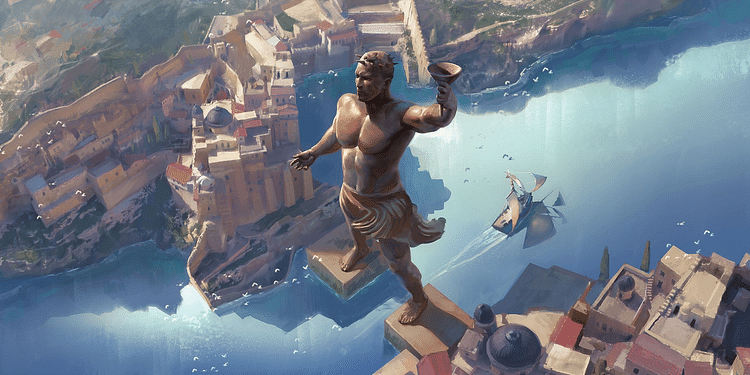 Greco-Roman Colossus (Artist's Impression) Mohawk Games (Copyright) ](https://www.worldhistory.org/image/12939/greco-roman-colossus-artists-impression/ "Greco-Roman Colossus (Artist's Impression)")In [sculpture](https://www.worldhistory.org/disambiguation/Sculpture/), Helios was shown in the east pediment of the [Parthenon](https://www.worldhistory.org/parthenon/) where he rises in his chariot from the ocean at the extreme left of the composition. As we have seen his most famous representation in antiquity was as the Colossus of Rhodes, but in Rome similar gigantic statues of the [Roman](https://www.worldhistory.org/disambiguation/Roman/) emperors [Vespasian](https://www.worldhistory.org/Vespasian/) and [Nero](https://www.worldhistory.org/Nero/) were made to represent these mere mortals as the mighty Helios too.
#### Editorial Review
This human-authored definition has been reviewed by our editorial team before publication to ensure accuracy, reliability and adherence to academic standards in accordance with our [editorial policy](https://www.worldhistory.org/static/editorial-policy/).
## Bibliography
- Bagnall, R. et al. *The Encyclopedia of Ancient History.* Wiley-Blackwell, 2012
- [Carabatea, M. *Greek Mythology.* Adam Editions, 1997.](https://www.worldhistory.org/books/9605001020/)
- [Carpenter, T.H. *Art and Myth in Ancient Greece.* Thames & Hudson, 1991.](https://www.worldhistory.org/books/0500202362/)
- [Graziosi, B. *The Gods of Olympus.* Picador, 2015.](https://www.worldhistory.org/books/1250062349/)
- [Hesiod. *Hesiod.* Harvard University Press, 2007.](https://www.worldhistory.org/books/0674996224/)
- [Homer. *The Odyssey.* Penguin Classics, 1999.](https://www.worldhistory.org/books/0140268863/)
## About the Author
Mark is WHE’s Publishing Director and has an MA in Political Philosophy (University of York). He is a full-time researcher, writer, historian and editor. Special interests include art, architecture and discovering the ideas that all civilizations share.
## Timeline
- **c. 800 BCE - c. 700 BCE**: [Homer](https://www.worldhistory.org/homer/) of [Greece](https://www.worldhistory.org/greece/) writes his *[Iliad](https://www.worldhistory.org/iliad/)* and *[Odyssey](https://www.worldhistory.org/Odyssey/)*.
- **c. 700 BCE**: [Greek](https://www.worldhistory.org/disambiguation/greek/) poet [Hesiod](https://www.worldhistory.org/hesiod/) writes his *[Theogony](https://www.worldhistory.org/Theogony/)* and *[Works and Days](https://www.worldhistory.org/Works_and_Days/)*.
- **c. 292 BCE - c. 280 BCE**: The [Colossus of Rhodes](https://www.worldhistory.org/Colossus_of_Rhodes/), a representation of [Helios](https://www.worldhistory.org/Helios/), is built in [Rhodes](https://www.worldhistory.org/Rhodes/) town harbour, one of [the Seven Wonders](https://www.worldhistory.org/The_Seven_Wonders/) of the Ancient World.
- **228 BCE - 226 BCE**: The [Colossus of Rhodes](https://www.worldhistory.org/Colossus_of_Rhodes/) is toppled by an [earthquake](https://www.worldhistory.org/disambiguation/earthquake/).
## Questions & Answers
### What is Helios the god of?
Helios is the Greek god of the Sun.
### Are Helios and Apollo the same god?
Helios and Apollo are not the same god, but Apollo was regarded as a Sun god from the 5th century BCE.
### What are 5 facts about Helios?
5 facts about Helios are: he was the Greek god of the Sun, he was the son of the Titan Hyperion, he was the father of Phaethon, he had a sacred herd of cattle, and he was the subject of the Colossus of Rhodes, a Wonder of the Ancient World.
## External Links
- [The science behind the myth: Homer's "Odyssey" - Matt Kaplan](http://ed.ted.com/lessons/the-science-behind-the-myth-homer-s-odyssey-matt-kaplan)
## Cite This Work
### APA
Cartwright, M. (2016, May 16). Helios. *World History Encyclopedia*.
### Chicago
Cartwright, Mark. "Helios." *World History Encyclopedia*, May 16, 2016. .
### MLA
Cartwright, Mark. "Helios." *World History Encyclopedia*, 16 May 2016, .
## License & Copyright
Submitted by [Mark Cartwright](https://www.worldhistory.org/user/markzcartwright/ "User Page: Mark Cartwright"), published on 16 May 2016. The copyright holder has published this content under the following license: [Creative Commons Attribution-NonCommercial-ShareAlike](https://creativecommons.org/licenses/by-nc-sa/4.0/deed.en). This license lets others remix, tweak, and build upon this content non-commercially, as long as they credit the author and license their new creations under the identical terms. When republishing on the web a hyperlink back to the original content source URL must be included. Please note that content linked from this page may have different licensing terms.