---
title: Hecate
author: Mark Cartwright
source: https://www.worldhistory.org/Hecate/
format: machine-readable-alternate
license: Creative Commons Attribution-NonCommercial-ShareAlike (https://creativecommons.org/licenses/by-nc-sa/4.0/)
updated: 2023-06-16
---
# Hecate
_Authored by [Mark Cartwright](https://www.worldhistory.org/user/markzcartwright/)_
Hecate (Hekate) is a goddess of [Greek mythology](https://www.worldhistory.org/Greek_Mythology/) capable of both good and evil. She was associated with witchcraft, magic, the Moon, doorways, and creatures of the night like hell-hounds and ghosts. Hecate often carries a torch in her connection with the night. She has three faces for her role as the goddess of boundaries and the guardian of crossroads.
### Hecate's Family Relations
According to [Hesiod](https://www.worldhistory.org/hesiod/) in his *[Theogony](https://www.worldhistory.org/Theogony/)*, Hecate is the daughter of Perses and Asteria, making her the granddaughter of the Titans Phoebe and Coeus. [Euripides](https://www.worldhistory.org/Euripides/), on the other hand, mentions her mother is [Leto](https://www.worldhistory.org/Leto/). Other writers claim her as the daughter of [Zeus](https://www.worldhistory.org/zeus/) and [Demeter](https://www.worldhistory.org/demeter/), Aristaion or Night. The goddess was frequently associated with Demeter and even assimilated to her in some cults.
### Rituals Associated with Hecate
From the 5th century BCE, the goddess is associated with the darker side of the human experience, that is [death](https://www.worldhistory.org/disambiguation/Death/), witchcraft, magic, the Moon, dreams, fierce hounds and creatures which roam the darkness of night. As the *Oxford Classical Dictionary* phrases it,
> …outlandish in her infernal aspects, she is more at home on the fringes than in the centre of [Greek](https://www.worldhistory.org/disambiguation/greek/) polytheism. Intrinsically ambivalent and polymorphous, she straddles conventional boundaries and eludes definition. (649)
Hesiod describes the goddess in the following glowing terms:
> Zeus, [Cronus](https://www.worldhistory.org/Cronus/)' son, honoured \[Hecate\] above all others: he gave her splendid gifts - to have a share of the earth and of the barren sea, and from the starry sky as well she has a share in honour, and is honoured most of all by the immortal gods. For even now, whenever any human on the earth seeks propitiation by performing fine sacrifices according to custom, he invokes Hecate; and much honor very easily stays with that man whose prayers the goddess accepts with gladness, and she bestows happiness upon him. (Theogony 411-420)
Hesiod goes on to say that Hecate supports or is a protective goddess of warriors, athletes, hunters, horsemen, herdsmen, shepherds, fishermen, and children. Her companions are the [Furies](https://www.worldhistory.org/Furies/) (Erinyes), the winged creatures who punished wrong-doing, and her children are the Empusae, female demons partial to seducing travellers.
[  The Temple of Hecate in Lagina, Caria Carole Raddato (CC BY-SA) ](https://www.worldhistory.org/image/4408/the-temple-of-hecate-in-lagina-caria/ "The Temple of Hecate in Lagina, Caria")The goddess had unusual rituals performed in her honour in the [Greek religion](https://www.worldhistory.org/Greek_Religion/), which include the offerings of food – given at crossroads, road junctions, and any other sort of boundary or threshold – known as 'the supper of Hecate'. These took the form of small cakes of eggs, cheese, bread, and dog meat, which were lit with miniature torches or, alternatively, a dish of red mullet, which was usually prohibited from offerings to the other gods. Hecate was also offered the sacrifice of dogs, especially puppies. The dog connection may be the fact that dogs were known to eat the dead if left unburied; they also howl at the moon, of course. A further canine connection may be with the [Egyptian](https://www.worldhistory.org/disambiguation/Egyptian/) [god](https://www.worldhistory.org/God/) [Anubis](https://www.worldhistory.org/Anubis/) who guided souls to the underworld, and the Greek three-headed hound of [Hades](https://www.worldhistory.org/Hades/), [Cerberus](https://www.worldhistory.org/Cerberus/), may be an earlier form of Hecate. The offerings to the goddess were made each month during the night of a new moon. The goddess was especially appealed to by sorceresses for aid in their magic and spells and appears on surviving examples of curse tablets.
According to [Pausanias](https://www.worldhistory.org/disambiguation/Pausanias/), the 2nd-century CE Greek traveller, the island of [Aegina](https://www.worldhistory.org/Aegina/) had a mystery cult dedicated to the goddess where it was believed those suffering mental illness could be cured. [Kos](https://www.worldhistory.org/Kos/), Erythrai, [Samothrace](https://www.worldhistory.org/Samothrace/), [Thessaly](https://www.worldhistory.org/disambiguation/Thessaly/), and Miletos also worshipped the goddess, with the latter having a 6th-century BCE circular altar for sacrifices to be made in her honour (the earliest archaeological evidence of her worship). The worship of Hecate continued into the [Hellenistic](https://www.worldhistory.org/Hellenic_World/) and [Roman](https://www.worldhistory.org/disambiguation/Roman/) periods with significant archaeological finds of votive offerings to the goddess being found at Lagina in Caria and [Phrygia](https://www.worldhistory.org/phrygia/).
### How is Hecate Represented in Art?
Hecate appears regularly in Greek art and [literature](https://www.worldhistory.org/literature/) only from the 5th century BCE onwards, before which she is only a minor figure who features in the stories of Demeter (as [Persephone](https://www.worldhistory.org/persephone/)'s handmaid) and [Artemis](https://www.worldhistory.org/artemis/). This may indicate the goddess' relatively late arrival in [Greece](https://www.worldhistory.org/greece/) from Caria, although, she was considered a Greek goddess and not of foreign origin by the ancient Greeks themselves. She is typically portrayed on [Greek pottery](https://www.worldhistory.org/Greek_Pottery/) as a young woman carrying a torch or a key, both reminders of her function as a night deity, a guardian of the gates of Hades, and as a goddess of boundaries. One 5th-century BCE Attic vase depicts a woman offering the goddess a puppy and a basket of cakes.
[ 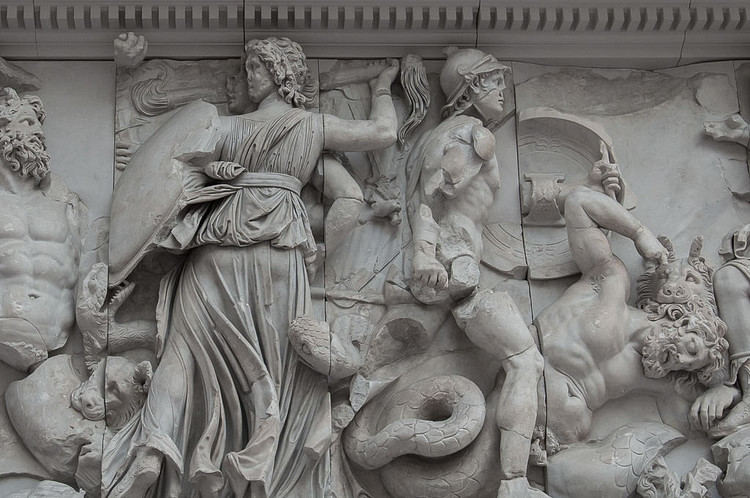 Hecate Fighting the Giant, Pergamon Altar Mina Bulic (CC BY-NC-ND) ](https://www.worldhistory.org/image/3618/hecate-fighting-the-giant-pergamon-altar/ "Hecate Fighting the Giant, Pergamon Altar")In [sculpture](https://www.worldhistory.org/disambiguation/Sculpture/), her most striking appearance occurs in Classical and [Hellenistic Period](https://www.worldhistory.org/Hellenistic_Period/) figures which have the goddess with three bodies and three heads (or a single body with three heads or three bodies and a single head), usually with halos of moonbeams. The historian Robert Graves notes that the heads could be of a dog, lion, and horse, which represented the constellations which cover the calendar year. The goddess, though, usually appears with human heads. Known as *hekataia*, the first example of the triple-Hecate form is credited to a figure which guarded the entrance to the [Acropolis](https://www.worldhistory.org/Acropolis/) of [Athens](https://www.worldhistory.org/Athens/), the Hekate Epipyrgidia ('On the Ramparts') by the 5th-century BCE sculptor Alcamenes. The 2nd-century BCE [Pergamon](https://www.worldhistory.org/pergamon/) Altar of Zeus has a three-headed Hecate attacking a snake-like [giant](https://www.worldhistory.org/Giants/), helped by a dog.
It was a common practice to place images of the triple goddess on city walls, in particular, at city gates, entrances to sacred sites and the doorways of private homes where it was believed she acted as a protectress and warded off evil spirits. Finally, the goddess is referenced in the tragedy plays of Euripides and [Sophocles](https://www.worldhistory.org/sophocles/), amongst others, and in [Virgil](https://www.worldhistory.org/virgil/)'s *[Aeneid](https://www.worldhistory.org/The_Aeneid/)* where she acts as Sibyl's guide in the Underworld.
#### Editorial Review
This human-authored definition has been reviewed by our editorial team before publication to ensure accuracy, reliability and adherence to academic standards in accordance with our [editorial policy](https://www.worldhistory.org/static/editorial-policy/).
## Bibliography
- Bagnall, R.S. *The Encyclopedia of Ancient History.* Wiley-Blackwell, 2012
- [Carpenter, T.H. *Art and Myth in Ancient Greece.* Thames & Hudson, 1991.](https://www.worldhistory.org/books/0500202362/)
- [Graves, R. *The Greek Myths.* Penguin UK, 2011.](https://www.worldhistory.org/books/0241952743/)
- [Hesiod. *Hesiod: Theogony.* Harvard University Press, 2007.](https://www.worldhistory.org/books/0674996224/)
- [Hornblower, S. *The Oxford Classical Dictionary.* Oxford University Press, 2012.](https://www.worldhistory.org/books/0199545561/)
## About the Author
Mark is WHE’s Publishing Director and has an MA in Political Philosophy (University of York). He is a full-time researcher, writer, historian and editor. Special interests include art, architecture and discovering the ideas that all civilizations share.
## Timeline
- **c. 700 BCE**: [Greek](https://www.worldhistory.org/disambiguation/greek/) poet [Hesiod](https://www.worldhistory.org/hesiod/) writes his *[Theogony](https://www.worldhistory.org/Theogony/)* and *[Works and Days](https://www.worldhistory.org/Works_and_Days/)*.
## Questions & Answers
### Is Hecate good or bad?
The Greek goddess Hecate is both good and bad because she is linked to death and the night but she also protects warriors, hunters, and shepherds.
### What does Hecate symbolise?
Hecate symbolises duality, both good and evil. She often has three faces to represent her role as a protector of boundaries of various kinds such as crossroads and doorways.
### What are Hecate's 3 forms?
The goddess Hecate often has three bodies and three heads. Most often these are human but sometimes she has the head of a dog, a lion, and a horse, perhaps representing different constellations and time periods.
### What are Hecate's powers?
The powers of Hecate include the ability to cure mental illness and magic of all kinds such as spells.
## Cite This Work
### APA
Cartwright, M. (2017, June 22). Hecate. *World History Encyclopedia*.
### Chicago
Cartwright, Mark. "Hecate." *World History Encyclopedia*, June 22, 2017. .
### MLA
Cartwright, Mark. "Hecate." *World History Encyclopedia*, 22 Jun 2017, .
## License & Copyright
Submitted by [Mark Cartwright](https://www.worldhistory.org/user/markzcartwright/ "User Page: Mark Cartwright"), published on 22 June 2017. The copyright holder has published this content under the following license: [Creative Commons Attribution-NonCommercial-ShareAlike](https://creativecommons.org/licenses/by-nc-sa/4.0/deed.en). This license lets others remix, tweak, and build upon this content non-commercially, as long as they credit the author and license their new creations under the identical terms. When republishing on the web a hyperlink back to the original content source URL must be included. Please note that content linked from this page may have different licensing terms.