---
title: Hebe
author: Liana Miate
source: https://www.worldhistory.org/Hebe/
format: machine-readable-alternate
license: Creative Commons Attribution-NonCommercial-ShareAlike (https://creativecommons.org/licenses/by-nc-sa/4.0/)
updated: 2023-02-23
---
# Hebe
_Authored by [Liana Miate](https://www.worldhistory.org/user/lianamiate/)_
Hebe (meaning "youth" or "bloom of youth") is the goddess and personification of eternal youth in [Greek mythology](https://www.worldhistory.org/Greek_Mythology/). She is the daughter of [Zeus](https://www.worldhistory.org/zeus/) and [Hera](https://www.worldhistory.org/Hera/) and the wife of the [Greek](https://www.worldhistory.org/disambiguation/greek/) hero [Hercules](https://www.worldhistory.org/hercules/). Hebe serves as the cupbearer for the gods and goddesses of Mount Olympus, and she has the gift of restoring youth to mortals.
In art, Hebe is depicted as a young virgin, holding a cup and wearing a flower crown or a golden wreath and a garment made up of varying colours. She often has dark hair and sparkling eyes and is sometimes accompanied by an eagle (symbolising Zeus). [Pindar](https://www.worldhistory.org/Pindar/) (c. 518 to c. 448/7 BCE), the ancient Greek lyric poet, referred to Hebe as the "fairest of all the goddesses" in his *Nemean Odes*, while in the *[Odyssey](https://www.worldhistory.org/Odyssey/)*, [Homer](https://www.worldhistory.org/homer/) (c. 750 BCE) states that she was famed for her "alluring ankles." Hebe's [Roman](https://www.worldhistory.org/disambiguation/Roman/) counterpart is Juventas.
### Birth & Family
In [Hesiod](https://www.worldhistory.org/hesiod/)'s (c. 700 BCE) *[Theogony](https://www.worldhistory.org/Theogony/)*, Hebe is listed as the daughter of Zeus and his sister-wife Hera, and the sister of [Ares](https://www.worldhistory.org/Ares/), the [god](https://www.worldhistory.org/God/) of [war](https://www.worldhistory.org/disambiguation/War/), and Eleithyia, the goddess of childbirth. She was also a half-sister to the [Graces](https://www.worldhistory.org/Graces/), the [Fates](https://www.worldhistory.org/Fates/), and the [Horae](https://www.worldhistory.org/Horae/).
> Last he took blooming Hera for his wife;
> Uniting with the king of gods and men,
> She gave him Hebe and Ares, and she bore
> The goddess Eileithuia to her mate.
> (*Theogony*, 921-925)
After Hebe's birth, the gods fought amongst themselves to give her gifts and honour. [Athena](https://www.worldhistory.org/athena/) and [Poseidon](https://www.worldhistory.org/poseidon/) gave her toys, while [Apollo](https://www.worldhistory.org/apollo/) soothed her with his [music](https://www.worldhistory.org/disambiguation/Music/). A rarer story of Hebe's birth has Hera becoming pregnant after eating or touching lettuce at a banquet with Apollo.
### Cupbearer to the Gods
Although Hebe was the daughter of the king and queen of the gods, she was given the role of cupbearer to the [immortals](https://www.worldhistory.org/disambiguation/immortals/). Her role is in line with ancient patriarchal customs, where the females in the home assisted with serving guests. She served the deities of Mount Olympus with wine, nectar and ambrosia in golden goblets. In the *[Iliad](https://www.worldhistory.org/iliad/)*, Homer mentions that Hebe served wine to the gods as they watched the [battle](https://www.worldhistory.org/disambiguation/battle/) between [Menelaus](https://www.worldhistory.org/Menelaus/) and [Paris](https://www.worldhistory.org/disambiguation/paris/).
> Now aloft by the side of Zeus the gods sat in council,
> conferring across Olympus' golden floor as noble Hebe
> poured them rounds of nectar. They lifted golden beakers,
> pledging each other warmly, gazing down on [Troy](https://www.worldhistory.org/troy/)…
> (*Iliad*, 4.1-4)
Hebe's time as cupbearer to the gods came to an end after she experienced a moment of ungracefulness and slipped while serving the gods. Zeus immediately dismissed her from her role and replaced her with the Trojan youth [Ganymede](https://www.worldhistory.org/Ganymede/), considered the most beautiful mortal by Zeus. Naturally, Hera was angered by her daughter's dismissal and her husband's affection for Ganymede. Annoyed by her anger, Zeus only continued to show his love for the youth by setting Ganymede's image among the stars as Aquarius, the water-bearer.
[ 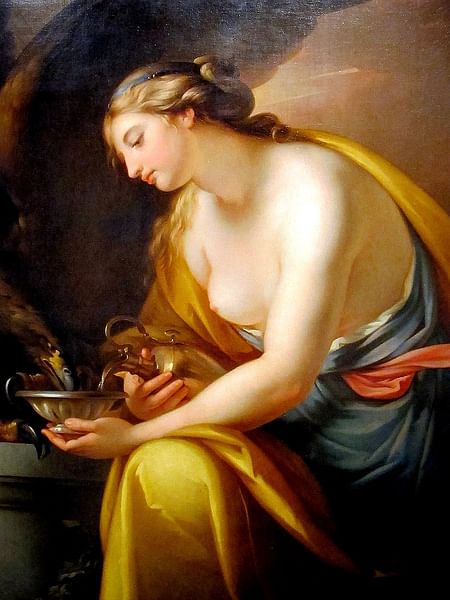 Hebe Giving Drink to the Eagle of Jupiter Gavin Hamilton (Public Domain) ](https://www.worldhistory.org/image/17045/hebe-giving-drink-to-the-eagle-of-jupiter/ "Hebe Giving Drink to the Eagle of Jupiter")Other sources state that Hebe stopped being the cupbearer to the gods when she married Hercules. Early on, Hebe was known as Ganymeda, which suggests that this deity was split into two – the male Ganymede, who carried on the job of cupbearer to the gods, while Hebe became a wife to Hercules and a mother to their two sons.
### Handmaiden to Hera
As the daughter of Hera, Hebe also served as her handmaiden, preparing her [chariot](https://www.worldhistory.org/chariot/) and harnessing her peacocks whenever they were needed. In Book 5 of the *Iliad*, Hebe helped her mother prepare her chariot by rolling the wheels, fastening them to their [bronze](https://www.worldhistory.org/disambiguation/bronze/) spokes and bolting them on the ends of the iron axle. In various sources and depictions in Greek art, she is found standing beside her mother, ready to obey her orders.
Hebe also washed Ares and dressed him in clean robes after he had engaged in a fierce battle against King [Diomedes](https://www.worldhistory.org/Diomedes/) of [Argos](https://www.worldhistory.org/argos/) during the [Trojan War](https://www.worldhistory.org/Trojan_War/). Hebe and Ares then returned to Mount Olympus.
### Goddess of Youth
As the goddess of youth, Hebe had the power to restore youth to mortals. The ancient Greeks viewed her as being brave and generous. Philostratus of Lemnos (190-230 CE) writes that Hebe was the youngest of the gods and the most loved. According to him, Hebe is the reason why the Olympian gods are eternally young. Hebe's power is touched on in a few myths, which are retold in [Ovid](https://www.worldhistory.org/ovid/)'s (43 BCE to 17 CE) *Metamorphoses*.
The Greek hero Jason pleaded with his sorceress wife, [Medea](https://www.worldhistory.org/Medea/), to take years off his life and give them to his ailing, elderly father, Aeson, so that he may live longer. Medea refused to do this, not able to face taking years off her husband's life. Instead, she told Jason that she would ask [Hecate](https://www.worldhistory.org/Hecate/) for help. Medea and her dragons roamed the Earth for nine days, collecting herbs of renewal. She built two altars of green turf, one dedicated to Hecate and the other dedicated to Hebe. She invoked the sorceress and goddess of youth for help. Sure enough, with their help, Medea was able to restore Aeson's youth.
Hercules asked his wife to bestow the gift of youth to his dear friend and nephew, Iolaus, so he could take revenge on King Eurystheus for the hardship he had put Hercules, Iolaus and their families through. Hebe agreed and gave Iolaus his youth back, but then swore that she would never use her gift on anyone else. However, [Themis](https://www.worldhistory.org/Themis/), the goddess of justice and divine [law](https://www.worldhistory.org/disambiguation/law/), stopped her from making that promise and reminded her of the Theban civil war taking place.
[ 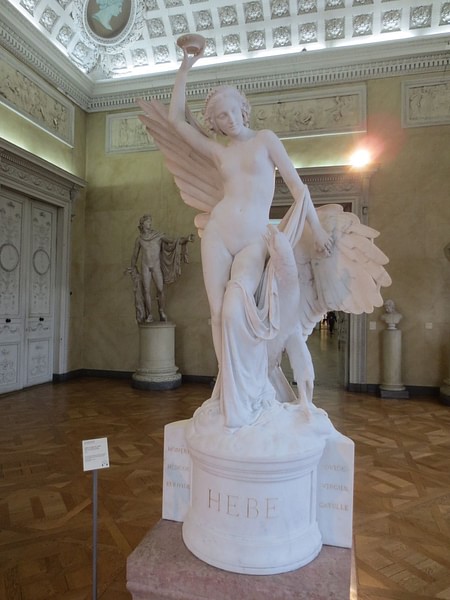 Hebe & the Eagle of Jupiter Arnaud 25 (CC BY-SA) ](https://www.worldhistory.org/image/17044/hebe--the-eagle-of-jupiter/ "Hebe & the Eagle of Jupiter")Themis prophecised that Callirhoe, daughter of the river god Achelous, would beg for Zeus to add the years that Iolaus had lost to her own young sons so that they could avenge their father. Hebe's gift would therefore be granted through Zeus' intervention. The gods were not happy that others would be given the gift of youth, and each one put forward someone they had in mind to receive Hebe's gift.
### Hebe & Hercules
After Hercules is accidentally sent a poisoned shirt by his wife, [Deianira](https://www.worldhistory.org/Deianira/), he puts it on, unaware that it had been covered with Hydra's venom. As he was praying to the gods and pouring libations, the heat from the fire caused the poison to spread through his body quickly. After killing his servant Lichas who had delivered the shirt into his hands, he built himself a funeral pyre and laid down on it.
The gods watched in horror from Mount Olympus as Hercules burned. Zeus reassured them that as his son, Hercules could not be touched by [death](https://www.worldhistory.org/disambiguation/Death/) and that he would be welcomed to Mount Olympus and given immortality.
[  Hebe Bringing Heracles to Olympus Sailko (CC BY-SA) ](https://www.worldhistory.org/image/17043/hebe-bringing-heracles-to-olympus/ "Hebe Bringing Heracles to Olympus")After Hercules' apotheosis (deification) was complete, Zeus and Hera allowed him to marry Hebe, cementing his new position as a god and forever uniting him with immortal youth. Hercules and Hebe's marriage was a sign that Hera had finally gotten over her hatred of Hercules (as he was a reminder of Zeus' infidelity), or at least was not so spiteful towards him as she was before. Hercules and Hebe had two sons together: Alexiares and Anicetus.
> And then strong Heracles, the glorious son
> Of trim-ankled Alcmene, at the end
> Of all his painful labours, made his bride
> Hebe, the modest child of mighty Zeus
> And golden-slippered Hera, on snow-clad
> Olympus. Happy god! For he has done
> His great work and he lives among the gods
> Forever young, forever free from pain.
> (Hesiod, *Theogony*, 950-957)
### Worship & Legacy
The two main areas of worship for Hebe in [Greece](https://www.worldhistory.org/greece/) were Philos and Sicyon, located in the [Peloponnese](https://www.worldhistory.org/Peloponnese/). According to Strabo (63 BCE to 23 CE), the Greek geographer, they worshipped Hebe as Dia. People prayed to Hebe for forgiveness, and released prisoners left behind their prison chains on trees in sacred groves to pay honour to her. In Philos, the head of Hebe and wreaths of ivy appeared on coins.
According to [Pausanias](https://www.worldhistory.org/disambiguation/Pausanias/) (c. 115 to c. 180 CE) in his *Description of Greece*, in [Corinth](https://www.worldhistory.org/corinth/), Hebe had a sanctuary and a golden and ivory statue made by the Greek sculptor Naukydes of Argos (4th century BCE) that stood beside a statue of Hera, with a peacock (Hera's sacred animal) between the figures. There was also a [silver](https://www.worldhistory.org/Silver/) altar that was decorated with the wedding of Hercules and Hebe. Hebe and Hercules had adjoining sanctuaries, which were separated by running water. Hens were kept in Hebe's sanctuary, while cocks were kept in Hercules'. In the Cynosarges (a cult centre for Hercules), there were altars dedicated to both Hercules and Hebe.
[ 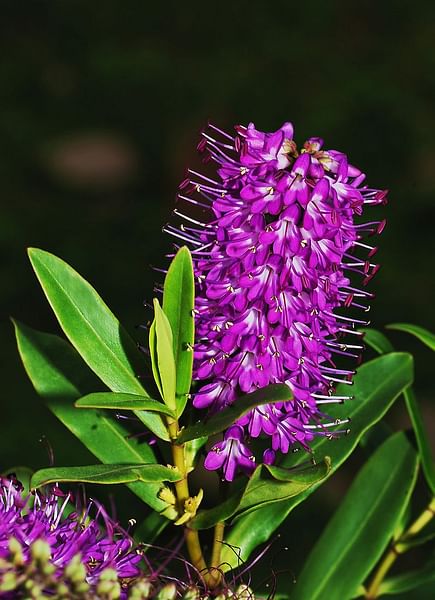 Veronica x franciscana (Blue Gem) Alvesgaspar (CC BY-SA) ](https://www.worldhistory.org/image/17046/veronica-x-franciscana-blue-gem/ "Veronica x franciscana (Blue Gem)")The flower species *Hebe* is named after the goddess of youth. Over 70 types of shrubs are found throughout the Southern Pacific, especially in New Zealand and South America. The flowers come in a variety of colours, including red, pink, white, purple, and blue, making them a popular plant to brighten up gardens.
Hebe is also the name given to a large asteroid that orbits between [Jupiter](https://www.worldhistory.org/jupiter/) and [Mars](https://www.worldhistory.org/Mars/) in the central asteroid belt. Hebe is not classified as a dangerous asteroid, as its orbit does not bring it close to the Earth.
#### Editorial Review
This human-authored definition has been reviewed by our editorial team before publication to ensure accuracy, reliability and adherence to academic standards in accordance with our [editorial policy](https://www.worldhistory.org/static/editorial-policy/).
## Bibliography
- [Asteroid Hebe | Space Reference](https://www.spacereference.org/asteroid/6-hebe-a847-na "Asteroid Hebe | Space Reference"), accessed 10 Feb 2023.
- [Bernhardt, Professor Peter. *Gods and Goddesses in the Garden.* Rutgers University Press, 2008.](https://www.worldhistory.org/books/0813542669/)
- [Bowman, Laurel & Bulloch, Anthony & Campbell, Andrew & Caviness, Alys & Chew, Kathryn. *Gods and Goddesses of Greece and Rome.* Cavendish Square, 2023.](https://www.worldhistory.org/books/0761479511/)
- [E. M. Berens. *A Hand-Book of Mythology.* Forgotten Books, 2018.](https://www.worldhistory.org/books/1330575164/)
- [Graves, Robert. *The Greek Myths\[May 15, 2018\] Graves, Robert.* Viking, 2018.](https://www.worldhistory.org/books/0241982359/)
- [Hesiod & Theognis & Wender, Dorothea & Wender, Dorothea. *Hesiod and Theognis.* Penguin Classics, 1976.](https://www.worldhistory.org/books/0140442839/)
- [Homer & Robert Fagles & Bernard Knox. *The Iliad.* Penguin Classics, 1998.](https://www.worldhistory.org/books/0140275363/)
- [Homer & Robert Fagles & Bernard Knox. *The Odyssey.* Penguin Classics, 1999.](https://www.worldhistory.org/books/0140268863/)
- [Internet History Sourcebooks Project: Ancient History](https://sourcebooks.fordham.edu/ancient/pausanias-bk1.asp "Internet History Sourcebooks Project: Ancient History"), accessed 10 Feb 2023.
- [Lewis, Tayler & Dwight, Mary Ann. *Grecian and Roman Mythology.* Palala Press, 2016.](https://www.worldhistory.org/books/1357463758/)
- [Ovid & Raeburn, David & Feeney, Denis. *Metamorphoses.* Penguin Classics, 2004.](https://www.worldhistory.org/books/014044789X/)
- [Pausanias & Peter Levi. *Guide to Greece, Vol. 1.* Penguin Classics, 1984.](https://www.worldhistory.org/books/0140442251/)
- [PHILOSTRATUS THE ELDER, IMAGINES BOOK 2.17-33 - Theoi Classical Texts Library](https://www.theoi.com/Text/PhilostratusElder2B.html "PHILOSTRATUS THE ELDER, IMAGINES BOOK 2.17-33 - Theoi Classical Texts Library"), accessed 10 Feb 2023.
## About the Author
Liana is the Social Media Editor for Ancient History Encyclopedia. She holds a Bachelor of Arts Degree with a major in ancient Greece, Rome & Late Antiquity. She is particularly passionate about Rome and Greece, and anything to do with mythology or wo
- [Linkedin Profile](https://www.linkedin.com/in/lian)
## Questions & Answers
### Did Hercules love Hebe?
Yes. Hercules and Hebe were married and had two sons together.
### Is Hebe a virgin goddess?
Hebe is originally considered a virgin/maiden goddess until she marries Hercules and has children. In art, she is often depicted as a virgin goddess.
### How do you pronounce Hebe the goddess?
You pronounce Hebe like 'hee-bee'.
### What is Hebe's symbol?
Hebe is often depicted holding a wine cup to symbolise her role as cupbearer to the gods.
## Cite This Work
### APA
Miate, L. (2023, February 15). Hebe. *World History Encyclopedia*.
### Chicago
Miate, Liana. "Hebe." *World History Encyclopedia*, February 15, 2023. .
### MLA
Miate, Liana. "Hebe." *World History Encyclopedia*, 15 Feb 2023, .
## License & Copyright
Submitted by [Liana Miate](https://www.worldhistory.org/user/lianamiate/ "User Page: Liana Miate"), published on 15 February 2023. The copyright holder has published this content under the following license: [Creative Commons Attribution-NonCommercial-ShareAlike](https://creativecommons.org/licenses/by-nc-sa/4.0/deed.en). This license lets others remix, tweak, and build upon this content non-commercially, as long as they credit the author and license their new creations under the identical terms. When republishing on the web a hyperlink back to the original content source URL must be included. Please note that content linked from this page may have different licensing terms.