---
title: Hausaland
author: Mark Cartwright
source: https://www.worldhistory.org/Hausaland/
format: machine-readable-alternate
license: Creative Commons Attribution-NonCommercial-ShareAlike (https://creativecommons.org/licenses/by-nc-sa/4.0/)
updated: 1970-01-01
---
# Hausaland
_Authored by [Mark Cartwright](https://www.worldhistory.org/user/markzcartwright/)_
Hausaland, sometimes referred to as the Hausa Kingdoms, was a group of small independent [city](https://www.worldhistory.org/city/)-states in northern central [Africa](https://www.worldhistory.org/disambiguation/africa/) between the Niger River and Lake Chad which flourished from the 15th to 18th century CE. The origins of the Hausa are not known, but one hypothesis suggests they were a group of indigenous peoples joined by a common language - Hausa - while another theory explains their presence as a consequence of a migration of peoples from the southern Sahara Desert. The [cities](https://www.worldhistory.org/city/) prospered thanks to local and interregional [trade](https://www.worldhistory.org/disambiguation/trade/) in such commodities as salt, precious metals, leather goods, and slaves. [Islam](https://www.worldhistory.org/islam/) was adopted by many of the rulers and elite of the city-states in the 14th and 15th century CE but was also one of the reasons for their loss of independence when the Muslim Fulani leader Usman dan Fodio (r. 1803-1815 CE) launched a holy [war](https://www.worldhistory.org/disambiguation/War/) and conquered the region in the early 19th century CE.
### Geography & Origins
The name Hausaland derives from the Hausa term *Kasar hausa*, meaning the 'country of the Hausa language', although the area also included other peoples such as the Tuareg, Fulbe, and Zabarma. The term 'Hausa' was in use only from the 16th century CE as the people called themselves according to which specific [city-state](https://www.worldhistory.org/Polis/) or kingdom they belonged to.
Hausaland was located in the Sahel region between the Niger River and Lake Chad in north-central Africa in what is today northern Nigeria. The Sahel is the semi-arid strip of land running across Africa between the Sahara Desert in the north and the Savannah grassland to the south. Hausland, specifically, stretched from the Air mountains (north) to the Jos plateau (south) and from Borno (east) to the Niger Valley (west). This region saw the development of towns by the Hausa-speaking people from 1000 to 1300 CE.
The exact origins of the Hausa cities are not known, but theories include a migration of peoples from the southern Sahara who, abandoning their own lands following the increased desiccation of that area, established new settlements in what would become known as Hausaland. An alternative theory suggests that the Hausa people originally lived on the western shore of Lake Chad and when the lake shrank (as a consequence of the same climatic changes that affected the Sahara) they occupied this new and fertile land and then eventually spread to the immediate north and west. There is as yet, unfortunately, no archaeological evidence to support either of these two theories. As a consequence, there is a third hypothesis, which is that the Hausa had not migrated from anywhere but were indigenous to the region. Support for this theory lies in the fact that there is no tradition of migration in Hausa oral history.
[  Map of Ancient & Medieval Sub-Saharan African States Mark Cartwright (CC BY-NC-SA) ](https://www.worldhistory.org/image/10453/map-of-ancient--medieval-sub-saharan-african-state/ "Map of Ancient & Medieval Sub-Saharan African States")There is, though, a foundation legend, known as the Bayajida or Daura legend, although this probably dates to the 16th century CE and reflects the increased influence of Islam in the region at that time. According to this tradition, Bayajida, a prince from Baghdad, arrived at the court of the ruler of the [Kingdom of Kanem](https://www.worldhistory.org/Kingdom_of_Kanem/) (or the Bornu [Empire](https://www.worldhistory.org/empire/) as it became by the 16th century CE). Receiving an unfavourable reception, Bayajida headed eastwards until he came upon the city of Daura. There, the queen and her kingdom were being terrorized by a great snake. Bayajida stepped in and killed the troublesome serpent and promptly married the queen. Together they had a son called Bawogari who then went on to have six sons of his own, each of which became the king of a Hausa city-state. Meanwhile, Bayajida had another son, this time with one of his concubines. This illegitimate son, called Karbogari, had seven sons, and these went on to rule seven other Hausa cities. This story neatly explains how the various cities were established but not, of course, just where Daura and its queen came from.
### Key Cities & Government
Wherever they had sprung from, by the early 15th century CE many small Hausa chiefdoms had come together to create several walled cities which controlled their respective surrounding countryside. Traditionally, there were seven city-states (the *hausa bakwai*), but there were, in fact, many more. The most important were (the traditional seven are marked with an asterisk):
- Biram\*
- Daura (the ritual mother city of the group)\*
- Garun Gobas
- Gobir\*
- Gwari
- Jukun (aka Kwararafa)
- Kano\*
- Kebbi
- Katsina\*
- Nupe
- Rano\*
- Yawuri
- Yoruba
- Zamfara
- Zaria (aka Zazzau)\*
Each city had its own king or ruler, the *sarkin kasa*, who was advised by a chief councillor or vizier, the *galadima*, and a small council of elders - typically consisting of nine members who also determined the next ruler in line. Various officials were appointed by the king to, for example, collect taxes and customs duties, lead the city's cavalry units or infantry, maintain security on roadways, and look after certain crops. The city ruled over various smaller chiefdoms or villages in its immediate vicinity, each ruled by a chief or *sarkin gari*. The third tier of this political [pyramid](https://www.worldhistory.org/pyramid/) was the family clan or *gida*, many of which made up an individual village.
Rural Hausa populations were farmers who worked the land which belonged to the community as a whole. Over time, as the city-states became more centralised, this system was corrupted by the kings giving out parcels of land as rewards to certain individuals. Hausa [agriculture](https://www.worldhistory.org/disambiguation/Agriculture/) also became heavily reliant on slaves, too. Meanwhile, the society within the main city of each kingdom was cosmopolitan, although dominated by the Hausa. There were slaves, craftworkers, merchants, religious officials, scholars, eunuchs and aristocrats (*masu sarauta*) related to or favoured by the king.
### Trade
The Hausa states traded [gold](https://www.worldhistory.org/gold/), ivory, salt, iron, tin, weapons, horses, dyed cotton cloth, kola nuts, glassware, metalware, ostrich feathers, and hides. There was trade with the coastal region of West Africa, Oyo in the Bight of Benin, and the [Songhai Empire](https://www.worldhistory.org/Songhai_Empire/) (c. 1460 -1591 CE) to the east. Slaves were an important source of revenue for all the cities but Zaria, in particular, specialised in acquiring slaves via raids to the south.
[ 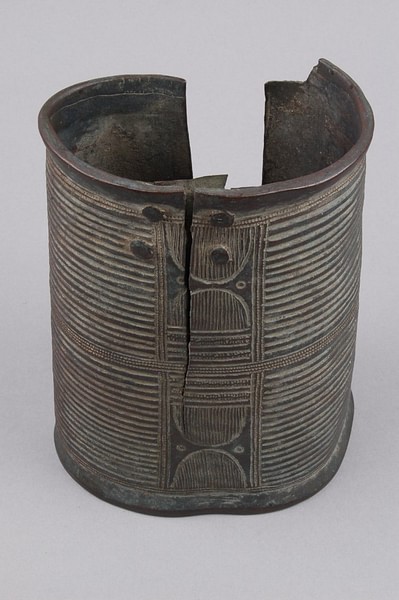 Metal Armlet, Hausaland The British Museum (Copyright) ](https://www.worldhistory.org/image/10547/metal-armlet-hausaland/ "Metal Armlet, Hausaland")Cities specialised in the manufacture or trade of certain goods, for example, dyes - especially indigo - at Katsina and Daura or [silver](https://www.worldhistory.org/Silver/) jewellery at Kebbi and Zamfara. Hausaland became famous (and still is today) for its finely worked leather goods such as water bags, saddles, harnesses, and sacks to transport goods for the region's trade caravans. Various [crafts](https://www.worldhistory.org/crafts/) were organised into guilds which ensured standards were maintained and prices were kept fair. Hausa agriculture, boosted by such techniques as crop rotation and the use of fertilizers, produced crops which included millet, sorghum, rice, maize, peanuts, beans, henna, tobacco, and onions. In addition, fishing and hunting were carried out and goats raised (important for ritual sacrifices) and donkeys bred (the principal form of transport). Each city had its own markets where both men and [women](https://www.worldhistory.org/disambiguation/women/) sold their wares, and many cities also had international trade markets where merchants sold in bulk. Goods were exchanged in kind although salt, cloth, and slaves were often used as a standardised form of commodity-currency.
### [Architecture](https://www.worldhistory.org/disambiguation/architecture/)
Traditional Hausa houses are made from dried mud bricks which are pear-shaped and laid in rows using mortar and with the pointed end facing upwards. The walls are then faced with plaster and given either painted or incised decoration. Houses were further decorated with sculpted additions, again using mud, creating three-dimensional geometric designs such as interlaced patterns and spirals. A secure roofing is achieved by creating a mud vault which is strengthened by a frame of split palms and palm fronds, an architectural feature particular to Hausaland. Each house is enclosed in its own high [wall](https://www.worldhistory.org/wall/) which may have additional buildings set into it. The chief cities were protected by massive fortification walls - an indication of the frequent siege [warfare](https://www.worldhistory.org/warfare/) that went on in Hausaland throughout its history.
### Conversion to Islam
Unlike much of Sub-Saharan Africa, the area occupied by Hausaland was largely untouched by Islam until the 14th century CE. Finally, though, a form of Islam was adopted and adapted following contact with Muslim merchants, missionaries, and scholars, who came from the east, the Niger River bend area. Islam was typically blended with traditional animist rituals and so took on its own distinct character in the region. Not having any commercial incentive to gain favour with foreign merchants like the Hausa rulers and elite, rural populations proved as difficult as in other parts of Africa to fully convert to the new [religion](https://www.worldhistory.org/religion/), despite (or perhaps because of) sometimes brutal methods such as the destruction of shrines and the burning of ancient sacred groves. Despite this resistance from some chiefs and much of the rural populace, Islam did eventually take a strong hold in the region. Mosques were built in the cities and one of the oldest surviving remnants of these early structures is the dried mud Gobarau [minaret](https://www.worldhistory.org/Minaret/) of the mosque at Katsina, which dates to the early 15th century CE.
### Regional Rivalries & Decline
Relations with the neighbouring Songhai Empire were not always peaceful, as when - at least according to the historian [Leo Africanus](https://www.worldhistory.org/Leo_Africanus/) (c. 1494 - c. 1554 CE) - the Songhai king Askia [Muhammad](https://www.worldhistory.org/disambiguation/Muhammad/) (r. 1494-1528 CE), managed to subdue the cities of Katsina, Kano, and Gobir, making them, albeit briefly, tributary states. It may be that this invasion was carried out by other smaller neighbouring states as the Songhai records and those from [Timbuktu](https://www.worldhistory.org/Timbuktu/) for the period are remarkably silent on the matter. Meanwhile, Hausa states made frequent raids to the south in the Benue Valley against various peoples including the Bauchi, Gongola, Jukun, and Yawuri.
The Fulani, nomadic cattle-herders from Senegal who migrated across Africa to Lake Chad in the mid-16th century CE, settled in Hausaland and brought with them another surge in interest in the Islamic religion and learning. In the last quarter of the 18th century CE, the Fulani abandoned their peaceful evangelism and launched a religious war in the region. In this, the Fulani were aided by the sometimes long-standing rivalries between Hausa cities, the internal disputes between the elites in several city-states, and a generally disaffected populace who had grown ever poorer while the Hausa trading aristocracy had grown richer. Thus, from 1804 CE, the Fulani leader Usman dan Fodio conquered all of the Hausa city-states, converting them to Islam. Usman dan Fodio, who was himself from the Hausa city-state of Gobir, then went on to expand his empire and establish his capital at Sokoto in 1817 CE which gave its name to the new state.
#### Editorial Review
This human-authored definition has been reviewed by our editorial team before publication to ensure accuracy, reliability and adherence to academic standards in accordance with our [editorial policy](https://www.worldhistory.org/static/editorial-policy/).
## Bibliography
- [Curtin, P. *African History.* Pearson, 1995.](https://www.worldhistory.org/books/0582050707/)
- [Hrbek, I. (ed). *UNESCO General History of Africa, Vol. III, Abridged Edition.* University of California Press, 1992.](https://www.worldhistory.org/books/0520066987/)
- [Ki-Zerbo, J. (ed). *UNESCO General History of Africa, Vol. IV, Abridged Edition.* University of California Press, 1998.](https://www.worldhistory.org/books/0520066995/)
- [McEvedy, C. *The Penguin Atlas of African History.* Penguin Books, 1996.](https://www.worldhistory.org/books/0140513213/)
- [Ogot, B.A. (ed). *General History of Africa volume 5.* James Currey, 1999.](https://www.worldhistory.org/books/0852550952/)
- [Oliver, R. (ed). *The Cambridge History of Africa, Vol. 3.* Cambridge University Press, 2001.](https://www.worldhistory.org/books/0521209811/)
- [Oliver, R.A. *Cambridge Encyclopedia of Africa.* Cambridge University Press, 1981.](https://www.worldhistory.org/books/0521230969/)
- [de Villiers, M. *Timbuktu.* Walker Books, 2007.](https://www.worldhistory.org/books/0802714978/)
## About the Author
Mark is WHE’s Publishing Director and has an MA in Political Philosophy (University of York). He is a full-time researcher, writer, historian and editor. Special interests include art, architecture and discovering the ideas that all civilizations share.
## Timeline
- **c. 1100 CE - c. 1300 CE**: The Hausa people form settlements in the central Sudan region of sub-Saharan [Africa](https://www.worldhistory.org/disambiguation/africa/).
- **c. 1400 CE - c. 1804 CE**: [Hausaland](https://www.worldhistory.org/Hausaland/) flourishes in [Africa](https://www.worldhistory.org/disambiguation/africa/).
- **c. 1804 CE - c. 1817 CE**: The Fulani leader Usman dan Fodio conquers the [city](https://www.worldhistory.org/city/)-states of [Hausaland](https://www.worldhistory.org/Hausaland/) and forms the Sokoto [Empire](https://www.worldhistory.org/empire/).
## Cite This Work
### APA
Cartwright, M. (2019, May 09). Hausaland. *World History Encyclopedia*.
### Chicago
Cartwright, Mark. "Hausaland." *World History Encyclopedia*, May 09, 2019. .
### MLA
Cartwright, Mark. "Hausaland." *World History Encyclopedia*, 09 May 2019, .
## License & Copyright
Submitted by [Mark Cartwright](https://www.worldhistory.org/user/markzcartwright/ "User Page: Mark Cartwright"), published on 09 May 2019. The copyright holder has published this content under the following license: [Creative Commons Attribution-NonCommercial-ShareAlike](https://creativecommons.org/licenses/by-nc-sa/4.0/deed.en). This license lets others remix, tweak, and build upon this content non-commercially, as long as they credit the author and license their new creations under the identical terms. When republishing on the web a hyperlink back to the original content source URL must be included. Please note that content linked from this page may have different licensing terms.