---
title: Hanuman
author: Anindita Basu
source: https://www.worldhistory.org/Hanuman/
format: machine-readable-alternate
license: Creative Commons Attribution-NonCommercial-ShareAlike (https://creativecommons.org/licenses/by-nc-sa/4.0/)
updated: 2024-06-23
---
# Hanuman
_Authored by [Anindita Basu](https://www.worldhistory.org/user/ab.techwriter/)_
Hanuman is one of several zoomorphic characters in Indian [mythology](https://www.worldhistory.org/mythology/), but is the only wholly animal figure who is revered as a [god](https://www.worldhistory.org/God/) today. The mythic texts speak of him as a monkey child of the Wind God, as possessing enormous strength, keen intellect and a mastery over [the Vedas](https://www.worldhistory.org/The_Vedas/) and other branches of learning. He is also an unquestioning devotee of [Rama](https://www.worldhistory.org/Rama/), the hero of the epic *Ramayana*, and has the ability to take on any form he wishes.
### Hanuman in [the Ramayana](https://www.worldhistory.org/The_Ramayana/)
The first reference to Hanuman in the epic *Ramayana* is casual – as a "group of monkeys" – and one has no inkling of the large role that he will go on to play in the remainder of the story. [Ravana](https://www.worldhistory.org/Ravana/), a demon, abducted Sita, wife of the exiled prince Rama. When Ravana was carrying away Sita in his air-borne [chariot](https://www.worldhistory.org/chariot/), Sita saw some monkeys atop a mountain and threw down her ornaments, hoping that monkeys with ornaments would attract the attention of her husband Rama, who would surely be searching for her in the same forest. Hanuman was one of these four monkeys. This monkey group was instrumental in giving Rama key information about Sita. They helped him build a bridge across the seas, and cross over with a monkey army that successfully stormed the demon stronghold and freed Sita.
Hanuman's role in the [battle](https://www.worldhistory.org/disambiguation/battle/) between Rama and Ravana is huge. He is the one who flies across the oceans (he is Wind's child), locates the exact place where Sita is imprisoned and brings this information back to Rama. While within the demon fort on his quest for Sita, he sets the entire place on fire and warns Ravana about an impending attack unless Sita is returned unharmed.
During the Rama–Ravana battle, Hanuman not only kills several demon generals but also brings Rama's brother back to life. How does he do that? Well, it so happens that Rama's brother is mortally wounded by Ravana's son, and the monkey-army-physician opines that the only things that can save the life of the younger prince are four specific herbs that grow on the Himalayan slopes. The catch? The battle is raging on in Lanka, across the southernmost tip of the country, while the Himalayas are far up north, and the herbs are needed within the next few [hours](https://www.worldhistory.org/Horae/), before the new day dawns. Hanuman leaps up into the air, flies northwards at lightning speed, and alights atop the Himalayas. This is where things start to become confusing: the monkey-physician had said that [medicine](https://www.worldhistory.org/disambiguation/medicine/) herbs glow in their own light and that it should be easy, therefore, to spot them. What Hanuman sees, however, is an entire mountain aglow with herbs of all kinds, each emitting its own peculiar light. Being unable to identify the exact four herbs that the physician had described, Hanuman uproots the entire mountain and carries it back to the battlefield. The physician gets his herbs, the near-dead prince is brought back his life, and, so strong is the effect of the mountain teeming with a thousand fragrant herbs that other monkeys who had fallen in battle are also healed just by inhaling the medicine-scented mountain air.
[ 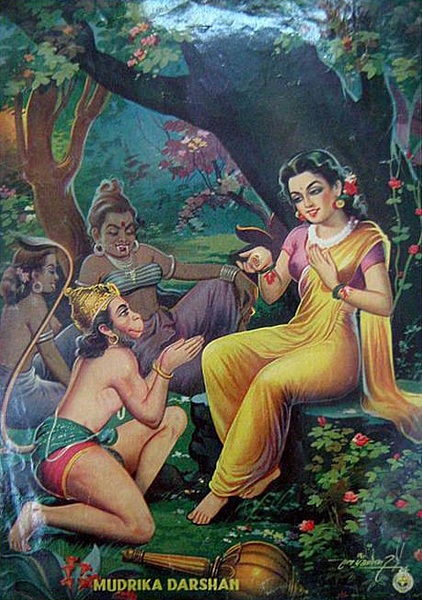 Hanuman finds Sita M.V. Sharma (Public Domain) ](https://www.worldhistory.org/image/5411/hanuman-finds-sita/ "Hanuman finds Sita")Hanuman is described in the epic as one of extremely pleasant visage, perfect diction, elegant speech, and faultless manners. He is also described as being knowledgeable in the three *[Vedas](https://www.worldhistory.org/The_Vedas/)*. From his father, the Wind God, he inherits his might and speed. He is also a shapeshifter who can increase and decrease his body size at will.
### Hanuman in the Mahabharat
The *Mahabharat* is an epic about two branches of a family warring for a throne. One of the princes in the *Mahabharat* is also a son of the Wind God and it is to him that Hanuman makes his only appearance in this epic. This prince, named Bhima, was as mighty as the wind and had once wandered into a large banana grove, which he proceeded to randomly destroy. While tearing down fruit and uprooting trees, he saw an old monkey dozing by the wayside, its tail lying right across the grove path. Bhima ordered the monkey to move its tail aside; the monkey opened his eyes and said it was rather weak and if the prince could be kind enough to lift it gently aside he would be grateful. Bhima, not given to either patience or conversations with lesser beings, bent to pick the monkey up by its tail, intending to hurl it across the banana trees. However, to his surprise, try as he might, he could not move even a whisker of the tail. It transpired that the monkey was none other than Hanuman, the mightiest being on earth. "Strength should not be trifled with; neither should it be something to be vain of", or words to similar effect, were what Hanuman told the chastened Bhima.
As a [mark](https://www.worldhistory.org/disambiguation/Mark/) of affection to Bhima, Hanuman agreed to reside on the flag of Bhima's younger brother [Arjuna](https://www.worldhistory.org/Arjuna/)'s chariot. It is for this reason that Arjuna is called *Kapi-dhwaj* (*kapi* = monkey, *dhwaj* = flag, *kapi+dhwaj* = ape-bannered). During the final terrible Mahabharat [war](https://www.worldhistory.org/disambiguation/War/), Arjun's war cries were amplified by the roar that would emanate from the ape emblem on his flagstaff, driving fear into the hearts of his enemies.
[  Rama & Hanuman Sowrirajan (CC BY) ](https://www.worldhistory.org/image/4058/rama--hanuman/ "Rama & Hanuman")### Hanuman in the Puranas
Hanuman is the child of the Wind God and the princess Anjana. He is referred to by his metronymic, *Anjaneya*, as often as his patronymic, which seems to be the norm in most of the [Hindu](https://www.worldhistory.org/hinduism/) mythological texts. The various *Puranas* say that Anjana was married to the monkey chief Kesari. The couple prayed to [Shiva](https://www.worldhistory.org/shiva/) for a son, and Hanuman was born to them from an aspect of Shiva, through the agency of the Wind God. Thus, Hanuman has two patronyms: *Vayu-putra* (Wind's son) as well as *Kesari-nandan* (Kesari's son).
So why is he called Hanuman then? The story is this: as soon as he was born, Hanuman grew up to a considerable size, jumped about like all monkeys do, and asked his mother what he should eat. Anjana pointed to the rising sun, a sphere of red in the golden dawn, and told him that anything that looked like that (i.e. ripe fruits) was his food. Hanuman mistook the sun itself to be a ripe fruit and leapt up in the air to grab it. The king of gods, seeing a dark streak speeding across the sky towards the sun as if to swallow it whole, was alarmed and hurled his thunderbolt at the flying figure. Whereupon Hanuman roared with laughter and said, "Do you not know, King, that I am unslayable? I am born of Shiva, how can your thunderbolt do anything to me? However, just so the Worlds do not laugh at you, I allow your weapon to scratch my chin". Or words to that effect. Thus, the honour of the king of gods was retained, the infallible thunderbolt hit its target, the monkey child got his chin disfigured, and came to be known as Hanuman (*hanu* = chin; *man* = of, with, bearing, having; *hanu+man*=he of \[broken\] chin).
The *Puranas* also tell us that Hanuman was taught the Vedas and all other branches of learning by Sun God himself, [Surya](https://www.worldhistory.org/Surya/). He learnt his lessons by trotting alongside the Sun's chariot as it moved across the sky.
[  Hanuman Fae (Public Domain) ](https://www.worldhistory.org/image/5410/hanuman/ "Hanuman")### Hanuman in Later [Literature](https://www.worldhistory.org/literature/)
During the 16th CE, a poet called Tulsidas retold the *Ramayana* in the vernacular Awadhi language (rather than the academic [Sanskrit](https://www.worldhistory.org/Sanskrit/)) and also composed several hymns to the gods. One such hymn, the *Hanuman Chalisa*, continues to be recited today by thousands of people. This canticle of about 40 verses celebrates all of the qualities that Hanuman came to signify over the centuries: strength, devotion, celibacy, and righteousness. Hanuman became a god. In an extract from the *Hanuman Chalisa*,
> भूत पिशाच निकट नहिं आवै।
> महाबीर जब नाम सुनावै॥
> नासै रोग हरै सब पीरा।
> जपत निरंतर हनुमत बीरा॥ Demons and ghosts do not come near
> If they hear the mighty one's name
> Diseases die, sorrows disappear
> If one constantly chants Hanuman's name
### Hanuman in the 21st Century
Hanuman is worshipped as a god in several parts of [India](https://www.worldhistory.org/india/) today. It is almost *de rigueur* to find a small shrine to him in police stations and wrestling clubs across the country, especially in the north. Outside of India, Hanuman is known in countries which were influenced by the Hindu [culture](https://www.worldhistory.org/disambiguation/culture/) such as Indonesia, Thailand, and Malaysia.
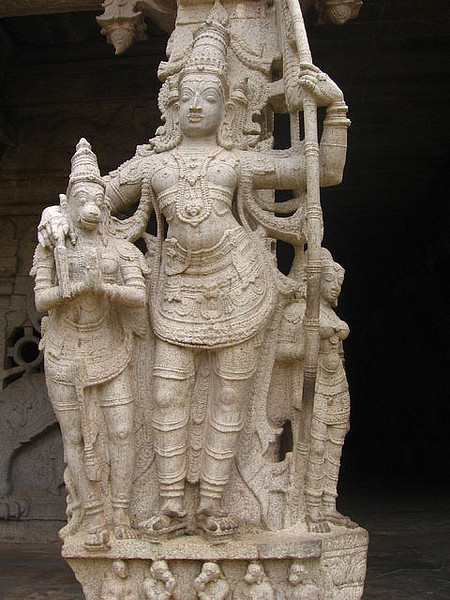
Hanuman is a recurring figure in the panels and motifs of the *Ramayana* that adorn the temples that were built over the centuries in India. He is most often depicted with his favourite weapon, the mace. He is also often depicted as flying across the skies, one hand holding aloft the mountain of herbs and the other a mace.
#### Editorial Review
This human-authored definition has been reviewed by our editorial team before publication to ensure accuracy, reliability and adherence to academic standards in accordance with our [editorial policy](https://www.worldhistory.org/static/editorial-policy/).
## Bibliography
- [Ganguly, K.M. *Mahabharata of Krishna-Dwaipayana Vyasa, 12 volumes.* Coronet Books Inc., 1991.](https://www.worldhistory.org/books/812150094X/)
- [Majumdar, R.C. *The History and Culture of the Indian People.* Bharatiya Vidya Bhavan, 1988.](https://www.worldhistory.org/books/B007WT65G0/)
- [Mani, V. *Puranic Encyclopaedia.* Motilal Banarsidass, 2010.](https://www.worldhistory.org/books/8120805976/)
- [The Ramayana of Valmiki](https://archive.org/details/ramayanofvlm00valmrich "The Ramayana of Valmiki"), accessed 1 Dec 2016.
## About the Author
Anindita is a technical writer and editor. Her off-work interests include Indology, data visualisation, and etymology.
- [X/Twitter Profile](https://twitter.com/anindita_basu)
- [Linkedin Profile](https://www.linkedin.com//in/aninditabasu)
## Timeline
- **c. 1500 BCE - c. 500 BCE**: Indian scholars of the so-called Vedic Period commit [the Vedas](https://www.worldhistory.org/The_Vedas/) to written form; basic tenets of [Hinduism](https://www.worldhistory.org/hinduism/) are established.
- **c. 500 BCE**: The Indian epic [the Ramayana](https://www.worldhistory.org/The_Ramayana/) is composed by the sage Valmiki.
## External Links
- [Sundara Kanda: Hanuman's Odyssey](http://www.gutenberg.us/eBooks/WPLBN0002097653-Sundara-Kanda-by-Murthy-B-S-.aspx?)
## Cite This Work
### APA
Basu, A. (2016, July 28). Hanuman. *World History Encyclopedia*.
### Chicago
Basu, Anindita. "Hanuman." *World History Encyclopedia*, July 28, 2016. .
### MLA
Basu, Anindita. "Hanuman." *World History Encyclopedia*, 28 Jul 2016, .
## License & Copyright
Submitted by [Anindita Basu](https://www.worldhistory.org/user/ab.techwriter/ "User Page: Anindita Basu"), published on 28 July 2016. The copyright holder has published this content under the following license: [Creative Commons Attribution-NonCommercial-ShareAlike](https://creativecommons.org/licenses/by-nc-sa/4.0/deed.en). This license lets others remix, tweak, and build upon this content non-commercially, as long as they credit the author and license their new creations under the identical terms. When republishing on the web a hyperlink back to the original content source URL must be included. Please note that content linked from this page may have different licensing terms.