---
title: Haniwa
author: Mark Cartwright
source: https://www.worldhistory.org/Haniwa/
format: machine-readable-alternate
license: Creative Commons Attribution-NonCommercial-ShareAlike (https://creativecommons.org/licenses/by-nc-sa/4.0/)
updated: 1970-01-01
---
# Haniwa
_Authored by [Mark Cartwright](https://www.worldhistory.org/user/markzcartwright/)_
*Haniwa* are the unglazed terracotta rings, cylinders, and figures of people, animals, and houses which were deposited at Japanese tombs during the [Kofun](https://www.worldhistory.org/Kofun/) and Asuka Periods (c. 250-710 CE). The exact purpose of these offerings is not known, although it seems likely they were examples of conspicuous consumption of the societal elite or performed some protective function. Many *haniwa* are particularly detailed in their execution and thus provide a valuable insight into the [culture](https://www.worldhistory.org/disambiguation/culture/) of the period. Standing over one metre in height, the mysterious figures are a striking example of early Japanese [sculpture](https://www.worldhistory.org/disambiguation/Sculpture/).
### Purpose
These ritual objects were buried with the deceased interred in *kofun* (tumuli) tombs throughout the Yamato Period of [ancient Japan](https://www.worldhistory.org/Ancient_Japan/) from the 3rd century CE to the early 8th century CE. The period is often subdivided into the [Kofun Period](https://www.worldhistory.org/Kofun_Period/) (c. 250-538 CE) and the [Asuka Period](https://www.worldhistory.org/Asuka_Period/) (538-710 CE). Early tombs were more modest, but by the 5th century CE, they had developed into huge earth mounds. The practice spread throughout [Japan](https://www.worldhistory.org/disambiguation/Japan/) so that the islands boast some 20,000 [burial](https://www.worldhistory.org/burial/) mounds known today. They follow a similar design with a keyhole-shaped inner [tomb](https://www.worldhistory.org/tomb/) covered by an earth mound and surrounded by a moat. The biggest is the tomb of Emperor Nintoku which is 823 metres long. The earliest examples of *haniwa* discovered are concentrated in the [Nara](https://www.worldhistory.org/Nara/) region. Unusually for votive offerings, haniwa* were not placed within the tomb itself but near it or on top of it in either a circle or rows.
[ 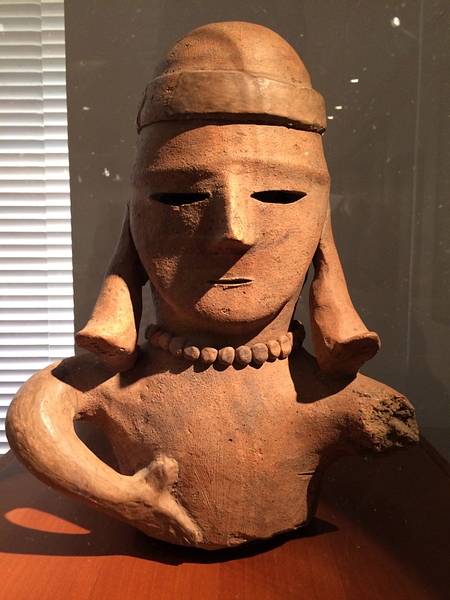 Haniwa Figurine James Blake Wiener (CC BY-NC-SA) ](https://www.worldhistory.org/image/6137/haniwa-figurine/ "Haniwa Figurine")The precise significance of these offerings is unclear, but in all probability, they substituted real objects and displayed the wealth and status of the individual interred in the large tumuli which were themselves reserved for the society's elite, such was the labour needed to build them. The *[Nihon Shoki](https://www.worldhistory.org/Nihon_Shoki/)* ('Chronicle of Japan' and also known as the *Nihongi*), written in 720 CE, suggests that *haniwa were replacements for the chieftain's attendants, it being a common feature of [ancient societies](https://www.worldhistory.org/collection/62/ancient-societies/) to bury the slaves of a ruler with their master. This does not, however, explain those *haniwa* which are simply rings or cylinders, which constitutes the majority. Although it may be that the cylinders were originally meant as stands for the more elaborate figures.
[ 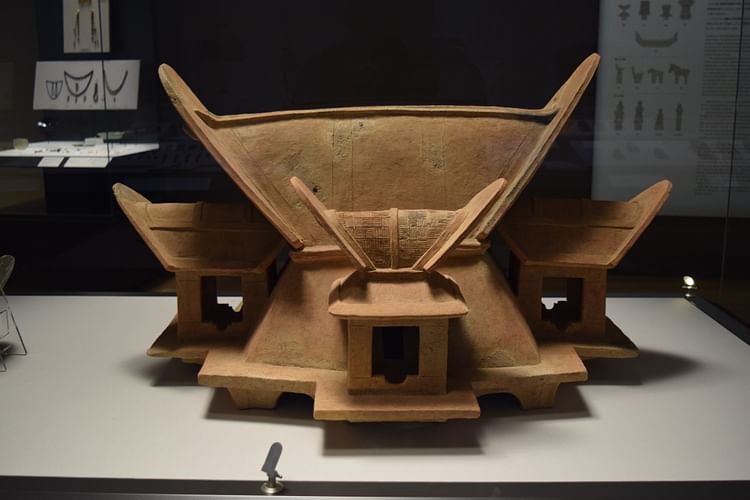 Haniwa House James Blake Wiener (CC BY-NC-SA) ](https://www.worldhistory.org/image/6510/haniwa-house/ "Haniwa House")Another theory is that *haniwa* acted as protective spirits for the deceased and ensured the tomb was not disturbed. Certainly, Korean tumuli in the contemporary [Silla](https://www.worldhistory.org/Silla/) kingdom, which may well have influenced Japanese culture, employed stone sculptures of animal signs for just that purpose. Finally, the *haniwa* may have protected not the dead but the living from the spirit of the deceased chief, ancestor worship and a reverence for spirits or *[kami](https://www.worldhistory.org/Kami/)* being long-held beliefs in ancient Japan.
[ 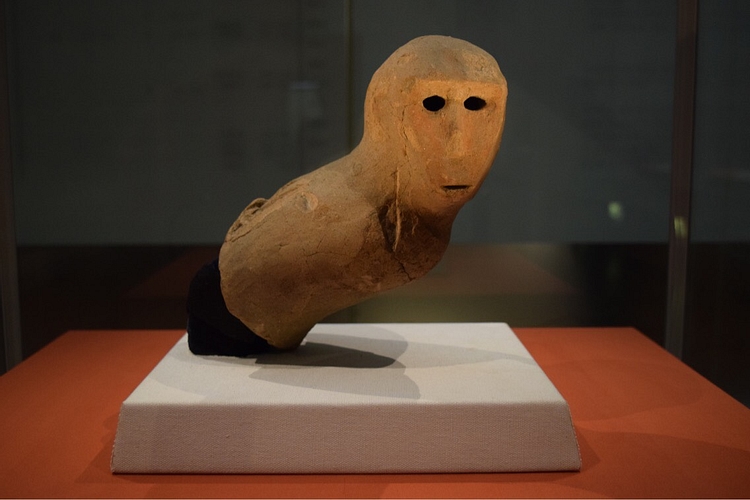 Monkey Haniwa James Blake Wiener (CC BY-NC-SA) ](https://www.worldhistory.org/image/6511/monkey-haniwa/ "Monkey Haniwa")### Shapes & Forms
The name *haniwa means 'clay ring' but the coarse red terracotta objects today given that label represent a wide range of figurines of people and animals, and besides the simpler ring types and common cylinder forms, there are also representations of houses, fishing boats, and trading ships. Amongst the most intricate *haniwa* are human figures representing female shamans with elaborate headdresses or holding a mirror, helmeted warriors wearing armour, horseriding warriors with bows and arrows, [women](https://www.worldhistory.org/disambiguation/women/) carrying babies on their backs or water vessels on their heads, farmers wielding hoes, musicians playing a drum or zither, and falconers with their hawk. Another common type is riderless horses with intricate saddles and bridles. Other animals include birds, dogs, deer, monkeys, rabbits, and sheep. Most haniwa are just under one metre in height but some are over 1.5 metres tall.
This content was made possible with generous support from the [Great Britain Sasakawa Foundation](http://www.gbsf.org.uk/?utm_source=ancient.eu&utm_medium=link&utm_campaign=ancient.eu).
#### Editorial Review
This human-authored definition has been reviewed by our editorial team before publication to ensure accuracy, reliability and adherence to academic standards in accordance with our [editorial policy](https://www.worldhistory.org/static/editorial-policy/).
## Bibliography
- [Beasley, W.G. *The Japanese Experience A Short History of Japan.* University of California, 1999.](https://www.worldhistory.org/books/B000ORKKBI/)
- [Ebrey, P.B. *Pre-Modern East Asia.* Cengage Learning, 2013.](https://www.worldhistory.org/books/1133606512/)
- [Mason, R.H.P. *A History of Japan.* Tuttle Publishing, 1997.](https://www.worldhistory.org/books/080482097X/)
- [Tsuda, N. *A History of Japanese Art.* Tuttle Publishing, 2009.](https://www.worldhistory.org/books/4805310316/)
## About the Author
Mark is WHE’s Publishing Director and has an MA in Political Philosophy (University of York). He is a full-time researcher, writer, historian and editor. Special interests include art, architecture and discovering the ideas that all civilizations share.
## Timeline
- **c. 300 CE - c. 700 CE**: [Haniwa](https://www.worldhistory.org/Haniwa/) terracotta figurines are placed outside Japanese mound tombs or [kofun](https://www.worldhistory.org/Kofun/).
## Cite This Work
### APA
Cartwright, M. (2017, April 18). Haniwa. *World History Encyclopedia*.
### Chicago
Cartwright, Mark. "Haniwa." *World History Encyclopedia*, April 18, 2017. .
### MLA
Cartwright, Mark. "Haniwa." *World History Encyclopedia*, 18 Apr 2017, .
## License & Copyright
Submitted by [Mark Cartwright](https://www.worldhistory.org/user/markzcartwright/ "User Page: Mark Cartwright"), published on 18 April 2017. The copyright holder has published this content under the following license: [Creative Commons Attribution-NonCommercial-ShareAlike](https://creativecommons.org/licenses/by-nc-sa/4.0/deed.en). This license lets others remix, tweak, and build upon this content non-commercially, as long as they credit the author and license their new creations under the identical terms. When republishing on the web a hyperlink back to the original content source URL must be included. Please note that content linked from this page may have different licensing terms.