---
title: Hamaxia
author: Joshua J. Mark
source: https://www.worldhistory.org/Hamaxia/
format: machine-readable-alternate
license: Creative Commons Attribution-NonCommercial-ShareAlike (https://creativecommons.org/licenses/by-nc-sa/4.0/)
updated: 1970-01-01
---
# Hamaxia
_Authored by [Joshua J. Mark](https://www.worldhistory.org/user/JPryst/)_
Hamaxia (now known as Sinek Kalesi or Sinekkalesi, near the modern Alanya) was a [city](https://www.worldhistory.org/city/) in western [Cilicia](https://www.worldhistory.org/Cilicia/) in southern [Turkey](https://www.worldhistory.org/Asia_Minor/) known for its lush landscape, cedar forests, and thriving timber export business. It was located on a high hill near to the city of Coracesium (modern Alanya) and its port was Aunesis on the coast of the [Mediterranean](https://www.worldhistory.org/disambiguation/mediterranean/). When the city was founded, how it developed, and when it was abandoned is unknown. It was governed in its early history by a series of empires (Akkadians, [Hittites](https://www.worldhistory.org/hittite/), Assyrians, and others) before becoming a province of [Rome](https://www.worldhistory.org/Rome/).
Prior to its development under Rome, Hamaxia was probably already involved in the timber industry, providing wood to [Egypt](https://www.worldhistory.org/egypt/). Cilicia was a known [trade](https://www.worldhistory.org/disambiguation/trade/) partner with Egypt, and it is reasonable to assume that Hamaxia, one of the major exporters of timber, would have been one of the Cilician [cities](https://www.worldhistory.org/city/) involved. It was already associated with shipbuilding by the time of [Mark Antony](https://www.worldhistory.org/Mark_Antony/) (l. 83-30 BCE) and [Cleopatra VII](https://www.worldhistory.org/Cleopatra_VII/) (l. 69-30 BCE).
Hamaxia is first mentioned as a city in the 3rd century BCE, after which the region is referenced only twice, once by Strabo (l. 64 BCE - 24 CE) and once in the 3rd-century CE guidebook *Stadiasmus Maris Magni* for its natural beauty and abundant resources.
Strabo mentions the city in his *Geography*, noting that it was part of the parcel of Cilicia which [Antony](https://www.worldhistory.org/Mark_Antony/) gave to [Cleopatra](https://www.worldhistory.org/disambiguation/cleopatra/) specifically for building her navy:
> After Coracesium, one comes to Arsinoe, a city; then to Hamaxia, a settlement on a hill, with a harbor, where ship-building timber is brought down. Most of this timber is cedar; and it appears that this region beyond others abounds in cedar-wood for ships; and it was on this account that Antony assigned this region to Cleopatra, since it was suited to the building of her fleets. (14.5.3)
Hamaxia is also referenced in the [Roman](https://www.worldhistory.org/disambiguation/Roman/) guidebook *Stadiasmus Maris Magni*, section 208. This work was an important resource for sailors as it described ports around the Mediterranean Sea, distances between each, and directions in reaching them. The city continued to thrive into the early [Roman Empire](https://www.worldhistory.org/Roman_Empire/) but depleted its resources and became impoverished. At some unknown point it was abandoned, most likely because it was no longer economically viable due to deforestation.
### Early History & [Piracy](https://www.worldhistory.org/Piracy/)
Cilicia was inhabited as far back as the [Neolithic Period](https://www.worldhistory.org/Neolithic/) with evidence of development pre-dating 9,000 BCE. The peoples known as the Luwians and [Hatti](https://www.worldhistory.org/hatti/) lived in the region c. 2500 BCE before it was taken by the [Akkadian Empire](https://www.worldhistory.org/akkad/) who held it c. 2334-2083 BCE and then the Hittites controlled it c. 1700-1200 BCE. From the time of its earliest mention, Cilicia was referenced as comprising two distinct regions: “Smooth Cilicia” of the fertile lowlands and “Rough Cilicia” of the mountains and rocky coast.
During the [Hittite](https://www.worldhistory.org/hittite/) era, the future Hamaxia was a small town in the independent country later known as Pamphylia. What its name was under the Hittites is unknown, but it was part of a vassal state on the coast. The city was located on a high hill up from the coast and was probably associated even then with the timber industry. The Hittites had established trade with Egypt after the [Battle](https://www.worldhistory.org/disambiguation/battle/) of [Kadesh](https://www.worldhistory.org/Kadesh/) in 1274 BCE and, although Lebanon was Egypt's primary source for wood, Cilicia also supplied timber, and it is likely much of it came from around Hamaxia.
After the fall of the Hittite [Empire](https://www.worldhistory.org/empire/), the region returned to rule under the Hatti until the Assyrian Empire held it c. 700-612 BCE and then the Persians between 547-333 BCE when [Alexander the Great](https://www.worldhistory.org/Alexander_the_Great/) took Cilicia. After his [death](https://www.worldhistory.org/disambiguation/Death/) in 323 BCE, it was divided between two of his generals who established the [Seleucid](https://www.worldhistory.org/Seleucid_Empire/) and Ptolemaic empires. Rome warred with the Seleucid king Antiochus III (r. 222-187 BCE), defeating him in 190 BCE and setting terms in the famous Treaty of Apamea (188 BCE) but did not take full advantage of Cilicia.
As the Seleucids continued to lose power in the region, piracy developed among the people as the principle [economy](https://www.worldhistory.org/disambiguation/economy/) of “Rough Cilicia” (although it was probably already practiced decades, if not centuries, before). The Cilician pirates (who were not all Cilician by nationality) thrived in their raids on ships and ports around the Mediterranean and found refuge in the many snug and concealed harbors along Cilicia's coast, including the port of Aunesis at Hamaxia.
[  The Regions of Ancient Anatolia Emok (CC BY-SA) ](https://www.worldhistory.org/image/253/the-regions-of-ancient-anatolia/ "The Regions of Ancient Anatolia")Rome first became involved with the region in 103 BCE when it launched a campaign to curtail piracy in Rough Cilicia and tried again between 78-74 BCE. Both campaigns firmly established Roman presence in the region but did little to curtail piracy. [Pompey the Great](https://www.worldhistory.org/pompey/) (l. c. 108-48 BCE) defeated them finally in 67 BCE in the sea battle of Korakesion (also known as Coracesium) just off the coast of Hamaxia. Those pirates who did not surrender were driven ashore and later surrendered in Coracesium. [Pompey](https://www.worldhistory.org/pompey/) then relocated many of them to the lowlands and divided Cilicia into six districts. At this time, the lowlands became known as [Cilicia Campestris](https://www.worldhistory.org/Cilicia_Campestris/) and “Rough Cilicia” became Cilicia Aspera, which translates to basically the same thing.
### Egypt, Rome, & Timber
Cilicia Campestris exported many goods under Rome (as they had previously) including beans, cereals, fish, sesame, wheat and barley, grapes, and wine but the primary export of Cilicia Aspera was timber. Wood was used in making ships, small boats, coffins (sarcophagi), furniture, artworks, home furnishings (such as chests and jewelry boxes), and barrels among other objects.
Trade with Egypt was no doubt lucrative because Egypt, having no forestation, had to import all their wood and required a significant amount on a regular basis. [Egyptian](https://www.worldhistory.org/disambiguation/Egyptian/) trade with the [Levant](https://www.worldhistory.org/levant/) was established by the time of the [Old Kingdom](https://www.worldhistory.org/disambiguation/Old_Kingdom/) (c. 2613-2181 BCE), and there may have been trade agreements with the Hatti of Cilicia at the same time, but this is unclear. By the time of the [New Kingdom](https://www.worldhistory.org/disambiguation/New_Kingdom/) (c. 1570 - c. 1069 BCE), however, Egyptian trade with Cilicia was well established and the [Egyptian Empire](https://www.worldhistory.org/Egyptian_Empire/) required more timber than ever. In the [Middle Kingdom](https://www.worldhistory.org/disambiguation/Middle_Kingdom/) (2040-1782 BCE), the boats of the [pharaoh](https://www.worldhistory.org/pharaoh/) [Senusret III](https://www.worldhistory.org/Senusret_III/) (r. c. 1878 - c. 1860 BCE) required “6- 8 tons of raw timber each equating to roughly 20 trees” (Creasman, 160). By the time of the New Kingdom, the boats were larger and, besides functional vessels, even more wood was needed for the ceremonial vessels known as the Barques of the Gods. The Barque of [Amun](https://www.worldhistory.org/amun/) and the Barque of [Osiris](https://www.worldhistory.org/osiris/) were two enormous ships of the gods which were brought out at festivals. Working to refurbish these ships every year was considered one of the greatest honors one could experience in one's life.
[ 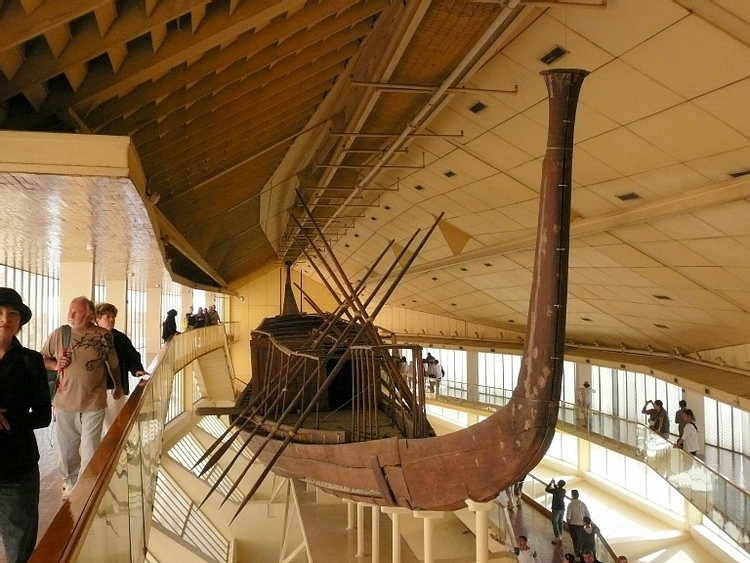 Khufu's Ship Vasudev (Vas) Bhandarkar (CC BY-NC-SA) ](https://www.worldhistory.org/image/6614/khufus-ship/ "Khufu's Ship")Even so, except for work on the ships of the gods, the Egyptians were known for their efforts in recycling. As far back as the Old Kingdom, there is evidence of the Egyptians reusing wood to shore up tombs, as the bases for artworks, and even to repair or construct ships. Recycled wood is apparent in the famous ship of the pharaoh Khufu (r. 2589-2566 BCE), and this paradigm continues throughout Egypt's history. So even though they required vast amounts of timber, they imported far less than they needed because of their recycling efforts.
Rome did not adhere to this same model and needed significantly more wood during the period of their empire than Egypt had. When [Mark](https://www.worldhistory.org/disambiguation/Mark/) Antony and Cleopatra met [Octavian](https://www.worldhistory.org/augustus/) at the [Battle of Actium](https://www.worldhistory.org/Battle_of_Actium/) in 31 BCE, Cleopatra's ships were made from the wood of Hamaxia (Life in the Truck Lane, Rauh, et. al., 264) and it is likely that many of Octavian's ships were also. Following Actium, Octavian became [Augustus](https://www.worldhistory.org/augustus/) [Caesar](https://www.worldhistory.org/disambiguation/caesar/) (r. 27 BCE - 14 CE) of the Roman Empire and Rome required even more timber for domestic uses such as villa gardens, artwork, barrels, buckets, and other such things as well as for merchant ships, warships, tow-ships, and fishing vessels. Any ship damaged or sunk had to be repaired or replaced, and the Romans were not as keen on recycling as the Egyptians had been. Hamaxia would have been among the chief suppliers of timber in Cilicia and the harvest and export of wood made the city wealthy.
### Hamaxia & the Timber Industry
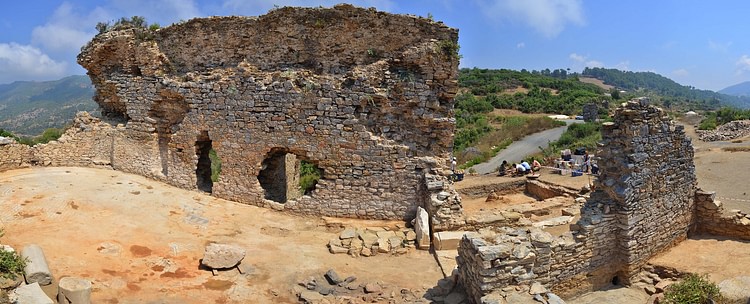
The site of ancient Hamaxia has not been excavated, and there are few references to it in [literature](https://www.worldhistory.org/literature/), so an evaluation of the city's wealth must be based on the physical evidence of the modern-day site. It was probably already a thriving timber-export city as it was worth noting by Strabo, and the ruins in the present day suggest a city of considerable affluence. There is an impressive cistern, a large public pool and fountain, a [temple](https://www.worldhistory.org/temple/), and exedra (portico) with seats where people would have sat overlooking the Mediterranean. There is also evidence of a good-sized [agora](https://www.worldhistory.org/agora/) (marketplace), a necropolis, inscriptions in stone paving to the [god](https://www.worldhistory.org/God/) [Hermes](https://www.worldhistory.org/Hermes/), and portions of thick city walls. The debris field suggests the city was brought down by an [earthquake](https://www.worldhistory.org/disambiguation/earthquake/).
Hamaxia, and other cities like it, thrived because of the timber trade but at the cost of the very environment they depended on. Scholar Nicholas K. Rauh of Perdue University, in his *Landscape Ecology and the End of Antiquity: The [Archaeology](https://www.worldhistory.org/Archaeology/) of Deforestation in South Coastal Turkey*, notes how Cilicia under the Romans industrialized at a significant rate unseen before in the region which the environment struggled to keep up with. Rauh comments:
> Urban development in Rough Cilicia during the Early Roman era was rapid and robust. The region entered the Roman era in a relatively backward state with little evidence of fire-driven production activities. Nonetheless, during the [Pax Romana](https://www.worldhistory.org/Pax_Romana/) the region's inhabitants adapted quickly to mainstream production systems and transformed their landscape into a [mosaic](https://www.worldhistory.org/Mosaic/) of small built environments surrounded by lush plots of terraced vineyards and groves of olive, fruit, and nut trees. The inhabitants replaced the region's natural forest cover with manicured, artificially built houses and public buildings of such permanence that their features survive to this day. Most of this development was based on fuel-driven firing technologies and production systems that required enormous quantities of fuel. The most likely fuel source was the region's forests. (5)
In addition to exporting wood to Rome, Hamaxia would have also supplied timber to cities throughout Cilicia. Cities like Iotapa (modern [Aytap](https://www.worldhistory.org/Iotape/)), not far down the coast from Hamaxia's port, would have required fuel to heat its baths. Iotapa was built in 52 CE by Antiochus IV, King of [Commagene](https://www.worldhistory.org/Commagene/) (r. 38-72 CE) who founded and named it after his late sister-wife. Antiochus IV is well known as the architect and builder of another and more famous coastal city in the nearby Gazipasa district, [Antiochia ad Cragum](https://www.worldhistory.org/Antiochia_ad_Cragum/), which had one of the largest bath complexes in all of Cilicia. The fuel required to heat the Great Bath at [Antiochia](https://www.worldhistory.org/Antiochia/) ad Cragum alone would have been considerable, aside from all the other baths in all the other cities. Houses in Cilicia used wood, and it was also required for artisans and Cilician shipwrights so the deforestation around cities like Hamaxia could have been quite extensive.
[  Bath Complex at Antiochia ad Cragum orientalizing (CC BY-NC-ND) ](https://www.worldhistory.org/image/11030/bath-complex-at-antiochia-ad-cragum/ "Bath Complex at Antiochia ad Cragum")### Conclusion
By c. 100 CE, Hamaxia had exhausted its supply of timber and seems to have become impoverished. It was taken over by nearby Coracesium at some point prior to 200 CE. The [Roman emperor](https://www.worldhistory.org/Roman_Emperor/) [Hadrian](https://www.worldhistory.org/hadrian/) (r. 117-138 CE) stipulated environmental controls in the region during his reign, prohibiting deforestation and allowing for new forest growth. Emperors after him are thought to have adhered to the same policy since, according to Rauh, further deforestation of the region seems to take place in the late Roman-[Byzantine](https://www.worldhistory.org/disambiguation/Byzantine/) eras and afterwards when Cilicia was part of the [Ottoman Empire](https://www.worldhistory.org/Ottoman_Empire/). There is no record of any military engagement which might have destroyed the city and so, as noted, it was most likely toppled by an earthquake and afterwards abandoned.
In the present day, the ruins of the city sit quietly on the hilltop 1,312 feet (400 meters) above the village of Elikesik. If not for Strabo and the *Stadiasmus Maris Magni,* no one now would even know its ancient name but, in its prime, Hamaxia was one of the major cities of the southern Cilician coast before depleting the resources which had once made its name worth remembering.
#### Editorial Review
This human-authored definition has been reviewed by our editorial team before publication to ensure accuracy, reliability and adherence to academic standards in accordance with our [editorial policy](https://www.worldhistory.org/static/editorial-policy/).
## Bibliography
- [Landscape Ecology and the End of Antiquity:The Archaeology of Deforestation in South Coastal Turkey by Nicholas K. Rauh](https://www.researchgate.net/publication/241731326_The_archaeology_of_deforestation_in_south_coastal_Turkey "Landscape Ecology and the End of Antiquity:The Archaeology of Deforestation in South Coastal Turkey by Nicholas K. Rauh"), accessed 23 Jul 2019.
- [Bryce, T. *The Kingdom of the Hittites.* Oxford University Press, 2006.](https://www.worldhistory.org/books/0199281327/)
- Creasman, P. P. "Ship Timber and the Reuse of Wood in Ancient Egypt." *Journal of Egyptian History*, Volume 6, 2013, pp. 152-176.
- [Hoff, M. C. & Townsend, R. F. *Rough Cilicia: New Historical and Archaeological Approaches.* Oxbow Books, 2013.](https://www.worldhistory.org/books/1842175181/)
- [Kuniholm, P. I. "Wood." *The Oxford Encyclopedia of Archaeology in the Near East*, edited by Meyers, E. M. Oxford University Press, 1996, 347-349.](https://www.worldhistory.org/books/0195065123/)
- [Peters, F. E. *The Harvest of Hellenism.* Barnes & Noble Books, 1996.](https://www.worldhistory.org/books/0760701296/)
- Rauh, N. K. et. al. "Life in the Truck Lane: Urban Development in Western Rough Cilicia." *University of Nebraska-Lincoln Anthropology Faculty Publications*, 2009, pp. 1-68.
- [Steadman, S. R. & McMahon G. *The Archaeology of Anatolia: Recent Discoveries 2011-2014.* Cambridge Scholars Publishing, 2015.](https://www.worldhistory.org/books/1443878154/)
- [Stiebing Jr, W. H. *Ancient Near Eastern History and Culture.* Pearson Higher Education, 2008.](https://www.worldhistory.org/books/032142297X/)
- [Strabo. *Strabo's Geography.* Harvard University Press, 1930.](https://www.worldhistory.org/books/0674992660/)
## About the Author
Joshua J. Mark is World History Encyclopedia's co-founder and Content Director. He was previously a professor at Marist College (NY) where he taught history, philosophy, literature, and writing. He has traveled extensively and lived in Greece and Germany.
- [Linkedin Profile](https://www.linkedin.com/pub/joshua-j-mark/38/614/339)
## Timeline
- **31 BCE**: [Hamaxia](https://www.worldhistory.org/Hamaxia/) supplies wood for [Cleopatra](https://www.worldhistory.org/disambiguation/cleopatra/)'s fleet in the [Battle of Actium](https://www.worldhistory.org/Battle_of_Actium/).
- **c. 27 BCE - c. 100 CE**: [Hamaxia](https://www.worldhistory.org/Hamaxia/) thrives in the timber export business in the early years of the [Roman Empire](https://www.worldhistory.org/Roman_Empire/).
- **c. 200 CE**: [Hamaxia](https://www.worldhistory.org/Hamaxia/) impoverished and under the authority of nearby Coracesium.
## Cite This Work
### APA
Mark, J. J. (2019, August 14). Hamaxia. *World History Encyclopedia*.
### Chicago
Mark, Joshua J.. "Hamaxia." *World History Encyclopedia*, August 14, 2019. .
### MLA
Mark, Joshua J.. "Hamaxia." *World History Encyclopedia*, 14 Aug 2019, .
## License & Copyright
Submitted by [Joshua J. Mark](https://www.worldhistory.org/user/JPryst/ "User Page: Joshua J. Mark"), published on 14 August 2019. The copyright holder has published this content under the following license: [Creative Commons Attribution-NonCommercial-ShareAlike](https://creativecommons.org/licenses/by-nc-sa/4.0/deed.en). This license lets others remix, tweak, and build upon this content non-commercially, as long as they credit the author and license their new creations under the identical terms. When republishing on the web a hyperlink back to the original content source URL must be included. Please note that content linked from this page may have different licensing terms.