---
title: Goryeo
author: Mark Cartwright
source: https://www.worldhistory.org/Goryeo/
format: machine-readable-alternate
license: Creative Commons Attribution-NonCommercial-ShareAlike (https://creativecommons.org/licenses/by-nc-sa/4.0/)
updated: 2025-11-27
---
# Goryeo
_Authored by [Mark Cartwright](https://www.worldhistory.org/user/markzcartwright/)_
Goryeo (Koryo) ruled [Korea](https://www.worldhistory.org/Korea/) from 918 to 1392. The kingdom oversaw an unprecedented flourishing in [culture](https://www.worldhistory.org/disambiguation/culture/) and arts with developments in [architecture](https://www.worldhistory.org/disambiguation/architecture/), ceramics, printing, and papermaking. The kingdom was repeatedly invaded by the [Mongols](https://www.worldhistory.org/Mongol_Empire/) in the 13th century and thereafter became less independent and more culturally influenced by their northern neighbours. Koryo is the origin of modern Korea's English name.
### The Fall of [Silla](https://www.worldhistory.org/Silla/)
The [Unified Silla Kingdom](https://www.worldhistory.org/Unified_Silla_Kingdom/) (668- 935) had held sway over the Korean peninsula for three centuries, but the state was in a slow decline. The rigidity of its class structure, based on the [bone rank system](https://www.worldhistory.org/Bone_Rank_System/), meant that few could rise above the position of their birth and ideas and innovation were stifled. The aristocracy began to resent the power of the king, landowners resisted centralised control, and the peasantry grew more and more rebellious over the incessant taxes levied upon them. The state was falling apart from within.
The period of political turmoil which followed is referred to as the [Later Three Kingdoms period](https://www.worldhistory.org/Later_Three_Kingdoms_Period/) (889-935). Gyeon Hwon, a peasant leader, took advantage of the political unrest in 892 and formed a revival of the old [Baekje](https://www.worldhistory.org/Baekje/) kingdom in the south-west portion of the peninsula. Meanwhile, an aristocratic [Buddhist](https://www.worldhistory.org/buddhism/) monk leader, Gung Ye, declared a new [Goguryeo](https://www.worldhistory.org/Goguryeo/) state in the north in 901, known as Later Goguryeo. There then followed a power struggle for control of the peninsula. Gyeon Hwon attacked [Gyeongju](https://www.worldhistory.org/Gyeongju/), the Silla capital in 927 while Gung Ye's unpopular and fanatical tyranny led to his [death](https://www.worldhistory.org/disambiguation/Death/) at the hands of his people. He was succeeded by his first minister, the able [Wang Geon](https://www.worldhistory.org/Taejo_of_Goryeo/), in 918 who attacked Later Baekje, now beset by leadership in-fighting, and then Silla. The last Silla king, Gyeongsun, surrendered in 935 and left Wang Geon to unify the country once again but under a new name, Goryeo.
#### Book Promotion
[  ](https://amzn.to/4isZ4B5 "The Forsaken 14th Century")### The Forsaken 14th Century
by World History Encyclopedia WHE's first book takes a truly global outlook and introduces readers to the different cultures that survived, thrived, and fell amid adversity in the 14th century. Filled with in-depth text written by WHE authors, many exclusive maps, and plenty of illustrations, The Forsaken 14th Century takes you on a global journey from the nomads of the Mongol Empire to the Black Death in Europe, the booming trade on the Swahili Coast to the Aztecs and the Māori settlements in New Zealand. [Learn More](https://amzn.to/4isZ4B5)
.sponsor.book img.key_art {
box-shadow: none !important;
}
.button_container {
margin-top: 1em;
}
.sponsor.book h3 {
text-transform: none;
margin-top: 0px;
margin-bottom: 15px;
font-family: "Libre Baskerville", "Palatino Linotype", "Book Antiqua", Palatino, serif;
}
.sponsor_message {
margin-left: 190px;
font-family: Karla, Arial, Helvetica, sans-serif;
line-height: 140%;
min-height: 200px;
}
.sponsor.book {
padding: 20px;
margin: 25px 0px;
background-color: #f3f3f3;
}
.sponsor.book .key_art {
margin-top: 0px;
margin-bottom: 10px;
float: left;
}
.sponsor h4 {
font-weight: bold;
text-transform: uppercase;
color: #000;
margin-bottom: 10px;
margin-top: 0px;
font-family: Karla,Arial,Helvetica,sans-serif;
font-size: 13px;
padding: 0;
}
.sponsor_book_author {
color: #999;
margin: -10px 0px 20px;
}
@media (max-width: 1199px) {
.sponsor.book .key_art {
float: none;
width: 100%;
}
.sponsor.book .sponsor_message {
margin-left: 0px;
}
.sponsor.book h3 {
margin-top: 20px;
margin-bottom: 10px;
}
}
@media (max-width: 767px) {
}
### A Unified Korea
Wang Geon was eager to rekindle the former glories of the Goguryeo ([Koguryo](https://www.worldhistory.org/Goguryeo/)) state, which had thrived during the [Three Kingdoms period](https://www.worldhistory.org/disambiguation/Three_Kingdoms_Period/) (37 BCE – 668), and perhaps for this reason selected the northern [city](https://www.worldhistory.org/city/) of Songdo (Modern Gaesong) as his new capital. Wang Geon declared himself king and for his contribution to creating the new state he was given the posthumous title of King Taejo or 'Great Founder.' However, Taejo's kingdom was far from secure and the [Khitan](https://www.worldhistory.org/Khitan/) (Qidan) tribes in the north proved stubbornly resistant to Goryeo's expansionist policies of the late 10th and early 11th century. Indeed, the Khitan counter-attacked twice and briefly took Songdo. A third [battle](https://www.worldhistory.org/disambiguation/battle/) in 1033 finally saw Goryeo victorious, and a defensive [wall](https://www.worldhistory.org/wall/) was built stretching right across the northern Korea border. This wall became especially useful when the Jin dynasty overran the old Khitan territories in the first quarter of the 12th century.
### Government & Class System
The Goryeo system of government was much like previous Korean kingdoms with a centralised government presided over by a monarch who might consult a small council of senior administrators. The civil administration was dominated by an expanded but still exclusive aristocracy ruling over a largely peasant populace with some skilled artisans producing manufactured goods such as ceramics, weapons, and art objects. Intermediary between these two levels were local magistrates (often large estate owners with their own private army) whose authority could be all-powerful in the districts where the centralised government was absent (perhaps 60% of districts remained semi-independent).
[ 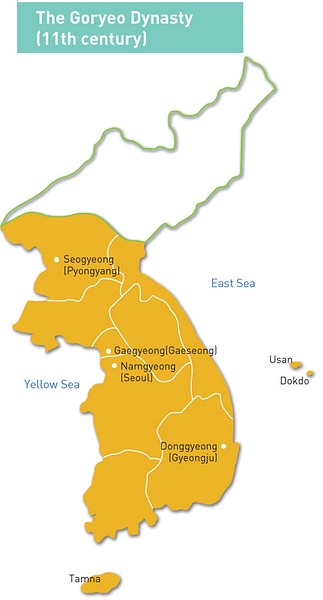 Map of the Goryeo Empire (11th century CE) Korean Culture & Information Service (CC BY-SA) ](https://www.worldhistory.org/image/5609/map-of-the-goryeo-empire-11th-century-ce/ "Map of the Goryeo Empire (11th century CE)")At the bottom of the social ladder were slaves (prisoners of [war](https://www.worldhistory.org/disambiguation/War/), debtors, and criminals) who worked on the estates of the landed gentry or for the government on building projects such as fortifications. There was very little social mobility as any positions of significance and even entrance exams to those positions were strictly limited to those of a particular status decided by one's birth. Entrance to the state schools system (centralised in 992) was also limited to those of a certain social rank.
In Goryeo, the female line was often as important as the male line, which meant that [women](https://www.worldhistory.org/disambiguation/women/) were treated more favourably than in contemporary cultures such as [China](https://www.worldhistory.org/china/). Sometimes a husband moved into his wife's family home, women could divorce and keep custody of their children, and they could also inherit equally with their male siblings.
One significant change from previous regimes was that Goryeo made slavery hereditary with a reform in 1037; any child was to inherit the status of the mother. Many landowners took it upon themselves to expand the scope of this edict and classify as slaves any child born to a slave father too. This greatly increased the number of slaves so that they eventually rose to around 30% of the total population.
### Relations with China
Goryeo established close ties with China's [Song dynasty](https://www.worldhistory.org/Song_Dynasty/). The Song requested that Goryeo help them deal with the Khitan and Jin, but the Koreans were not keen to be embroiled in a wider regional conflict. Tribute was paid to China, but both state-sponsored and private [trade](https://www.worldhistory.org/disambiguation/trade/) included all manner of goods moving in both directions. China exported [silk](https://www.worldhistory.org/Silk/), books, spices, tea, [medicine](https://www.worldhistory.org/disambiguation/medicine/), and ceramics while Goryeo sent [gold](https://www.worldhistory.org/gold/), [silver](https://www.worldhistory.org/Silver/), [copper](https://www.worldhistory.org/copper/), ginseng, porcelain, pine nuts, and *[hanji](https://www.worldhistory.org/Hanji/)* paper. Other sources of foreign goods were [Japan](https://www.worldhistory.org/disambiguation/Japan/), which provided swords and folding fans, and Arab traders, who brought by ship such goods as spices and mercury. Such were the number of goods available that in the 13th century Songdo boasted over 1,000 shops.
[  Bronze Korean Coin, Goryeo Dynasty British Museum (Copyright) ](https://www.worldhistory.org/image/5717/bronze-korean-coin-goryeo-dynasty/ "Bronze Korean Coin, Goryeo Dynasty")Cultural ties were also strong with [Chinese literature](https://www.worldhistory.org/Chinese_Literature/) being very popular, and the state administration modelled on the Chinese approach with a civil service examination introduced in 958 and Confucian principles followed. The state [religion](https://www.worldhistory.org/religion/) was [Buddhism](https://www.worldhistory.org/buddhism/), which had been introduced from China centuries before and which continued to be endorsed by the king with many temples and monasteries being built. The Buddhist [temple](https://www.worldhistory.org/temple/)-monasteries, with their landed estates, royal patronage, and exemption from tax, became wealthy and the whole religious apparatus rivalled that of the state itself. Many such monasteries even had their own armed forces recruited from warrior-monks and the general populace. Buddhism was practised not only by the elite families, which often sent a son to study at a monastery and become a monk, but also by the lower classes too.
One more example of the cultural ties with China is coinage. Korea had long used Chinese currency but began to mint its own coinage from 996. These coins imitated those of the earlier Chinese [Tang dynasty](https://www.worldhistory.org/Tang_Dynasty/) (618 – 907) and were made of iron and copper. Even the 'heavy [coin](https://www.worldhistory.org/coinage/) of the Qianyuan period' inscription was translated from the Chinese *Qianyuan zhongbao*) to the Korean *Konwonchungbo*. The Goryeo mint did add an identifying [mark](https://www.worldhistory.org/disambiguation/Mark/) such as 'Eastern kingdom' (*Tongkuk*) on the reverse side of their coins. As with Chinese coins, the Korean coins had a square central hole. An alternative to coins was the *unbyong (aka *hwalgu*) silver vases which were made from 1101. The vases took the shape of the Goryeo [empire](https://www.worldhistory.org/empire/) and were marked as legitimate currency by having the official state seal engraved on them.
### Paper, Movable Type Printing & Paintings
Buddhism was directly responsible for the development of printing for it was to spread Buddhist scriptures and Buddhist [literature](https://www.worldhistory.org/literature/) that woodblock printing improved and then movable [metal](https://www.worldhistory.org/disambiguation/metal/) type was invented in 1234. Improved quality ink and *hanji* paper made from mulberry trees accompanied these developments, the latter gaining fame as the finest paper in the world. The period also saw an interest in documenting the history of the country with the famous *Samguk sagi* ('History of the Three Kingdoms') written in 1145 by Gim Busik. Drawing extensively on earlier sources now lost, it is the single most important historical text on ancient Korea.
[  Buddhist Illuminated Manuscript, Goryeo Period Eggmoon (CC BY-SA) ](https://www.worldhistory.org/image/5920/buddhist-illuminated-manuscript-goryeo-period/ "Buddhist Illuminated Manuscript, Goryeo Period")### Buddhist Scriptures
Another Buddhist contribution to the arts is [illuminated manuscripts](https://www.worldhistory.org/Illuminated_Manuscripts/). These *sagyong are usually of texts from the sutras (sermons) attributed to [Buddha](https://www.worldhistory.org/Siddhartha_Gautama/) and formed scrolls and folded books. They were written by monk-scribes on indigo *hanji* paper using bright dyes and sometimes even silver and gold. Buddhist monks also painted frescoes and silk wall hangings to decorate temples. These Goryeo Buddhist paintings presented popular subjects like bodhisattvas and water-flowers. Non-religious paintings of this period have not survived so well but were popular at the time, especially the specialised art form of fan-painting. It is known that painting was not merely done by professional artists but also as a hobby by those with the leisure time and means to pursue it.
### Goryeo [Sculpture](https://www.worldhistory.org/disambiguation/Sculpture/)
Goryeo's sculptors used a variety of mediums including marble, stone, terracotta clay, and metal. Figures of Buddha as Maitreya (the coming Buddha) were popular and some are massive such as the 17.4 metre (57 ft.) high one at Paju and the 18.4 metre (59.3 ft.) tall figure at the Kwanchok temple in Nonsan which were both carved out of natural boulders in the 11th century. Many figures wear unique tall hats and this may represent a link with shamanism, long practised in ancient Korea. Standing figures of soldiers or officials were commonly placed in pairs outside tombs, as per the China model. In the second half of the period, sculptures are mostly small-scale and made with gilt-[bronze](https://www.worldhistory.org/disambiguation/bronze/).
Another area of metalwork was the production of bells for Buddhist temples. Smaller than the [giant](https://www.worldhistory.org/Giants/) bells made by the earlier Unified Silla kingdom, Goryeo bells can still be up to 1.7 metres tall and were cast in bronze and decorated with dragons and heavenly figures amongst others. One unique feature is the lotus medallion cast at the point where the bell was struck. Bells must not have been too popular with the local populace as they were often compelled by monasteries and temples to 'donate' bronze goods so that they could be melted down and recast. Handbells, temple gongs, incense burners, and vases were also cast in bronze and sometimes embellished with very fine silver and gold inlay.
[  Maebyeong Celadon Vase, Goryeo Dynasty NeIC (CC BY-NC-ND) ](https://www.worldhistory.org/image/5604/maebyeong-celadon-vase-goryeo-dynasty/ "Maebyeong Celadon Vase, Goryeo Dynasty")### Goryeo Celadon & Ceramics
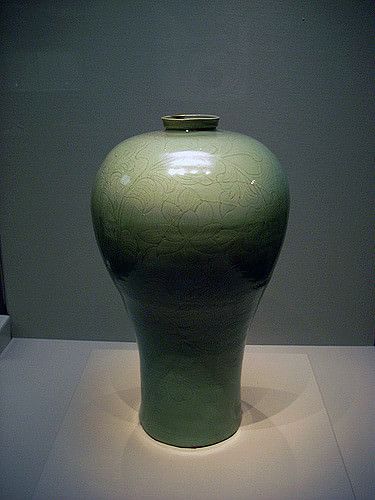
Goryeo potters produced unglazed stoneware and white porcelain, but their most celebrated creation is celadon ware. The latter, also known as greenware because of its pale green colour, has a smooth glaze and pieces typically have fine inlaid designs (*sanggam*), especially Buddhist motifs such as the lotus flower, cranes, and clouds. Goryeo celadon was first introduced into Korea from China during the 9th century, but Korean potters became so skilled at their manufacture that their wares were exported back to China and, even today, Korean celadons are amongst the most prized ceramics in the world. All manner of items were made from incense burners to ink stands to roof tiles, but the most quintessential shape is the tall elegant jar with bulbous neck known as a *maebyeong*.
### Goryeo Architecture
There are no surviving temples from the Goryeo dynasty, made as they were largely of wood, which is a poor archaeological survivor. A good idea of the architectural style is seen in the 13th-century Hall of Eternal Life (Muryangsujeon) at the Buseoksa temple in Yongju. It is one of the oldest wooden structures surviving in the whole of Korea. Its roof displays a dual-edge and is supported by three-tiered supports. It also has the more complex roof brackets at the top of supporting columns typical of the period. The wooden columns taper and permit ceilingless openwork. Stone pagodas have survived better, and these are eclectic depending on location. Stone lanterns are another indicator of Goryeo architectural design with many taking the form of pairs of lions, columns, or octagonal platforms.[ 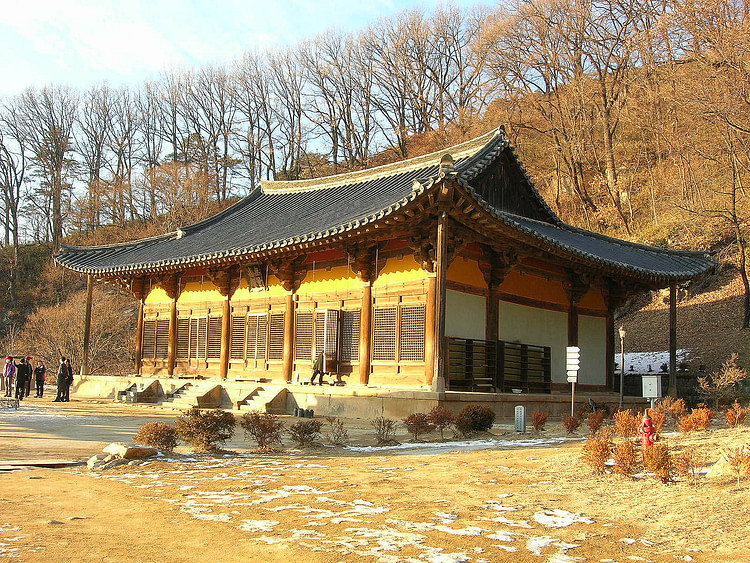 Muryangsujeon, Buseoksa, Korea ko:Excretion (CC BY-SA) ](https://www.worldhistory.org/image/5614/muryangsujeon-buseoksa-korea/ "Muryangsujeon, Buseoksa, Korea")
The best-preserved [tomb](https://www.worldhistory.org/tomb/) from the Goryeo period, located near Gaeseong, is that of king Gongmin (r. 1330-1374) and his Mongolian wife Noguk. The two mounds of the tomb have stone balustrades with statues of tigers and sheep, which represent [yin and yang](https://www.worldhistory.org/Yin_and_Yang/). Within the mound are two stone chambers decorated with wall-paintings and constellations on the ceilings. 11th and 12th century tombs are also to be found at Gaeseong and are similarly decorated, the animal zodiac occurring in several as it does in Gongmin's tomb. Many Goryeo tombs contained slate coffins which were decorated with relief carvings of the four animals of the cardinal directions.
### [Yuan Dynasty](https://www.worldhistory.org/Yuan_Dynasty/)-[Mongol](https://www.worldhistory.org/Mongol_Empire/) Invasions
The years of relative peace in the 12th and 13th centuries allowed for a flourishing of the arts, but it also resulted in a steadily increasing decadence among the ruling elite, corruption, and social unrest. A significant rebellion led by the king's father-in-[law](https://www.worldhistory.org/disambiguation/law/) I- Jagyeom in 1126 and another by the monk Myocheong in 1135 were quashed, but matters came to a head in the reign of king Uijong (1147-1170) who was much criticised for building lavish palaces and water parks. There were, too, conflicts between the various sects of Buddhism and claims the king favoured the Kyo sect over the others. The military, with not much else to do and no status in higher society, staged a coup in 1170. Uijong was replaced by his brother Myeongjong, but he only remained as a puppet sovereign. Decades of turbulent in-fighting between all levels of Goryeo society ensued with more coups, assassinations, and slave rebellions.
A new threat to Korea emerged in the early 13th century when the Mongol tribes, united by [Genghis Khan](https://www.worldhistory.org/Genghis_Khan/) (Chinggis), swept through China and conquered Beijing in 1215, establishing the Yuan Dynasty. The crisis came in 1231 when the Mongols, now led by [Ogedei Khan](https://www.worldhistory.org/Ogedei_Khan/), invaded Korea, forcing Goryeo to move its capital to Kanghwa Island the following year. While the ruling elite was safely ensconced on their island, the rest of the Goryeo population had to face six Mongol invasions over the next three decades. By 1258 the people had had enough, and the military ruler was assassinated, the king reinstalled with full powers, and peace made with the Mongols. The price for the latter was an obligation to provide ships and materials for the (failed) Mongol invasions of Japan in 1274 and 1281. Korea then became increasingly influenced by Mongol culture, princes were required to live as hostages in Beijing, and several kings married Mongolian princesses. Korea would have to wait another century to re-establish its independence when, in 1392, the general I Sionggye (aka Taejo) formed the new Joseon dynasty.
This content was made possible with generous support from the [British Korean Society](http://www.britishkoreansociety.org.uk/?utm_source=ancient.eu&utm_medium=link&utm_campaign=ancient.eu).
#### Editorial Review
This human-authored definition has been reviewed by our editorial team before publication to ensure accuracy, reliability and adherence to academic standards in accordance with our [editorial policy](https://www.worldhistory.org/static/editorial-policy/).
## Bibliography
- [Ki-baik Lee. *A New History of Korea.* Harvard University Asia Center, 1984.](https://www.worldhistory.org/books/067461576X/)
- Kim, C. *The Arts of Korea.* Thames & Hudson, 1966
- [Patricia Buckley Ebrey. *Pre-Modern East Asia.* Cengage Learning, 2008.](https://www.worldhistory.org/books/0547005393/)
- [Portal, J. *Korea.* Thames & Hudson, 2000.](https://www.worldhistory.org/books/0500282021/)
- [Pratt, K. *Korea.* Routledge, 1999.](https://www.worldhistory.org/books/0700704639/)
- [Seth, M.J. *A History of Korea.* Rowman & Littlefield Publishers, 2010.](https://www.worldhistory.org/books/0742567168/)
## About the Author
Mark is WHE’s Publishing Director and has an MA in Political Philosophy (University of York). He is a full-time researcher, writer, historian and editor. Special interests include art, architecture and discovering the ideas that all civilizations share.
## Timeline
- **918 CE - 943 CE**: Reign of [Goryeo](https://www.worldhistory.org/Goryeo/) founder King Taejo (formerly [Wang Geon](https://www.worldhistory.org/Taejo_of_Goryeo/)).
- **918 CE - 1392 CE**: The [Goryeo Dynasty](https://www.worldhistory.org/Goryeo/) rules in [Korea](https://www.worldhistory.org/Korea/).
- **935 CE**: The last [Silla](https://www.worldhistory.org/Silla/) king, Gyeongsun, surrenders to [Wang Geon](https://www.worldhistory.org/Taejo_of_Goryeo/) ruler of [Goryeo](https://www.worldhistory.org/Goryeo/).
- **992 CE**: The school system in [Goryeo](https://www.worldhistory.org/Goryeo/) is centralised.
- **994 CE**: The [Khitan](https://www.worldhistory.org/Khitan/) [Liao dynasty](https://www.worldhistory.org/Khitan/) invades the Korean peninsula.
- **996 CE**: The first Korean coins are minted by the [Goryeo Dynasty](https://www.worldhistory.org/Goryeo/).
- **1033 CE**: [Goryeo](https://www.worldhistory.org/Goryeo/) wins a decisive [battle](https://www.worldhistory.org/disambiguation/battle/) against the northern [Khitan](https://www.worldhistory.org/Khitan/) tribes.
- **1097 CE**: The [Goryeo](https://www.worldhistory.org/Goryeo/) king, Sukjong, mints [copper](https://www.worldhistory.org/copper/) coins in [Korea](https://www.worldhistory.org/Korea/).
- **1101 CE**: The unbyong (aka hwalgu) [silver](https://www.worldhistory.org/Silver/) vases are first made and used as currency in [Korea](https://www.worldhistory.org/Korea/).
- **1102 CE**: The [Goryeo](https://www.worldhistory.org/Goryeo/) king, Sukjong, mints a second issue of [copper](https://www.worldhistory.org/copper/) coins in [Korea](https://www.worldhistory.org/Korea/).
- **1126 CE**: A rebellion led by the king's father-in-[law](https://www.worldhistory.org/disambiguation/law/) I Jagyeom is quashed in [Goryeo](https://www.worldhistory.org/Goryeo/).
- **1126 CE**: The [Goryeo](https://www.worldhistory.org/Goryeo/) kingdom of [Korea](https://www.worldhistory.org/Korea/) submits to vassal status towards the [Jurchen Jin dynasty](https://www.worldhistory.org/Jurchen_Jin_Dynasty/).
- **1135 CE**: A rebellion led by the monk Myocheong is quashed in [Goryeo](https://www.worldhistory.org/Goryeo/).
- **1145 CE**: The '[Samguk sagi](https://www.worldhistory.org/Samguk_Sagi/)' ('History of the Three Kingdoms') is written by Gim Busik in [Goryeo](https://www.worldhistory.org/Goryeo/).
- **1170 CE**: The military stages a coup in [Goryeo](https://www.worldhistory.org/Goryeo/). King Uijong is replaced by his brother Myeongjong as a puppet sovereign.
- **1219 CE**: A [Goryeo](https://www.worldhistory.org/Goryeo/) army allies with the [Mongols](https://www.worldhistory.org/Mongol_Empire/) to attack the [Khitan](https://www.worldhistory.org/Khitan/) in northern [Korea](https://www.worldhistory.org/Korea/).
- **1231 CE - 1232 CE**: [Ogedei Khan](https://www.worldhistory.org/Ogedei_Khan/) leads a [Mongol](https://www.worldhistory.org/Mongol_Empire/) invasion into [Korea](https://www.worldhistory.org/Korea/).
- **1234 CE**: Movable [metal](https://www.worldhistory.org/disambiguation/metal/) type printing is invented in [Goryeo](https://www.worldhistory.org/Goryeo/), [Korea](https://www.worldhistory.org/Korea/).
- **1258 CE**: An uprising restores the monarchy in [Korea](https://www.worldhistory.org/Korea/) and makes peace with the [Mongol Empire](https://www.worldhistory.org/Mongol_Empire/).
- **1285 CE**: The [Samguk yusa](https://www.worldhistory.org/Samguk_Yusa/) ('Memorabilia of the Three Kingdoms') is written by Iryeon in [Korea](https://www.worldhistory.org/Korea/).
## External Links
- [List of Rulers of Korea | Lists of Rulers | Heilbrunn Timeline of Art History | The Metropolitan Museum of Art](https://www.metmuseum.org/toah/hd/koru/hd_koru.htm)
## Cite This Work
### APA
Cartwright, M. (2016, October 17). Goryeo. *World History Encyclopedia*.
### Chicago
Cartwright, Mark. "Goryeo." *World History Encyclopedia*, October 17, 2016. .
### MLA
Cartwright, Mark. "Goryeo." *World History Encyclopedia*, 17 Oct 2016, .
## License & Copyright
Submitted by [Mark Cartwright](https://www.worldhistory.org/user/markzcartwright/ "User Page: Mark Cartwright"), published on 17 October 2016. The copyright holder has published this content under the following license: [Creative Commons Attribution-NonCommercial-ShareAlike](https://creativecommons.org/licenses/by-nc-sa/4.0/deed.en). This license lets others remix, tweak, and build upon this content non-commercially, as long as they credit the author and license their new creations under the identical terms. When republishing on the web a hyperlink back to the original content source URL must be included. Please note that content linked from this page may have different licensing terms.