---
title: Gortyn
author: Mark Cartwright
source: https://www.worldhistory.org/Gortyn/
format: machine-readable-alternate
license: Creative Commons Attribution-NonCommercial-ShareAlike (https://creativecommons.org/licenses/by-nc-sa/4.0/)
updated: 1970-01-01
---
# Gortyn
_Authored by [Mark Cartwright](https://www.worldhistory.org/user/markzcartwright/)_
Gortyn is located on the Mesara plain of central [Crete](https://www.worldhistory.org/crete/) and was an important settlement throughout antiquity from the [Minoan](https://www.worldhistory.org/disambiguation/Minoan/) to [Hellenistic](https://www.worldhistory.org/Hellenic_World/) periods. In [Roman](https://www.worldhistory.org/disambiguation/Roman/) times the [city](https://www.worldhistory.org/city/) went on to gain even more importance as the capital of the Roman province of Crete and [Cyrene](https://www.worldhistory.org/cyrene/). The site today is particularly noted for the Gortyn [Law](https://www.worldhistory.org/disambiguation/law/) Code, a lengthy [wall](https://www.worldhistory.org/wall/) inscription created in the 5th century BCE which is the earliest such example in [Europe](https://www.worldhistory.org/europe/).
### [Bronze Age](https://www.worldhistory.org/disambiguation/Bronze_Age/) Gortyn
First settled in the Late [Bronze](https://www.worldhistory.org/disambiguation/bronze/) Age, Gortyn was built on an [acropolis](https://www.worldhistory.org/Acropolis/) and initially controlled by the Minoan [palace](https://www.worldhistory.org/disambiguation/palace/) of nearby [Phaistos](https://www.worldhistory.org/Phaistos/) until it rose to prominence as the most important [city-state](https://www.worldhistory.org/Polis/) in the region. Bronze Age Gortyn is also the setting of several important stories from [Greek mythology](https://www.worldhistory.org/Greek_Mythology/). [Europa](https://www.worldhistory.org/Europa/) was seduced here by [Zeus](https://www.worldhistory.org/zeus/) when he took the form of a bull; their marriage taking place under an evergreen tree at the site. Gortyn is mentioned in [Homer](https://www.worldhistory.org/homer/)'s *[Iliad](https://www.worldhistory.org/iliad/)* as being a walled city and in the *[Odyssey](https://www.worldhistory.org/Odyssey/)* where the Greeks, returning home from the [Trojan War](https://www.worldhistory.org/Trojan_War/), are driven against the stormy coastline of southern Crete.
### The [Archaic Period](https://www.worldhistory.org/Archaic_Period/)
In the 8th and 7th centuries BCE the city spread onto the plain near the Mylopotomos River. It was served by several nearby harbours, notably Matala and Lebena. The city acquired the usual *[agora](https://www.worldhistory.org/agora/)*, monumental [sculpture](https://www.worldhistory.org/disambiguation/Sculpture/) and religious temples of a prosperous [Greek](https://www.worldhistory.org/disambiguation/greek/) *[polis](https://www.worldhistory.org/Polis/)* or city-state. Two of the city's most important temples were dedicated to [Apollo](https://www.worldhistory.org/apollo/) and [Athena](https://www.worldhistory.org/athena/), the latter being regarded as the guardian of the city.
### The Classical Period & Law Code
Gortyn continued to flourish and created its own [coinage](https://www.worldhistory.org/coinage/) from 470 BCE. Unfortunately, there are few remains of buildings from this period but there is one truly unique survivor. This is the famous Gortyn Law Code, which dates to c. 450 BCE. Inscribed on a curved porticus wall of marble blocks on the edge of the agora, this huge text spans 8 metres. It is divided into 12 columns and is in *boustrophedon*, that is alternate lines are read in opposite directions. The 600-line text, using the Doric [alphabet](https://www.worldhistory.org/alphabet/) and dialect, is almost complete and was clearly meant to be read by any member of the public. The Code describes articles of property and marital law, and is of special interest to historians for its details on the family and [women](https://www.worldhistory.org/disambiguation/women/)'s status. Also covered are rules concerning inheritance, debts, adoption, marriage, slavery, and sexual violence. It is the earliest surviving legal inscription from anywhere in Europe. Following the destruction of the supporting wall, the Code was actually dismantled and reassembled in the 1st century BCE. It was re-set in its original position although the communal space now functioned as a *bouleuterion* or meeting place for the city's council.
[  The Law Code of Gortyn, Crete Mark Cartwright (CC BY-NC-SA) ](https://www.worldhistory.org/image/397/the-law-code-of-gortyn-crete/ "The Law Code of Gortyn, Crete")### The [Hellenistic Period](https://www.worldhistory.org/Hellenistic_Period/)
Gortyn continued to prosper in the Hellenistic period and, in the 3rd century BCE, it led a confederation of Cretan city-states against [Knossos](https://www.worldhistory.org/knossos/). Other indicators of Gortyn's increase in status included construction of an extra agora and a sanctuary to [Demeter](https://www.worldhistory.org/demeter/) and Kore. With the support of [Ptolemy](https://www.worldhistory.org/disambiguation/Ptolemy/) IV Philopater of [Egypt](https://www.worldhistory.org/egypt/), Gortyn felt confident enough to take on rival Cretan powers such as Knossos and Phaistos in the Cretan Wars. Gortyn defeated Phaistos in the 2nd century BCE and then sided with old enemy Knossos to defeat Lyttos in c. 220 BCE.
### The Roman Period
[Rome](https://www.worldhistory.org/Rome/) began to take an interest in Cretan affairs in the 2nd century BCE, but Gortyn made the strategic error of giving sanctuary to Rome's great enemy [Hannibal](https://www.worldhistory.org/hannibal/) in 189 BCE. Then, switching policy and supporting Quintus Caecilius Metellus during his brutal invasion of Crete in the mid-1st century BCE, Gortyn seized the opportunity to increase its own power on the island and grow to an unprecedented size. The strategy worked as c. 27 BCE [Augustus](https://www.worldhistory.org/augustus/) made Gortyn the capital of the Roman province Crete and Cyrene (in modern Libya).
Made the seat of the proconsul, the city also benefitted from a new complex for this purpose, the *praetorium*. Continuing to prosper in the following centuries the population grew to 300,000 and the city benefitted from [Roman baths](https://www.worldhistory.org/Roman_Baths/), theatres, a [stadium](https://www.worldhistory.org/Stadium/), arena, *odeion*, and [circus](https://www.worldhistory.org/disambiguation/Circus/), as well as a much improved water system which included fountains, cisterns and [aqueducts](https://www.worldhistory.org/aqueduct/). A further indicator of Gortyn's status in the Roman world was the stationing of such prominent figures as future emperor [Trajan](https://www.worldhistory.org/trajan/), who served as the island's [quaestor](https://www.worldhistory.org/Quaestor/) in 81 CE.[ 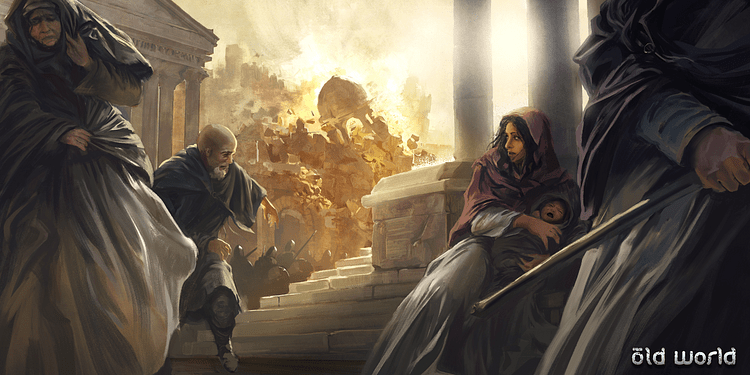 Ancient Earthquake Mohawk Games (Copyright) ](https://www.worldhistory.org/image/14290/ancient-earthquake/ "Ancient Earthquake")From the 3rd century CE Gortyn was involved in several episodes during the rise of [Christianity](https://www.worldhistory.org/christianity/), notably, in 249 CE when 10 Christian martyrs were killed in a nearby [amphitheatre](https://www.worldhistory.org/amphitheatre/) in a brutal wild animal hunt the Romans were so fond of staging. In 295-297 CE the province of Crete and Cyrene was divided and, although Gortyn remained the Cretan capital, it was now responsible to the prefect of Illyricum. The city fell into decline following a devastating [earthquake](https://www.worldhistory.org/disambiguation/earthquake/) in 365 CE after which it was abandoned as an administrative centre. Gortyn's fortunes did revive in the early [Byzantine](https://www.worldhistory.org/disambiguation/Byzantine/) period with the construction of a new city further east where several basilicas were built, notably the 6th century CE Church of St. [Titus](https://www.worldhistory.org/disambiguation/Titus/) (Hagios Titos), a follower of St. [Paul](https://www.worldhistory.org/disambiguation/Paul/) who was martyred at the site. However, after another major earthquake in 670 CE Gortyn was definitively abandoned.
#### Editorial Review
This human-authored definition has been reviewed by our editorial team before publication to ensure accuracy, reliability and adherence to academic standards in accordance with our [editorial policy](https://www.worldhistory.org/static/editorial-policy/).
## Bibliography
- Bagnall, R. et al. *The Encyclopedia of Ancient History.* Wiley-Blackwell, 2012
- [Davaras, C. *Phaistos, Hagia Triada, Gortyn.* Hannibal, Athen.](https://www.worldhistory.org/books/B007Z0AFA8/)
- [Hornblower, S. *The Oxford Classical Dictionary.* Oxford University Press, 2012.](https://www.worldhistory.org/books/0199545561/)
## About the Author
Mark is WHE’s Publishing Director and has an MA in Political Philosophy (University of York). He is a full-time researcher, writer, historian and editor. Special interests include art, architecture and discovering the ideas that all civilizations share.
## Timeline
- **470 BCE**: [Gortyn](https://www.worldhistory.org/Gortyn/) on [Crete](https://www.worldhistory.org/crete/) begins to mint its own [coinage](https://www.worldhistory.org/coinage/).
- **c. 450 BCE**: The [Law](https://www.worldhistory.org/disambiguation/law/) Code of [Gortyn](https://www.worldhistory.org/Gortyn/) is written.
- **c. 220 BCE**: [Gortyn](https://www.worldhistory.org/Gortyn/) allies with [Knossos](https://www.worldhistory.org/knossos/) to defeat Lyttos on [Crete](https://www.worldhistory.org/crete/).
- **189 BCE**: [Gortyn](https://www.worldhistory.org/Gortyn/) gives sanctuary to [Hannibal](https://www.worldhistory.org/hannibal/).
- **c. 180 BCE**: [Phaistos](https://www.worldhistory.org/Phaistos/) conquered by [Gortyn](https://www.worldhistory.org/Gortyn/).
- **c. 27 BCE**: [Augustus](https://www.worldhistory.org/augustus/) makes [Gortyn](https://www.worldhistory.org/Gortyn/) the capital of the [Roman](https://www.worldhistory.org/disambiguation/Roman/) province of [Crete](https://www.worldhistory.org/crete/) & [Cyrene](https://www.worldhistory.org/cyrene/).
- **60 CE**: An early Christian community is established at [Gortyn](https://www.worldhistory.org/Gortyn/), [Crete](https://www.worldhistory.org/crete/).
- **81 CE**: [Trajan](https://www.worldhistory.org/trajan/) serves as [quaestor](https://www.worldhistory.org/Quaestor/) at [Gortyn](https://www.worldhistory.org/Gortyn/), [Crete](https://www.worldhistory.org/crete/).
- **249 CE**: 10 Christians are famously martyred at [Gortyn](https://www.worldhistory.org/Gortyn/) in a wild animal hunt.
- **365 CE**: [Gortyn](https://www.worldhistory.org/Gortyn/) is destroyed by a devastating [earthquake](https://www.worldhistory.org/disambiguation/earthquake/).
- **670 CE**: [Gortyn](https://www.worldhistory.org/Gortyn/) is destroyed by [earthquake](https://www.worldhistory.org/disambiguation/earthquake/).
## Cite This Work
### APA
Cartwright, M. (2016, January 13). Gortyn. *World History Encyclopedia*.
### Chicago
Cartwright, Mark. "Gortyn." *World History Encyclopedia*, January 13, 2016. .
### MLA
Cartwright, Mark. "Gortyn." *World History Encyclopedia*, 13 Jan 2016, .
## License & Copyright
Submitted by [Mark Cartwright](https://www.worldhistory.org/user/markzcartwright/ "User Page: Mark Cartwright"), published on 13 January 2016. The copyright holder has published this content under the following license: [Creative Commons Attribution-NonCommercial-ShareAlike](https://creativecommons.org/licenses/by-nc-sa/4.0/deed.en). This license lets others remix, tweak, and build upon this content non-commercially, as long as they credit the author and license their new creations under the identical terms. When republishing on the web a hyperlink back to the original content source URL must be included. Please note that content linked from this page may have different licensing terms.