---
title: Gojoseon
author: Mark Cartwright
source: https://www.worldhistory.org/Gojoseon/
format: machine-readable-alternate
license: Creative Commons Attribution-NonCommercial-ShareAlike (https://creativecommons.org/licenses/by-nc-sa/4.0/)
updated: 1970-01-01
---
# Gojoseon
_Authored by [Mark Cartwright](https://www.worldhistory.org/user/markzcartwright/)_
Gojoseon (Gochoson or Old Choson) was an ancient kingdom which ruled northern [Korea](https://www.worldhistory.org/Korea/) in the second half of the first millennium BCE. Gojoseon possessed the most advanced [culture](https://www.worldhistory.org/disambiguation/culture/) in the Korean peninsula at that time and was an important marker in the progression towards the more centralised states of later periods.
### Foundation
According to Korean [mythology](https://www.worldhistory.org/mythology/), as recounted in the 13th-century CE *Samguk yusa* ('Memorabilia of the Three Kingdoms'), Gojoseon was founded in 2333 BCE by [Dangun](https://www.worldhistory.org/Dangun/) Wanggeom (Tangun) who was the offspring of the [god](https://www.worldhistory.org/God/) Hwanung and a female bear transformed into a woman. This myth may symbolise the arrival of [Bronze Age](https://www.worldhistory.org/disambiguation/Bronze_Age/) culture in Korea. Dangun was born on the third day of the tenth month, and so today the 3rd of October is celebrated as National Foundation Day in South Korea. The Korean name Choson derives from the Chinese name Chaoxian, itself a combination of the two words *chao* ('dawn') and *xian* ('calm' or 'fresh'), hence the referral to Korea on occasion as 'Land of the Morning Calm.'
According to some historians, the state was formed from the alliance of small fortified towns around the Daedong (Taedong) and Liao River basins perhaps from the 7th century BCE and more certainly from the 4th century BCE. The northern boundary of Gojoseon was the Liao River while its immediate southern neighbour was the Jin (Chin) state. An early reference to the Gojoseon state is found in the c. 100 BCE text *Records of the Grand Historian* written by the Chinese historian [Sima Qian](https://www.worldhistory.org/Sima_Qian/). Qian mentions that Gojoseon existed in 190 BCE. However, the only uncontested date for the existence of a state by the name of Choson/Gojoseon is 109 BCE, and historians continue to debate whether it is possible to describe Gojoseon as a state proper, when exactly did it exist, where was its capital, and what were the exact territories under its control. The location of the capital has long been considered as being near [Pyongyang](https://www.worldhistory.org/Pyongyang/), but there is also evidence that it may have been further north in Manchuria.
### Relations with [China](https://www.worldhistory.org/china/)
Relations between Korea and China go back to mythology when the sage Gija (Jizi) and 5,000 followers left China and settled in Dangun's kingdom. When the latter decided to retreat to meditation on a mountaintop, Giji was made king of Gojoseon in 1122 BCE. This myth may represent the arrival of [Iron Age](https://www.worldhistory.org/disambiguation/Iron_Age/) culture to Korea.
The historical rulers of Gojoseon did adopt the Chinese title *wang* (king) illustrating an early influence from neighbouring Yan China, probably a [trade](https://www.worldhistory.org/disambiguation/trade/) partner, perhaps, with Gojoseon acting as a middleman between China and the southern states of Korea. Another indicator of trade relations is the discovery of Chinese crescent knife coins (*mingdaoqian*) at various Korean sites.
Chinese culture was likely brought to Korea by refugees fleeing the 4th-century BCE conflicts of the [Warring States period](https://www.worldhistory.org/Warring_States_Period/). Archaeological evidence of this cultural influence is perhaps best seen in the use of pit [burial](https://www.worldhistory.org/burial/) tombs in the Daedong River area and the frequent presence of horse trappings therein. The tombs are also of interest as several contain over 100 slaves buried with, and presumably belonging to, the occupant. With better iron tools introduced from China, agricultural production increased and so too the general prosperity of Gojoseon. Grey stoneware, which was rich in iron, also first appeared at this time, as did the famous Korean *ondol* underfloor heating system.
[ 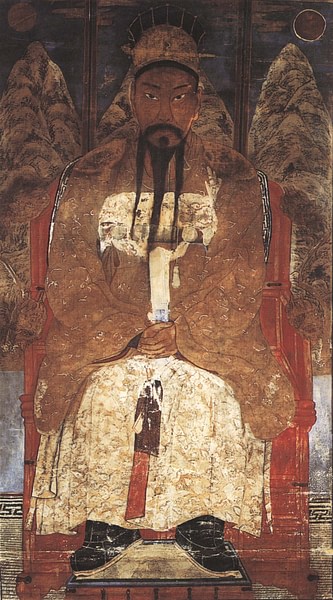 Dangun Wanggeom Chae Yong-sin (Public Domain) ](https://www.worldhistory.org/image/5859/dangun--wanggeom/ "Dangun Wanggeom")### Collapse
Gojoseon was weakened by attacks from the neighbouring Yan state c. 300 BCE, and a long decline set in so that when Gojoseon finally collapsed in the 2nd century BCE its territories were taken over by Wiman Joseon (Wiman Choson). This was a state which was led by Weiman, a Chinese refugee (though possibly of Korean origin) who had earlier fled the Yan state. He and his 1,000 followers were given the task of protecting the north-western borders of Gojoseon by king Jun, but Weiman, or Wiman in Korean, took the opportunity to seize control of part of the country himself sometime between 194 and 180 BCE and declared himself king. Jun is said to have fled south to the Jin state where he reigned as king.
Wiman may well have brought elements of Chinese culture to Korea such as [Confucianism](https://www.worldhistory.org/Confucianism/) and [Taoism](https://www.worldhistory.org/Taoism/). Wiman Joseon did not last very long and, in 108 BCE, was conquered by the [Han dynasty](https://www.worldhistory.org/Han_Dynasty/) of China (206 BCE – 220 CE) and the capital Wanggom captured. The [Han](https://www.worldhistory.org/Han_Dynasty/) emperor Wu (141-87 BCE) was eager to expand his [empire](https://www.worldhistory.org/empire/) and acquire northern Korea's natural resources, especially iron and salt, and sent an army of 50,000 men and a 7,000-man naval force. Having removed this troublesome southern kingdom, the Han then divided northern Korea into four commanderies directly administered by the Han central government. They would maintain control of this part of the peninsula for the next four centuries. Refugees from the collapsed Wiman Joseon took their culture south, which would eventually rise again and defeat the Chinese in the subsequent [Three Kingdoms period](https://www.worldhistory.org/disambiguation/Three_Kingdoms_Period/). The name Joseon/Choson would also reappear as the name of the state which dominated Korea from the 14th century CE.
This content was made possible with generous support from the [British Korean Society](http://www.britishkoreansociety.org.uk/?utm_source=ancient.eu&utm_medium=link&utm_campaign=ancient.eu).
#### Editorial Review
This human-authored definition has been reviewed by our editorial team before publication to ensure accuracy, reliability and adherence to academic standards in accordance with our [editorial policy](https://www.worldhistory.org/static/editorial-policy/).
## Bibliography
- [Buckley Ebrey, P. *Pre-Modern East Asia.* Wadsworth Publishing, 2013.](https://www.worldhistory.org/books/1133606512/)
- [Ho-tae Jeon. *Goguryeo.* Hollym International Corporation, 2008.](https://www.worldhistory.org/books/1565912829/)
- [Jinwung Kim. *A History of Korea"Land of the Morning Calm" to States in Conflict.* Indiana University Press, 2012.](https://www.worldhistory.org/books/0253000246/)
- [Ki-baik Lee. *A New History of Korea.* Harvard University Asia Center, 1984.](https://www.worldhistory.org/books/067461576X/)
- Kim, C. *The Arts of Korea.* Thames & Hudson, 1966
- [Kyung Hwang. *A History of Korea.* Palgrave Macmillan, 2010.](https://www.worldhistory.org/books/0230205461/)
- [Portal, J. *Korea: Art & Archaeology.* Thames & Hudson, 2000.](https://www.worldhistory.org/books/0500282021/)
- [Pratt, K. *Korea.* Routledge, 1999.](https://www.worldhistory.org/books/0700704639/)
- [Seth, M.J. *A History of Korea.* Rowman & Littlefield Publishers, 2010.](https://www.worldhistory.org/books/0742567168/)
## About the Author
Mark is WHE’s Publishing Director and has an MA in Political Philosophy (University of York). He is a full-time researcher, writer, historian and editor. Special interests include art, architecture and discovering the ideas that all civilizations share.
## Timeline
- **2333 BCE**: Traditional founding of [Gojoseon](https://www.worldhistory.org/Gojoseon/) by [Dangun](https://www.worldhistory.org/Dangun/) Wanggeom (Tangun).
- **1122 BCE**: Traditional date that Gija (Jizi) becomes king of [Gojoseon](https://www.worldhistory.org/Gojoseon/).
- **c. 300 BCE**: [Gojoseon](https://www.worldhistory.org/Gojoseon/) is attacked by the Yan state.
- **194 BCE - 180 BCE**: Wiman Joseon (Wiman Choson) takes control of [Gojoseon](https://www.worldhistory.org/Gojoseon/), declaring himself king.
- **108 BCE**: Wiman Joseon is conquered by the [Han dynasty](https://www.worldhistory.org/Han_Dynasty/).
## Cite This Work
### APA
Cartwright, M. (2016, October 13). Gojoseon. *World History Encyclopedia*.
### Chicago
Cartwright, Mark. "Gojoseon." *World History Encyclopedia*, October 13, 2016. .
### MLA
Cartwright, Mark. "Gojoseon." *World History Encyclopedia*, 13 Oct 2016, .
## License & Copyright
Submitted by [Mark Cartwright](https://www.worldhistory.org/user/markzcartwright/ "User Page: Mark Cartwright"), published on 13 October 2016. The copyright holder has published this content under the following license: [Creative Commons Attribution-NonCommercial-ShareAlike](https://creativecommons.org/licenses/by-nc-sa/4.0/deed.en). This license lets others remix, tweak, and build upon this content non-commercially, as long as they credit the author and license their new creations under the identical terms. When republishing on the web a hyperlink back to the original content source URL must be included. Please note that content linked from this page may have different licensing terms.