---
title: Goguryeo
author: Mark Cartwright
source: https://www.worldhistory.org/Goguryeo/
format: machine-readable-alternate
license: Creative Commons Attribution-NonCommercial-ShareAlike (https://creativecommons.org/licenses/by-nc-sa/4.0/)
updated: 1970-01-01
---
# Goguryeo
_Authored by [Mark Cartwright](https://www.worldhistory.org/user/markzcartwright/)_
Goguryeo (Koguryo) was a kingdom which ruled northern [Korea](https://www.worldhistory.org/Korea/) during the [Three Kingdoms period](https://www.worldhistory.org/disambiguation/Three_Kingdoms_Period/) from the 1st century BCE to 7th century CE. The kingdom flourished in the 5th and 6th century CE and has left a rich cultural heritage best seen in its [tomb](https://www.worldhistory.org/tomb/) art and [architecture](https://www.worldhistory.org/disambiguation/architecture/). Goguryeo gave its name to the modern state of Korea.
Goguryeo was in constant rivalry with the smaller [Baekje](https://www.worldhistory.org/Baekje/) ([Paekche](https://www.worldhistory.org/Baekje/)) and [Silla](https://www.worldhistory.org/Silla/) kingdoms, as well as the contemporary [Gaya](https://www.worldhistory.org/Gaya/) ([Kaya](https://www.worldhistory.org/Gaya/)) confederation and regional heavyweight [China](https://www.worldhistory.org/china/). The kingdom was finally crushed by a combined [Tang](https://www.worldhistory.org/Tang_Dynasty/) and Silla army in 668 CE. Thereafter it became a Chinese province.
### Historical Overview
The traditional founding date of the Goguryeo kingdom was 37 BCE and credited to one Dongmyeong, a refugee from Buyeo (Puyo). In this period five horse-riding warrior tribes formed a loose alliance, the most powerful being the Sono and Gyeru. Their capital was established at Gungnae in 3 CE. During the reign of Taejo (53-146 CE) the Chinese commandery at Lintun was taken over in a general campaign of territorial expansion spreading out from the Yalu and Tumen Rivers.
The various tribes of the region began to create a more homogenous political unit structured around five provinces (*pu*) during the reign of Gogukcheon (179-196 CE). Gogukcheon is also credited with creating a centralised and hierarchical aristocracy, appointing a prime minister, and establishing a system whereby [peasants](https://www.worldhistory.org/disambiguation/Peasants/) could borrow grain from the state in times of famine and so avoid enslaving themselves to the local aristocratic land owners.
Despite these noble developments, modern historians consider the 4th century CE to be a more certain date for the establishment of a fully centralised kingdom. The same century saw further expansion with the last Chinese commandery at Lelang taken in 313 CE, but disaster struck in 342 CE when Murong Huang invaded from China and sacked Gungnae, taking 50,000 inhabitants prisoner. Goguryeo eventually recovered and the Xianbei were subdued in the north in 370 CE. In 371 CE the Baekje king Geunchogo attacked [Pyongyang](https://www.worldhistory.org/Pyongyang/) and killed king Gogugwon (r. 331-371 CE). However, by the end of the 4th century CE, Goguryeo had formed an alliance with neighbouring Silla against Baekje, allowing some, if only brief, stability in the region.
The early 5th century CE saw the beginning of Goguryeo's greatest period when, during the reign of Gwanggaeto (391-413), who was appropriately named 'broad expander of domain,' it dominated northern Korea, most of Manchuria, and a portion of Inner Mongolia. So successful was this period that Gwanggaeto even coined a new term for it: *Yongnak* or 'Eternal Rejoicing'. During the long reign of king Jangsu (413-491 CE), Goguryeo continued to prosper and Pyongyang replaced Gungnae as the capital in 427 CE. Diplomatic relations were maintained with China (which was weakened and divided at that time into two rival dynasties) while Goguryeo attacked Hansong (modern Gwangju), the Baekje capital, in 475 CE, executing their king Gaero in the process. Goguryeo now controlled 90% of ancient Korea.
[  Three Kingdoms of Korea Map Ashraf Kamel (CC BY-NC-SA) ](https://www.worldhistory.org/image/5790/three-kingdoms-of-korea-map/ "Three Kingdoms of Korea Map")In the 6th century CE, after facing both its rival kingdoms to the south in the previous century, Goguryeo now allied itself with the Baekje kingdom against Silla. All three kingdoms were ambitious for each other's territories, and China was now once more a threat under the [Sui dynasty](https://www.worldhistory.org/Sui_Dynasty/). Goguryeo struck first by attacking the [Sui](https://www.worldhistory.org/Sui_Dynasty/) regions to the north. This brought a military response from China, but the general Eulji Mundeok won a great victory for Goguryeo at the [battle](https://www.worldhistory.org/disambiguation/battle/) of the Salsu River in 612 CE. According to legend, of the 300,000-strong Sui army, only 2,700 returned to China. Two more attacks we rebuffed in 613 and 614 CE and Goguryeo built a 480-km (300 miles) long defensive [wall](https://www.worldhistory.org/wall/) in 628 CE so as to deter any further Chinese ambitions.
The new [Tang Dynasty](https://www.worldhistory.org/Tang_Dynasty/) did not learn the lesson of their predecessors or worry about the wall, but once again, in 644 CE, the Goguryeo army defeated a combined Chinese land and naval force. The celebrated Gorguryeo general [Yang](https://www.worldhistory.org/Yin_and_Yang/) Manchun had crucially managed to hold out at the fortress of Anshi despite a three-month siege. Undeterred by this setback, the Tangs attacked Korea three more times in the next decade, but each time without success.
In 655 CE, in another round of complex regional alliances, Baekje attacked Silla who then called for Tang aid once again, which, when it came, was overwhelming. In 661 CE a Tang army besieged Pyongyang which was weakened by an internal power struggle for the throne. The Tangs were forced to withdraw, but when they attacked again in 667 CE, the [city](https://www.worldhistory.org/city/), although this time holding out for a year, finally fell. In 668 CE the Goguryeo king Bojang (r. 642-668 CE) was removed to China along with 200,000 of his subjects in a forced resettlement programme. Both the Baekje and Goguryeo kingdoms were swept aside and became Chinese provinces leaving Silla to dominate the Korean peninsula for the next three centuries.
### Government & Social Classes
As with the other two kingdoms of the period Goguryeo was ruled by a monarch with senior administrative positions held by a landed aristocracy. In a structure similar to the Silla sacred [bone rank system](https://www.worldhistory.org/Bone_Rank_System/), individuals belonged to specific social groups based on birth. One's rank dictated which of the 14 levels of administration one could apply for. Below the aristocracy were the *taega* and *soga social ranks and below them the peasantry who worked their own land. At the very bottom of the social ladder were slaves and criminals, who were forced to work on the estates of the aristocracy. The state extracted a tax, usually payable in kind, and could oblige citizens to fight in the army or work on government projects such as building fortifications.
[  Gilt-bronze Buddha, Goguryeo Kingdom National Museum of Korea (CC BY) ](https://www.worldhistory.org/image/5764/gilt-bronze-buddha-goguryeo-kingdom/ "Gilt-bronze Buddha, Goguryeo Kingdom")### Relations with China
Despite the conflicts between Goguryeo and China over the centuries, the two states were frequent trading partners with the former exporting [gold](https://www.worldhistory.org/gold/), [silver](https://www.worldhistory.org/Silver/), pearls, and textiles while China sent weapons, [silk](https://www.worldhistory.org/Silk/), and [writing](https://www.worldhistory.org/writing/) materials in return. There were also close cultural ties between the two with Goguryeo adopting the [Chinese writing](https://www.worldhistory.org/Chinese_Writing/) system, *wuzhu* coins (known locally as *oshuchon*), Chinese poetry style, architectural elements (especially regarding tombs), art motifs (again seen in tombs such as constellations painted on ceilings and images of the Chinese animals of the four directions), and belief systems. In 372 CE a National Confucian Academy was created and [Buddhism](https://www.worldhistory.org/buddhism/) was adopted as the official state [religion](https://www.worldhistory.org/religion/) (replacing the predominant Shamanism) when it was introduced by the Chinese monk Shundao (Sundo to the Koreans).
### Goguryeo Art
An important art form was wall-painting. Perhaps the most famous surviving examples are found in the 5th-century CE Tomb of the Dancers at Gungnae (modern Tonggou). One mural, which gives its name to the tomb, has rows of dancers with arms raised. They wear either long-sleeved robes or jackets and trousers tied at the ankles. Other chambers have paintings of the tomb's occupants, warriors on horseback, a tiger hunt, mythical animals, and details of daily life and architecture. Around 80 Goguryeo tombs contain murals, either painted directly onto the stone chamber walls or applied to a lime plaster. Bright colours and flowing outlines are a typical feature of Goguryeo paintings. It is likely that just as Korean painters learned from their Chinese counterparts, so too, they passed on their knowledge to artists in [Japan](https://www.worldhistory.org/disambiguation/Japan/).
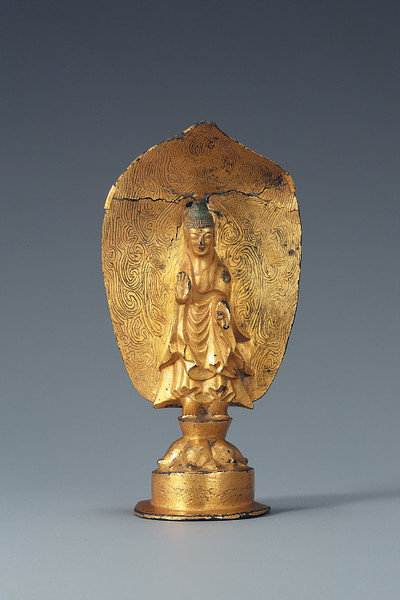
[  Tortoise & Snake Mural, Goguryeo Tomb ddol-mang (CC BY-SA) ](https://www.worldhistory.org/image/5762/tortoise--snake-mural-goguryeo-tomb/ "Tortoise & Snake Mural, Goguryeo Tomb")Tombs are also a rich source of artefacts, but the tendency to build easily accessible horizontal entrances has meant that many Goguryeo tombs were looted long ago. Some few surviving art pieces include gilt-[bronze](https://www.worldhistory.org/disambiguation/bronze/) crowns and jewellery, which are testimony to the craftsmanship of their creators. Very few examples of Goguryeo [pottery](https://www.worldhistory.org/pottery/) have survived and are of dubious provenance. More numerous are bronze and gilt-bronze figurines of the [Buddha](https://www.worldhistory.org/Siddhartha_Gautama/), which typically show Northern Wei influence with a flaming mandorla and flanked by seated bodhisattvas.
### Goguryeo Architecture
There are no extant temples from this period, but some of the more substantial surviving archaeological remains from the Goguryeo towns are walls and fortifications from Tonggou, Fushun, and Pyongyang. Pyongyang, one-time Goguryeo capital, had very large buildings measuring up to 80 x 30 m and palaces with gardens which had artificial hills and lakes. Buildings were decorated with impressed roof tiles carrying lotus flower and demon mask designs, which are found in abundance at the sites.
Better survivors than external buildings are the 10,000 Goguryeo tombs, and the earliest ones took the form of stone cairns using river cobbles. However, by the 4th century CE, square tombs were placed within [pyramids](https://www.worldhistory.org/pyramid/) made of cut-stone blocks. The largest example is at the former capital Gungnae and thought to be that of King Gwanggaeto the Great. 75 metres long and using blocks measuring 3 x 5 metres, it also has four smaller [dolmen](https://www.worldhistory.org/dolmen/)-like structures at each corner.
[ 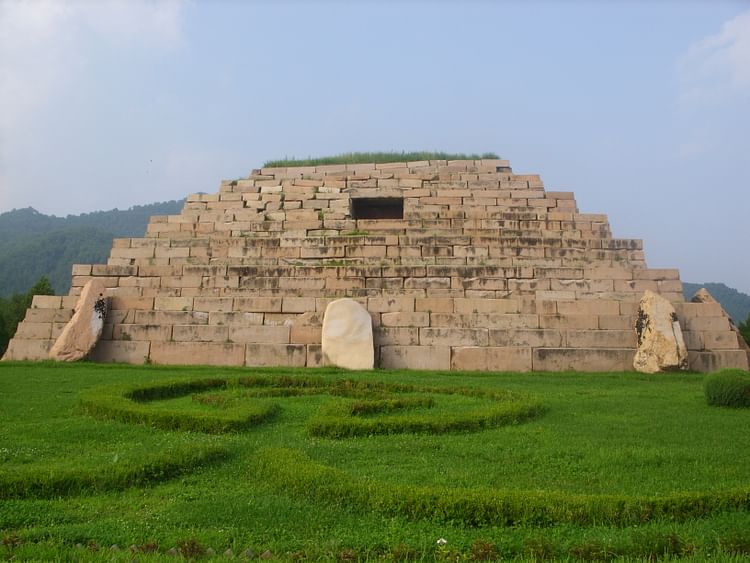 Tomb of Gwanggaeto the Great Bart0278 (CC BY-SA) ](https://www.worldhistory.org/image/5761/tomb-of-gwanggaeto-the-great/ "Tomb of Gwanggaeto the Great")Another important tomb is that of Tong Shou, last ruler of Taebang. Located near Pyongyang, an inscription dates the tomb to 357 CE. Its central chamber has 18 limestone columns and wall-paintings; it is surrounded by four smaller chambers. More typical, though, of Goguryeo-period tombs than these two examples are more modest hemispherical earth mounds built over a square base and with an interior tomb of stone. Other architectural features seen in various Goguryeo tombs include corbelled roofing, octagonal pillars, and pivoted stone doors.
This content was made possible with generous support from the [British Korean Society](http://www.britishkoreansociety.org.uk/?utm_source=ancient.eu&utm_medium=link&utm_campaign=ancient.eu).
#### Editorial Review
This human-authored definition has been reviewed by our editorial team before publication to ensure accuracy, reliability and adherence to academic standards in accordance with our [editorial policy](https://www.worldhistory.org/static/editorial-policy/).
## Bibliography
- [Jackson, B. *Korean Architecture.* Seoul Selection USA, Inc., 2013.](https://www.worldhistory.org/books/8997639234/)
- [Jinwung Kim. *A History of Korea"Land of the Morning Calm" to States in Conflict.* Indiana University Press, 2012.](https://www.worldhistory.org/books/0253000246/)
- [Ki-baik Lee. *A New History of Korea.* Harvard University Asia Center, 1984.](https://www.worldhistory.org/books/067461576X/)
- Kim, Chiwon. *Arts of Korea.* Thames & Hudson, 1966
- [Kyung Hwang. *A History of Korea.* Palgrave Macmillan, 2010.](https://www.worldhistory.org/books/0230205461/)
## About the Author
Mark is WHE’s Publishing Director and has an MA in Political Philosophy (University of York). He is a full-time researcher, writer, historian and editor. Special interests include art, architecture and discovering the ideas that all civilizations share.
## Timeline
- **57 BCE - 668 CE**: [Three Kingdoms Period in Korea](https://www.worldhistory.org/Three_Kingdoms_Period_in_Korea/) ([Silla](https://www.worldhistory.org/Silla/), [Goguryeo](https://www.worldhistory.org/Goguryeo/), and [Baekje](https://www.worldhistory.org/Baekje/)).
- **37 BCE**: Traditional founding date of the [Goguryeo](https://www.worldhistory.org/Goguryeo/) Kindom in northern [Korea](https://www.worldhistory.org/Korea/).
- **37 BCE - 668 CE**: The [Goguryeo](https://www.worldhistory.org/Goguryeo/) kingdom rules in northern [Korea](https://www.worldhistory.org/Korea/).
- **3 CE**: The [Goguryeo](https://www.worldhistory.org/Goguryeo/) capital is established at Gungnae.
- **53 CE - 146 CE**: Reign of [Goguryeo](https://www.worldhistory.org/Goguryeo/) king Taejo in northern [Korea](https://www.worldhistory.org/Korea/).
- **179 CE - 196 CE**: Reign of [Goguryeo](https://www.worldhistory.org/Goguryeo/) king Gogukcheon in northern [Korea](https://www.worldhistory.org/Korea/).
- **313 CE**: The [Goguryeo](https://www.worldhistory.org/Goguryeo/) kingdom conquers the last Chinese commandery at Lelang.
- **331 CE - 371 CE**: Reign of [Goguryeo](https://www.worldhistory.org/Goguryeo/) king Gogugwon in northern [Korea](https://www.worldhistory.org/Korea/).
- **342 CE**: Murong Huang invades [Korea](https://www.worldhistory.org/Korea/) from [China](https://www.worldhistory.org/china/) and sacks the [Goguryeo](https://www.worldhistory.org/Goguryeo/) capital of Gungnae, taking 50,000 inhabitants prisoner.
- **371 CE**: [Baekje](https://www.worldhistory.org/Baekje/) conquers the Mahan federation and attacks [Pyongyang](https://www.worldhistory.org/Pyongyang/), killing the [Goguryeo](https://www.worldhistory.org/Goguryeo/) king Gogugwon.
- **372 CE**: A Confucian Academy is established in the [Goguryeo](https://www.worldhistory.org/Goguryeo/) kingdom of northern [Korea](https://www.worldhistory.org/Korea/) and Buddism is adopted as the state [religion](https://www.worldhistory.org/religion/).
- **391 CE - 413 CE**: Reign of [Goguryeo](https://www.worldhistory.org/Goguryeo/) king [Gwanggaeto the Great](https://www.worldhistory.org/Gwanggaeto_the_Great/) in northern [Korea](https://www.worldhistory.org/Korea/).
- **413 CE - 491 CE**: Reign of [Goguryeo](https://www.worldhistory.org/Goguryeo/) king Jangsu in northern [Korea](https://www.worldhistory.org/Korea/).
- **427 CE**: [Pyongyang](https://www.worldhistory.org/Pyongyang/) replaces Gungnae as the [Goguryeo](https://www.worldhistory.org/Goguryeo/) capital.
- **475 CE**: [Goguryeo](https://www.worldhistory.org/Goguryeo/) attacks the [Baekje](https://www.worldhistory.org/Baekje/) kingdom, killing the king Gaero and forcing the abandonment of Hansong, his capital.
- **612 CE**: [Goguryeo](https://www.worldhistory.org/Goguryeo/) general Eulji Mundeok wins a great victory against the Chinese [Sui](https://www.worldhistory.org/Sui_Dynasty/) at the [battle](https://www.worldhistory.org/disambiguation/battle/) of the Salsu River.
- **628 CE**: The [Goguryeo](https://www.worldhistory.org/Goguryeo/) kingdom of northern [Korea](https://www.worldhistory.org/Korea/) builds a 480-km defensive [wall](https://www.worldhistory.org/wall/) as protection against attack from [China](https://www.worldhistory.org/china/).
- **642 CE**: The [Baekje](https://www.worldhistory.org/Baekje/) and [Goguryeo](https://www.worldhistory.org/Goguryeo/) kingdoms join forces against the [Silla](https://www.worldhistory.org/Silla/) and [conquer](https://www.worldhistory.org/warfare/) Taeya-song (modern Hapchon).
- **642 CE - 668 CE**: Reign of [Goguryeo](https://www.worldhistory.org/Goguryeo/) king Bojang in northern [Korea](https://www.worldhistory.org/Korea/).
- **644 CE**: A [Goguryeo](https://www.worldhistory.org/Goguryeo/) army defeats a combined [Silla](https://www.worldhistory.org/Silla/) and [Tang](https://www.worldhistory.org/Tang_Dynasty/) army.
- **661 CE**: A [Tang Dynasty](https://www.worldhistory.org/Tang_Dynasty/) army unsuccessfully besieges the [Goguryeo](https://www.worldhistory.org/Goguryeo/) capital of [Pyongyang](https://www.worldhistory.org/Pyongyang/).
- **667 CE**: A [Tang Dynasty](https://www.worldhistory.org/Tang_Dynasty/) army besieges the [Goguryeo](https://www.worldhistory.org/Goguryeo/) capital of [Pyongyang](https://www.worldhistory.org/Pyongyang/) for a second time, this time successfully.
- **668 CE**: The [Goguryeo](https://www.worldhistory.org/Goguryeo/) kingdom of northern [Korea](https://www.worldhistory.org/Korea/) collapses following an attack by the [Tang Dynasty](https://www.worldhistory.org/Tang_Dynasty/) of [China](https://www.worldhistory.org/china/).
## External Links
- [List of Rulers of Korea | Lists of Rulers | Heilbrunn Timeline of Art History | The Metropolitan Museum of Art](https://www.metmuseum.org/toah/hd/koru/hd_koru.htm)
## Cite This Work
### APA
Cartwright, M. (2016, September 29). Goguryeo. *World History Encyclopedia*.
### Chicago
Cartwright, Mark. "Goguryeo." *World History Encyclopedia*, September 29, 2016. .
### MLA
Cartwright, Mark. "Goguryeo." *World History Encyclopedia*, 29 Sep 2016, .
## License & Copyright
Submitted by [Mark Cartwright](https://www.worldhistory.org/user/markzcartwright/ "User Page: Mark Cartwright"), published on 29 September 2016. The copyright holder has published this content under the following license: [Creative Commons Attribution-NonCommercial-ShareAlike](https://creativecommons.org/licenses/by-nc-sa/4.0/deed.en). This license lets others remix, tweak, and build upon this content non-commercially, as long as they credit the author and license their new creations under the identical terms. When republishing on the web a hyperlink back to the original content source URL must be included. Please note that content linked from this page may have different licensing terms.