---
title: Glanum
author: Mark Cartwright
source: https://www.worldhistory.org/Glanum/
format: machine-readable-alternate
license: Creative Commons Attribution-NonCommercial-ShareAlike (https://creativecommons.org/licenses/by-nc-sa/4.0/)
updated: 1970-01-01
---
# Glanum
_Authored by [Mark Cartwright](https://www.worldhistory.org/user/markzcartwright/)_
Glanum, located near St-Rémy-de-Provence in southern France, was a [Greek](https://www.worldhistory.org/disambiguation/greek/) and then [Roman](https://www.worldhistory.org/disambiguation/Roman/) town which prospered due to its location on trading routes between [Italy](https://www.worldhistory.org/italy/) and the Rhodanus (Rhone River). The town benefitted from a large building project in the [Hellenistic period](https://www.worldhistory.org/Hellenistic_Period/) and another spree during the reign of [Augustus](https://www.worldhistory.org/augustus/) which furnished Glanum with temples, a [theatre](https://www.worldhistory.org/disambiguation/theatre/), basilica, monumental arch, and [Roman baths](https://www.worldhistory.org/Roman_Baths/), amongst other amenities. The town was abandoned in the 3rd century CE but today offers the modern visitor an impressive array of Greco-Roman ruins.
### Historical Overview
Glanum was first settled by the [Celts](https://www.worldhistory.org/celt/), specifically the Salyans (Salluvii), from the 7th to 6th century BCE. Indeed, the town's name derives from Glan, a [Celtic](https://www.worldhistory.org/celt/) spring deity who continued to be worshipped at the site into the Roman period. The town grew following an influx of colonists from Massalia (Marseilles) in the 2nd century BCE. Flourishing as a [trade](https://www.worldhistory.org/disambiguation/trade/) centre and noted as a place of healing, Glanum began to mint its own [silver](https://www.worldhistory.org/Silver/) [coinage](https://www.worldhistory.org/coinage/) (with a bull and a Glanic mother goddess design) and benefitted from a [Hellenistic](https://www.worldhistory.org/Hellenic_World/) building programme which included a peristyle building, ornamental spring, [temple](https://www.worldhistory.org/temple/), *bouleuterion* (public assembly theatre), and several large private villas. The town spread to cover some 20 ha in this period and was protected by a circuit [wall](https://www.worldhistory.org/wall/).
The Romans took an interest in the town from the 1st century BCE following the Second Salyan [War](https://www.worldhistory.org/disambiguation/War/) (90 BCE) when the [consul](https://www.worldhistory.org/Consul/) Caecilius quashed what would be the last Celtic revolt in the region. The town was razed, but during the reign of Augustus, Glanum once more benefitted from a programme of rebuilding. New monumental structures included an [agora](https://www.worldhistory.org/agora/), forum, theatre, a curia (council building), basilica and various other public buildings, temples, Roman baths, a [triumphal arch](https://www.worldhistory.org/Triumphal_Arch/), and mausoleum. Outside the town, two [aqueducts](https://www.worldhistory.org/aqueduct/) were built to regulate Glanum's water supply. In addition to new buildings, the town was granted certain Latin privileges, made a full Roman colony in the 1st century CE, and continued to prosper as a trading stop near the Via Domitia.
[ 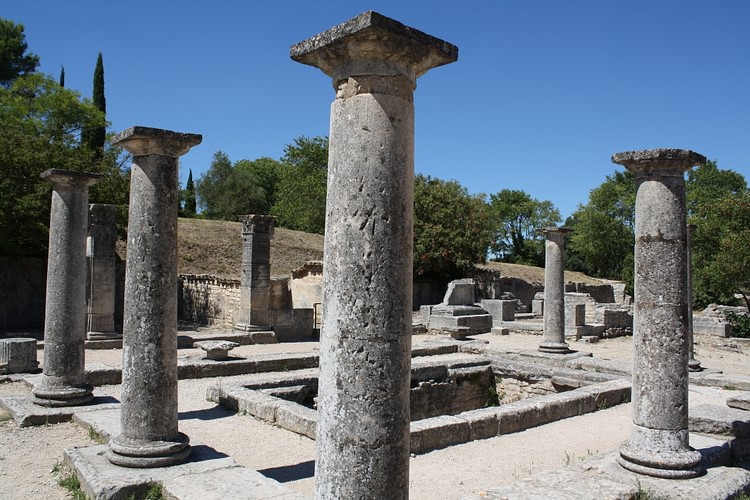 Greek-Style House, Glanum Mark Cartwright (CC BY-NC-SA) ](https://www.worldhistory.org/image/5581/greek-style-house-glanum/ "Greek-Style House, Glanum")Glanum's glory days came to an end when it was destroyed by the [Alemanni](https://www.worldhistory.org/alemanni/) c. 260 CE. The site was then abandoned by the local people in favour of a new location at nearby St-Rémy-de-Provence. Glanum was first excavated in the early 20th century CE and work continues today with some of the temples undergoing restoration.
### Architectural Highlights
**Triumphal Arch & Mausoleum**
Both of these structures, just on the edge of ancient Glanum, have remained above ground since antiquity (unlike the rest of the town). Together they became known as 'Les Antiques' and received such notable visitors as King Charles IX. The monumental arch was built in the early 1st century CE, probably to commemorate Glanum's new status as a Roman colony. The top portion is missing but the statues at the sides remain and depict enslaved Gauls.
[ 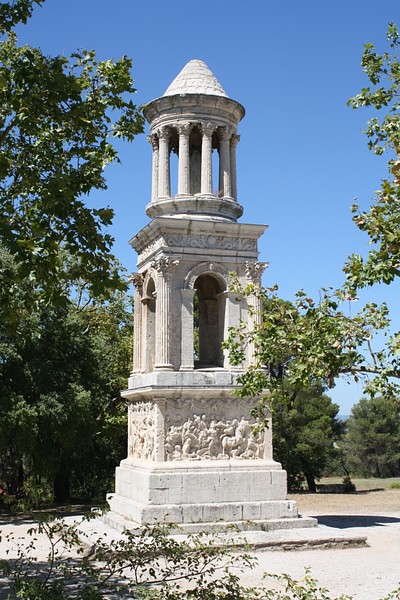 Mausoleum, Glanum Mark Cartwright (CC BY-NC-SA) ](https://www.worldhistory.org/image/5580/mausoleum-glanum/ "Mausoleum, Glanum")The mausoleum tower, which would have once stood alongside many other funerary monuments, dates to c. 40 BCE. It has traditionally been attributed to the three [Julius](https://www.worldhistory.org/disambiguation/Julius/) brothers of [Julius Caesar](https://www.worldhistory.org/Julius_Caesar/)'s family but the names (Sextus, Lucius, and Marcus Gaius) are probably only coincidental. More likely, they were members of a wealthy local family who, given Roman privileges, took the names of the famous ruling family for purposes of prestige. The square base of the tower has relief panels depicting various scenes from [mythology](https://www.worldhistory.org/mythology/): a [battle](https://www.worldhistory.org/disambiguation/battle/) with [Amazons](https://www.worldhistory.org/amazon/), a cavalry scene, the fight for the body of [Patroclus](https://www.worldhistory.org/Patroclus/) from the [Trojan War](https://www.worldhistory.org/Trojan_War/) story, and the Calydonian boar hunt. Above the base is the tetrapylon with an arch on each side with protective heads of [Medusa](https://www.worldhistory.org/Medusa/) and a frieze running around it depicting Tritons carrying the sun. The top of the tower is a tholos with Corinthian columns and a conical roof.
**Sacred Spring of Glan**
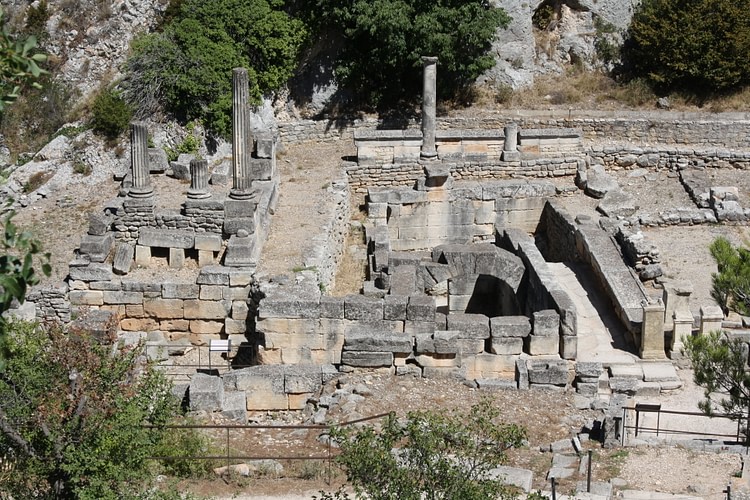
This spring, associated with the Celtic [god](https://www.worldhistory.org/God/) Glan and various other female Celtic deities, was believed to have healing properties, and so believers visited Glanum and threw into it offerings such as coins, [pottery](https://www.worldhistory.org/pottery/), and figurines in the hope of curing their ailments. Roman artefacts in the well attest to the fact that it continued to be used even after the Romans took over the site. The well is reached by a paved passageway and down steps beneath a single arch. Opposite the spring a wide stone staircase winds up the hill to a sanctuary, probably once dedicated to prehistoric and then Celtic deities.
[  Spring of Glan, Glanum Mark Cartwright (CC BY-NC-SA) ](https://www.worldhistory.org/image/5577/spring-of-glan-glanum/ "Spring of Glan, Glanum")**Hellenistic Houses**
The site has several Hellenistic-period houses built in typical Greek style. The best preserved is the House of the Antae, which has a columned peristyle with a large basin to channel rainwater to a cistern below it via an open stone channel. It also has two unusual square doorway columns topped by Corinthian capitals. The House of the Capricorn had two fine mosaics, one depicting dolphins swimming around a central goat and the other with a geometric design.
**The Twin Temples**
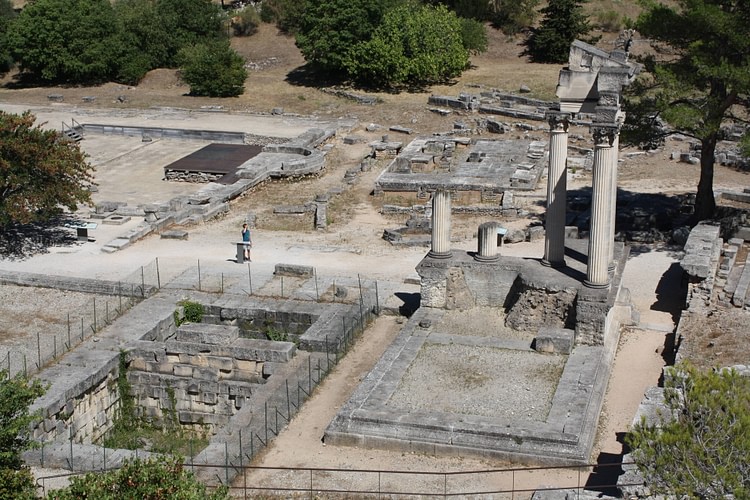
Two identical temples each have a four [column](https://www.worldhistory.org/column/) façade. One is slightly larger, and both were built c. 20 BCE in the forum. They were dedicated to the imperial cult and surrounded by a u-shaped colonnaded building (*peribolos*) to enclose the sacred space. The smaller temple has had a portion partially reconstructed using original pieces as models.
[  Twin Imperial Temples, Glanum Mark Cartwright (CC BY-NC-SA) ](https://www.worldhistory.org/image/5587/twin-imperial-temples-glanum/ "Twin Imperial Temples, Glanum")**Roman Baths**
The thermal baths of Glanum were built in the latter half of the 1st century BCE with improvements made in the late 1st century CE. They have the typical features one would expect to find: a cold room (*frigidarium*), steam room (*laconicum*), hot room (*caldarium*) and a large swimming pool. The latter was fed water via a stone theatre mask, a replica of which is on site. There is also a stone bench still in position along one of the walls.
#### Editorial Review
This human-authored definition has been reviewed by our editorial team before publication to ensure accuracy, reliability and adherence to academic standards in accordance with our [editorial policy](https://www.worldhistory.org/static/editorial-policy/).
## Bibliography
- Bagnall, R. et al. *The Encyclopedia of Ancient History.* Wiley-Blackwell, 2012
- [Hornblower, S. *The Oxford Classical Dictionary.* Oxford University Press, 2012.](https://www.worldhistory.org/books/0199545561/)
- Roth Congés, A. *Glanum.* Centre des Monuments Nationaux, 2014
## About the Author
Mark is WHE’s Publishing Director and has an MA in Political Philosophy (University of York). He is a full-time researcher, writer, historian and editor. Special interests include art, architecture and discovering the ideas that all civilizations share.
## Timeline
- **c. 90 BCE**: The Romans raze [Glanum](https://www.worldhistory.org/Glanum/) but sebsequently rebuild the town.
- **c. 40 BCE**: The Mausoleum tower is built at [Glanum](https://www.worldhistory.org/Glanum/).
- **c. 20 BCE**: The twin temples dedicated to the imperial cult are built at [Glanum](https://www.worldhistory.org/Glanum/).
- **c. 260 CE**: [Glanum](https://www.worldhistory.org/Glanum/) is destroyed by the [Alemanni](https://www.worldhistory.org/alemanni/).
## Cite This Work
### APA
Cartwright, M. (2016, September 02). Glanum. *World History Encyclopedia*.
### Chicago
Cartwright, Mark. "Glanum." *World History Encyclopedia*, September 02, 2016. .
### MLA
Cartwright, Mark. "Glanum." *World History Encyclopedia*, 02 Sep 2016, .
## License & Copyright
Submitted by [Mark Cartwright](https://www.worldhistory.org/user/markzcartwright/ "User Page: Mark Cartwright"), published on 02 September 2016. The copyright holder has published this content under the following license: [Creative Commons Attribution-NonCommercial-ShareAlike](https://creativecommons.org/licenses/by-nc-sa/4.0/deed.en). This license lets others remix, tweak, and build upon this content non-commercially, as long as they credit the author and license their new creations under the identical terms. When republishing on the web a hyperlink back to the original content source URL must be included. Please note that content linked from this page may have different licensing terms.