---
title: Giants
author: Liana Miate
source: https://www.worldhistory.org/Giants/
format: machine-readable-alternate
license: Creative Commons Attribution-NonCommercial-ShareAlike (https://creativecommons.org/licenses/by-nc-sa/4.0/)
updated: 2023-08-02
---
# Giants
_Authored by [Liana Miate](https://www.worldhistory.org/user/lianamiate/)_
In [Greek mythology](https://www.worldhistory.org/Greek_Mythology/), the Giants (*Gigantes*) are an aggressive race of creatures who were born from [Gaia](https://www.worldhistory.org/Gaia/) (the Earth) after drops of [Uranus](https://www.worldhistory.org/Uranus/)' blood fell on the Earth after he was castrated. The Giants had great strength and were fearsome to look upon, with long hair and scaly feet.
There were many different Giants, some having more prominent roles in [mythology](https://www.worldhistory.org/mythology/) than others. The most famous story involving the Giants is the Gigantomachy (Revolt of the Giants), which came after the Titanomachy.
Giants have since become a common sight in various fantasy and [science](https://www.worldhistory.org/science/) fiction movies, books, and TV shows, including the *Harry Potter* series (both books and films), the movie *The Princess Bride* (1987), and the book *The BFG* by Roald Dahl (1916-1990), and the movie *The BFG* (2016) that was based on the book. They have been portrayed as both friendly, gentle beings who make friends with humans and menacing, cruel figures who use their brute strength for harm rather than good.
### Birth
The Giants sprung from Gaia after Uranus was emasculated by his son [Cronus](https://www.worldhistory.org/Cronus/), and drops of his blood fell upon the Earth.
> They did not fall
> From his hands in vain, for all the bloody drops
> That leaped out were received by Earth; and when
> The year's time was accomplished, she gave birth
> To the [Furies](https://www.worldhistory.org/Furies/), and the Giants, strong and huge,
> Who fought in shining armour, with long spears.
> ([Hesiod](https://www.worldhistory.org/hesiod/), *[Theogony](https://www.worldhistory.org/Theogony/)*, 182-188)
Apollodorus wrote that Gaia gave birth to the Giants because she was upset that the Olympians had conquered the Titans. The Latin author Hyginus (64 BCE to 17 CE) states that the Giants were the offspring of Gaia and [Tartarus](https://www.worldhistory.org/Tartarus/) (the deepest part of the Underworld).
### Description & Characteristics
According to the [Greek](https://www.worldhistory.org/disambiguation/greek/) writer Pseudo-Apollodorus in his *Bibliotheca*, the Giants were unmatched in size with a frightening appearance - they had long hair that flowed down from their head and chin and had serpent scales on their feet and legs. Hesiod (c. 700 BCE) described them as being 'great' and 'strong' with shining armour and long spears. [Pindar](https://www.worldhistory.org/Pindar/) (c. 518 BCE) stated that the Giant Porphyrion was incredibly violent. The poet Bacchylides (c. 516-451 BCE) called them arrogant.
In later years, the Giants had snakes in place of their legs, and they became more monstrous in nature and larger in stature. [Ovid](https://www.worldhistory.org/ovid/) (43 BCE to 17 CE) listed them as having a hundred arms and being snake-footed, while Nonnus described them as 'serpent-haired.' According to most ancient sources, the Giants resided either in Thrace or Pellene. Their brute strength and aggression were usually on display as they often used rocks and boulders as weapons, being able to hurl them long distances.
[ 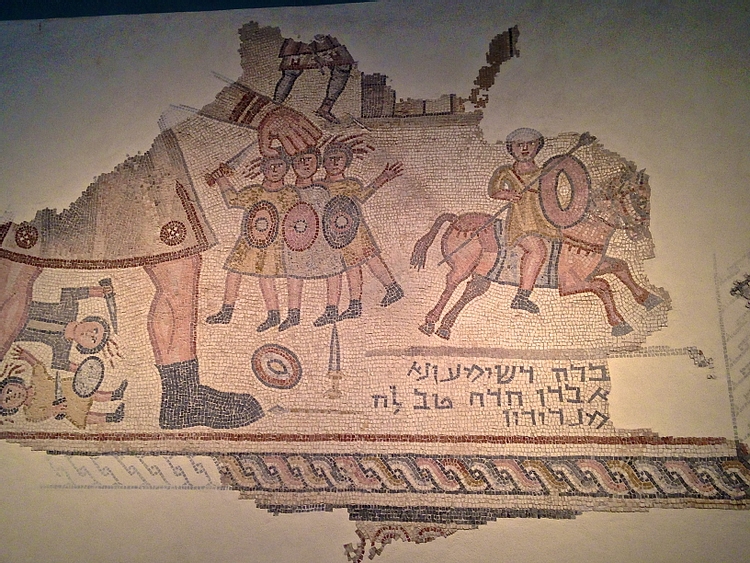 Battling Giant Dana Murray (CC BY-NC-SA) ](https://www.worldhistory.org/image/4030/battling-giant/ "Battling Giant")In [Homer](https://www.worldhistory.org/homer/)'s (c. 750 BCE) *[Odyssey](https://www.worldhistory.org/Odyssey/)*, he writes about the legendary Laestrygonians and how they were more like Giants than humans in appearance.
> Down from the cliff they flung great rocks a man could hardly hoist
> and a ghastly shattering din rose up from all the ships –
> men in their [death](https://www.worldhistory.org/disambiguation/Death/) cries, hulls smashed to splinters-
> They speared the crews like fish
> and whisked them off to make their grisly meal.
> (Homer, *Odyssey*, 10-132-136).
### Notable Giants
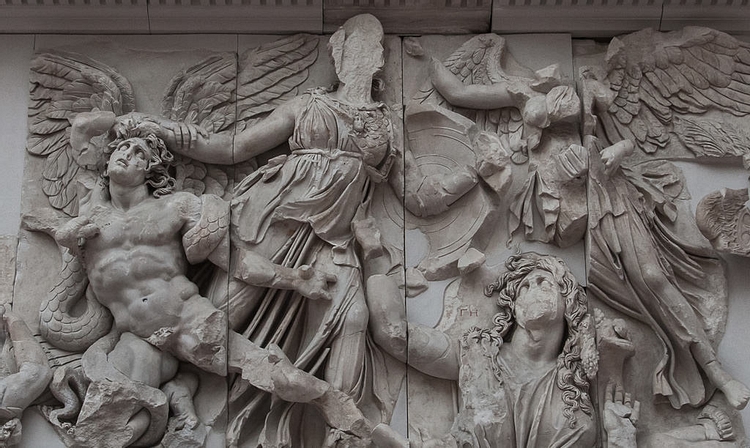
There were multiple Giants in Greek mythology, some better known than others. Among the most notable of the giants is Porphyrion, who was the king of the Giants and who was killed by [Zeus](https://www.worldhistory.org/zeus/) and [Hercules](https://www.worldhistory.org/hercules/) after he had attempted to rape [Athena](https://www.worldhistory.org/athena/); Enceladus, who was buried underneath Mount Etna by Athena; Polybotes, who was crushed by an island that was thrown by [Poseidon](https://www.worldhistory.org/poseidon/) and Alcyoneus, who was immortal, as long as he fought on his homeland. Most of the Giants fought various gods and were defeated, often with the help of a particular weapon or tool.
[  Athena Killing a Giant Mina Bulic (CC BY-NC-ND) ](https://www.worldhistory.org/image/3614/athena-killing-a-giant/ "Athena Killing a Giant")### The Gigantomachy
Apollodorus (c. 180 to c. 120 BCE) stated that the Gigantomachy took place after the Titanomachy. It was considered one of the crucial battles that cemented the sovereignty of the Olympian gods. The Giants were angry at Zeus, as he had imprisoned their brothers, the Titans, in Tartarus. They plotted their revenge by planning an attack on the heavens. On their mountaintops, the Giants grabbed firebrands and boulders and threw them upward. [Hera](https://www.worldhistory.org/Hera/) foresaw that a [god](https://www.worldhistory.org/God/) could never kill the Giants, but only a mortal who was lion-skinned could defeat them, referring to the Greek hero Hercules. However, even Hercules would need the assistance of a herb that made a mortal invulnerable. Gaia knew of the existence of this herb and tried to search for it herself. However, this herb grew in a dark secret place under the Earth, and so Zeus forbade [Selene](https://www.worldhistory.org/Selene/), [Helios](https://www.worldhistory.org/Helios/), and [Eros](https://www.worldhistory.org/Eros/) to shine and found the herb first with Athena's help. The Olympians were now in a position to fight the Giants.
Hercules did not waste time and shot an arrow at Alcyoneus, the leader of the Giants, who was instantly revived because he was fighting on his own land. On the advice of Athena, Hercules took Alcyoneus over the border, where he was able to kill him. Porphyrion jumped up into Heaven, and only Athena stood her ground against him. He rushed past her and went to Hera, whom he tried to strangle. An arrow from Eros hit him, and his violence instantly turned to lust. Attempting to rape Hera, he was stopped by Zeus, who struck Porphyrion with his thunderbolt. Porphyrion did not stay down for long but was ultimately killed by Hercules.
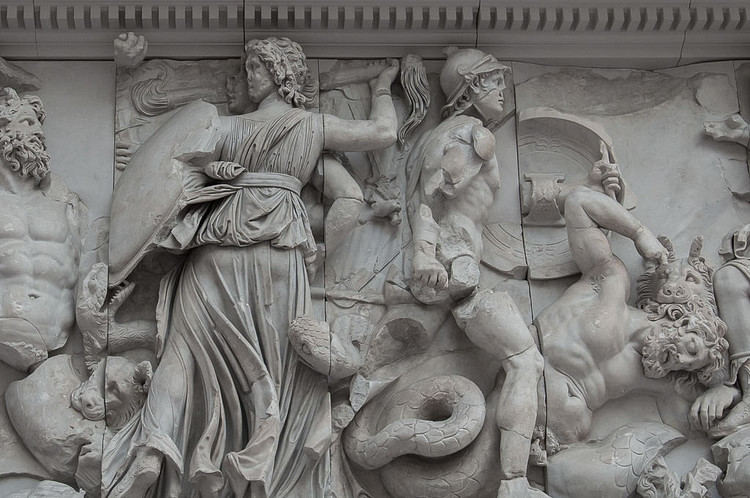
[  Gods Fighting Giants, Delphi Mark Cartwright (CC BY-NC-SA) ](https://www.worldhistory.org/image/523/gods-fighting-giants-delphi/ "Gods Fighting Giants, Delphi")Ephialtes was fighting against [Ares](https://www.worldhistory.org/Ares/) and had driven him to his knees. [Apollo](https://www.worldhistory.org/apollo/) came to Ares' rescue, shot the Giant in his left eye, and called out to Hercules for help. Hercules shot Ephialtes in the right eye, ending his life. A fierce [battle](https://www.worldhistory.org/disambiguation/battle/) raged on between the gods and the Giants. [Dionysos](https://www.worldhistory.org/Dionysos/) used his staff (*thyrsus*) to bring down Eurytus; [Hecate](https://www.worldhistory.org/Hecate/) burned Clytius with her torches; Athena crushed Pallas with a boulder, and [Hephaestus](https://www.worldhistory.org/Hephaistos/) scalded Mimas with hot [metal](https://www.worldhistory.org/disambiguation/metal/). Every time a god injured a Giant, Hercules would come running to deliver the killing blow. Only two Olympian goddesses were notably absent from the conflict, the peaceful [Demeter](https://www.worldhistory.org/demeter/) and [Hestia](https://www.worldhistory.org/Hestia/), who watched the battle from afar in dismay but refused to take part in it.
The Giants could see they were fighting a losing battle and retreated to Earth with the Olympians pursuing them. Athena threw a large item at Enceladus, which crushed him and buried him, becoming Mount Etna in [Sicily](https://www.worldhistory.org/sicily/). Poseidon used his trident to break off a piece of [Kos](https://www.worldhistory.org/Kos/) in the [Aegean](https://www.worldhistory.org/aegean/) Sea and threw it at Polybotes, who also transformed into a piece of land – the Isle of Nisyros. The surviving Giants made a last stand at Bathos in Arcadia. [Hermes](https://www.worldhistory.org/Hermes/), wearing [Hades](https://www.worldhistory.org/Hades/)' helmet, struck down [Hippolytus](https://www.worldhistory.org/Hippolytus/), while [Artemis](https://www.worldhistory.org/artemis/) shot an arrow at Gration. The [Fates](https://www.worldhistory.org/Fates/) used their pestles to smash the heads of Thoas and Agrius. Ares and Zeus used their spear and thunderbolt to take down the remaining Giants, with Hercules killing each Giant as they fell. In some sources, the companion of Dionysos, [Silenus](https://www.worldhistory.org/Silenus/), boasted about fighting on the side of the gods and killing the Giant Enceladus. His braying sent the Giants running in fear.
[  Hecate Fighting the Giant, Pergamon Altar Mina Bulic (CC BY-NC-ND) ](https://www.worldhistory.org/image/3618/hecate-fighting-the-giant-pergamon-altar/ "Hecate Fighting the Giant, Pergamon Altar")### Aftermath
After the Giants were defeated, their mother, Gaia, lay with Tartarus and gave birth to [Typhon](https://www.worldhistory.org/Typhon/), the largest monster to ever roam the Earth. In his *Metamorphoses*, Ovid writes that Gaia transformed the Giants into a new race.
> When, crushed by the mass they had raised, those
> fearsome bodies lay prostrate,
> Mother Earth, as the story continues, now steeped and
> drenched
> in the blood of her offspring, gave fresh life to the
> seething liquid.
> Unwilling that all the fruits of her womb should be lost and forgotten,
> she turned their blood into human form; but the new race
> also
> looked on the gods with contempt. Their passionate lust for
> ferocious
> violence and slaughter prevailed. You'd have known they
> were born of blood.
> (Ovid, *Metamorphoses*, 1.156-163)
### Alternative Versions
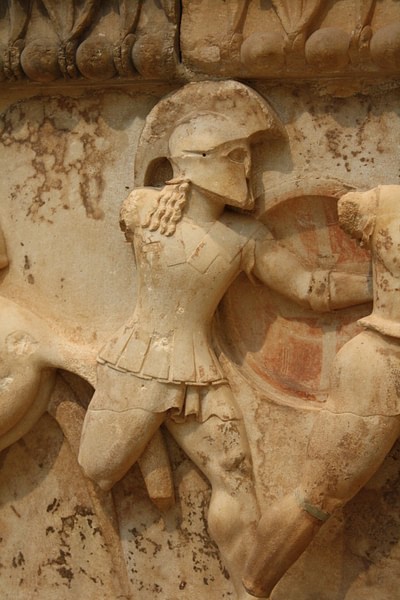
According to the Greek poet Pindar, the Giant Alcyoneus was the catalyst for the conflict between the Olympian gods and the Giants. In various versions, he either stole some of Helios' cattle, which angered the god, or confronted Hercules either as he was returning from his Trojan expedition with Telamon or at the Isthmus of [Corinth](https://www.worldhistory.org/corinth/). A scene from a vase painting shows Hercules creeping up on Alcyoneus as he is sleeping and attacking him.
[  Gigantomachy of Delphi Mark Cartwright (CC BY-NC-SA) ](https://www.worldhistory.org/image/524/gigantomachy-of-delphi/ "Gigantomachy of Delphi")### In the Ancient Greek World
According to [Pausanias](https://www.worldhistory.org/disambiguation/Pausanias/) (c. 115 to c. 180 CE) in his *Description of [Greece](https://www.worldhistory.org/greece/)*, in the region of [Trapezus](https://www.worldhistory.org/Trapezus/) in Arcadia, there was a place called the Depth, where the Mystery of the Great Goddesses was celebrated every two years. Not far from the Depth was a spring called the [Olympias](https://www.worldhistory.org/Olympias/), which is where the legendary Gigantomachy was said to have taken place. Sacrifices were made here to the storms, lightning, and thunder.
On the south [wall](https://www.worldhistory.org/wall/) of the [Acropolis](https://www.worldhistory.org/Acropolis/) in [Athens](https://www.worldhistory.org/Athens/) was a wall relief that depicted the great battle between the gods and the Giants. A short distance away from the [Temple](https://www.worldhistory.org/temple/) of Demeter in Athens stood a statue of Poseidon on horseback, throwing a spear towards the Giant Polybotes.
#### Editorial Review
This human-authored definition has been reviewed by our editorial team before publication to ensure accuracy, reliability and adherence to academic standards in accordance with our [editorial policy](https://www.worldhistory.org/static/editorial-policy/).
## Bibliography
- [Apollodorus & Hard, Robin. *The Library of Greek Mythology .* Oxford University Press, 2008.](https://www.worldhistory.org/books/0199536325/)
- [Graves, Robert. *The Greek Myths\[May 15, 2018\] Graves, Robert.* Viking, 2018.](https://www.worldhistory.org/books/0241982359/)
- [Hansen, William. *Classical Mythology.* Oxford University Press, 2005.](https://www.worldhistory.org/books/0195300351/)
- [Hard, Robin. *The Routledge Handbook of Greek Mythology.* Routledge, 2003.](https://www.worldhistory.org/books/0415478901/)
- [Hesiod & Theognis & Wender, Dorothea & Wender, Dorothea. *Hesiod and Theognis .* Penguin Classics, 1976.](https://www.worldhistory.org/books/0140442839/)
- [Homer & Robert Fagles & Bernard Knox. *The Odyssey.* Penguin Classics, 1999.](https://www.worldhistory.org/books/0140268863/)
- [Ovid & Raeburn, David & Feeney, Denis. *Metamorphoses .* Penguin Classics, 2004.](https://www.worldhistory.org/books/014044789X/)
- [Pausanias & Newberry, John & Levi, Peter & Levi, Peter. *Guide to Greece, Vol. 2.* Penguin Classics, 1984.](https://www.worldhistory.org/books/014044226X/)
- [Pausanias & Peter Levi. *Guide to Greece, Vol. 1.* Penguin Classics, 1984.](https://www.worldhistory.org/books/0140442251/)
## About the Author
Liana is the Social Media Editor for Ancient History Encyclopedia. She holds a Bachelor of Arts Degree with a major in ancient Greece, Rome & Late Antiquity. She is particularly passionate about Rome and Greece, and anything to do with mythology or wo
- [Linkedin Profile](https://www.linkedin.com/in/lian)
## Questions & Answers
### What did the Giants look like?
The Giants were depicted with long hair hanging from their head and chin, and scaly feet and lower bodies. Some sources state that they had snakes in place of their feet.
### What are the Giants called in Greek?
The Giants are known as Gigantes in Greek.
### Who was able to kill the Giants?
While the gods could harm the Giants, only the Greek hero Hercules could kill them, thanks to a herb that made him invulnerable.
### What was the Gigantomachy?
The Gigantomachy was a battle between the Olympian gods and the Giants in Greek mythology.
## Cite This Work
### APA
Miate, L. (2023, July 31). Giants. *World History Encyclopedia*.
### Chicago
Miate, Liana. "Giants." *World History Encyclopedia*, July 31, 2023. .
### MLA
Miate, Liana. "Giants." *World History Encyclopedia*, 31 Jul 2023, .
## License & Copyright
Submitted by [Liana Miate](https://www.worldhistory.org/user/lianamiate/ "User Page: Liana Miate"), published on 31 July 2023. The copyright holder has published this content under the following license: [Creative Commons Attribution-NonCommercial-ShareAlike](https://creativecommons.org/licenses/by-nc-sa/4.0/deed.en). This license lets others remix, tweak, and build upon this content non-commercially, as long as they credit the author and license their new creations under the identical terms. When republishing on the web a hyperlink back to the original content source URL must be included. Please note that content linked from this page may have different licensing terms.