---
title: Gezer
author: Henry Curtis Pelgrift
source: https://www.worldhistory.org/Gezer/
format: machine-readable-alternate
license: Creative Commons Attribution-NonCommercial-ShareAlike (https://creativecommons.org/licenses/by-nc-sa/4.0/)
updated: 1970-01-01
---
# Gezer
_Authored by [Henry Curtis Pelgrift](https://www.worldhistory.org/user/hpelgrift/)_
Gezer is an ancient [city](https://www.worldhistory.org/city/) and archaeological site located in central [Israel](https://www.worldhistory.org/disambiguation/Israel/) where the central mountains meet the northern Shephelah, about 10 km southeast of the city of Ramleh. According to the Hebrew [Bible](https://www.worldhistory.org/bible/), Gezer was one of the great [cities](https://www.worldhistory.org/city/) fortified by [Solomon](https://www.worldhistory.org/solomon/), in addition to [Jerusalem](https://www.worldhistory.org/jerusalem/), Megiddo, and Hazor (1 Kings 9:15–17) .
Gezer is located on a manmade mound or *tell* in Arabic—transliterated as *tel* in Latin characters from Hebrew - consisting of more than 25 layers of debris and soil, representing the material remains of successive periods of human occupation. The mound of Tel Gezer measures about 650 meters long east to west, by 200-250 meters wide, with hills on the east and west ends and a dip or "saddle" in between.
The site was inhabited from about 3500 BCE through the [Roman](https://www.worldhistory.org/disambiguation/Roman/) period. It remained a small, unfortified settlement until the Middle [Bronze Age](https://www.worldhistory.org/disambiguation/Bronze_Age/) (c. 2000-1500 BCE) (the "MB"), when stone fortifications were first constructed. Additional fortifications and monumental structures were built in the [Iron Age](https://www.worldhistory.org/disambiguation/Iron_Age/), sometime from the 10th to the 8th century BCE, and the site continued to be inhabited until the Roman period.
### Geography & Excavations
**Strategic location**
Gezer occupied a strategic geographical position in antiquity. It was located just to the east of the *Via Maris* that ran from [Egypt](https://www.worldhistory.org/egypt/) north along the sea and then east past Megiddo and on to Damascus. It was also on the "trunk road" that ran east through the hills to Jerusalem and on to [Jordan](https://www.worldhistory.org/Jordan/). The trunk road ran around the north of the tell into the Aijalon Valley where the Hebrew Bible says that the moon "stayed" when Joshua commanded it to do so (Joshua 10: 12–13).
**Excavations of Tel Gezer**
The site has been excavated several times in the past century. It was first excavated by the Irish archaeologist R.A.S. Macalister for the [Palestine](https://www.worldhistory.org/palestine/) Exploration Fund (PEF) in the early 20th century CE, and then, more than 50 years later, by a joint expedition of the Hebrew Union College Biblical and Archaeological School (HUC) and the Harvard Semitic Museum in the 1960s CE and 1970s CE and by archaeologists from the University of Arizona in 1984 CE and 1990 CE. As of 2015 CE, it is currently being excavated by a team from the Tandy Institute for [Archaeology](https://www.worldhistory.org/Archaeology/) at the Southwestern Baptist Theological Seminary (SBTS), and by a group from the Moskau Institute for Archaeology at the New Orleans Baptist Theological Seminary (NOBTS) which is excavating the Gezer Water System.
### Earliest Occupation of the Site
The earliest evidence of occupation of Tel Gezer dates to the Early [Bronze](https://www.worldhistory.org/disambiguation/bronze/) Age (EB), probably in the period from about 3500–3250 BCE. The period was called "Ghassulian-Beersheba," and during this time, the inhabitants initially lived in caves. Later, when they moved to other dwellings, they used the caves as tombs and crematoria. The tell was occupied throughout the EB, but the settlement was destroyed at the end of the EB in the 24th century BCE.
### The Middle Bronze Age (2000–1500 BCE)
In the earliest period of the MB, called the "Middle Bronze Age I" (MBI), the tell was again inhabited, as indicated by the presence of MBI [pottery](https://www.worldhistory.org/pottery/) in the archaeological record. In the second part of the MB, called "Middle Bronze Age II" (MBII), around 1875–1850 BCE, the process of building the city began. Large fortifications were built throughout the site, including stone walls and towers, a glacis, and a gate on the western hill. The fortified city of the MB was destroyed in about 1500 BCE at the end of the MB.
[  MB Canaanite Gate at Tel Gezer Avishai Teicher (CC BY) ](https://www.worldhistory.org/image/4371/mb-canaanite-gate-at-tel-gezer/ "MB Canaanite Gate at Tel Gezer")**The High Place**
In the latest part of the MB II, called "Middle Bronze Age IIC" (MBIIC), ten stone columns, 1.65 to 3.25 meters tall, called the "High Place," were built at Gezer. They were also called "standing stones," "standing *stelae*," or "*Massebot*." The purpose of the stones of the High Place is not known, but it has been suggested that they were used for cultic purposes or perhaps as altars, possibly, for purposes of infant sacrifice. However, the longtime excavator of Tel Gezer, William G. Dever, recently rejected the last suggestion, pointing out that although there was evidence of infant sacrifice, it was found in a different stratum from that of the High Place. Instead, Dever suggested, the stones might have been used to memorialize a treaty among ten tribes in the area.
[ 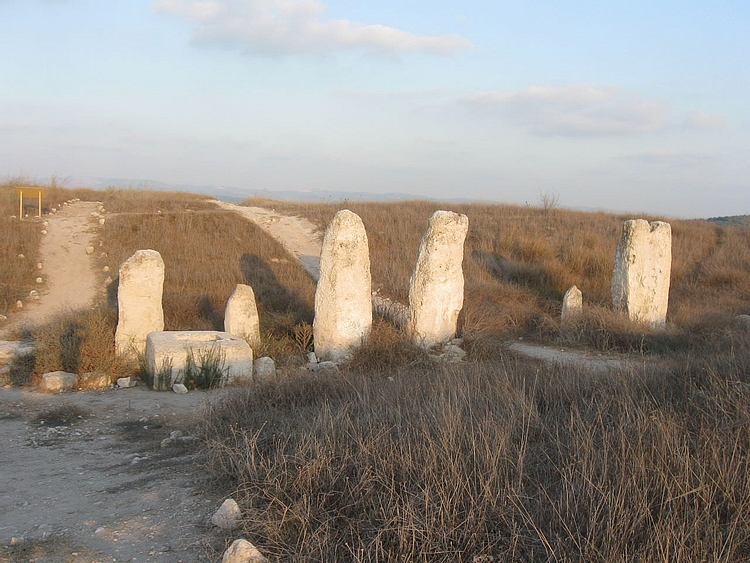 The High Place at Gezer Ori~ (CC BY-SA) ](https://www.worldhistory.org/image/4367/the-high-place-at-gezer/ "The High Place at Gezer")**The Tel Gezer Water System**
A sophisticated water system was constructed at Gezer in the MB, perhaps as early as 2000 BCE. The water system was designed to allow the city's inhabitants to reach a source of water within the city's walls in relative safety from enemies. It included a long sloping shaft that allowed people to walk down to a basin where water collected.
[  Gezer Water System (Under Excavation) Oren Rozen (CC BY-SA) ](https://www.worldhistory.org/image/4369/gezer-water-system-under-excavation/ "Gezer Water System (Under Excavation)")### The Late Bronze Age
In the Late Bronze Age (LB), Gezer was rebuilt, but the city was conquered several times during the period by [Egyptian](https://www.worldhistory.org/disambiguation/Egyptian/) armies and apparently came under Egypt's control. An inscription dating to 1468 BCE indicates that Gezer was conquered by [Thutmose III](https://www.worldhistory.org/Thutmose_III/). Then during the reign of Thutmose IV in the late 15th century BCE, the king of Gezer was summoned to appear before the [pharaoh](https://www.worldhistory.org/pharaoh/). The Egyptians were also said to have taken prisoners in Gezer and sent them to Egypt, according to a stela of Thutmose IV, a [cuneiform](https://www.worldhistory.org/cuneiform/) letter found at Gezer by Macalister and another ancient inscription. Then in the late 13th century BCE, Gezer was captured and destroyed by the pharaoh Merneptah, according to the pharaoh's stela. In the 12th century BCE, the [Philistines](https://www.worldhistory.org/Philistines/) conquered Gezer and took control of the city.
### References in the Hebrew Bible
Gezer is mentioned often in Biblical accounts whose setting is the LB or the Iron Age, including the following:
- Joshua 10:33
- Joshua 16:10
- Joshua 16:3
- Joshua 21:21
- Judges 1:29
- 2 [Samuel](https://www.worldhistory.org/samuel/) 5:25
- Chronicles 20:4
- 1 Kings 9:15–17
**The Time of Joshua**
According to the Hebrew Bible, Gezer's king Horam aided Lachish and was defeated by Joshua, but Gezer continued to be inhabited by Canaanites (Joshua 10:31–33 and 16:3; Judges 1:29).
**The Time of David & Solomon**
According to the Biblical account, many of David's battles with the Philistines were fought around Gezer (1 Chronicles 14:16 and 20:4, and 2 Samuel 5:25). It has been suggested that David did not capture Gezer - or Ashdod, Ashkelon or Gaza - because he did not want to interfere with Egypt's involvement in these cities.
A Biblical account says that Gezer was destroyed by an Egyptian pharaoh in the 10th century BCE (possibly the 21st dynasty pharaoh Siamun) (1 Kings 9:16). The city was then given to pharaoh's daughter as a dowry when she married Solomon, and at that time, Gezer became an Israelite city, and "Solomon rebuilt Gezer" (1 Kings 9:15–17).
The Hebrew Bible also states that Solomon used forced labor "to build the [wall](https://www.worldhistory.org/wall/) of Jerusalem, Hazor, Megiddo, \[and\] Gezer" (1 Kings 9:15). In the Iron Age, a six-chambered gate was built on the saddle. But archaeologists disagree on the dating of the gates. During or shortly before the HUC-Harvard excavation, Yigael Yadin re-examined Macalister's dating of the gate at Gezer (which Macalister had incorrectly dated to the Maccabee period) and attributed the Gezer gate, as well as those at Megiddo and Hazor, to Solomon in the 10th century BCE.
However, other archaeologists have re-dated the gates and certain other massive structures to later dates - in the 9th and the 8th centuries BCE. Nevertheless, for the moment, the directors of the current expedition at Gezer continue to maintain that the gate at Gezer dates to Solomon and the 10th century BCE, as Yadin said.
[ 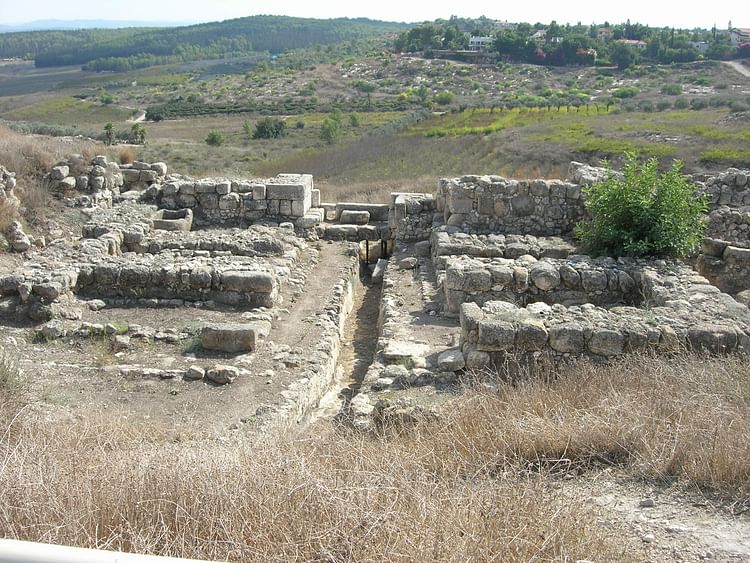 Six-Chambered Gate at Tel Gezer Mickael101 (Public Domain) ](https://www.worldhistory.org/image/4370/six-chambered-gate-at-tel-gezer/ "Six-Chambered Gate at Tel Gezer")### The Iron Age
During the Iron Age, Gezer was attacked many times. In addition, it was again conquered by Egypt, according to an inscription in [Karnak](https://www.worldhistory.org/Karnak/) dating to 918 BCE. Famed American archaeologist William F. Albright, longtime director of the American School for Oriental Research in Jerusalem in the 1920s CE and 1930s CE, stated that the pharaoh Shishak was responsible for the attack in the late 10th century BCE. Albright went on to say that Gezer was then abandoned. However, pottery evidence suggests that the city continued to be inhabited by a substantial population in the 8th and 7th centuries BCE.
In the second half of the 8th century BCE, the Assyrian king [Tiglath-Pileser III](https://www.worldhistory.org/Tiglath_Pileser_III/) (745–728 BCE) attacked and laid siege to Gezer. Then, after the Northern [Kingdom of Israel](https://www.worldhistory.org/Kingdom_of_Israel/) was conquered by the Assyrians in the late 8th century BCE, Gezer became part of the Kingdom of Judah. Finally, at the end of the 7th and beginning of the 6th century BCE, Gezer, like Jerusalem, was captured by the Neo-Babylonian king Nebuchadnezzar.
Many of the people of Judah were carried off to the lands to the east controlled by the Neo-Babylonians, and they remained there for several decades during the Babylonian Exile. However, beginning in 539 BCE, many of them returned to Judah after they were freed by an edict issued in that year by the Persian king, [Cyrus the Great](https://www.worldhistory.org/Cyrus_the_Great/), who had conquered the Neo-Babylonians.
### The Persian & [Hellenistic](https://www.worldhistory.org/Hellenic_World/)/Maccabean Periods
After the Babylonian Exile, the former Kingdom of Judah, became the Persian province of "Yehud." Then, in the [Hellenistic Period](https://www.worldhistory.org/Hellenistic_Period/), the province became part of the Hellenistic [Ptolemaic kingdom](https://www.worldhistory.org/Ptolemaic_Egypt/) of Egypt. A seal found in Gezer shows that the city was part of the province of Yehud in the Persian and Ptolemaic periods.
In the Maccabean period, Gezer was captured by the Maccabees, and the Hasmonean kings Simon Maccabaeus and John Hyrcanus lived there, after which the city may have been temporarily deserted.
[  Gezer Boundary Stone Gil Maestro (CC BY-SA) ](https://www.worldhistory.org/image/4368/gezer-boundary-stone/ "Gezer Boundary Stone")Herodian, Roman & [Byzantine](https://www.worldhistory.org/disambiguation/Byzantine/) Periods
In the Herodian and Roman periods in the first century CE, Gezer seems to have been part of the estate of a [Greek](https://www.worldhistory.org/disambiguation/greek/) landowner named Alkios. It was apparently farmed by Jewish settlers who lived on the land. The inscribed boundary stones may belong to the Roman period. Tel Gezer may have been uninhabited after this, but in the Roman and Byzantine periods, it was apparently used as the location of tombs and structures other than dwellings.
#### Editorial Review
This human-authored definition has been reviewed by our editorial team before publication to ensure accuracy, reliability and adherence to academic standards in accordance with our [editorial policy](https://www.worldhistory.org/static/editorial-policy/).
## Bibliography
- [Franklin, Norma. 2013. Who Really Built the Water System at Megiddo?](http://asorblog.org/2013/10/08/who-really-built-the-water-system-at-megiddo/ "Franklin, Norma. 2013. Who Really Built the Water System at Megiddo?"), accessed 1 Dec 2016.
- [Myers, Gary D. 2015. “More Canaanite Evidence Found by Gezer Dig Team.†Gatekeeper (October 30).](https://nobtsgatekeeper.wordpress.com/2015/10/30/more-canaanite-evidence-found-by-gezer-dig-team/#more-358 "Myers, Gary D. 2015. “More Canaanite Evidence Found by Gezer Dig Team.†Gatekeeper (October 30)."), accessed 1 Dec 2016.
- [Ortiz, Steven and Samuel Wolff. 2015. “Archaeological Views: In the Shadow of Solomon (and Everyone Else).†Biblical Archaeology Review 41.4 (Jul/Aug): 32, 68.](http://members.bib-arch.org/publication.asp?PubID=BSBA&Volume=41&Issue=4&ArticleID=10 "Ortiz, Steven and Samuel Wolff. 2015. “Archaeological Views: In the Shadow of Solomon (and Everyone Else).†Biblical Archaeology Review 41.4 (Jul/Aug): 32, 68."), accessed 1 Dec 2016.
- [Ortiz, Steven and Samuel Wolff. 2012. “Guarding the Border to Jerusalem: The Iron Age City of Gezer.†Near Eastern Archaeology 75(1).](http://www.telgezer.com/gezer/assets/File/neareastarch%2075%201%200004%20(4).pdf "Ortiz, Steven and Samuel Wolff. 2012. “Guarding the Border to Jerusalem: The Iron Age City of Gezer.†Near Eastern Archaeology 75(1)."), accessed 1 Dec 2016.
- [Pelgrift, Henry Curtis. 2015. "Tel Gezer Water System Built by Canaanites?" Bible History Daily (19 November).](http://www.biblicalarchaeology.org/daily/ancient-cultures/ancient-israel/tel-gezer-water-system-built-by-canaanites/ "Pelgrift, Henry Curtis. 2015. "Tel Gezer Water System Built by Canaanites?" Bible History Daily (19 November)."), accessed 1 Dec 2016.
- [Shanks, Hershel. 1983. “The Sad Case of Tell Gezer.†Biblical Archaeology Review 9.4 (Jul/Aug): 30-35, 38-42.](http://members.bib-arch.org/publication.asp?PubID=BSBA&Volume=9&Issue=4&ArticleID=2 "Shanks, Hershel. 1983. “The Sad Case of Tell Gezer.†Biblical Archaeology Review 9.4 (Jul/Aug): 30-35, 38-42."), accessed 1 Dec 2016.
- [“Commemorating a Covenant.†2015. Biblical Archaeology Review 41.1 (Jan/Feb): 63–65.](http://members.bib-arch.org/publication.asp?PubID=BSBA&Volume=41&Issue=1&ArticleID=12 "“Commemorating a Covenant.†2015. Biblical Archaeology Review 41.1 (Jan/Feb): 63–65."), accessed 1 Dec 2016.
- [Barkay, Gabriel. "The Iron Age II-III." *The Archaeology of Ancient Israel*, edited by Amnon Ben-Tor. New Haven: Yale University Press, 1992, 302–373.](https://www.worldhistory.org/books/B010TTOTOY/)
- [Cline, Eric H. *Biblical Archaeology: A Very Short Introduction.* Oxford: Oxford University Press, 2009.](https://www.worldhistory.org/books/0195342631/)
- [Dever, William G., H. Darrell Lance and G. Ernest Wright. *Gezer I: Preliminary Report of the 1964-66 Seasons. Vol. 1.* Jerusalem: Hebrew Union College Biblical and Archaeological School, 1970.](https://www.worldhistory.org/books/B007T05VC6/)
- [Finkelstein, Israel and Neil Asher Silberman. *The Bible Unearthed: Archaeology's New Vision of Ancient Israel and the Origin of Sacred Texts.* New York: Simon & Schuster, 2001.](https://www.worldhistory.org/books/0684869136/)
- [Magness, Jodi. *The Archaeology of the Holy Land – From the Destruction of Solomon’s Temple to the Muslim Conquest.* Cambridge: Cambridge University Press, 2013.](https://www.worldhistory.org/books/0521124131/)
- [Negev, Avraham and S. Gibson. "Gezer." *Archaeological Encyclopedia of the Holy Land Revised and Updated Edition*, edited by Negev, Avraham and S. Gibson. New York: Continuum Publishing, 2001.](https://www.worldhistory.org/books/0826413161/)
- Yadin, Yigael. "Megiddo of the Kings of Israel." *The Biblical Archaeologist*, 33(3), 1970, pp. 65–96.
## About the Author
Henry Curtis Pelgrift is an archaeologist with 13 excavations over seven seasons under his belt and has worked at the British Museum and Met. He is currently doing a PhD in Archaeology and has an MA in Mediterranean Archaeology and a BA in Archaeology.
- [Facebook Profile](https://www.facebook.com/10153238128496461)
- [Linkedin Profile](https://www.linkedin.com/in/henrypelgrift)
## Cite This Work
### APA
Pelgrift, H. C. (2015, January 02). Gezer. *World History Encyclopedia*.
### Chicago
Pelgrift, Henry Curtis. "Gezer." *World History Encyclopedia*, January 02, 2015. .
### MLA
Pelgrift, Henry Curtis. "Gezer." *World History Encyclopedia*, 02 Jan 2015, .
## License & Copyright
Submitted by [Henry Curtis Pelgrift](https://www.worldhistory.org/user/hpelgrift/ "User Page: Henry Curtis Pelgrift"), published on 02 January 2015. The copyright holder has published this content under the following license: [Creative Commons Attribution-NonCommercial-ShareAlike](https://creativecommons.org/licenses/by-nc-sa/4.0/deed.en). This license lets others remix, tweak, and build upon this content non-commercially, as long as they credit the author and license their new creations under the identical terms. When republishing on the web a hyperlink back to the original content source URL must be included. Please note that content linked from this page may have different licensing terms.