---
title: Germanicus
author: Marianne R. H. Fisher
source: https://www.worldhistory.org/Germanicus/
format: machine-readable-alternate
license: Creative Commons Attribution-NonCommercial-ShareAlike (https://creativecommons.org/licenses/by-nc-sa/4.0/)
updated: 1970-01-01
---
# Germanicus
_Authored by [Marianne R. H. Fisher](https://www.worldhistory.org/user/mayfisher81/)_
Germanicus (15 BCE - 19 CE) was a commander in the [Roman Empire](https://www.worldhistory.org/Roman_Empire/) with a glowing reputation in his time under the rule of the Emperor [Tiberius](https://www.worldhistory.org/Tiberius/). His position in the [Roman](https://www.worldhistory.org/disambiguation/Roman/) [Empire](https://www.worldhistory.org/empire/) was a unique and important one. His marriage to [Agrippina the Elder](https://www.worldhistory.org/Agrippina_the_Elder/) ([Augustus](https://www.worldhistory.org/augustus/)' granddaughter) tied the Julian and Claudian branches of the imperial family. Along with their children, they became the most popular family in [Rome](https://www.worldhistory.org/Rome/). His [death](https://www.worldhistory.org/disambiguation/Death/) set into motion some nasty politics which saw the exile of his wife and their oldest son, as well as the death of their second son. Nevertheless, due to his popularity and military career, the next two emperors, [Caligula](https://www.worldhistory.org/Caligula/) and [Claudius](https://www.worldhistory.org/claudius/), neither of whom had any military credentials of their own, constantly evoked his name and their relationship with him as their surrogate with the army.
### EARLY LIFE OF GERMANICUS
Germanicus [Julius Caesar](https://www.worldhistory.org/Julius_Caesar/) was born in 15 BCE to [Nero](https://www.worldhistory.org/Nero/) Claudius Drusus (Drusus the Elder), the son of Augustus' wife, [Livia](https://www.worldhistory.org/Livia_Drusilla/), from her first marriage, and Antonia Minor, daughter of Augustus' sister, [Octavia](https://www.worldhistory.org/disambiguation/Octavia/), from her marriage with [Mark Antony](https://www.worldhistory.org/Mark_Antony/). The name Germanicus was given to him when it was awarded to his father posthumously in honor of his victories in Germania.
By 4 BCE, it was becoming urgent for Augustus to make arrangements to continue the principate after his death. His previous attempts, the adoption his nephew Marcellus and later his grandsons Gaius and Lucius, failed with their untimely deaths. Augustus then adopted his stepson Tiberius and [Postumus](https://www.worldhistory.org/Postumus/) [Agrippa](https://www.worldhistory.org/Marcus_Agrippa/), younger brother of the deceased Gaius and Lucius. The emperor then had Tiberius adopt Germanicus to further secure the succession, despite the fact that Tiberius had a son of his own, Nero Claudius Drusus (Drusus the Younger), who was a few years younger than Germanicus.
Part of Augustus' plan in 4 CE included Germanicus marrying Agripinna the Elder. Apart from bringing the prestige of her Julian blood to the Claudian branch of the family, Agripinna proved to be very fertile, bearing Germanicus nine children in the next fourteen years, six of whom survived their father.
As a young man of the imperial family, Germanicus' career in Rome's military and political arenas progressed quickly. He was allowed to stand for the quaestorship in 7 CE at the age of 20, four years earlier than the allowed minimum age for the position under the Empire. He then proceeded directly to the consulship in 12 CE. In his military duties, his wife Agrippina, the daughter of a great general, was always by his side. His children also became an important public relations resource for the imperial family. Apart from traveling with Germanicus and Agripinna, the children were put on display with both Augustus and Germanicus whenever opportunity allowed.
Germanicus held subordinate commands on the Danube frontier under Tiberius from 7-9 CE. Tiberius was then transferred to the Rhine frontier in response to the disaster that befell [Publius Quinctilius Varus](https://www.worldhistory.org/Publius_Quinctilius_Varus/) when his three legions were trapped and massacred at the [Battle](https://www.worldhistory.org/disambiguation/battle/) of the Teutoburg Forest by an alliance of Germanic tribes led by [Arminius](https://www.worldhistory.org/Arminius/). Germanicus joined Tiberius in Germany in 11 CE and left to spend the year 12 CE in Rome as consul, strengthening his own position as second in line for the principate. Postumus Aggripa, who was the heir of the principate along with Tiberius, had, meanwhile, fallen out of favor and was banished.
[  Roman Empire under Augustus Cristiano64 (CC BY-SA) ](https://www.worldhistory.org/image/4334/roman-empire-under-augustus/ "Roman Empire under Augustus")### MUTINy of the rhine legions
Augustus died in 14 CE, followed shortly by Postumus Agrippa. The stability of the Roman Empire was tested by the first transition of imperial power. Mutinies broke out on the Danube and German frontiers where Germanicus served as governor. Germanicus was, at this point, a very popular leader - more popular than Tiberius, and for a Roman legion, loyalty to a field commander was a given. Germanicus' connections with Augustus were also helpful, and his public relations gambit of having his little son Gaius dressed like a little soldier (which earned Gaius the nickname Caligula, or "Little Boots") made Germanicus and his family even more beloved. The legionaries in the west offered to swear to Germanicus as their new emperor rather than to Tiberius. Germanicus refused to accept their oath of allegiance, but still needed to make some attempt to help the soldiers to quell the rebellion and still keep their favor. Germanicus needed to act quickly because of the threat of enemy attack. He tried to quiet them by threatening suicide which proved to be ineffective as some soldiers actually offered their swords for him to use to stab himself. After regrouping, his solution was to forge a letter from Tiberius that gave the soldiers all they had demanded. Payment to the legions was the quickest way to settle the mutiny and increase Germanicus' popularity with them.
Then Tiberius' envoys came from Rome, and the soldiers quickly understood that the letter was a forgery. They dragged Germanicus out of bed and threatened his wife and son Caligula who were with him. Tearfully, according to [Tacitus](https://www.worldhistory.org/tacitus/), Germanicus appealed to his men to let him send away his wife and young son. This speech to his troops when Agrippina and Caligula prepared to leave camp had more effect than any other of his actions.
Germanicus successfully ended the mutiny by urging his soldiers to demonstrate that they were sorry. The soldiers, ashamed of themselves, prepared to punish and execute the rebel leaders themselves. Always very conscious of his image, Germanicus left the matter up to the soldiers. He did not interfere, neither by giving the order nor taking the blame. This way, he was able to have the ring-leaders punished without incurring any resentment towards himself. He got the soldiers to discipline themselves voluntarily and kept his hands clean from any unpleasantness. However, behind the scenes, Germanicus ordered his general Aulus Caecina Severus to gather some trusted men from among the two still hostile legions, and had them kill the unsuspecting leaders of the revolt in their tents. Germanicus also, after the mutiny ended, paid his soldiers from his own pocket in order to ensure their loyalty to him.
### Germanicus Crosses the Rhine
Gernanicus was shrewd enough to realize that idleness played a big part in the mutinies. To divert his soldiers and recover the lost standards of Varus' legions, Germanicus led 12,000 [Roman legionaries](https://www.worldhistory.org/Roman_Legionary/) with detachments of auxiliaries and cavalrymen across the Rhine. In 15 CE, he made a sudden raid against the Chatti. In the middle of this [war](https://www.worldhistory.org/disambiguation/War/), Tiberius decreed a [triumph](https://www.worldhistory.org/Roman_Triumph/) upon him, and made Germanicus a member of a new college of priests of Augustus. As he was in the middle of war, Germanicus had to delay his coming back to Rome for the promised triumph. Taking the Chatti by surprise, he massacred them and refused to negotiate peace. Never forgetting his diplomacy, he rescued the German leader Segestes and his countrymen from a siege by Arminius, who conquered Varus and his legions, thereby winning the gratitude of both Segestes and Tiberius.
16 CE was marked by disturbances in the East. Germanicus built a great fleet of a thousand ships whose objective was the Rhine delta. His father Drusus had been the first of the Romans to navigate the German ocean. Now the son made the voyage to the Zuyderzee without mishap. The return journey was marred by serious damage to the ships by violent storms. Germanicus, who reached the land safely, sent out boats to rescue survivors. Then they marched back to winter quarters. Urgent letters from Tiberius awaited them, bidding him to finally return to Rome for the Triumph that had been decreed to him. So Germanicus returned to Rome as the man of the hour. The Triumph of Germanicus took place on May 26, 17 CE with his five living children riding with him in the parade, advertising a promise of a long and stable future for Rome.
[ 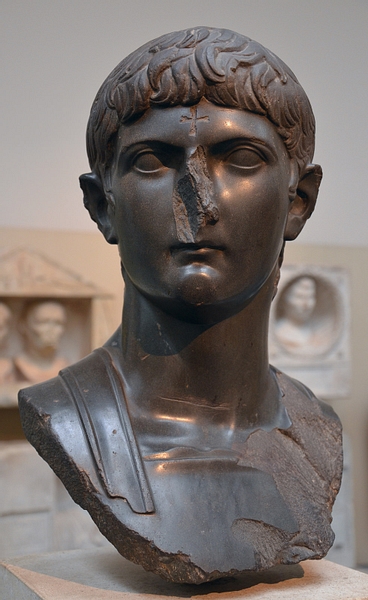 Bust of Germanicus mutilated by Christians Carole Raddato (CC BY-SA) ](https://www.worldhistory.org/image/4120/bust-of-germanicus-mutilated-by-christians/ "Bust of Germanicus mutilated by Christians")### MAIUS IMPERIUM (SUPREME POWER)
In 18 CE, Germanicus was made consul again, and this time he shared the honor with the emperor, a distinction reserved for an intended heir. Tiberius had given him *maius imperium* - a supreme authority over the territory east of the Adriatic, a command that was not only geographically unlimited, but also superseded the authority of all the governors in the area. The need for this authority was due to the power struggles within Rome's territories of [Asia Minor](https://www.worldhistory.org/Asia_Minor/) as well as by the necessity of giving Germanicus a responsibility which fitted his status as the intended heir. Germanicus approached his new base in [Antioch](https://www.worldhistory.org/Antiochia/), the imperial province of [Syria](https://www.worldhistory.org/syria/), by a grand tour of the eastern [Mediterranean](https://www.worldhistory.org/disambiguation/mediterranean/), stopping at Actium, [Athens](https://www.worldhistory.org/Athens/), and the site of ancient [Troy](https://www.worldhistory.org/troy/).
Once in Syria Germanicus came into conflict with Gnaeus Calpurnius Piso, whom Tiberius had appointed as governor of that province at the time when Germanicus received his authority. Germanicus and Piso, along with their wives, each thought that the other was exceeding his jurisdiction. Germanicus fulfilled Tiberius' orders to display a Roman presence in the area and to settle internal affairs. In [Armenia](https://www.worldhistory.org/armenia/), he crowned Artaxias, who was an ally, and installed the first Roman governor of the new province of Cappadoccia.
Germanicus left Asia minor in 19 CE to visit [Egypt](https://www.worldhistory.org/egypt/). Although this trip was scheduled in response to reports of famine in the area, it included a sightseeing tour of its renowned ancient sites. Germanicus was warmly received and he made himself even more popular with the natives by lowering the price of grain and opening the doors of the grain storehouses himself. Unfortunately, by lowering the price of grain he made the mistake of interfering with imperial regulations and was consequently rebuked by the Emperor. Egypt was the granary of the Empire and virtually a private imperial domain. By doing this, he was also upstaging Tiberius.
When Germanicus returned to Syria at the end of the summer, he found that Piso had undone all the arrangements which he had made. Germanicus renounced his *amicitia* (friendship) with Piso and banished him from his company. Piso also claimed that Germanicus ordered him from his post as well as from the province. Piso abandoned his command and went to an island off the coast so that he could return when the opportunity to do so arose. Germanicus had fallen ill shortly after his return from Egypt. He suspected that Piso had cursed him by placing objects of black magic in his house and was in the process of poisoning him.
### THE DEATH OF GERMANICUS
Germanicus died in Antioch on October 10, 19 CE. Ancient sources wrote about marks of poison in Germanicus' corpse such as bruises and foaming at the mouth. Eulogies compared him with [Alexander](https://www.worldhistory.org/disambiguation/Alexander/), who had died at the same age. His aides in Syria appointed Gnaeus Sentius Saturninus to fill the post abandoned by Piso. Piso tried to regain his former position as governor by claiming that Germanicus had illegally forced him out of the province because he was the only one strong enough to stop Germanicus from attempting a coup against Tiberius. Piso re-entered Syria with his own military force. His re-entry was easily countered and he was sent back to Rome to stand trial for treason. Dead, perhaps even martyred, Germanicus remained a formidable force in Roman politics.
Germanicus's death in the midst of his promising career kept him from becoming the emperor. However, he still influenced history for the next fifty years not only from the reputation he built when he was alive, but also from his role as the father of one emperor (Caligula), the brother of another (Claudius), and the grandfather of a third (Nero).
#### Editorial Review
This human-authored definition has been reviewed by our editorial team before publication to ensure accuracy, reliability and adherence to academic standards in accordance with our [editorial policy](https://www.worldhistory.org/static/editorial-policy/).
## Bibliography
- [Dio Cassius. *Roman History, Volume VI.* Harvard University Press, 1917.](https://www.worldhistory.org/books/0674990927/)
- Gordon, R., and J. Reynolds, M. Beard, C. Roueché, C. "Roman Inscriptions." *JRS*, 1997, pp. 206-240.
- Hurley, D.W. "Gaius Caligula in the Germanicus Tradition." *The American Journal of Philology*, Vol. 110, No. 2/1989, pp. 316-338.
- Mierow, C.C. "Germanicus Caesar Imperator." *The Classical Journal*, Vol. 39, No. 3/1943, pp. 137-155.
- [R. Syme. *Tacitus.* Oxford Clarendon Press, 1967.](https://www.worldhistory.org/books/B00JS5FKGC/)
- [Suetonius. *Suetonius, Vol. 1.* Harvard University Press, 1914.](https://www.worldhistory.org/books/0674995708/)
- Sumner, G. V. "Germanicus and Drusus Caesar." *Société d'Études Latines de Bruxelles Stable*, 1967, pp. 413-435.
- [Tacitus. *Annals.* Penguin Classics, 2013.](https://www.worldhistory.org/books/0140455647/)
- Williams, M.F. "Four Mutinies: Tacitus "Annals" 1.16-30; 1.31-49 and Ammianus Marcellinus "Res Gestae" 20.4.9- 20.5.7; 24.3.1-8." *Phoenix*, Vol. 51, No. 1/1997, pp. 44-74.
## About the Author
Marianne R. H. Fisher is the co-author of Time Maps: Matriarchy and the Goddess Culture and Time Maps: Gods, Kings and Prophets. Her work explores ancient history and myth through broad comparative perspectives.
- [X/Twitter Profile](https://twitter.com/dominatempora)
- [Linkedin Profile](https://www.linkedin.com/in/marianne-rh-fisher)
## Timeline
- **15 BCE - 19 CE**: Life of [Roman](https://www.worldhistory.org/disambiguation/Roman/) general [Germanicus](https://www.worldhistory.org/Germanicus/).
- **7 CE**: [Germanicus](https://www.worldhistory.org/Germanicus/) is made [quaestor](https://www.worldhistory.org/Quaestor/).
- **12 CE**: [Germanicus](https://www.worldhistory.org/Germanicus/) is made [consul](https://www.worldhistory.org/Consul/) for the first time.
- **15 CE**: [Germanicus](https://www.worldhistory.org/Germanicus/) leads 12,000 men across the Rhine to attack the Chatti.
- **26 May 17 CE**: [Roman emperor](https://www.worldhistory.org/Roman_Emperor/) [Tiberius](https://www.worldhistory.org/Tiberius/) grants [Germanicus](https://www.worldhistory.org/Germanicus/) a [Triumph](https://www.worldhistory.org/Roman_Triumph/) for his military victories across the Rhine.
- **18 CE**: [Germanicus](https://www.worldhistory.org/Germanicus/) and his wife [Agrippina the Elder](https://www.worldhistory.org/Agrippina_the_Elder/) visit the ancient [city](https://www.worldhistory.org/city/) of Assos.
- **18 CE**: [Roman](https://www.worldhistory.org/disambiguation/Roman/) general [Germanicus](https://www.worldhistory.org/Germanicus/) is made [consul](https://www.worldhistory.org/Consul/) for the second time.
- **10 Oct 19 CE**: [Roman](https://www.worldhistory.org/disambiguation/Roman/) general [Germanicus](https://www.worldhistory.org/Germanicus/) dies at [Antioch](https://www.worldhistory.org/Antiochia/).
## External Links
- [The Story Of Emperor Caligula, Ancient Rome's Most Infamous Leader](https://allthatsinteresting.com/caligula)
## Cite This Work
### APA
Fisher, M. R. H. (2016, January 11). Germanicus. *World History Encyclopedia*.
### Chicago
Fisher, Marianne R. H.. "Germanicus." *World History Encyclopedia*, January 11, 2016. .
### MLA
Fisher, Marianne R. H.. "Germanicus." *World History Encyclopedia*, 11 Jan 2016, .
## License & Copyright
Submitted by [Marianne R. H. Fisher](https://www.worldhistory.org/user/mayfisher81/ "User Page: Marianne R. H. Fisher"), published on 11 January 2016. The copyright holder has published this content under the following license: [Creative Commons Attribution-NonCommercial-ShareAlike](https://creativecommons.org/licenses/by-nc-sa/4.0/deed.en). This license lets others remix, tweak, and build upon this content non-commercially, as long as they credit the author and license their new creations under the identical terms. When republishing on the web a hyperlink back to the original content source URL must be included. Please note that content linked from this page may have different licensing terms.