---
title: Geghard
author: James Blake Wiener
source: https://www.worldhistory.org/Geghard/
format: machine-readable-alternate
license: Creative Commons Attribution-NonCommercial-ShareAlike (https://creativecommons.org/licenses/by-nc-sa/4.0/)
updated: 1970-01-01
---
# Geghard
_Authored by [James Blake Wiener](https://www.worldhistory.org/user/jbw288/)_
Geghard (Armenian: *Geghardavank* or "monastery of the spear") is a [medieval monastery](https://www.worldhistory.org/Medieval_Monastery/) located in [Armenia](https://www.worldhistory.org/armenia/)'s Kotayk province, deep within the Azat Valley, which was built directly out of an adjacent mountain. Geghard is renown throughout Armenia for its medieval art and [architecture](https://www.worldhistory.org/disambiguation/architecture/), and local traditions associate the site with [Saint Gregory the Illuminator](https://www.worldhistory.org/Saint_Gregory_the_Illuminator/) (c. 257 – c. 331 CE) who came to the area to found a small Christian chapel in the 4th century CE. Geghard's name attests to the former presence of a spear that supposedly pierced the body of [Jesus Christ](https://www.worldhistory.org/Jesus_Christ/) while he was crucified. This is now kept at Echmiadzin Cathedral in [Vagharshapat](https://www.worldhistory.org/Vagharshapat/), Armenia. The complex was designated as a UNESCO World Heritage Site in 2000 CE.
### History & Geography
Geghard is enveloped by tall cliffs along the Azat River, and the monastery is not too far from the strategic Ararat Plain. Located 30 km (19 mi) from Yerevan, the Geghard is quite near the [Temple of Garni](https://www.worldhistory.org/Temple_of_Garni/) - Armenia's only surviving pagan [temple](https://www.worldhistory.org/temple/) - which is only 11 km (7 mi) down the Azat River. Geghard is additionally not too far from the ancient Armenian capital of [Artashat](https://www.worldhistory.org/Artashat/) and the medieval fortress of Kakavaberd. It is likely that the environs around Geghard were inhabited in prehistoric times, including by the Urartians between the 8th-6th centuries BCE. In pagan times, local inhabitants venerated a spring that emerged from the cave that today forms part of the monastery. It is for this reason that Geghard is sometimes referred to as "Ayvirank," which in Armenian means "Monastery of the Cave."
[ 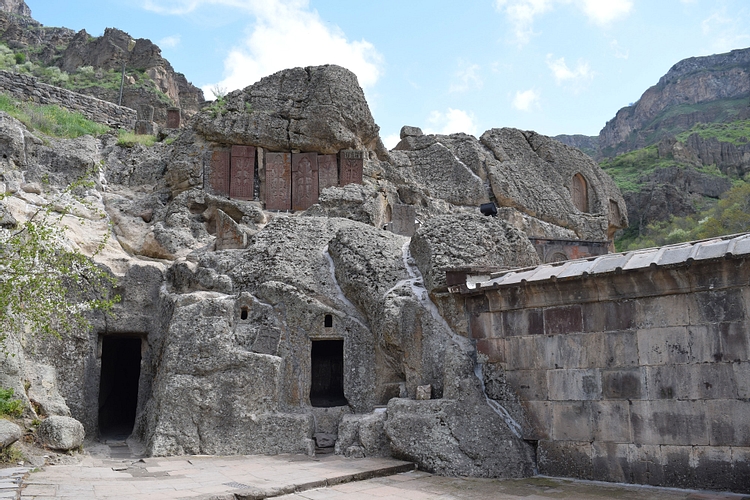 Geghard Monastery Cut from Rock James Blake Wiener (CC BY-NC-SA) ](https://www.worldhistory.org/image/8599/geghard-monastery-cut-from-rock/ "Geghard Monastery Cut from Rock")Over time, Ayvirank grew from being a small chapel into a monastic community. The monastery is attested by ancient and early medieval Armenian historians, although the remains of Ayvirank have not survived the ages. In the 8th and 9th centuries CE, Arab invaders pillaged Ayvirank, destroying unique manuscripts, libraries, and burning down the multiple religious edifices of which comprised the monastery. Although Ayvirank was ruined, in time, a new monastery would be rebuilt in its place: Geghard.
Inscriptions within the complex insinuate that construction on the main church of Geghard - Katoghike - ended around the year 1215 CE. This church was commissioned under the patronage of two Armenian princes: Zakharia and Ivan. However, it should be noted that the oldest inscriptions at the complex are located within the small Chapel of St Gregory, and they date to the 1170s CE. When [Queen Tamar](https://www.worldhistory.org/Queen_Tamar/) (r. 1184-1213 CE) reconquered much of Armenia from the Seljuk Turks and other Turkic tribes in the late 12th and early 13th centuries, she helped stimulate a brief golden age of artistic splendor and cultural production in both Armenia and Georgia. Geghard flourished, as a result, from c. 1200-1400 CE when it was a popular destination for Armenian and Georgian Christians. Mkhitar Ayrivanetsi and Simeon Ayrivanetsi - Armenian historians who pioneered innovative techniques in Armenian manuscript art - lived and worked at Geghard in the 13th century CE. Geghard was called the "monastery of the seven churches and the monastery of the forty altars" during its medieval heyday.
Pilgrims came to Geghard mainly to see the sacred spear that touched Christ and was brought to the Caucasus by the Jude the Apostle (d. 70 CE). He is usually identified with Thaddeus and sometimes called "Jude Thaddaeus" in Christian texts. For 500 years, this spear was visible at the monastery. Other relics attributed to the Apostles John and Andrew entered the Geghard treasury in the 12th century CE, and they were equally venerated and revered. Georgian and Armenian nobles, as well as the Proshyan princes, patronized Geghard, donating immense riches and sums of money to the monastery. As Geghard grew wealthy, it began to function as an ecclesiastical and cultural center with a scriptorium, several schools, and a library. Other religious structures were built in the 13th century CE, and further living and economic structures were built in the 17th century CE, the latter of which are now in ruin.
### Art & Architecture
Geghard is built into solid rock in an equal-armed cruciform fashion. More than 20 buildings were carved directly from the side of the mountains, and these structures include tombs, chapels, vestries, and churches. More specifically, Geghard consists of eastern and western churches cut from rock, a [tomb](https://www.worldhistory.org/tomb/) complex belonging to the Proshyan princes, the tomb and chapel of General Papak and Ruzukan (the generals who captured Geghard for Queen Tamar of Georgia), a cathedral, and an adjacent narthex. There are also old monastic dwelling cells and countless *khachkars* (memorial stele with a cross) around Geghard.
[ 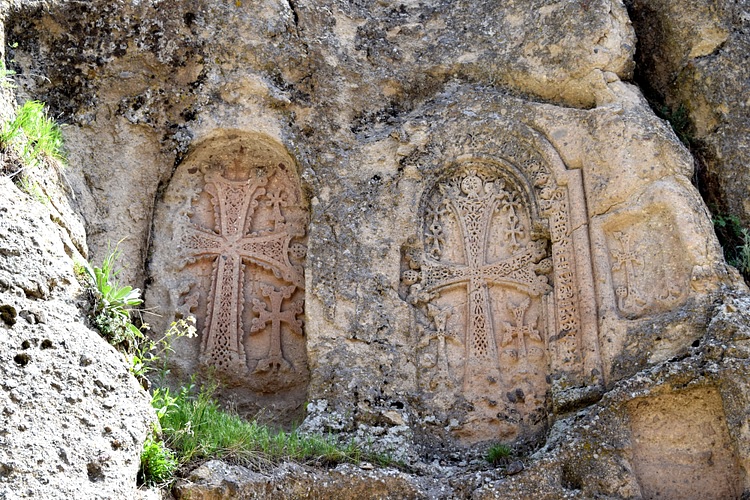 Three Khachkars at Geghard Monastery in Armenia James Blake Wiener (CC BY-NC-SA) ](https://www.worldhistory.org/image/8602/three-khachkars-at-geghard-monastery-in-armenia/ "Three Khachkars at Geghard Monastery in Armenia")The main church, Katoghike, has a cruciform layout, which was typical of medieval Armenian architecture. A defensive [wall](https://www.worldhistory.org/wall/), which dates from the 12-13th centuries CE, encircles and protects the area to the south, east, and west of the monastery, while the cliffs and mountains protect the area to the north. The interiors of the buildings at Geghard are ornately decorated. Many feature carvings of various wild animals, flowers and other vegetation, and complex geometrical patterns rendered in high relief. Among the most elaborate carvings is that of a lion attacking an ox, which was symbolic of the Proshyan princes' authority and munificence. On the internal walls of Geghard, there are numerous inscriptions recording the names of patrons and those who provided donations to individual churches or chapels.
Geghard represents the apogee of achievement in medieval Armenian art and architecture. Its stunning natural location, innovative architecture, and rich decor greatly influenced the subsequent trajectory and course of medieval architecture in Armenia.
This article was made possible with generous support from the [National Association for Armenian Studies and Research](https://naasr.org/?utm_source=ancient.eu&utm_medium=link&utm_campaign=ancient.eu) and the Knights of Vartan Fund for Armenian Studies.
#### Editorial Review
This human-authored definition has been reviewed by our editorial team before publication to ensure accuracy, reliability and adherence to academic standards in accordance with our [editorial policy](https://www.worldhistory.org/static/editorial-policy/).
## Bibliography
- [Geghard Monastery -- Armeniapedia](http://www.armeniapedia.org/index.php?title=Geghard_Monastery "Geghard Monastery -- Armeniapedia"), accessed 27 Apr 2018.
- [Monastery of Geghard -- Atlas Obscura](https://www.atlasobscura.com/places/monastery-of-geghard "Monastery of Geghard -- Atlas Obscura"), accessed 19 Mar 2020.
- [Monastery of Geghard -- CyArk](http://www.cyark.org/projects/monastery-of-geghard/plan-of-geghard "Monastery of Geghard -- CyArk"), accessed 27 Apr 2018.
- [Monastery of Geghard and the Upper Azat Valley -- UNESCO](http://whc.unesco.org/pg.cfm?cid=31&id_site=960 "Monastery of Geghard and the Upper Azat Valley -- UNESCO"), accessed 27 Apr 2018.
- [Abrahamian, L. and Sweezy, N. (eds). *Armenian Folk Arts, Culture, and Identity:.* Indiana University Press, 2001, 46, 150, 195, 2.](https://www.worldhistory.org/books/0253337046/)
- [Bedrosian, G. *Feasts of the Armenian Church and National Traditions.* Western Prelacy of the Armenian Apostolic Church of American, 1998, 40-50.](https://www.worldhistory.org/books/B000R3BVG2/)
- [Hill, J. *The Silk Road Revisited.* AuthorHouse, 2006, 256-257.](https://www.worldhistory.org/books/1425972802/)
- [Kiesling, J. B. *Rediscovering Armenia/Touristic Gazetteer and Map Set for the Historical Monuments..* Tigran Mets, 2001, 50-54.](https://www.worldhistory.org/books/9993052280/)
- UNESCO. "Advisory Body Evaluation (ICOMOS): Geghard (Armenia)." *5 March 1999*, No 960, pp. 20-21.
## About the Author
James Blake Wiener has a particular interest in cross-cultural exchange and world history. He is a co-founder of World History Encyclopedia and formerly was its Communications Director.
- [Linkedin Profile](https://www.linkedin.com/in/jameswiener)
## Timeline
- **c. 1170 CE**: The oldest inscriptions of the Chapel of St Gregory at [Geghard](https://www.worldhistory.org/Geghard/) monastery, [Armenia](https://www.worldhistory.org/armenia/).
- **c. 1200 CE - c. 1400 CE**: [Geghard](https://www.worldhistory.org/Geghard/) is a popular destination for Armenian and Georgian Christians.
- **c. 1215 CE**: Construction of Katoghike, the main church of [Geghard](https://www.worldhistory.org/Geghard/) is finished.
## Cite This Work
### APA
Wiener, J. B. (2018, April 27). Geghard. *World History Encyclopedia*.
### Chicago
Wiener, James Blake. "Geghard." *World History Encyclopedia*, April 27, 2018. .
### MLA
Wiener, James Blake. "Geghard." *World History Encyclopedia*, 27 Apr 2018, .
## License & Copyright
Submitted by [James Blake Wiener](https://www.worldhistory.org/user/jbw288/ "User Page: James Blake Wiener"), published on 27 April 2018. The copyright holder has published this content under the following license: [Creative Commons Attribution-NonCommercial-ShareAlike](https://creativecommons.org/licenses/by-nc-sa/4.0/deed.en). This license lets others remix, tweak, and build upon this content non-commercially, as long as they credit the author and license their new creations under the identical terms. When republishing on the web a hyperlink back to the original content source URL must be included. Please note that content linked from this page may have different licensing terms.