---
title: Gaya
author: Mark Cartwright
source: https://www.worldhistory.org/Gaya/
format: machine-readable-alternate
license: Creative Commons Attribution-NonCommercial-ShareAlike (https://creativecommons.org/licenses/by-nc-sa/4.0/)
updated: 1970-01-01
---
# Gaya
_Authored by [Mark Cartwright](https://www.worldhistory.org/user/markzcartwright/)_
Gaya (aka Kaya or Karak) was a confederation which ruled central-southern [Korea](https://www.worldhistory.org/Korea/) during the [Three Kingdoms period](https://www.worldhistory.org/disambiguation/Three_Kingdoms_Period/) from the 1st to 6th century CE. The peninsula was dominated by Gaya's more powerful neighbouring kingdoms of [Goguryeo](https://www.worldhistory.org/Goguryeo/) ([Koguryo](https://www.worldhistory.org/Goguryeo/)), [Baekje](https://www.worldhistory.org/Baekje/) ([Paekche](https://www.worldhistory.org/Baekje/)), and [Silla](https://www.worldhistory.org/Silla/), but Gaya, often the forgotten entity in this period, was nevertheless rich in iron ore and their craftsmen became highly skilled at fashioning iron objects such as armour and weapons. The high level of [culture](https://www.worldhistory.org/disambiguation/culture/) achieved by the Gaya states would influence [Japan](https://www.worldhistory.org/disambiguation/Japan/), their most important trading partner. The confederation came to a definitive end when it was fully conquered by the Silla kingdom in 562 CE.
### Foundation
The traditional dates for the Gaya confederacy are 42-532 CE, however, modern historians prefer to emphasise the entity's more certain existence from the 2nd century CE. The confederation consisted of six tribes, the most powerful of which were the Dae Gaya and Guya tribes, with the latter later known as the Bon Gaya ('Original'). These had developed from the original 12 states of Byeonhan. The overall area of Gaya control was west of the Naktong River and south of Mt. Gaya. The chief [city-state](https://www.worldhistory.org/Polis/) was Geumgwan Gaya (Bon-Gaya).
### Prosperity
The Gaya confederation prospered due to its fertile agricultural lands, maritime [trade](https://www.worldhistory.org/disambiguation/trade/), and above all, its rich iron ore deposits. There are few details available on the working of the Gaya states or daily life, but we can imagine a similar model to the contemporary Three Kingdoms where a royal family dominated a hierarchical aristocracy which, in turn, governed the provinces dominated by a farming peasantry.
There are some clues as to Gaya religious life offered by artefacts recovered from tombs. There many [pottery](https://www.worldhistory.org/pottery/) vessels contain residues of food offerings suggesting shamanistic beliefs. Some examples of royal crowns imitate trees and antlers, again suggesting links with shamanism. In addition, a mural in one Gaya [tomb](https://www.worldhistory.org/tomb/) has the typical motifs seen in [Buddhist](https://www.worldhistory.org/buddhism/) art such as lotus leaves and clouds.[  Three Kingdoms of Korea Map Ashraf Kamel (CC BY-NC-SA) ](https://www.worldhistory.org/image/5790/three-kingdoms-of-korea-map/ "Three Kingdoms of Korea Map")
### Collapse
Throughout their history, the Gaya states were constantly harassed by their neighbours the Silla and Baekje kingdoms and consequently never had the opportunity to form a more centralised state which political stability might have permitted. From the mid-4th century CE, Baekje became more territorial ambitious during the reign of King Geunchogo and attacked Gaya lands. Then when the Silla kingdom expanded in the 6th century CE, Gaya's alliance with Baekje did it no good at all and Bon-Gaya was conquered and destroyed (532 CE), as was Daegaya (562 CE) and the other important Gaya towns. The Gaya confederation was no more.
### Relations with Japan & [China](https://www.worldhistory.org/china/)
Ties with the Wa (Wae) of Japan were particularly close, and scholars continue to debate which culture more influenced the other. The issue is coloured by nationalistic bias so that some historians claim that Gaya was a Japanese colony while others propose that horse riders from the Eurasian steppe came to Japan via Gaya and introduced the [burial](https://www.worldhistory.org/burial/) tumulus to that culture. Evidence is lacking either way, although most scholars agree that the Gaya was the more advanced culture and recent finds of iron horse armour, notably from a 5th century CE tomb, suggest that the Gaya did master the use of that animal. More certain is that iron was the most important Gaya export to Japan. Early relations with [Han](https://www.worldhistory.org/Han_Dynasty/) China is evidenced by 1st-century CE Chinese [coin](https://www.worldhistory.org/coinage/) finds at Bon-Gaya and by the presence of the sloping kiln used by Gaya potters.
[ 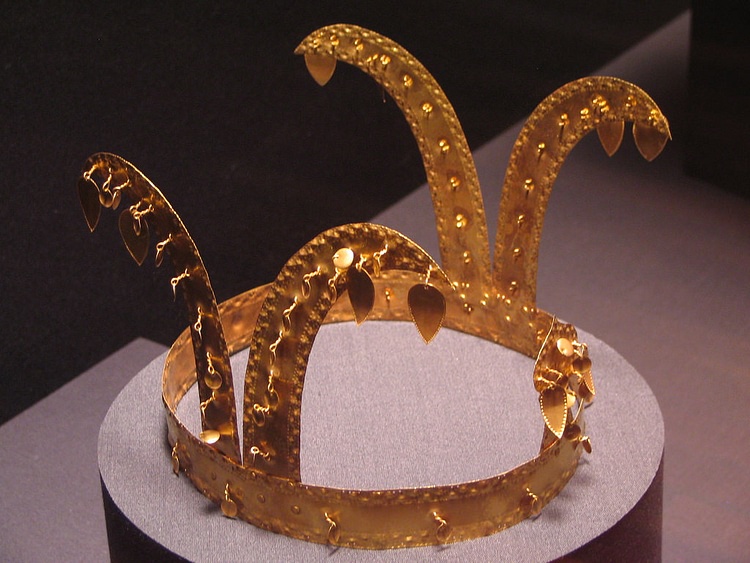 Gold Gaya Crown Pressapochista (CC BY-SA) ](https://www.worldhistory.org/image/5744/gold-gaya-crown/ "Gold Gaya Crown")### Art & [Architecture](https://www.worldhistory.org/disambiguation/architecture/)
Gaya artists produced grey stoneware clay pottery in the form of stemmed cups, horn-shaped cups, tall jars with pierced stems, and spouted vessels in the form of ducks, shoes, warriors, boats, and even houses. Stoneware requires a high firing temperature, and this technology was, no doubt, connected to the furnaces required to produce iron. Gaya potters likely passed on this innovation to Japan where the famous *sueki* (or *sue*) stoneware would be produced as a result.
Objects were also made of [silver](https://www.worldhistory.org/Silver/) and [gold](https://www.worldhistory.org/gold/) by Gaya craftsmen, including high and intricate crowns. Gaya iron products include swords, riveted body armour, helmets, and arrowheads. These were so esteemed as to be exported to the north-east region of Korea, China and Japan. Another successful export was the *gayageum* (*kayagum*), a zither with 12 [silk](https://www.worldhistory.org/Silk/) strings thought to have been invented by King Gasil in the 6th century CE, which would be taken up by musicians in Japan and which remains a potent symbol of Korean culture even today.
The Gaya region is rich in tombs; over 1,000 have been identified at Bon-Gaya alone. In the 4th century CE, the tombs of the Gaya typically took the form of rectangular or oval pit graves set into natural mounds. From the mid-5th century CE, the Gaya constructed stone chamber tombs with later examples having a horizontal entrance. As already mentioned, many tombs have equestrian equipment such as iron armour, saddle parts, bits, and stirrups suggesting the horse was an important part of Gaya culture and [warfare](https://www.worldhistory.org/warfare/).
This content was made possible with generous support from the [British Korean Society](http://www.britishkoreansociety.org.uk/?utm_source=ancient.eu&utm_medium=link&utm_campaign=ancient.eu).
#### Editorial Review
This human-authored definition has been reviewed by our editorial team before publication to ensure accuracy, reliability and adherence to academic standards in accordance with our [editorial policy](https://www.worldhistory.org/static/editorial-policy/).
## Bibliography
- [Jackson, B. *Korean Architecture.* Seoul Selection USA, Inc., 2013.](https://www.worldhistory.org/books/8997639234/)
- [Jinwung Kim. *A History of Korea"Land of the Morning Calm" to States in Conflict.* Indiana University Press, 2012.](https://www.worldhistory.org/books/0253000246/)
- [Kyung Hwang. *A History of Korea.* Palgrave Macmillan, 2010.](https://www.worldhistory.org/books/0230205461/)
- [Portal, J. *Korea: Art & Archaeology.* Thames & Hudson, 2000.](https://www.worldhistory.org/books/0500282021/)
## About the Author
Mark is WHE’s Publishing Director and has an MA in Political Philosophy (University of York). He is a full-time researcher, writer, historian and editor. Special interests include art, architecture and discovering the ideas that all civilizations share.
## Timeline
- **57 BCE - 668 CE**: [Three Kingdoms Period in Korea](https://www.worldhistory.org/Three_Kingdoms_Period_in_Korea/) ([Silla](https://www.worldhistory.org/Silla/), [Goguryeo](https://www.worldhistory.org/Goguryeo/), and [Baekje](https://www.worldhistory.org/Baekje/)).
- **42 CE - 532 CE**: The [Gaya](https://www.worldhistory.org/Gaya/) ([Kaya](https://www.worldhistory.org/Gaya/)) Confederation rules in central [Korea](https://www.worldhistory.org/Korea/).
- **532 CE**: [Silla](https://www.worldhistory.org/Silla/) captures and destroys the [Gaya](https://www.worldhistory.org/Gaya/) [city](https://www.worldhistory.org/city/) of Bon-Gaya in southern [Korea](https://www.worldhistory.org/Korea/).
- **562 CE**: [Silla](https://www.worldhistory.org/Silla/) conquers the [Gaya](https://www.worldhistory.org/Gaya/) [city](https://www.worldhistory.org/city/) of Daegaya in southern [Korea](https://www.worldhistory.org/Korea/).
## Cite This Work
### APA
Cartwright, M. (2016, September 28). Gaya. *World History Encyclopedia*.
### Chicago
Cartwright, Mark. "Gaya." *World History Encyclopedia*, September 28, 2016. .
### MLA
Cartwright, Mark. "Gaya." *World History Encyclopedia*, 28 Sep 2016, .
## License & Copyright
Submitted by [Mark Cartwright](https://www.worldhistory.org/user/markzcartwright/ "User Page: Mark Cartwright"), published on 28 September 2016. The copyright holder has published this content under the following license: [Creative Commons Attribution-NonCommercial-ShareAlike](https://creativecommons.org/licenses/by-nc-sa/4.0/deed.en). This license lets others remix, tweak, and build upon this content non-commercially, as long as they credit the author and license their new creations under the identical terms. When republishing on the web a hyperlink back to the original content source URL must be included. Please note that content linked from this page may have different licensing terms.