---
title: Ganges: The Sacred Hindu River
author: Mark Cartwright
source: https://www.worldhistory.org/Ganges/
format: machine-readable-alternate
license: Creative Commons Attribution-NonCommercial-ShareAlike (https://creativecommons.org/licenses/by-nc-sa/4.0/)
updated: 2025-04-18
---
# Ganges: The Sacred Hindu River
_Authored by [Mark Cartwright](https://www.worldhistory.org/user/markzcartwright/)_
The River Ganges, also known as the Ganga, flows 2,700 km from the Himalaya mountains to the Bay of Bengal in northern [India](https://www.worldhistory.org/india/) and Bangladesh. Regarded as sacred by Hindus, the river is personified as the goddess Ganga in ancient texts and art. Ritual bathing in the Ganges was and is an important part of [Hindu](https://www.worldhistory.org/hinduism/) pilgrimage and the ashes of the cremated are often spread across her waters.
### The Ganges in Sacred Texts
Described in the *[Mahabharata](https://www.worldhistory.org/Mahabharata/)* as the 'best of rivers, born of all the sacred waters', the Ganges is personified as the goddess Ganga. Ganga's mother is Mena and her father is Himavat, the personification of the Himalaya mountains. In one myth Ganga marries King Sanatanu but the relationship comes to a shattering end when the goddess is discovered to have drowned her own children. In the *Mahabharata* Ganga is the mother of Bhishma and in some myths Skanda (Karttikeya), the Hindu [god](https://www.worldhistory.org/God/) of [war](https://www.worldhistory.org/disambiguation/War/), is her son with [Agni](https://www.worldhistory.org/Agni/), the god of fire.
In Hindu [mythology](https://www.worldhistory.org/mythology/) the Ganges river was created when [Vishnu](https://www.worldhistory.org/Vishnu/), in his incarnation as the dwarf brahmin, took two steps to cross the universe. On the second step Vishnu's big toe accidentally created a hole in the [wall](https://www.worldhistory.org/wall/) of the universe and through it spilled some of the waters of the River Mandakini. Meanwhile, the great mythological king Bhagiratha was concerned to discover that 60,000 of King Sagara's ancestors had been incinerated from the stare of the Vedic sage Kapila. Wanting these ancestors to reach heaven, Bhagiratha asked Kapila how this might be achieved. The response was to pray earnestly to Vishnu and perform ascetic acts for a thousand years. The great god, gratified by Bhagiratha's piety, agreed for Ganga to descend to earth where she might wash over the ashes of the 60,000, purify them, and permit them to ascend to heaven. There was a problem though, that if Ganga merely dropped from heaven her swirling waters would do untold damage. Therefore, [Shiva](https://www.worldhistory.org/shiva/) offered to gently lower the goddess in his hair which he did, rather cautiously taking 1,000 years. Safely arrived on earth, Bhagiratha guided Ganga across India, where she split into many subsidiaries, and successfully washed the ashes of Sagara's ancestors in her sacred waters.
The Ganges often appears in Hindu mythology as a background location, for example, as a place where the famous figures Atri and [Death](https://www.worldhistory.org/disambiguation/Death/) performed various acts of asceticism. In the *Siva* *Purana* the Ganges carries the seed of Shiva which, when carried to a clump of reeds, became Skanda. In the *Matsya* *Purana* and the story of the Great Flood the first man Manu throws a [giant](https://www.worldhistory.org/Giants/) fish into the river which then continues to grow to gigantic proportions, eventually escaping to the sea.
[ 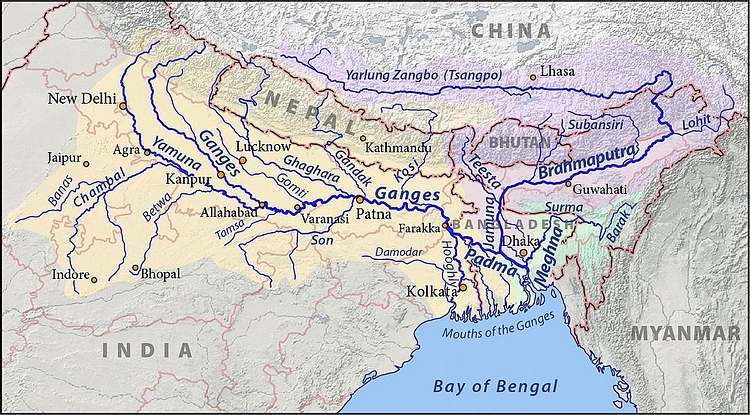 The River Ganges Pfly (CC BY-SA) ](https://www.worldhistory.org/image/3888/the-river-ganges/ "The River Ganges")### The Kumbha Mela & Varanasi
The Ganges is considered a *tirtha* which means a crossing point between heaven and earth. At a *tirtha,* prayers and offerings are thought most likely to reach the gods and, in the other direction, blessings can descend most readily from heaven.
The river is, along with two other sites, the location of the extraordinary Kumbha Mela ritual which dates back to at least the 7th century CE. Now held every three years, Hindu pilgrims of all social status perform a ritual bathing in the river which is thought to purify body and soul, wash away [karma](https://www.worldhistory.org/Karma/), and bring good fortune. The event, involving from 70 to 100 million people, grows ever bigger and can claim to be the largest human gatherings in history. Waters from the Ganges are also collected by believers and taken home for use in rituals and as an offering. Drops from the river are also dropped into the mouth before a body is cremated.
One of the most sacred sites in India is alongside the Ganges at Varanasi. Here, in one of the oldest inhabited [cities](https://www.worldhistory.org/city/) in the world, there is the Hindu Golden [Temple](https://www.worldhistory.org/temple/), dedicated to Shiva. The site is also sacred to Jains and Buddhists but it is perhaps most famous as a place of retirement, cremation, and the spreading of ashes upon the sacred river.
[ 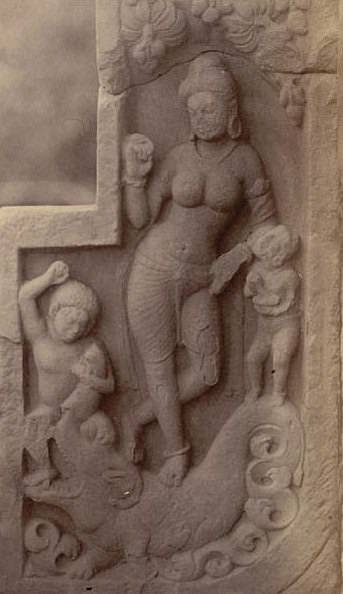 Ganga Fowler&fowler (Public Domain) ](https://www.worldhistory.org/image/3887/ganga/ "Ganga")### Ganga in Art
The goddess is often depicted in Hindu art wearing a white saree and riding a crocodile. Ganga frequently appears in [sculpture](https://www.worldhistory.org/disambiguation/Sculpture/) near temple doors and on decorative relief panels along with her sister river goddess Yamuna. A celebrated representation of Ganga is from a sandstone lintel of a temple at Beshnagar. Dating to c. 500 CE, the goddess stands on a *makara* (a mythological mix of crocodile and elephant) which symbolises the life-giving nature of water.
The descent of the goddess aided by Shiva is another popular scene in art and an outstanding example is the 7th century CE granite relief panel at a cave-shrine at [Mamallapuram](https://www.worldhistory.org/Mahabalipuram/) near Madras. Measuring 24 x 6 metres, the scene shows Ganga descending in the centre surrounded by gods, people, and animals. A cistern positioned above the relief could be filled on special occasions and so water trickled down the sculpture to add some three-dimensional realism to the miracle of the great Ganges arriving on earth.
#### Editorial Review
This human-authored definition has been reviewed by our editorial team before publication to ensure accuracy, reliability and adherence to academic standards in accordance with our [editorial policy](https://www.worldhistory.org/static/editorial-policy/).
## Bibliography
- [Anonymous. *Hindu Myths.* Penguin Classics, 2004.](https://www.worldhistory.org/books/0140449906/)
- [Craven, R.C. *Indian Art.* Thames & Hudson, 1997.](https://www.worldhistory.org/books/0500203024/)
- Dowson, J. *A Classical Dictioary of Himdu Mythology.* D.K.Printworld, 2005
- [Hackin, J. *Asiatic Mythology 1932.* Kessinger Publishing, LLC, 2005.](https://www.worldhistory.org/books/1417976950/)
- [Michell, G. *Hindu Art and Architecture.* Thames & Hudson, 2000.](https://www.worldhistory.org/books/0500203377/)
## About the Author
Mark is WHE’s Publishing Director and has an MA in Political Philosophy (University of York). He is a full-time researcher, writer, historian and editor. Special interests include art, architecture and discovering the ideas that all civilizations share.
## Cite This Work
### APA
Cartwright, M. (2015, May 27). Ganges: The Sacred Hindu River. *World History Encyclopedia*.
### Chicago
Cartwright, Mark. "Ganges: The Sacred Hindu River." *World History Encyclopedia*, May 27, 2015. .
### MLA
Cartwright, Mark. "Ganges: The Sacred Hindu River." *World History Encyclopedia*, 27 May 2015, .
## License & Copyright
Submitted by [Mark Cartwright](https://www.worldhistory.org/user/markzcartwright/ "User Page: Mark Cartwright"), published on 27 May 2015. The copyright holder has published this content under the following license: [Creative Commons Attribution-NonCommercial-ShareAlike](https://creativecommons.org/licenses/by-nc-sa/4.0/deed.en). This license lets others remix, tweak, and build upon this content non-commercially, as long as they credit the author and license their new creations under the identical terms. When republishing on the web a hyperlink back to the original content source URL must be included. Please note that content linked from this page may have different licensing terms.