---
title: Gaia
author: Liana Miate
source: https://www.worldhistory.org/Gaia/
format: machine-readable-alternate
license: Creative Commons Attribution-NonCommercial-ShareAlike (https://creativecommons.org/licenses/by-nc-sa/4.0/)
updated: 2023-04-09
---
# Gaia
_Authored by [Liana Miate](https://www.worldhistory.org/user/lianamiate/)_
Gaia (also Gaea or Ge) is a primordial goddess and the personification of the Earth in [Greek mythology](https://www.worldhistory.org/Greek_Mythology/). Gaia emerged from Chaos and is considered the supreme or mother goddess by [immortals](https://www.worldhistory.org/disambiguation/immortals/) and mortals alike. All gods and goddesses are descended from her through her union with [Uranus](https://www.worldhistory.org/Uranus/) (Heaven) and Pontus (Sea). Her [Roman](https://www.worldhistory.org/disambiguation/Roman/) equivalent is Terra Mater or Tellus Mater.
Gaia was the first overseer at the Oracle of [Delphi](https://www.worldhistory.org/delphi/) and sometimes warned others of prophecies she had received. She helped [Zeus](https://www.worldhistory.org/zeus/) overthrow his father, [Cronus](https://www.worldhistory.org/Cronus/), and defeat the Titans. However, she soon turned against Zeus and sent her monstrous son, [Typhon](https://www.worldhistory.org/Typhon/), after him.
### Mother Goddess
According to [Hesiod](https://www.worldhistory.org/hesiod/) (c. 700 BCE) in his *[Theogony](https://www.worldhistory.org/Theogony/)*, Gaia emerged from Chaos (the great void) and gave birth to Uranus (Heaven), Ourea (Mountains), and Pontus (Sea). She married her son Uranus, and together they had the 12 Titans ([Oceanus](https://www.worldhistory.org/Oceanus/), Coeus, Crius, Hyperion, Iapetus, Theia, [Rhea](https://www.worldhistory.org/Rhea/), [Themis](https://www.worldhistory.org/Themis/), Mnemosyne, Phoebe, Tethys, and Cronus). Gaia also bore the three one-eyed Cyclopes (Brontes, Arges, and Steropes) and the three Hecatoncheires, the hundred-handed and fifty-headed [Giants](https://www.worldhistory.org/Giants/) (Kottos, Gyes, and Briareus).
With Pontus, Gaia gave birth to the sea gods and goddesses Thaumas, Phorcys, Ceto, and Eurybia. All the notable gods and goddesses are descended from Gaia, and she is viewed as a mother or supreme goddess.
### The Creation of the World & Orphism
The 6th century BCE saw the rise of Orphism, a religious movement based on what the legendary [Greek](https://www.worldhistory.org/disambiguation/greek/) hero [Orpheus](https://www.worldhistory.org/Orpheus/) learnt while he was in the underworld. According to Orphism, the Earth began with Chronos (Time). From Chronos came Aether (Radiance), Chaos, and Erebus (Darkness). Chronos formed an egg inside Aether, from which hatched Phanes – the creator of all that exists. Phanes gave birth to [Nyx](https://www.worldhistory.org/Nyx/) (Night) and then had Gaia and Uranus with her.
### Gaia & Cronus
Uranus hated his children and hid them away out of sight in the depths of the earth. Gaia was heartbroken over how her children were being treated by their father and devised a plan to destroy him.
> And then she thought of a clever, evil plan.
> Quickly she made grey adamant, and formed
> A mighty sickle, and addressed her sons,
> Urging them on, with sorrow in her heart,
> 'My sons, whose father is a reckless fool,
> If you will do as I ask, we shall repay
> Your father's wicked crime. For it was he
> Who first began devising shameful acts.
> (Hesiod, *Theogony*, 157-164).
Only Cronus, her youngest son, was brave enough to step up and agree to help his mother carry out her plan. Cronus hid in his mother's chambers and waited for his father to appear. Before too long, a lustful Uranus arrived in Gaia's chambers, wanting to lay with her. Cronus waited for the right moment and then swung the sickle, severing Uranus' genitals. As he threw the genitals into the sea, the blood fell on Gaia, and she gave birth to the [Furies](https://www.worldhistory.org/Furies/) (Alecto, Tisiphone, and Megaera), the Giants, and the Meliae (tree nymphs).
[ 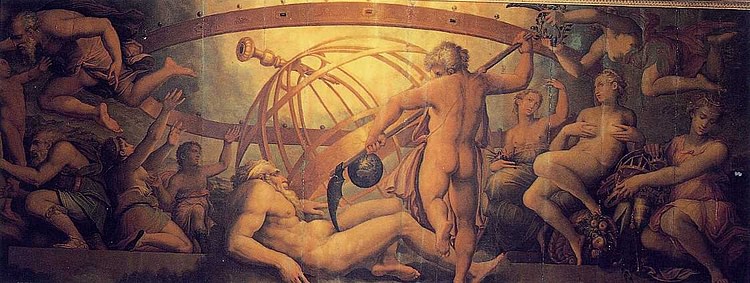 The Mutilation of Uranus by Saturn (Cronus) Giorgio Vasari (Public Domain) ](https://www.worldhistory.org/image/16552/the-mutilation-of-uranus-by-saturn-cronus/ "The Mutilation of Uranus by Saturn (Cronus)")Cronus married his sister Rhea, and Gaia and Uranus warned him that he, too, would be overthrown by his son. Therefore, Cronus swallowed each baby as it was born. A pregnant Rhea approached Gaia for help, and Gaia helped her escape to [Crete](https://www.worldhistory.org/crete/), where she gave birth to Zeus. Zeus and his siblings faced Cronus and the rest of the Titans in the Titanomachy. During the tenth year of the [battle](https://www.worldhistory.org/disambiguation/battle/), Gaia gave council to Zeus and told him to free the Hecatoncheires and the Cyclopes from [Tartarus](https://www.worldhistory.org/Tartarus/) in order to defeat the Titans. They had been imprisoned by Uranus, who had feared their power.
### The Revolt of the Giants
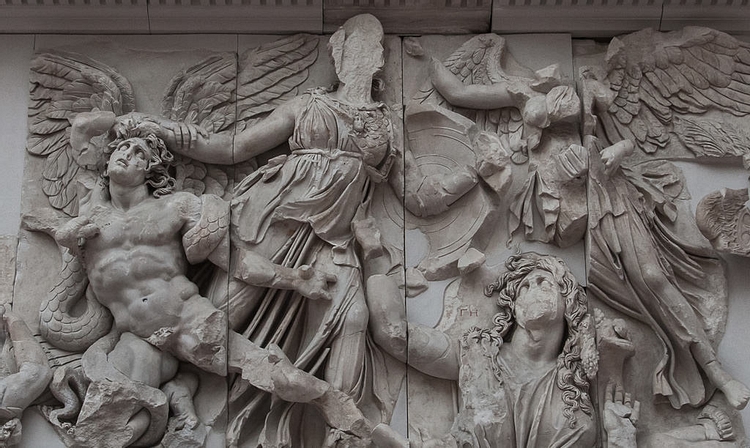
After the Titans were defeated and sent down to Tartarus by Zeus and the Olympian deities, Gaia sent her children, the Giants, to destroy the Olympians. The Giants were unmatched in size and strength and fearful to behold, with feet made from dragon scales and long hair hanging from their head and cheeks.
An oracle told the Olympian gods that they could not defeat the Giants on their own but needed the help of a mortal who would be made invulnerable by a magic herb. Once Gaia learned of this prophecy, she searched for the herb. However, Zeus prevented her from finding the herb and instead ordered [Eos](https://www.worldhistory.org/Eos/) (Dawn), [Selene](https://www.worldhistory.org/Selene/) (Moon), and [Helios](https://www.worldhistory.org/Helios/) (Sun) not to shine so that he could pick the herb himself.
The gods destroyed the Giants with help from [Hercules](https://www.worldhistory.org/hercules/), as prophecised. In revenge, Gaia lay with Tartarus and bore her youngest child, Typhon, the biggest monster ever born. Typhon later fought Zeus and was defeated by him after he was buried under Mount Etna.
[  Athena Killing a Giant Mina Bulic (CC BY-NC-ND) ](https://www.worldhistory.org/image/3614/athena-killing-a-giant/ "Athena Killing a Giant")### Oracle
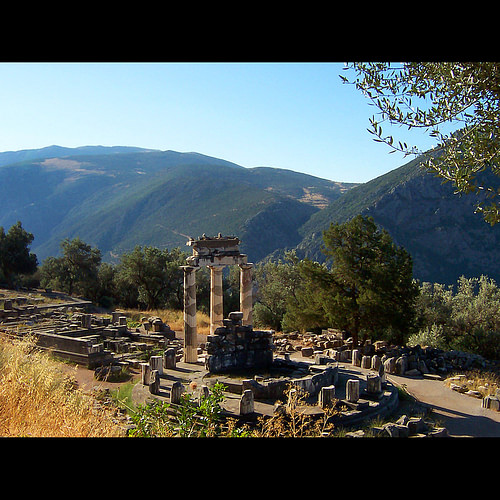
The Oracle at Delphi originally belonged to Gaia, who later handed over the rights to her daughters Themis and Phoebe, and then later on to the [god](https://www.worldhistory.org/God/) [Apollo](https://www.worldhistory.org/apollo/), who built himself a shrine. As mentioned in [Pausanias](https://www.worldhistory.org/disambiguation/Pausanias/)' (c. 115 to c. 180 CE) *Description of [Greece](https://www.worldhistory.org/greece/)*, Gaia appointed the mountain [nymph](https://www.worldhistory.org/nymph/) Daphnis as the prophetess. According to the ancient poem *Eumolpia*, Gaia and [Poseidon](https://www.worldhistory.org/poseidon/) shared the oracle until Gaia gave her share to Themis. Apollo later got Themis' share as a gift and gave Poseidon an island off Troizen in exchange for it.
Other sources say that Apollo stole the oracle from Gaia after killing Python, the serpent who guarded the Delphic Oracle. After giving up Delphi, Gaia was still consulted as an oracle at Aegeira in Achaea, where her priestess drank bull's blood – something that was poisonous to other mortals.
Just as Gaia foretold that Cronus would be overthrown by his son, she also prophecised that Zeus and his wife Metis would have a daughter who would be strong and wise like her father and a son who would become king of the gods in Zeus' place. Zeus swallowed Metis to prevent this prophecy from coming true. However, Metis was already pregnant with their daughter, who would be born from Zeus' head – the goddess of wisdom, [Athena](https://www.worldhistory.org/athena/).
[  Sanctuary of Apollo in Delphi Marcel Germain (CC BY-NC-ND) ](https://www.worldhistory.org/image/324/sanctuary-of-apollo-in-delphi/ "Sanctuary of Apollo in Delphi")When Gaia's grandchildren, Zeus and [Hera](https://www.worldhistory.org/Hera/), got married on the beautiful island of the [Hesperides](https://www.worldhistory.org/Hesperides/), Gaia gave them a gift of golden apples, which grew on a magical tree and granted immortality to anyone who was in possession of them.
### Gaia & Apollo
Gaia complained to Zeus after Apollo had killed the monstrous serpent Python at Delphi. As a result, Zeus ordered Apollo to visit Tempe for purification and to preside over the Pythian Games, which were to be held in Python's honour.
According to some writers such as Hyginus (64 BCE to 17 CE) and Nonnus of Panopolis (5th century CE), after Apollo pursued the mountain nymph, Daphne, a priestess of Mother Earth, she cried out for help. Gaia transformed her into a laurel tree to save her. Apollo never forgave Gaia for this.
### Birth of Erichthonius
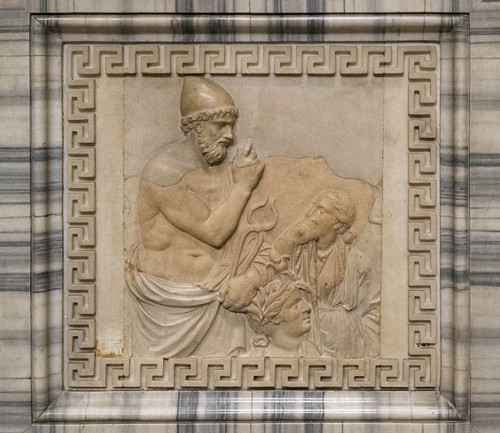
Athena had many potential suitors who would have done anything to be with her. However, she rejected all advances. During the [Trojan War](https://www.worldhistory.org/Trojan_War/), she asked [Hephaestus](https://www.worldhistory.org/Hephaistos/), the god of metallurgy, to make her a suit of armour. While she watched him work in his smithy, an unusually bold Hephaestus made his move on Athena after being tricked by Poseidon. Athena pushed him away, but not before Hephestus ejaculated against her thigh. Disgusted, Athena wiped it off with a piece of wool that she threw onto the ground.
As soon as it fell on the ground, it accidentally impregnated Mother Earth. Gaia did not wish to bear the child that Hephaestus had intended to have with Athena and declared that she would not raise the child. Athena accepted responsibility for the boy and named him Erichthonius.
[  Hephaestus/Vulcan at the Birth of Erichthonius Egisto Sani (CC BY-NC-SA) ](https://www.worldhistory.org/image/12709/hephaestusvulcan-at-the-birth-of-erichthonius/ "Hephaestus/Vulcan at the Birth of Erichthonius")### Worship & Legacy
Gaia has an Orphic Hymn dedicated to her, where she is referred to as the "mother of men" and the nourisher and giver of all. She is eternal and revered, and the fruit, flowers, grass, rain, and stars are all created by her. In the Homeric Hymn to Gaia, she is called "the mother of all."
> Gaia, mother of all,
> I shall sing,
> the strong foundation, the oldest one.
> She feeds everything in the world.
> Whoever walks upon her scared ground
> or moves through the sea
> or flies in the air, it is she
> who nourishes them from her treasure-store.
> Queen of Earth, through you
> beautiful children,
> beautiful harvests,
> come.
> It is you who give life to mortals
> and who take life away.
> Blessed is the one you honour with a willing heart.
> He who has this has everything.
> (*The Homeric Hymns*: *Hymn to Gaia, Mother of All,* 30.1-10)
In his *Description of Greece*, Pausanias states that there was sacred ground dedicated to Gaia in [Athens](https://www.worldhistory.org/Athens/) near a [bronze](https://www.worldhistory.org/disambiguation/bronze/) statue of Zeus and a [temple](https://www.worldhistory.org/temple/) dedicated to Cronos and Rhea. Phlya in Attica had an altar dedicated to Gaia, who was referred to as the 'Great goddess' by the Phlyans. In Pátrai (Patras), there was a seated statue of Gaia, which was located near shrines to Apollo and [Aphrodite](https://www.worldhistory.org/Aphrodite/) and a sanctuary to [Demeter](https://www.worldhistory.org/demeter/). In Aigai (Vergina), there was a sanctuary dedicated to Broad-Breasted Earth in Gaios, which had one of the oldest wooden idols. The priestess of this sanctuary had to be chaste and drink bull's blood to determine whether they were being truthful.
An altar to Gaia could be found In [Tegea](https://www.worldhistory.org/Tegea/) (Arcadia) beside the sanctuary to Eileithuia. In [Olympia](https://www.worldhistory.org/Olympia/), another altar to Gaia was located. It was made of ash and was originally the site of an oracle of Earth. In [Sparta](https://www.worldhistory.org/sparta/), sanctuaries dedicated to Gaia could be found in Laconia (one of them was called Gasepton).
[ 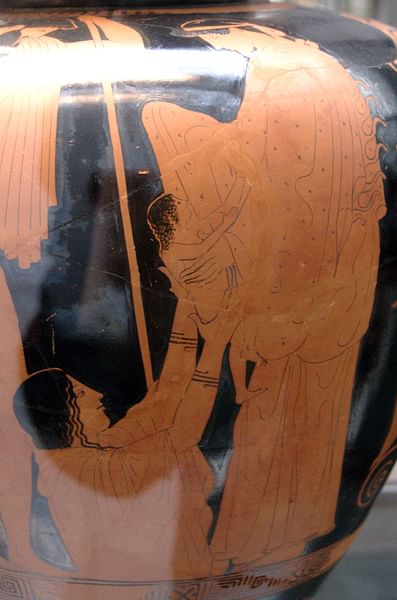 Gaia & Erichthonius Bibi Saint-Pol (CC BY-NC-SA) ](https://www.worldhistory.org/image/6234/gaia--erichthonius/ "Gaia & Erichthonius")In the present day, Gaia is the popular video-streaming site with the most extensive collection of consciousness-expanding and health-related videos online. Gaia is also the name of the European Space Agency's star surveyor, which creates a 3D map of the millions of stars found throughout the Milky Way galaxy and beyond.
### The Gaia Hypothesis
The Gaia Hypothesis is a recent thought model that was partly invented by the British scientist James Lovelock (1919-2022). It proposes that the Earth functions as a single organism that helps all living things survive. All living beings act as a single harmonious entity to regulate Earth's climate, food sources, vegetation, and chemical composition.
If one part of this harmonious unit does not do its share, then the chain is broken, and Earth and its inhabitants will suffer the consequences. The Gaia Hypothesis promotes the understanding of the complex yet interconnected systems that make up the Earth.
#### Editorial Review
This human-authored definition has been reviewed by our editorial team before publication to ensure accuracy, reliability and adherence to academic standards in accordance with our [editorial policy](https://www.worldhistory.org/static/editorial-policy/).
## Bibliography
- [Apollodorus & Hard, Robin. *The Library of Greek Mythology .* Oxford University Press, 2008.](https://www.worldhistory.org/books/0199536325/)
- [Athanassakis, Apostolos N. & Wolkow, Benjamin M. *The Orphic Hymns.* Johns Hopkins University Press, 2013.](https://www.worldhistory.org/books/1421408821/)
- [de-Gaia, Susan. *Encyclopedia of Women in World Religions \[2 volumes\].* ABC-CLIO, 2018.](https://www.worldhistory.org/books/1440848491/)
- [ESA - Gaia](https://www.esa.int/Science_Exploration/Space_Science/Gaia "ESA - Gaia"), accessed 11 Mar 2023.
- [Gaia - Conscious Media, Streaming Yoga Videos & More](https://www.gaia.com/ "Gaia - Conscious Media, Streaming Yoga Videos & More"), accessed 11 Mar 2023.
- [Graves, Robert. *The Greek Myths\[May 15, 2018\] Graves, Robert.* Viking, 2018.](https://www.worldhistory.org/books/0241982359/)
- [Hesiod & Theognis & Wender, Dorothea & Wender, Dorothea. *Hesiod and Theognis .* Penguin Classics, 1976.](https://www.worldhistory.org/books/0140442839/)
- [Homer & Richardson, Nicholas & Cashford, Jules & Richardson, Nicholas. *Homeric Hymns .* Penguin Classics, 2003.](https://www.worldhistory.org/books/0140437827/)
- [Leeming, David. *Oxford Companion to World Mythology.* Oxford University Press, 2009.](https://www.worldhistory.org/books/0195387082/)
- [Pausanias & Newberry, John & Levi, Peter & Levi, Peter. *Guide to Greece, Vol. 2.* Penguin Classics, 1984.](https://www.worldhistory.org/books/014044226X/)
- [Pausanias & Peter Levi. *Guide to Greece, Vol. 1.* Penguin Classics, 1984.](https://www.worldhistory.org/books/0140442251/)
- [Rubenstein, Elissa. *The Gaia Hypothesis/ Natural Planet.* Balboa Press, 2019.](https://www.worldhistory.org/books/B07SW2F5RN/)
## About the Author
Liana is the Social Media Editor for Ancient History Encyclopedia. She holds a Bachelor of Arts Degree with a major in ancient Greece, Rome & Late Antiquity. She is particularly passionate about Rome and Greece, and anything to do with mythology or wo
- [Linkedin Profile](https://www.linkedin.com/in/lian)
## Questions & Answers
### What does Gaia mean?
Gaia refers to the personification of the Earth in Greek mythology or the Gaia Hypothesis, which believes every living entity works together in harmony for the Earth's survival.
### Is Gaia the first god?
Technically, the first god was Chaos (the great void). Gaia is considered the mother and supreme goddess as she was the first immortal to emerge from Chaos, and all gods are descended from her.
### What does Gaia mean spiritually?
Spiritually, Gaia is the meaning and source of all life. She is a mother goddess.
### Who is Gaia in Greek mythology?
In Greek mythology, Gaia is the personification of the Earth and a supreme and mother goddess. All gods and humans descend from her.
## Cite This Work
### APA
Miate, L. (2023, March 16). Gaia. *World History Encyclopedia*.
### Chicago
Miate, Liana. "Gaia." *World History Encyclopedia*, March 16, 2023. .
### MLA
Miate, Liana. "Gaia." *World History Encyclopedia*, 16 Mar 2023, .
## License & Copyright
Submitted by [Liana Miate](https://www.worldhistory.org/user/lianamiate/ "User Page: Liana Miate"), published on 16 March 2023. The copyright holder has published this content under the following license: [Creative Commons Attribution-NonCommercial-ShareAlike](https://creativecommons.org/licenses/by-nc-sa/4.0/deed.en). This license lets others remix, tweak, and build upon this content non-commercially, as long as they credit the author and license their new creations under the identical terms. When republishing on the web a hyperlink back to the original content source URL must be included. Please note that content linked from this page may have different licensing terms.