---
title: Fates
author: Liana Miate
source: https://www.worldhistory.org/Fates/
format: machine-readable-alternate
license: Creative Commons Attribution-NonCommercial-ShareAlike (https://creativecommons.org/licenses/by-nc-sa/4.0/)
updated: 2023-01-23
---
# Fates
_Authored by [Liana Miate](https://www.worldhistory.org/user/lianamiate/)_
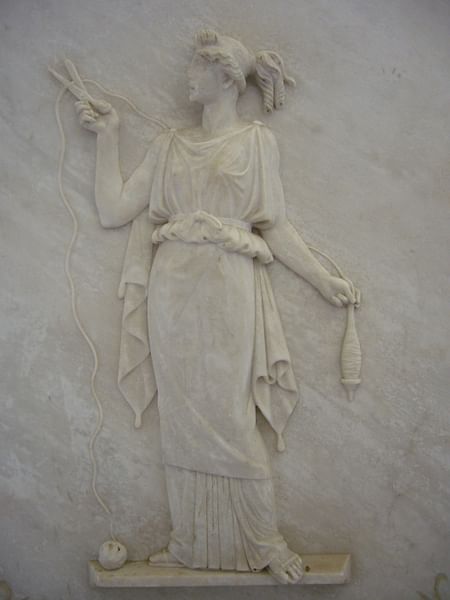
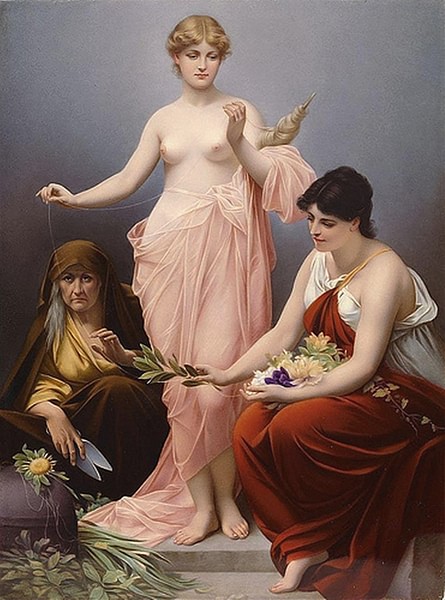
The Fates (also known as the Moirai in [Greek mythology](https://www.worldhistory.org/Greek_Mythology/)) are three sister goddesses responsible for assigning destinies to mortals at their birth, a human's lifespan, and the timing of their [death](https://www.worldhistory.org/disambiguation/Death/). The golden thread they spin represents each individual's fate, and when the thread is broken, it signifies the end of a human's life.
The Fates were said to be the daughters of either [Nyx](https://www.worldhistory.org/Nyx/) (the Night) or of [Zeus](https://www.worldhistory.org/zeus/) and [Themis](https://www.worldhistory.org/Themis/) ([Law](https://www.worldhistory.org/disambiguation/law/) and Justice). There were three Fates: Clotho (the Spinner), Lachesis (the Measurer/Apportioner), and Atropos (the Unbending/Inflexible one). The [Roman](https://www.worldhistory.org/disambiguation/Roman/) equivalent of the Fates are the *Parcae*.
### The Fates
As the daughters of the Night, the Fates ruled the dark destinies of humankind. A golden thread represented each person's life and destiny that the Fates spun on their spinning wheel. Once a person's life ended, the sisters cut the thread. Clotho spun the thread, Lachesis (the allotter of time) measured it, and Atropos cut it when it was time for someone to die. The gods themselves dared not to interfere with the Fates once they had decided a person's fate, meaning that they were unable to save their mortal children's lives or the lives of their favourite mortals.
The Three Fates developed from one singular *Moira* (Fate or Destiny), who was mentioned in [Homer](https://www.worldhistory.org/homer/)'s (c. 750 BCE) *[Iliad](https://www.worldhistory.org/iliad/)* as spinning the thread for Hector, prince of [Troy](https://www.worldhistory.org/troy/). Although the Fates are not featured prominently in any myth, they play a small yet crucial role in various stories. They interacted with multiple gods, including [Hermes](https://www.worldhistory.org/Hermes/), who was said to have assisted the Fates in creating the [alphabet](https://www.worldhistory.org/alphabet/). They were also present at the birth of various gods and mortals. They only took action in myths when they needed to intervene with a person's fate.
In art, the Fates were originally portrayed as attractive [women](https://www.worldhistory.org/disambiguation/women/). However, in later forms of art, they started to be shown as older women with a serious demeanour and holding a spindle or the dice of fate, or sometimes [writing](https://www.worldhistory.org/writing/) down the fate of humans. In [literature](https://www.worldhistory.org/literature/), they tended to be depicted as older women.
[  Atropos, One of the Fates Tom Oates (CC BY-SA) ](https://www.worldhistory.org/image/6233/atropos-one-of-the-fates/ "Atropos, One of the Fates")### Birth & Family
Depending on the source, the Fates are either the daughters of Nyx (Night) or Zeus and Themis (Law and Justice). [Hesiod](https://www.worldhistory.org/hesiod/) (c. 700 BCE) lists the Fates as Nyx's fatherless daughters in his *[Theogony](https://www.worldhistory.org/Theogony/):*
> She bore the Destinies and ruthless Fates,
> Goddesses who track down the sins of men
> And gods, and never cease from awful rage
> Until they give the sinner punishment.
> (219-222)
As daughters of Nyx, the Fates were sisters of the dark forces of the world, including Blame, Sad Distress, Nemesis and Strife. Later in the *Theogony,* the Fates were mentioned as the daughters of Zeus and Themis.
> And shining Themis was second wife.
> She bore the [Horae](https://www.worldhistory.org/Horae/): Order, blooming Peace,
> And Justice, who attend the works if men,
> And then the Fates, to whom wise Zeus has paid
> The greatest honour: Clotho, Atropos,
> Lachesis, who give men all good and bad.
> (902-907)
It is believed that the Fates being a daughter of Zeus and Themis, was written after Hesiod's time, possibly added by an unknown writer to provide a translation to Hesiod's *Catalogue of Women.*
Although Zeus claimed to be their father and called himself 'the Leader of the Fates', some ancient writers did not take his claim seriously, including [Herodotus](https://www.worldhistory.org/herodotus/) (c. 484-425/413 BCE) and [Plato](https://www.worldhistory.org/plato/) (c. 428/427-348/347 BCE).
### The Revolt of the [Giants](https://www.worldhistory.org/Giants/) & [Typhon](https://www.worldhistory.org/Typhon/)
[Gaia](https://www.worldhistory.org/Gaia/) (Earth) was so angered by the victory of the Titans in the Titanomachy that she gave birth to the Giants with [Uranus](https://www.worldhistory.org/Uranus/) (Heaven). They were fearsome beings with hair falling from their head and cheeks and feet made from dragons' scales. An oracle stated that the gods could not kill the Giants; however, if the gods fought along a mortal ally, they would be able to be killed. So the great [Greek](https://www.worldhistory.org/disambiguation/greek/) hero, [Hercules](https://www.worldhistory.org/hercules/), joined the fight alongside the gods.
[  The Fates Gathering in the Stars Wikimedia Commons (Public Domain) ](https://www.worldhistory.org/image/2877/the-fates-gathering-in-the-stars/ "The Fates Gathering in the Stars")Even the Fates joined the [battle](https://www.worldhistory.org/disambiguation/battle/), fighting with [bronze](https://www.worldhistory.org/disambiguation/bronze/) clubs and killing the Giants Agrios and Thoon. The rest of the Giants were killed by Zeus. After the Giants were destroyed, Gaia conceived Typhon, a half-man, half-beast, in an act of vengeance. He surpassed all the other children of Gaia in size. He unleashed a vicious attack on the heavens, causing the gods to flee to [Egypt](https://www.worldhistory.org/egypt/), where they transformed into animals to hide from him. Zeus attacked Typhon with his thunderbolts from afar and engaged him in hand-to-hand combat once he had been weakened. Typhon managed to trap Zeus in his coils and cut his tendons from his hands and feet, which he hid in a bear's skin.
[ YouTube Follow us on YouTube!](https://link.worldhistory.org/youtube_intext)
Hermes returned the tendons to Zeus and, after getting his strength back, he pursued Typhon to Mount Nysa, where the Fates tricked him into eating poisonous fruit, claiming that it would make him stronger. While escaping across the Sicilian sea, a weakened Typhon was finally killed after Zeus hurled Mount Etna at him.
### The Fates & [Meleager](https://www.worldhistory.org/Meleager/)
Meleager was a Greek hero and the son of Oineus, the king of Calydon and his wife Althaia, the daughter of Thestios, a king of [Anatolia](https://www.worldhistory.org/Asia_Minor/) ([Asia Minor](https://www.worldhistory.org/Asia_Minor/)). When Meleager was seven days old, the Fates appeared and declared that Meleager would die when the log that was burning in the hearth had stopped burning. Full of despair, Althaia grabbed the log from the fire and hid it away in a chest in a desperate attempt to prevent his death.
Meleager grew into a strong man but made a fatal mistake when he forgot to honour [Artemis](https://www.worldhistory.org/artemis/) during the annual harvest. A furious Artemis sent a large and ferocious boar that caused havoc. A hunt was organised to kill the beast, with the bravest men in [Greece](https://www.worldhistory.org/greece/) taking part, including Meleager. [Atalanta](https://www.worldhistory.org/Atalanta/), the Greek heroine, also took part in the hunt and was the first to strike the boar, with Meleager landing the killing blow. He gave the skin of the boar to Atalanta, which caused an uproar amongst the sons of King Thestios, who believed that the prize should have gone to a man. Furious, Meleager killed the sons of Thestios, angering his mother, who mourned the loss of her brothers. In her distress, she removed the log from the chest and rekindled it, resulting in Meleager's death, just as the Fates proclaimed.
[  Statue of Meleager Mark Cartwright (CC BY-NC-SA) ](https://www.worldhistory.org/image/9780/statue-of-meleager/ "Statue of Meleager")### The Fates & Admetus
Admetus, king of Pherae, wished to marry [Alcestis](https://www.worldhistory.org/Alcestis/), the most beautiful daughter of King Pelias of Iolcus. However, first, he would need to pass a test – to yoke a wild boar and lion to a [chariot](https://www.worldhistory.org/chariot/) and drive them around a race course. So Admetus enlisted the help of his friend [Apollo](https://www.worldhistory.org/apollo/), who Zeus had appointed his herdsman.
Victorious, Admetus made the foolish mistake of forgetting to make the customary sacrifice to Artemis before he married Alcestis. As a result, the goddess punished him by filling his marriage bed with snakes. Apollo intervened and made a deal with Artemis; that on the day of Admetus' death, he would be spared if a family member died instead of him.
The day of Admetus' death came when Hermes summoned him to [Tartarus](https://www.worldhistory.org/Tartarus/) (the deepest part of the Underworld). Apollo delayed his death by getting the Fates drunk and persuaded them to let somebody else die in his place.
### The Fates & the Birth of Hercules
The Fates were present when Alcmene was in labour with Hercules, along with [Eileithyia](https://www.worldhistory.org/Eileithyia/), the goddess of childbirth, and Galinthias, a childhood friend of Alcmene. The Fates and Eileithya were doing their best to stop Alcmene from giving birth to appease [Hera](https://www.worldhistory.org/Hera/). Galinthias, seeing how much pain her friend was in, lied to the goddesses and told them that a male child had been born to Zeus and their divine privileges had been revoked.
[  The Three Fates Paul Thumann (Public Domain) ](https://www.worldhistory.org/image/16814/the-three-fates/ "The Three Fates")The Fates panicked and stopped Alcemene's pain, allowing Hercules to be born. But, like all deities, the Fates did not take kindly to being tricked and took away Galinthias' identity as a woman and transformed her into a weasel who undertook grotesque sexual and reproductive activities.
### Worship & Legacy
According to [Pausanias](https://www.worldhistory.org/disambiguation/Pausanias/) (c. 115 to c. 180 CE), the Fates had an altar in the grove of [the Eumenides](https://www.worldhistory.org/The_Eumenides/) at Sicycon ([Corinth](https://www.worldhistory.org/corinth/)), where they received offerings. He also mentioned a sanctuary in [Thebes](https://www.worldhistory.org/disambiguation/Thebes/) that was located between the sanctuaries of Themis and Zeus Agoraios and was most likely in the open air since he talks about there being no statues or reliefs present. There may have been a [temple](https://www.worldhistory.org/temple/) where the Fates, [Demeter](https://www.worldhistory.org/demeter/), and [Persephone](https://www.worldhistory.org/persephone/) were worshipped together or three separate temples dedicated to each, located in the same area. During the annual festival, pregnant sheep were sacrificed, honey and water libations were poured, and flowers were worn instead of myrtle wreaths in honour of the Fates and other goddesses.
The three Fates lend their names to three separate asteroids: 97 Klotho, 120 Lachesis, 273 Atropos, which are all located in the central asteroid belt and orbit between [Mars](https://www.worldhistory.org/Mars/) and [Jupiter](https://www.worldhistory.org/jupiter/).
#### Editorial Review
This human-authored definition has been reviewed by our editorial team before publication to ensure accuracy, reliability and adherence to academic standards in accordance with our [editorial policy](https://www.worldhistory.org/static/editorial-policy/).
## Bibliography
- [Apollodorus & Hard, Robin. *The Library of Greek Mythology .* Oxford University Press, 2008.](https://www.worldhistory.org/books/0199536325/)
- [Asteroid Klotho | Space Reference](https://www.spacereference.org/asteroid/97-klotho-a868-db "Asteroid Klotho | Space Reference"), accessed 9 Dec 2022.
- [Asteroid Lachesis | Space Reference](https://www.spacereference.org/asteroid/120-lachesis-a872-gb "Asteroid Lachesis | Space Reference"), accessed 9 Dec 2022.
- [Bettini, Maurizio & Eisenach, Emlyn. *Women and Weasels.* University of Chicago Press, 2013.](https://www.worldhistory.org/books/0226044742/)
- [Bookidis, Nancy. *The Sanctuary of Demeter and Kore.* American School of Classical Studies at Athens, 2010.](https://www.worldhistory.org/books/0876611854/)
- [Graves, Robert. *The Greek Myths\[May 15, 2018\] Graves, Robert.* Viking, 2018.](https://www.worldhistory.org/books/0241982359/)
- [Hard, Robin. *The Routledge Handbook of Greek Mythology’s A Handbook of Greek Mythology.* Routledge, 2022.](https://www.worldhistory.org/books/1032337443/)
- [Hesiod & West, M. L. *Theogony and Works and Days .* Oxford University Press, 2009.](https://www.worldhistory.org/books/019953831X/)
- [Neumann, Erich & Manheim, Ralph & Liebscher, Martin. *The Great Mother.* Princeton University Press, 2015.](https://www.worldhistory.org/books/0691166072/)
- [Petiscus, A.H. *The Gods of Olympos, or Mythology of the Greeks and Romans.* HardPress Publishing, 2012.](https://www.worldhistory.org/books/1290853770/)
- [Rose, H. J. *A Handbook Of Greek Mythology, Including Its Extension To Rome.* Kessinger Publishing, LLC, 2010.](https://www.worldhistory.org/books/1162977388/)
- [Symeonoglou, Sarantis. *The Topography of Thebes from the Bronze Age to Modern Times .* Princeton University Press, 2016.](https://www.worldhistory.org/books/0691639442/)
- [Woodard, Roger D. *The Cambridge Companion to Greek Mythology .* Cambridge University Press, 2008.](https://www.worldhistory.org/books/0521607264/)
## About the Author
Liana is the Social Media Editor for Ancient History Encyclopedia. She holds a Bachelor of Arts Degree with a major in ancient Greece, Rome & Late Antiquity. She is particularly passionate about Rome and Greece, and anything to do with mythology or wo
- [Linkedin Profile](https://www.linkedin.com/in/lian)
## Cite This Work
### APA
Miate, L. (2022, December 16). Fates. *World History Encyclopedia*.
### Chicago
Miate, Liana. "Fates." *World History Encyclopedia*, December 16, 2022. .
### MLA
Miate, Liana. "Fates." *World History Encyclopedia*, 16 Dec 2022, .
## License & Copyright
Submitted by [Liana Miate](https://www.worldhistory.org/user/lianamiate/ "User Page: Liana Miate"), published on 16 December 2022. The copyright holder has published this content under the following license: [Creative Commons Attribution-NonCommercial-ShareAlike](https://creativecommons.org/licenses/by-nc-sa/4.0/deed.en). This license lets others remix, tweak, and build upon this content non-commercially, as long as they credit the author and license their new creations under the identical terms. When republishing on the web a hyperlink back to the original content source URL must be included. Please note that content linked from this page may have different licensing terms.