---
title: Fasces
author: Mark Cartwright
source: https://www.worldhistory.org/Fasces/
format: machine-readable-alternate
license: Creative Commons Attribution-NonCommercial-ShareAlike (https://creativecommons.org/licenses/by-nc-sa/4.0/)
updated: 1970-01-01
---
# Fasces
_Authored by [Mark Cartwright](https://www.worldhistory.org/user/markzcartwright/)_
The *fasces* were a bundle of rods and a single axe which were carried as a symbol of magisterial and priestly authority in ancient [Rome](https://www.worldhistory.org/Rome/). They featured prominently in important administrative ceremonies and public processions such as triumphs. The symbol was adopted by later cultures to represent order and strength through unity, notably the fascist movement in [Italy](https://www.worldhistory.org/italy/) in the 20th century CE. The *fasces* are still visible today in many official contexts as a symbol of Republican principles, for example, in the United States' House of Representatives and on the cover of passports of French nationals.
### Evolution & Form
The symbol of the *fasces* was probably borrowed by the Romans from the [Etruscan](https://www.worldhistory.org/Etruscan_Civilization/) kings, as evidenced by the excavation of a miniature iron version from a 7th-century BCE Etruscan [tomb](https://www.worldhistory.org/tomb/) at [Vetulonia](https://www.worldhistory.org/Vetulonia/). The [Roman](https://www.worldhistory.org/disambiguation/Roman/) *fasces* were composed of a bundle of rods (*vergae*) which were made from either birch or elm wood. Rounded or rectangular in form the rods were typically 1.5 metres (5 ft.) in length. The rods were bound together with a single-headed axe and a slightly longer central staff using red leather straps. The axe was not only ceremonial but was used in the early Republic to execute those sentenced to [death](https://www.worldhistory.org/disambiguation/Death/). For this reason, when the axe was removed from the bundle it was to signify that a citizen could launch an appeal (*provocatio*) against a death penalty decision.
### Fasces & Magistrates
*Fasces* were typically carried over the left shoulder of magisterial attendants known as lictors (*lictores*) as symbols of judicial authority. During official duty magistrates would be preceded by the lictors and the *fasces* which indicated to the public that a magistrate was coming and remind them of his authority to arrest or summon any person he saw fit. If one magistrate met another, the lictors of the less senior would lower their *fasces* in recognition of the greater standing of the other magistrate. When a magistrate died, he had the right to have a *fasces* representation on his tomb. Conversely, if a magistrate committed any wrong-doing, not only was he obliged to resign but his *fasces* were ceremoniously broken to symbolise his disgrace and loss of authority.
### Widening the Function of Fasces
During the Republic consuls (chief magistrate), and later proconsuls, also had their personal lictors bearing the *fasces*. Then only when the [consul](https://www.worldhistory.org/Consul/) was outside Rome did the *fasces* have the axe element as this came to signify military authority. During the [triumph](https://www.worldhistory.org/Roman_Triumph/) of a [Roman military](https://www.worldhistory.org/Roman_Army/) commander the *fasces* were carried by lictors in the procession and decorated with laurel leaves. The emperor also decorated his *fasces* in the same way. At the other end of the scale, municipal magistrates may have had, according to [Cicero](https://www.worldhistory.org/Cicero/), a lesser version, the *bacilli*, which had only two rods and no axe.
[ 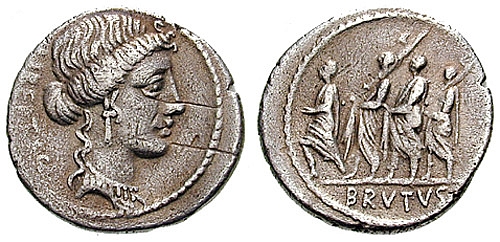 Roman Coin Depicting Lictors Carrying Fasces Carlomorino (CC BY-SA) ](https://www.worldhistory.org/image/5044/roman-coin-depicting-lictors-carrying-fasces/ "Roman Coin Depicting Lictors Carrying Fasces")Over time the use of lictors and *fasces* further widened to represent the authority of other officials and religious posts such as praetors (one step down from consuls), propraetors, the wife of the emperor in her role as imperial cult priestess, and the [Vestal Virgins](https://www.worldhistory.org/Vestal_Virgin/). A ranking system developed where the more senior positons had the right to bear a greater number of *fasces*. In the Republic *magistri equitum* (cavalry commanders) and praetors had six, proconsuls and consuls had 12, and dictators had 24. In the Principate, senatorial governors had a number indicating their experience, imperial legates (senators who were also military commanders) had five, and emperors had 12, with [Augustus](https://www.worldhistory.org/augustus/) perhaps having 24 *fasces* whenever he was outside Rome.
#### Editorial Review
This human-authored definition has been reviewed by our editorial team before publication to ensure accuracy, reliability and adherence to academic standards in accordance with our [editorial policy](https://www.worldhistory.org/static/editorial-policy/).
## Bibliography
- Bagnall, R. et al. *The Encyclopedia of Ancient History.* Wiley-Blackwell, 2012
- [Hornblower, S. *The Oxford Classical Dictionary.* Oxford University Press, 2012.](https://www.worldhistory.org/books/0199545561/)
## About the Author
Mark is WHE’s Publishing Director and has an MA in Political Philosophy (University of York). He is a full-time researcher, writer, historian and editor. Special interests include art, architecture and discovering the ideas that all civilizations share.
## Cite This Work
### APA
Cartwright, M. (2016, May 08). Fasces. *World History Encyclopedia*.
### Chicago
Cartwright, Mark. "Fasces." *World History Encyclopedia*, May 08, 2016. .
### MLA
Cartwright, Mark. "Fasces." *World History Encyclopedia*, 08 May 2016, .
## License & Copyright
Submitted by [Mark Cartwright](https://www.worldhistory.org/user/markzcartwright/ "User Page: Mark Cartwright"), published on 08 May 2016. The copyright holder has published this content under the following license: [Creative Commons Attribution-NonCommercial-ShareAlike](https://creativecommons.org/licenses/by-nc-sa/4.0/deed.en). This license lets others remix, tweak, and build upon this content non-commercially, as long as they credit the author and license their new creations under the identical terms. When republishing on the web a hyperlink back to the original content source URL must be included. Please note that content linked from this page may have different licensing terms.