---
title: Faras
author: Joshua J. Mark
source: https://www.worldhistory.org/Faras/
format: machine-readable-alternate
license: Creative Commons Attribution-NonCommercial-ShareAlike (https://creativecommons.org/licenses/by-nc-sa/4.0/)
updated: 1970-01-01
---
# Faras
_Authored by [Joshua J. Mark](https://www.worldhistory.org/user/JPryst/)_
Faras was an important town near [Abu Simbel](https://www.worldhistory.org/Abu_Simbel/) in southern [Egypt](https://www.worldhistory.org/egypt/)/northern [Kush](https://www.worldhistory.org/Kush/) (modern-day Sudan). It was a center of [trade](https://www.worldhistory.org/disambiguation/trade/) and administrative offices which was founded between 2040-1750 BCE. In the [New Kingdom](https://www.worldhistory.org/disambiguation/New_Kingdom/) (1550-1070 BCE) a [temple](https://www.worldhistory.org/temple/) to [Hathor](https://www.worldhistory.org/Hathor/) of Ibschek was built and it has been suggested that Ibschek was the ancient name of the town. A temple to the [Pharaoh](https://www.worldhistory.org/pharaoh/) [Tutankhamun](https://www.worldhistory.org/Tutankhamun/) was located there (c. 1333-1323) which measured 81 by 182 feet (24 by 55 metres) and sported a hypostyle hall and elaborate portico. Owing to its location, the town was also claimed by the Nubians of Kush. With the rise of the Kingdom of [Meroe](https://www.worldhistory.org/Meroe/), and the expulsion of [Egyptian](https://www.worldhistory.org/disambiguation/Egyptian/) influence from Kush, Faras gained greater prominence as a centre of trade and commerce and, after the advent of [Christianity](https://www.worldhistory.org/christianity/), became the capital [city](https://www.worldhistory.org/city/) of the Christian Nubian bishops. It was also the capital of the Nubian Kingdom of Nobatia (350-590 CE) which rose to greatness after the fall of Meroe to the Christian Axumites in 350 CE.
Known as Faras or Pakhoras (also Pachoras) in most ancient documents, the town steadily grew in stature between 300-350 BCE and a [palace](https://www.worldhistory.org/disambiguation/palace/) complex was built. This palace, along with the temples and the remains of royal tombs, suggest Faras may have been a provincial capital of the area at this time. The scholar Derek A. Welsby writes, "The Egyptians built on a massive scale at a number of sites and their monuments appear to have survived long enough to have influenced the location of urban and religious centres in the first millentium B.C." (139). According to local tradition around the site which was once Faras, the town was a wonderous beauty of white limestone temples and palaces which shone in the sun like a jewel from miles away. It was important enough to attract the attention of [Ramesses II](https://www.worldhistory.org/Ramesses_II/) (responsible for the nearby complex of [Abu](https://www.worldhistory.org/disambiguation/Abu/) Simbel) who repaired and enlarged the Temple of Hathor there.
Under Kushite rule, Faras remained a significant religious centre. The temples and complexes were improved upon and Egyptian artistic designs and influences were replaced, or augmented, by Nubian art. Derek A. Welsby cites Faras along with [cities](https://www.worldhistory.org/city/) like Jebel Barkal, Soleb, Sedeinga, Kerma, and Kawa as among the most important. The fortress at Faras was occupied through the Meroitic Period and into the reign of the Nubian king Silko (reigned c. 536-555 CE) of the Nobatian kingdom.
In the Christian period a bishopric was established at Faras and the remains of six churches in the town have been discovered and excavated as well as [pottery](https://www.worldhistory.org/pottery/) shops which seemed to specialize in Christian-themed [crafts](https://www.worldhistory.org/crafts/) (such as bowls with Christian symbols on them and pendants). The most important archaelogical find in Faras from the Christian period has been the rock chapel and the town's cathedral from the Christian Nubian period. The cathedral walls were adorned with paintings of biblical narratives in intricate detail as well as portaits of famous citizens and leaders. These [Byzantine](https://www.worldhistory.org/disambiguation/Byzantine/)-Coptic style paintings were done in tempera on dried plaster and are some of the most exquisite examples of [Byzantine art](https://www.worldhistory.org/Byzantine_Art/) extant.
[ 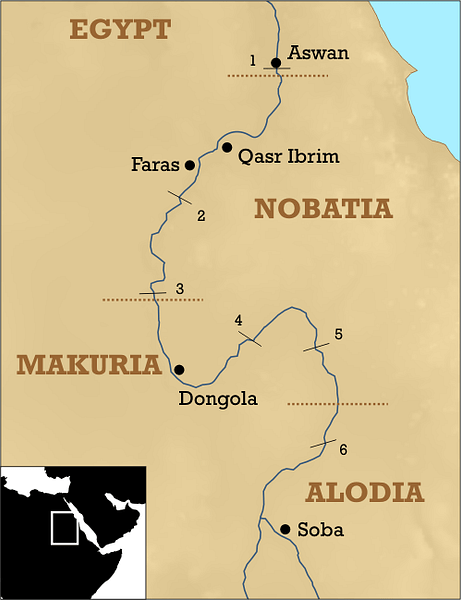 Southern Egypt/Nubia Map SimonP (CC BY-SA) ](https://www.worldhistory.org/image/5141/southern-egyptnubia-map/ "Southern Egypt/Nubia Map")The town of Faras was flooded by Lake Nasser as part of Egypt's public works program in 1964 and now rests forever underwater. Before the planned flooding was accomplished, however, a Polish team of archaeologists excavated the site and removed the painted walls of the cathedral as well as many other ancient artifacts including Nubian pottery from the necropolis of the city. These works of art may now be viewed in museums in Warsaw, Poland and Khartoum, Sudan. Although Nubian buildings such as the Temple of Kalabsha were saved from the flooding, by moving it to higher ground, those of Faras were left to the flood and now remain submerged.
#### Editorial Review
This human-authored definition has been reviewed by our editorial team before publication to ensure accuracy, reliability and adherence to academic standards in accordance with our [editorial policy](https://www.worldhistory.org/static/editorial-policy/).
## Bibliography
- [Bunson, M. *Encyclopedia of Ancient Egypt.* Gramercy, 1999.](https://www.worldhistory.org/books/0517203804/)
- [Van De Mieroop, M. *A History of Ancient Egypt.* Wiley-Blackwell, 2010.](https://www.worldhistory.org/books/1405160713/)
- [Welsby, D. A. *The Kingdom of Kush.* Markus Wiener Pub, 1998.](https://www.worldhistory.org/books/1558761829/)
## About the Author
Joshua J. Mark is World History Encyclopedia's co-founder and Content Director. He was previously a professor at Marist College (NY) where he taught history, philosophy, literature, and writing. He has traveled extensively and lived in Greece and Germany.
- [Linkedin Profile](https://www.linkedin.com/pub/joshua-j-mark/38/614/339)
## Timeline
- **2040 BCE - 1750 BCE**: The town of [Faras](https://www.worldhistory.org/Faras/) is founded.
- **1550 BCE - 1070 BCE**: The [temple](https://www.worldhistory.org/temple/) to [Hathor](https://www.worldhistory.org/Hathor/) of Ibschek built and dedicated.
- **1333 BCE - 1323 BCE**: The [temple](https://www.worldhistory.org/temple/) to [Tutankhamun](https://www.worldhistory.org/Tutankhamun/) built and dedicated.
- **350 BCE - 300 BCE**: [Palace](https://www.worldhistory.org/disambiguation/palace/) complex built during this time of [Faras](https://www.worldhistory.org/Faras/)' prominence.
- **c. 150 CE - c. 250 CE**: Christian churches built in [Faras](https://www.worldhistory.org/Faras/), including the ornate Cathedral and the rock church.
- **c. 697 CE**: The Kingdom of Dongola absorbs or unifies with the two neighbouring Christian kingdoms of [Faras](https://www.worldhistory.org/Faras/) (Nobatia) and Alodia.
- **c. 707 CE**: The first version of [Faras Cathedral](https://www.worldhistory.org/Faras_Cathedral/) is built.
- **c. 1000 CE**: The second version of the [Faras Cathedral](https://www.worldhistory.org/Faras_Cathedral/) is built.
## External Links
- [National Museum in Warsaw](http://www.mnw.art.pl/en/collections/permanent-galleries/faras-gallery/)
## Cite This Work
### APA
Mark, J. J. (2011, April 28). Faras. *World History Encyclopedia*.
### Chicago
Mark, Joshua J.. "Faras." *World History Encyclopedia*, April 28, 2011. .
### MLA
Mark, Joshua J.. "Faras." *World History Encyclopedia*, 28 Apr 2011, .
## License & Copyright
Submitted by [Joshua J. Mark](https://www.worldhistory.org/user/JPryst/ "User Page: Joshua J. Mark"), published on 28 April 2011. The copyright holder has published this content under the following license: [Creative Commons Attribution-NonCommercial-ShareAlike](https://creativecommons.org/licenses/by-nc-sa/4.0/deed.en). This license lets others remix, tweak, and build upon this content non-commercially, as long as they credit the author and license their new creations under the identical terms. When republishing on the web a hyperlink back to the original content source URL must be included. Please note that content linked from this page may have different licensing terms.