---
title: Ezekiel
author: Rebecca Denova
source: https://www.worldhistory.org/Ezekiel/
format: machine-readable-alternate
license: Creative Commons Attribution-NonCommercial-ShareAlike (https://creativecommons.org/licenses/by-nc-sa/4.0/)
updated: 1970-01-01
---
# Ezekiel
_Authored by [Rebecca Denova](https://www.worldhistory.org/user/rdenova/)_
Ezekiel was both a priest and a prophet who lived in the 6th century BCE. The prophets of [Israel](https://www.worldhistory.org/disambiguation/Israel/) were oracles (a term for a person as well as a place) for ways in which humans communicated with their gods. The oracle was possessed by the deity and served as a vehicle for the words. Sometimes the deity appeared in a vision. At other times, the prophet could experience an out-of-body journey to heaven and receive information from [God](https://www.worldhistory.org/God/) or his angels.
### The Prophets of Israel
In 722 BCE, the Assyrian [Empire](https://www.worldhistory.org/empire/) conquered and destroyed the Northern [Kingdom of Israel](https://www.worldhistory.org/Kingdom_of_Israel/). This is when ten of the [twelve tribes of Israel](https://www.worldhistory.org/article/1822/the-twelve-tribes-of-israel/) were lost to history. In 587 BCE, the Babylonian Empire conquered and destroyed the Southern Kingdom of Judah and [Solomon](https://www.worldhistory.org/solomon/)'s [Temple in Jerusalem](https://www.worldhistory.org/article/852/the-temple-in-jerusalem/). The Prophets of Israel explained both disasters by claiming that the sins of the Israelites (specifically their idolatry) led God to punish them. However, they also offered a message of hope: sometime in the future, God would intervene once more in the final days (*eschaton* in [Greek](https://www.worldhistory.org/disambiguation/greek/)). At that time, he would restore Israel to its former glory and rectify all injustice.
The Prophets related their visions and experiences as secrets that were revealed to them (*apocalypsos* in Greek). Criticism of the dominant ruling powers was often construed as treason. Hence, their [literature](https://www.worldhistory.org/literature/) utilized allegory and symbolism. Modern scholars refer to such texts as apocalyptic eschatology, meaning the study of secrets revealed concerning the final days. The Book of Ezekiel displays the elements of apocalyptic eschatology in both his visions and predictions for the nation of Israel.
### The Babylonian [Conquest](https://www.worldhistory.org/warfare/) & Destruction
Ezekiel ben-Buzi came from a priestly family in [Jerusalem](https://www.worldhistory.org/jerusalem/) and served during the reign of King Josiah. Made a vassal state during the reign of [Nebuchadnezzar II](https://www.worldhistory.org/Nebuchadnezzar_II/) (r. 605/604-562 BCE), Judah rebelled. Babylon destroyed the [Temple](https://www.worldhistory.org/temple/) in 587 BCE and took the aristocracy (priests, scribes, and nobles) to their capital in a period that became known as the time of exile. Ezekiel was one of the captives who lived there until 571 BCE.
The Book of Ezekiel remains important for Jewish life in Babylon. No longer having access to the Temple in which to perform sacrifices, the period of captivity most likely was when the concept of synagogues arose. Synagogues were not sacred spaces, there were no sacrifices there, but they became community centers for Jews to assemble in their weekly meetings.
Solomon's Temple was understood to contain the presence of God on earth, located between the cherubim on the Ark of Covenant, the mercy seat. Referred to in the phrase *kavod* YHWH, or the *shekhinah* of YHWH, Ezekiel had a vision of the presence of God on his throne:
> I looked, and I saw a windstorm coming out of the north—an immense cloud with flashing lightning and surrounded by brilliant light. The center of the fire looked like glowing [metal](https://www.worldhistory.org/disambiguation/metal/), and in the fire was what looked like four living creatures. In appearance their form was human, but each of them had four faces and four wings. Their legs were straight; their feet were like those of a calf and gleamed like burnished [bronze](https://www.worldhistory.org/disambiguation/bronze/). Under their wings on their four sides they had human hands. All four of them had faces and wings, and the wings of one touched the wings of another. Each one went straight ahead; they did not turn as they moved. Their faces looked like this: Each of the four had the face of a human being, and on the right side each had the face of a lion, and on the left the face of an ox; each also had the face of an eagle. Such were their faces. They each had two wings spreading out upward, each wing touching that of the creature on either side; and each had two other wings covering its body. (Ezekiel 1:4-11).
It should be noted that artists have always had difficulty portraying this complicated vision of the throne.
[ 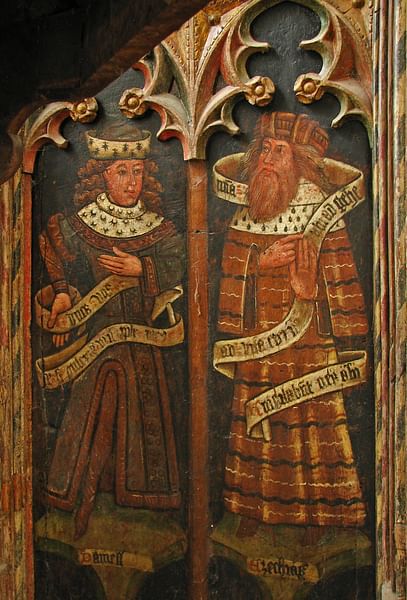 Daniel and Ezekiel Fr Lawrence Lew, O.P. (CC BY-NC) ](https://www.worldhistory.org/image/15331/daniel-and-ezekiel/ "Daniel and Ezekiel")### The Idolatry in the Temple
> In the sixth year, in the sixth month on the fifth day, while I was sitting in my house and the elders of Judah were sitting before me, the hand of the Sovereign Lord came on me there. I looked, and I saw a figure like that of a man. From what appeared to be his waist down he was like fire, and from there up his appearance was as bright as glowing metal. He stretched out what looked like a hand and took me by the hair of my head. The Spirit lifted me up between earth and heaven and in visions of God he took me to Jerusalem, to the entrance of the north gate of the inner court, where the idol that provokes to jealousy stood. (Ezekiel 8:1-3)
Ezekiel claimed that an idol of the Babylonian fertility god Tammuz had been erected in the Temple. Destroyed by demons from the land of the dead, he arose in the spring as a symbol of new life. This was the element that defiled the Temple, and why God let the Babylonians destroy it. A new Temple would be raised by God, purified of this defilement. The "figure like that of a man" is a reference to "one like the son of man" in Daniel 7 and the apocalyptic books of [Enoch](https://www.worldhistory.org/Enoch/). This was the concept of a pre-existence angel, whom God elevated to be the judge of the nations in the final days.
### The Valley of Dry Bones
The Spirit of the Lord took Ezekiel to a valley, littered with the bones of dead Israelites.
> Prophesy to these bones and say to them .... "I will make breath enter you, and you will come to life . ... I will bring you back to the land of Israel ... I will put my Spirit in you and you will live, and I will settle you in your own land" (37:4-14).
By the 1st century CE, the Jewish sect of the [Pharisees](https://www.worldhistory.org/Pharisees/) had incorporated this passage into their teaching on the resurrection of the dead, as did the emerging sect of Christians. It also became the conviction of a future restoration of all of Israel.
[ 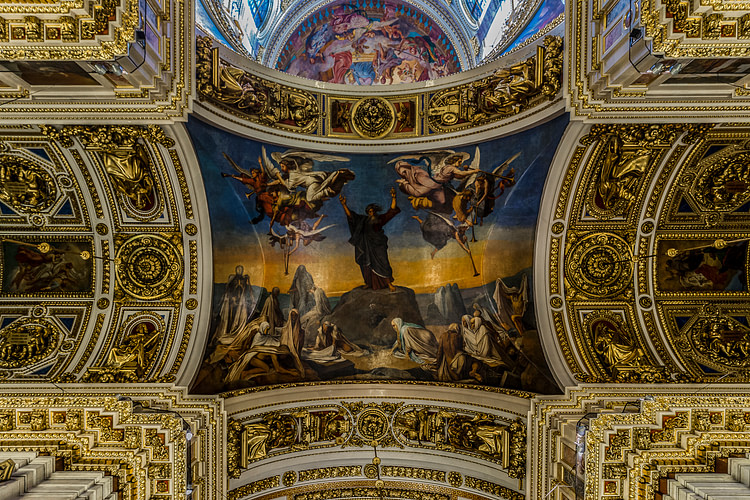 Vision of the Prophet Ezekiel Ninara (CC BY) ](https://www.worldhistory.org/image/15332/vision-of-the-prophet-ezekiel/ "Vision of the Prophet Ezekiel")### Ezekiel in Rabbinic [Judaism](https://www.worldhistory.org/disambiguation/judaism/)
A movement that eventually became known as Merkabah Mysticism emerged in the [Hellenistic](https://www.worldhistory.org/Hellenic_World/) Jewish period (in the [Dead Sea Scrolls](https://www.worldhistory.org/Dead_Sea_Scrolls/)) and among the early rabbis. *Merkabah* ("to ride") referred to the throne [chariot](https://www.worldhistory.org/chariot/) in Ezekiel’s vision. Visions of similar heavenly ascents began to include the many layers of heaven, and the incorporation of more angels and divinities in God's realm. By the Middle Ages, these commentaries were part of [Kabbalah](https://www.worldhistory.org/Kabbalah/) Mysticism.
### Ezekiel in [Christianity](https://www.worldhistory.org/christianity/)
The writers of the [gospels](https://www.worldhistory.org/The_Gospels/) utilized many of Ezekiel's prophecies to describe the ministry of [Jesus](https://www.worldhistory.org/Jesus_Christ/) of Nazareth as a similar apocalyptic Prophet claiming that the kingdom of God was imminent. Recalling Ezekiel, God would send out a new spirit and a new covenant, embedded now in the heart. A favorite title for Jesus was the prophesized "son of man." As the final judge, this became a favored term to describe Jesus and why he was able to forgive sins on earth. In Luke's story of Pentecost, he described the Jewish pilgrims in Jerusalem for the festival "from every nation under heaven" (Acts 2:5). Luke then utilized Ezekiel 39:25-29: "I will now restore the fortunes of [Jacob](https://www.worldhistory.org/Jacob/) ... when I have brought them back .... I will pour out my Spirit on the people of Israel." Luke then described God sending his spirit on the gathering of believers in the upper room.
The Christian seer John of Patmos, who wrote down his visions in the [Book of Revelation](https://www.worldhistory.org/Book_of_Revelation/) while exiled on the island c. 100 CE, utilized Ezekiel almost exclusively. Revelation predicts the coming destruction of the [Roman Empire](https://www.worldhistory.org/Roman_Empire/) for its persecution of Christians. Allegorically, [Rome](https://www.worldhistory.org/Rome/) is presented as Babylon. For the final [battle](https://www.worldhistory.org/disambiguation/battle/) in Revelation, Satan will gather the evil nations beginning with Gog and Magog, "but fire came down from heaven and devoured them" (Revelation 20:9).
[ 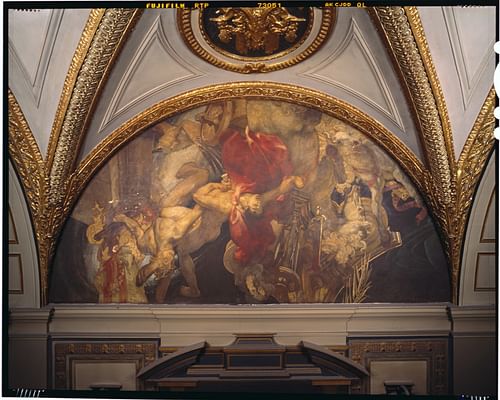 Fall of Gog and Magog Boston Public Library (CC BY-NC-ND) ](https://www.worldhistory.org/image/15333/fall-of-gog-and-magog/ "Fall of Gog and Magog")In chapter 38 of Ezekiel, Gog is an individual, while Magog is his land. Ezekiel presented Gog and Magog as future enemies of Israel who would attack and begin the tribulations of the final days and the final battle. The 1st-century CE Jewish historian, [Flavius Josephus](https://www.worldhistory.org/Flavius_Josephus/) claimed that they represented the [Scythians](https://www.worldhistory.org/Scythians/) in the Eurasian steppes of Kazakhstan and Southern Siberia. Like most prophetic texts, Ezekiel did not specify when the final days would occur as the time is known only to God. Ezekiel was ordered to take the scroll where he had written his visions and eat it so to avoid obsessive speculation (Ezekiel 3:1-3). Over time, Gog and Magog became symbolic of the [Huns](https://www.worldhistory.org/Huns/), the [Goths](https://www.worldhistory.org/Goths/), [Vandals](https://www.worldhistory.org/Vandals/), and [Vikings](https://www.worldhistory.org/Vikings/). Modern Christians still turn to John's revelations in attempts to decode his document in light of contemporary crises. During the red scare of the 1940s and 1950s, Communist Russia was often described as Gog and Magog.
#### Editorial Review
This human-authored definition has been reviewed by our editorial team before publication to ensure accuracy, reliability and adherence to academic standards in accordance with our [editorial policy](https://www.worldhistory.org/static/editorial-policy/).
## Bibliography
- [Blenkinsopp, Joseph. *Ezekiel (Interpretation& Preaching).* John Knox Press, 1990.](https://www.worldhistory.org/books/0804231184/)
## About the Author
Rebecca I. Denova, Ph.D. is Emeritus Professor of Early Christianity in the Department of Religious Studies, University of Pittsburgh. She has recently completed a textbook, "The Origins of Christianity and the New Testament" (Wiley-Blackwell)
## Timeline
- **722 BCE**: The upper class in [Israel](https://www.worldhistory.org/disambiguation/Israel/), the Northern Kingdom, is exiled by the Assyrians.
- **586 BCE**: Destruction of the First [Temple in Jerusalem](https://www.worldhistory.org/article/852/the-temple-in-jerusalem/) and exile of upper class Judeans.
## Cite This Work
### APA
Denova, R. (2022, March 09). Ezekiel. *World History Encyclopedia*.
### Chicago
Denova, Rebecca. "Ezekiel." *World History Encyclopedia*, March 09, 2022. .
### MLA
Denova, Rebecca. "Ezekiel." *World History Encyclopedia*, 09 Mar 2022, .
## License & Copyright
Submitted by [Rebecca Denova](https://www.worldhistory.org/user/rdenova/ "User Page: Rebecca Denova"), published on 09 March 2022. The copyright holder has published this content under the following license: [Creative Commons Attribution-NonCommercial-ShareAlike](https://creativecommons.org/licenses/by-nc-sa/4.0/deed.en). This license lets others remix, tweak, and build upon this content non-commercially, as long as they credit the author and license their new creations under the identical terms. When republishing on the web a hyperlink back to the original content source URL must be included. Please note that content linked from this page may have different licensing terms.