---
title: Excalibur
author: Joshua J. Mark
source: https://www.worldhistory.org/Excalibur/
format: machine-readable-alternate
license: Creative Commons Attribution-NonCommercial-ShareAlike (https://creativecommons.org/licenses/by-nc-sa/4.0/)
updated: 1970-01-01
---
# Excalibur
_Authored by [Joshua J. Mark](https://www.worldhistory.org/user/JPryst/)_
Excalibur is the sword of [King Arthur](https://www.worldhistory.org/King_Arthur/) in Sir [Thomas Malory](https://www.worldhistory.org/Thomas_Malory/)'s iconic work *Le Morte D'Arthur* published in in 1485 CE. The sword was originally introduced in Geoffrey of Monmouth's *History of the Kings of [Britain](https://www.worldhistory.org/disambiguation/Britain/)* (1136 CE) as *Caliburnus* (or Caliburn) and further developed by later writers before Malory immortalized it in his work. The sword, from its first appearance, is a powerful weapon in the hands of a skilled warrior and retains that reputation in every story which features it.
As with many other magical or powerful swords in legend or [mythology](https://www.worldhistory.org/mythology/), it is identified with a single hero and should not be allowed to fall into the hands of an enemy owing to its inherent power. In the case of Excalibur, when Arthur is dying of his wounds following his [battle](https://www.worldhistory.org/disambiguation/battle/) with Mordred, it must be returned to its source, the Lady of the Lake, rather than being entrusted to whichever knight - no matter how noble - might succeed Arthur as king.
This rule does not always hold true in every version of the legend, however. In the poem *Conte du Graal*, Provencal poet [Chretien de Troyes](https://www.worldhistory.org/Chretien_de_Troyes/) (c. 1130 - c. 1190 CE) makes Excalibur (called *Escalibor*) Sir Gawain's weapon. In the *Vulgate Cycle* (1215-1235 CE) and the *Post-Vulgate Cycle* (c. 1240-1250 CE) Arthur presents Gawain with Excalibur who then loans it to [Lancelot](https://www.worldhistory.org/Lancelot/) for his defense of [Guinevere](https://www.worldhistory.org/Guinevere/). Gawain then returns the sword to Arthur for his final battle with Mordred and, afterwards, it must be returned to the Lady of the Lake.
### Swords in Mythology
The concept of a "sword of power" did not originate with the [Arthurian legend](https://www.worldhistory.org/collection/226/the-arthurian-legend/). [Greek mythology](https://www.worldhistory.org/Greek_Mythology/) mentions a number of magical swords and, especially, the *harpe used by the [titan](https://www.worldhistory.org/Titan/) Cronos to overthrow his father [Uranus](https://www.worldhistory.org/Uranus/). [Julius Caesar](https://www.worldhistory.org/Julius_Caesar/)'s sword, the *Crocea Mors* was supposed to have supernatural powers as was the Sword of [Mars](https://www.worldhistory.org/Mars/) wielded by [Attila the Hun](https://www.worldhistory.org/Attila_the_Hun/). The *Gianjiang* and *Moye* swords of the Chinese Spring and Autumn Period are also supposed to have been imbued with great power by their makers.
In the biblical [Book of Genesis](https://www.worldhistory.org/Book_of_Genesis/), after the Fall of Man, [God](https://www.worldhistory.org/God/) sets his cherubim to stand watch to the east of the [Garden of Eden](https://www.worldhistory.org/Garden_of_Eden/) along with a flaming sword "which turned every way" to prevent Adam and Eve from returning. The [Shinto](https://www.worldhistory.org/Shinto/) storm god [Susanoo](https://www.worldhistory.org/Susanoo/) finds a magical sword in the tail of a dragon and this eventually became part of the Japanese imperial regalia. [Norse mythology](https://www.worldhistory.org/Norse_Mythology/) frequently makes use of magic swords, such as Gram, the weapon of Sigmund and his son Sigurd and the [Celts](https://www.worldhistory.org/celt/) wove a number of magical swords into their tales, including the *Claiomh Solais* (*kleeve sollish*), the Sword of Light which triumphs over darkness. The 11th century CE Spanish hero El Cid was claimed to have two magic swords and the 8th century CE French champion Roland wielded his famous blade Durendal and fell with it defending the Pass of Roncevaux in the epic Song of Roland.
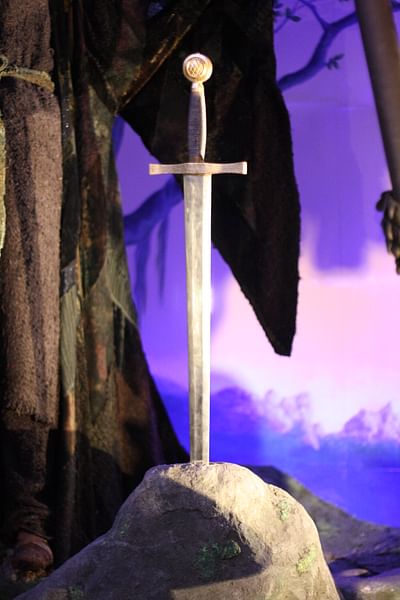
Although there are these precedents for earlier magical or supernaturally powerful swords, Excalibur is arguably the most famous. It is frequently associated with another Arthurian motif, the Sword in the Stone, but these are actually two different swords. In some versions of the legend, the Sword in the Stone is broken in Arthur's first battle and is replaced by Excalibur while, in others, the Sword in the Stone substantiates Arthur's right to rule (as only he can draw the blade from the rock) as the son and successor of Uther Pendragon while Excalibur serves as a symbol of his power as king.
### THE FAMOUS NAME & ORIGIN
The name Excalibur may originate in the work *Culhwch and Olwen* from the *Mabinogion*, a collection of Welsh legends, if one accepts a date of composition as c. 1100 CE. The *Mabinogion* only exists in manuscripts from the 13th and 14th centuries, however, and some scholars date it at 1200 CE. In this tale Arthur's sword is called Caledvwich which derives from the Latin *chalybs* ("steel" or "iron") and means "hard cleft". Caledvwich as the name for a sword of power most likely comes from the mythological Irish blade *Caladbolg* (which means "voracious") carried by the king Fergus mac Roich in the Ulster Cycle of Irish mythology.
[ 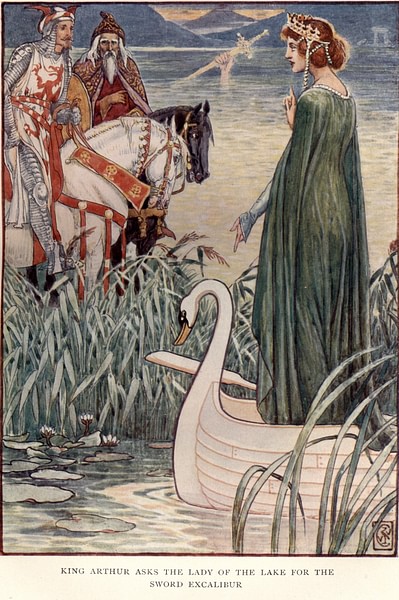 King Arthur & the Lady of the Lake Walter Crane (Public Domain) ](https://www.worldhistory.org/image/6643/king-arthur--the-lady-of-the-lake/ "King Arthur & the Lady of the Lake")Geoffrey of Monmouth calls Arthur's sword *Caliburnus* in Medieval Latin which is a more direct use of the Latin *chalybs* as "steel" but denotes a particularly hard or effective blade. Essentially, by the time Geoffrey was [writing](https://www.worldhistory.org/writing/), the name of Arthur's blade would be understood as "famous sword" or "great sword" because of the earlier associations of *chalybs* with mythological weapons.
The French poet Wace (c. 1110-1174 CE) translated Geoffrey's work into Old French vernacular and re-named the sword Chaliburn*. Chretien de Troyes changed the name to *Escalibor*. When the Arthurian legend was translated into English, *Chaliburn*/*Escalibor* became Excalibur. Malory, drawing on the *Vulgate Cycle*, calls Arthur's sword *Excalibur* shortly after Arthur has found and drawn the Sword in the Stone, linking the name with that weapon, and this association has stuck. Later, however, once this first sword is broken in battle, it is made clear that Arthur must receive the "true Excalibur" from a mystical source, the Lady of the Lake, and [Merlin](https://www.worldhistory.org/Merlin/) (who seems to be the magical force behind both swords) guides him to the place where it will be offered to him. No explanation is given as to the meaning, power, or origin of the sword and, in fact, Malory focuses more attention on the scabbard.
Whether presented as the Sword in the Stone or given by the Lady of the Lake, it is clear Excalibur comes from another realm. This motif follows from an established paradigm in [Celtic](https://www.worldhistory.org/celt/) lore of magical weapons, such as the spear of Cuchulain or the sword of Fergus mac Roich, having been forged in a mystical realm. The same device, however, is used in legends from many cultures around the world. The great swords of *Gianjiang* and *Moye*, for example, also have mystical origins. In the case of Excalibur, the sword develops from a mighty weapon to a symbol of divinely inspired justice and redemption. When the weapon is first mentioned in Geoffrey of Monmouth's work, no magical attributes are ascribed to it.
### THE POWER OF THE SWORD
In Book IX of *History of the Kings of Britain*, Caliburn is first referenced as "the best of swords, that was forged within the isle of Avallon" and is listed by Geoffrey along with Arthur's other gear as an item of particular importance. As Arthur is preparing to meet the [Saxons](https://www.worldhistory.org/Saxons/) in battle at Bath, Geoffrey writes:
> He did set upon his head a helm of [gold](https://www.worldhistory.org/gold/) graven with the semblance of a dragon. Upon his shoulders, moreover, did he bear the shield that was named Pridwen, wherein, upon the inner side, was painted the image of holy Mary, Mother of God, that many a time and oft did call her back unto his memory. Girt was he also with Caliburn, best of swords, that was forged within the Isle of Avallon; and the lance that did grace his right hand was called by the name Ron, a tall lance and stout, full meet to do slaughter withal. (188)
The Saxons have broken trust with Arthur after they had sworn a treaty of peace and so the battle is a matter of personal honor as well as a necessary defense of his realm. Geoffrey describes a hard-fought battle in which the Saxons hold the high ground and inflict heavy casualties on the Britons under Arthur. The Saxons continue to hold their position until the day is almost gone and then Arthur has finally had enough and leads a final charge on their position himself. Geoffrey writes:
> Arthur waxed wroth at the stubborness of their resistance, and the slowness of his own advance, and drawing forth Caliburn, his sword, crieth aloud in the name of Holy Mary, and thrusteth him forward with a swift onset into the thickest press of the enemy's ranks. Whomsoever he touched, calling upon God, he slew at a single blow, nor did he once slacken in his onslaught until that he had slain four hundred and seventy men single-handed with his sword Caliburn. This, when the Britons beheld, they followed him up in close rank dealing slaughter on every side. (189)
Excalibur is described in more or less the same way every time it appears in a story. In Malory's work, when Arthur is attacked by King Lot, he is at first beaten until he unleashes the power of his sword:
> Therewith King Lot smote down King Arthur. With that, his four knights rescued him and set him on horseback; then he drew his sword Excalibur, and it was so bright in his enemies' eyes that it gave light like thirty torches. Therewith he put them back and slew many people. (13)
Arthur confronts Lot early in Malory's version of the legend and it seems as though Excalibur is the same sword as the one Arthur earlier drew from the stone. This has caused confusion between two weapons which are often identified as the same but are not.
[  Excalibur, from the 1981 Film Excalibur Eduardo Otubo (CC BY) ](https://www.worldhistory.org/image/6667/excalibur-from-the-1981-film-excalibur/ "Excalibur, from the 1981 Film Excalibur")### THE SWORD IN THE STONE
The concept of the Sword in the Stone was added to the Arthurian legend by the French poet Robert de Boron (12th century CE) in his *Merlin*. Robert de Boron presents the sword as anchored in an anvil which later writers changed to a stone. The *Vulgate Cycle* of the legend differentiates between the sword that Arthur drew from the stone and Excalibur and this tradition is continued in the Post-Vulgate Cycle and repeated in Malory's work.
Although Arthur's sword is identified as Excalibur early in Malory's version, it becomes clear that it is not the true Excalibur since this sword is broken in Arthur's fight with King Pellinore. Pellinore gets the best of Arthur after his sword breaks and tells him to yield but the young king will not. In order to save both their lives, Merlin puts Pellinore to sleep and then takes Arthur to receive the true Excalibur from the Lady of the Lake. Arthurian scholar Norris J. Lacy writes:
> In certain texts (and in popular Arthurian lore), Excalibur is also the Sword in the Stone, but such an identification is incompatible with the tradition, found, for example, in the Post-Vulgate Cycle and Malory, whereby the sword is given to Arthur (and finally taken from him) by a hand in the lake. (176)
Since Excalibur is defined by its power and strength it cannot be the same weapon which is broken in Arthur's encounter with Pellinore. Even so, according to Merlin, it is not Excalibur which is so extraordinary but its scabbard. Merlin asks Arthur, "Which pleases you better, the sword or the scabbard?" and Arthur answers, "The sword pleases me better." Merlin then rebukes him:
> "Ye are the more unwise," said Merlin, "for the scabbard is worth ten of the sword. While ye have the scabbard upon you, ye shall never lose any blood, be ye ever so sorely wounded. Therefore always keep the scabbard with you." (37)
This detail becomes significant later in Malory's version of the story when Arthur's sister, Morgan le Fay, steals the scabbard. She had hoped to defeat Arthur through magic by pitting her lover Sir Accolon against Arthur, giving Accolon the true Excalibur and Arthur a fake (a plot device taken almost directly from the Irish *Ulster Cycle*). When Arthur's sword breaks he knows it is not Excalibur and manages to defeat and kill Accolon. Morgan takes the magical scabbard in revenge and throws it into a lake; thus dooming Arthur in his final battle with Mordred.
### SIGNIFICANCE OF EXCALIBUR
The sword has become more famous than the powerful scabbard and continues as a symbol of Arthur's virtue and power. Later works, including El Cid and the Song of Roland, draw on the symbolism of Excalibur for their heroes. J.R.R. Tolkien's famous trilogy of *The Lord of the Rings* relies on the symbolism of a sword of power which is broken and must be made whole to convey the concept of the return of the rightful king; a plot device which is similar to the Sword in the Stone motif where the land suffers after Uther Pendragon's [death](https://www.worldhistory.org/disambiguation/Death/) until the legitimate king is able to draw the magical sword from the stone.
[ 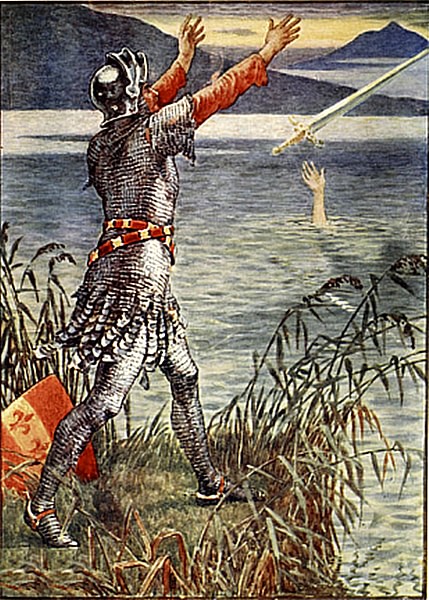 Sir Bedevere Returns Excalibur to the Lake Walter Crane (Public Domain) ](https://www.worldhistory.org/image/6666/sir-bedevere-returns-excalibur-to-the-lake/ "Sir Bedevere Returns Excalibur to the Lake")More than simply a literary device, however, Excalibur has come to represent the noblest aspects of the Arthurian legend. Although it is always described as a sword of power, that power is wielded in the best interests of the people, of justice, not in the self-interest of the king. Excalibur is given to Arthur through magical means, by the Lady of the Lake; it is not a weapon forged in this world but in another. The sword comes from this other realm and, once Arthur is defeated and dying, it must be returned there. This motif is not unique to the Arthurian legend but is borrowed from Celtic tradition in which the magical weapon must be returned to its source.
In some versions of the story, the knight Sir Girflet, who has survived the final battle between Arthur and Mordred, is given the task of throwing Excalibur back into the lake; in Malory this falls to Sir Bedevere. Whether Girflet or Bedevere, Arthur's command that Excalibur be returned to where it came from goes unheeded twice since the knight he sends on the errand cannot see the sense in throwing away such a noble and powerful weapon. This failure on the part of one of Arthur's most trusted companions resonates with the Christian story of the betrayal of Christ by Judas, as it is intended to, and points to the same meaning: that the world cannot understand or appreciate the efforts of the divine will to help it rise to more than what it thinks it can be.
#### Editorial Review
This human-authored definition has been reviewed by our editorial team before publication to ensure accuracy, reliability and adherence to academic standards in accordance with our [editorial policy](https://www.worldhistory.org/static/editorial-policy/).
## Bibliography
- Geoffrey of Monmouth. *The History of the Kings of Britain.* E.P.Dutton & Company, N.Y., 1958
- [Hamilton, E. *Mythology.* Grand Central Publishing, 2011.](https://www.worldhistory.org/books/0446574759/)
- [Hamilton, R. & Perry, J. (translators). *The Poem of the Cid.* Penguin Classics, 1985.](https://www.worldhistory.org/books/0140444467/)
- Jones, G. & Jones, T. *The Mabinogion.* J.M.Dent & Sons Ltd., London, 1989
- Lacy, N.J. *The Arthurian Encylopedia.* Peter Bedrick Books, 1986
- [Lindow, J. *Norse Mythology.* Oxford University Press, 2002.](https://www.worldhistory.org/books/0195153820/)
- Lumiansky, R.M. (editor). *Sir Thomas Malory's Le morte d'Arthur.* Collier Books, 1982
- [Mathews, J. *An Arthurian Reader.* Aquarian Press, 1988.](https://www.worldhistory.org/books/B01K0S65NW/)
- [Rutherford, W. *Celtic Mythology.* Sterling Publishing, 1990.](https://www.worldhistory.org/books/B002K5ATX6/)
- [Sayers, D.L. (translator). *The Song of Roland.* Penguin Classics, 1957.](https://www.worldhistory.org/books/0140440755/)
- [Staines, D. *The Complete Romances of Chretien de Troyes.* Indiana University Press, 1991.](https://www.worldhistory.org/books/0253207878/)
- [Tolkien, J.R.R. *The Lord of the Rings.* Mariner Books, 2005.](https://www.worldhistory.org/books/0618640150/)
- [Zondervan. *Holy Bible, King James Version.* Zondervan, 2010.](https://www.worldhistory.org/books/0310941784/)
## About the Author
Joshua J. Mark is World History Encyclopedia's co-founder and Content Director. He was previously a professor at Marist College (NY) where he taught history, philosophy, literature, and writing. He has traveled extensively and lived in Greece and Germany.
- [Linkedin Profile](https://www.linkedin.com/pub/joshua-j-mark/38/614/339)
## Timeline
- **c. 460 CE - c. 560 CE**: Probable dates for historical Arthur, King of the Britons.
- **c. 830 CE**: Welsh Historian Nennius first mentions Arthur as king and hero of [Battle](https://www.worldhistory.org/disambiguation/battle/) of Badon Hill.
- **c. 1095 CE - c. 1143 CE**: Life of historian William of Malmesbury who mentions Arthur as [war](https://www.worldhistory.org/disambiguation/War/)-chief of Britons, not king.
- **c. 1130 CE - c. 1190 CE**: Life of French Poet [Chretien de Troyes](https://www.worldhistory.org/Chretien_de_Troyes/) who introduces Grail Quest, [Lancelot](https://www.worldhistory.org/Lancelot/), and other elements to [Arthurian Legend](https://www.worldhistory.org/collection/226/the-arthurian-legend/); calls sword Escalibur.
- **1136 CE**: Geoffrey of Monmouth's History of the Kings of [Britain](https://www.worldhistory.org/disambiguation/Britain/) introduces [Arthurian Legend](https://www.worldhistory.org/collection/226/the-arthurian-legend/) and Arthur's sword as Caliburn.
- **c. 1160 CE**: French Poet Wace develops [Arthurian Legend](https://www.worldhistory.org/collection/226/the-arthurian-legend/) further, adds Round Table, calls sword Chaliburn.
- **c. 1170 CE - c. 1220 CE**: Life of German Poet Wolfram von Eschenbach who develops [Arthurian Legend](https://www.worldhistory.org/collection/226/the-arthurian-legend/) in his poem Parzival.
- **c. 1190 CE**: French Poet Robert de Boron develops [Arthurian Legend](https://www.worldhistory.org/collection/226/the-arthurian-legend/) further including Grail Quest, [Merlin](https://www.worldhistory.org/Merlin/), Sword in the Stone.
- **c. 1190 CE - c. 1220 CE**: Layamon translates Arthurian Legends into English.
- **c. 1200 CE**: The Welsh Mabinogion influences development of [Arthurian Legend](https://www.worldhistory.org/collection/226/the-arthurian-legend/).
- **c. 1210 CE**: Gottfried von Strassburg writes Tristan, contributes to [Arthurian Legend](https://www.worldhistory.org/collection/226/the-arthurian-legend/).
- **c. 1215 CE - c. 1235 CE**: The Vulgate Cycle of the [Arthurian Legend](https://www.worldhistory.org/collection/226/the-arthurian-legend/) composed in English Prose; Arthur's sword is [Excalibur](https://www.worldhistory.org/Excalibur/).
- **c. 1469 CE**: Sir [Thomas Malory](https://www.worldhistory.org/Thomas_Malory/) composes Le Morte D'Arthur, definitive version of [Arthurian Legend](https://www.worldhistory.org/collection/226/the-arthurian-legend/) including [Excalibur](https://www.worldhistory.org/Excalibur/) as the king's sword.
- **1485 CE**: Le Morte D'Arthur published by William Caxton, becomes instant best-seller popularizing [Arthurian Legend](https://www.worldhistory.org/collection/226/the-arthurian-legend/).
## Cite This Work
### APA
Mark, J. J. (2017, May 17). Excalibur. *World History Encyclopedia*.
### Chicago
Mark, Joshua J.. "Excalibur." *World History Encyclopedia*, May 17, 2017. .
### MLA
Mark, Joshua J.. "Excalibur." *World History Encyclopedia*, 17 May 2017, .
## License & Copyright
Submitted by [Joshua J. Mark](https://www.worldhistory.org/user/JPryst/ "User Page: Joshua J. Mark"), published on 17 May 2017. The copyright holder has published this content under the following license: [Creative Commons Attribution-NonCommercial-ShareAlike](https://creativecommons.org/licenses/by-nc-sa/4.0/deed.en). This license lets others remix, tweak, and build upon this content non-commercially, as long as they credit the author and license their new creations under the identical terms. When republishing on the web a hyperlink back to the original content source URL must be included. Please note that content linked from this page may have different licensing terms.