---
title: Essenes
author: Rebecca Denova
source: https://www.worldhistory.org/Essenes/
format: machine-readable-alternate
license: Creative Commons Attribution-NonCommercial-ShareAlike (https://creativecommons.org/licenses/by-nc-sa/4.0/)
updated: 1970-01-01
---
# Essenes
_Authored by [Rebecca Denova](https://www.worldhistory.org/user/rdenova/)_
The Essenes were a Jewish sect that emerged in the 2nd century BCE and established the community at Qumran. They emphasized ritual purity, copied books of the Jewish Scriptures, and wrote commentaries on the Books of the Prophets. They believed that history was predestined, and their apocalyptic theology resulted in a worldview polarized between good and evil.
### Origins
The [Maccabean Revolt](https://www.worldhistory.org/article/827/the-maccabean-revolt/) by the Jews of 167 BCE, drove out the [Greek](https://www.worldhistory.org/disambiguation/greek/) occupiers and established an independent [kingdom of Israel](https://www.worldhistory.org/Kingdom_of_Israel/). The Hasmonean family (who led the revolt) combined the office of the king with that of the high priest at the [Temple in Jerusalem](https://www.worldhistory.org/article/852/the-temple-in-jerusalem/). Not everyone was happy with Hasmonean rule. Kings in [Israel](https://www.worldhistory.org/disambiguation/Israel/) were to be from David's tribe, Judah, and the high priest had to descend from Zadok, the first high priest under [Solomon](https://www.worldhistory.org/solomon/); the Hasmoneans could claim neither line.
This is the period when we find evidence of what scholars term Jewish sectarianism. Various groups of Jews formed sects within the religious body. All agreed on the basics of the [Law](https://www.worldhistory.org/disambiguation/law/) of [Moses](https://www.worldhistory.org/Moses/) and the Books of the Prophets. The dominating difference was the ability to live in this now cosmopolitan [Greek culture](https://www.worldhistory.org/disambiguation/Greek_Culture/), and yet retain the unique identity-markers and traditions of the Jews. The group known as the Essenes were among the more oppositional to the current Hasmonean rule as well as the current operation of the [Temple](https://www.worldhistory.org/temple/).
The name 'Essene' remains a problematic debate among scholars; the word itself does not appear in Essene manuscripts but only in the writings of outsiders. Here we find "*essaios*," without explanation, but it may indicate "holiness," or "doers of [Torah](https://www.worldhistory.org/Torah/)."
### Sources
The main sources for the Essenes come from the Jewish philosopher, Philo of [Alexandria](https://www.worldhistory.org/alexandria/) (20 BCE to c. 50 CE), [Pliny the Elder](https://www.worldhistory.org/Pliny_the_Elder/) (23-79 CE) in his *Natural History*, and the Jewish historian [Flavius Josephus](https://www.worldhistory.org/Flavius_Josephus/) (36-100 CE). They are described as a separate community north of the oasis of Ein Gedi on the shores of the Dead Sea (Qumran). All the writers claim that these Essenes were celibate.
The major sources for the study of the Essenes are [Josephus](https://www.worldhistory.org/Flavius_Josephus/)' *The Jewish [War](https://www.worldhistory.org/disambiguation/War/)* (75 CE) and *The Antiquities of the Jews* (94 CE). In these works, Josephus described the various Jewish sects as "philosophies of the Jews." From the details of Josephus, we can summarize the following regarding the Essenes:
1. Around 150 BCE, an unnamed "righteous teacher," in opposition to the Hasmoneans, took his followers to the desert and established a community at Qumran. In their documents, the righteous teacher and his followers were persecuted by those in [Jerusalem](https://www.worldhistory.org/jerusalem/).
2. The Essenes also lived in towns and [cities](https://www.worldhistory.org/city/), where members married. There was a community in Jerusalem; one of the gates into the [city](https://www.worldhistory.org/city/) was known as the Essene Gate in the 1st century.
3. Members had a three-year initiation period (later adopted by Christians) and emphasized the water rituals of baptism and the restoration of purity. At Qumran, they were able to install a phenomenal number of water cisterns and channels in the bedrock for these rituals.
Most of the members at Qumran spent their time both copying the books of the Jewish Scriptures as well as [writing](https://www.worldhistory.org/writing/) commentaries on the Prophets and apocryphal books. The details of communal life were written in *The Rule of the Community* and *The Damascus Document (Covenant of Damascus)*. Upon membership, personal possessions and accumulated wealth were shared with all members, as needed. In relation to the concept of celibacy, like 'Essenes,' the equivalent word for celibacy does not appear in the writings from Qumran. The Qumran cemetery was excavated in the 1950s where 43 skeletons were uncovered, with some containing [women](https://www.worldhistory.org/disambiguation/women/) and children. However, the practice of reusing cemeteries means that some of them could be from ancient Bedouins as well. Excavation of the remaining graves has been halted in Israel because of Rabbinical concerns for the violation of the graves of the dead.
[ 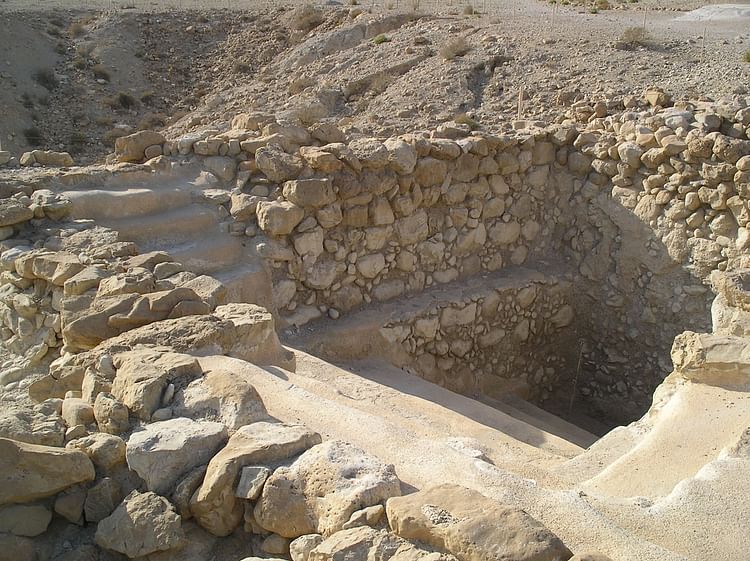 Mikvah, Qumran Randall Niles (CC BY-NC-SA) ](https://www.worldhistory.org/image/7489/mikvah-qumran/ "Mikvah, Qumran")### The Apocalyptic Worldview of the Essenes
The theology of the Essenes is described as apocalyptic, from the Greek *apokalypsis*, a "revelation of hidden or secret knowledge." Reflecting on the national disasters – foreign invasions – of the nation of Israel, the Prophets of Israel had predicted that [God](https://www.worldhistory.org/God/) would intervene in human history one more time, in the final days. At that time, God would establish his kingdom on earth. With the continuing disasters of first the Greek occupation and then [Rome](https://www.worldhistory.org/Rome/), many Jews called upon God to deliver his promises now.
The [literature](https://www.worldhistory.org/literature/) of this period included seers who had out-of-body experiences of being taken on tours of Heaven and where they were shown the secrets of the final days usually by angels. As part of the Essene theology and practice, they separated themselves from the majority of Jews, to await God's final intervention. While replicating many of the teachings of the Prophets, the views of the Essenes were more radical in that everything was understood within the polarity of good or evil, which is evident in the following aspects of Essene thought:
1. Chronological dualism and ethical dualism
2. A conviction that history is predestined
3. The demonization of others
To the Essenes, history was divided between the current wicked era and a future age of perfection. The era they lived in was considered so thoroughly evil, only a violent interaction by God could restore it. Humanity was understood to consist of two opposing camps: the sons of darkness and the sons of light (the Essenes belonging to the latter). Given the current state of evil, they thought the righteous should set themselves apart, avoiding interaction with all unbelievers.
The Essenes believed that human efforts, no matter how well-intended, could not avert the coming disaster or influence God to change his mind. There was no time for repentance; a person's fate had already been determined. They also developed a process known as the demonization of others who do not agree with the Essenes. Their literature contains some of the earliest polemics that the rest of humanity (including other Jews) are under the influence of agents of the Devil.
[ 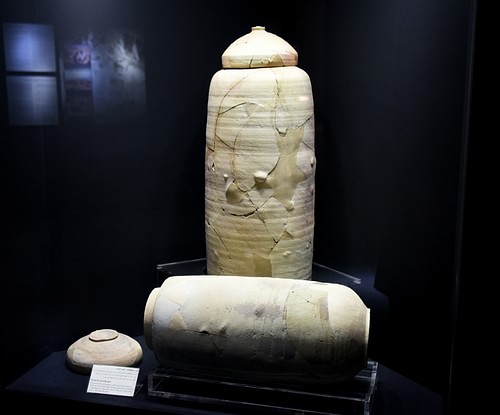 Dead Sea Scrolls Jars Osama Shukir Muhammed Amin (Copyright) ](https://www.worldhistory.org/image/8468/dead-sea-scrolls-jars/ "Dead Sea Scrolls Jars")Apocalyptic literature was the way in which to articulate both social and political critique. Critique of existing governments was equivalent to treason. Thus, apocalyptic writings utilized allegory and symbols, to which you and your community had the key. This is why contemporary rulers and high priests are not named in the documents. It also gives such writings unlimited interpretive elasticity so that they can be applied to any age.
The Essenes were able to maintain their apocalyptic visions and lifestyle until the [Great Jewish Revolt of 66 CE](https://www.worldhistory.org/article/823/the-great-jewish-revolt-of-66-ce/). Some participated in the war against Rome, perhaps seeing this as the final [battle](https://www.worldhistory.org/disambiguation/battle/). John the Essene is listed as a general in Galilee and some may have been among the [Zealots](https://www.worldhistory.org/Zealots/) in the final hold-out at [Masada](https://www.worldhistory.org/Masada/). A legion of the [Roman army](https://www.worldhistory.org/Roman_Army/) massacred the community at Qumran in 68 CE.
### The [Dead Sea Scrolls](https://www.worldhistory.org/Dead_Sea_Scrolls/)
The Dead Sea Scrolls are the collected writings discovered in the caves near Qumran in 1946 by an Arab shepherd boy who took several of the manuscripts to a black-market antiquities dealer in Bethlehem. As the fragments and scrolls came on the market, they were distributed to an international team of scholars for translation and preservation. They include 225 biblical texts, copies of older apocalyptic texts, their own apocalyptic views, manuals, commentaries, hymns, prayers, and curses. The manuscripts are labeled according to the number of the cave in which they were found (4Q, 11Q, etc.). Carbon and paleographic dating, along with coins, support a timespan of roughly 135 BCE to 68 CE.
Initially, the excitement of the discovery of the scrolls anticipated any information on [Jesus](https://www.worldhistory.org/Jesus_Christ/) or the communities of [early Christianity](https://www.worldhistory.org/article/1205/early-christianity/). No contemporary writings from the time of Jesus have survived. [Jesus of Nazareth](https://www.worldhistory.org/Jesus_Christ/) was also an apocalyptic prophet, and the scrolls confirm that similar ideas were in the air in the 1st century CE. However, the more important discovery is in the transmission of biblical books. Before the discovery of the Dead Sea Scrolls, the oldest manuscripts of the Hebrew Scriptures were the Masoretic texts of the 10th century CE. We now have manuscripts that are a thousand years older, and they confirm the careful textual transmission of this material over time. In other words, what we read now in the Jewish Scriptures are reliable copies of the original documents.
[ 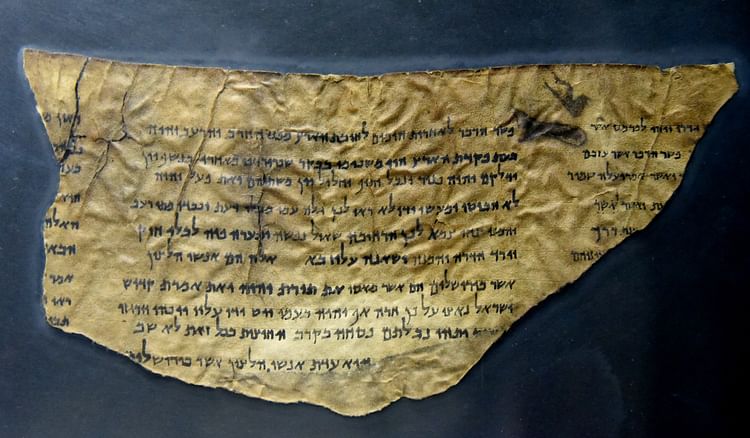 Dead Sea Scroll of Pesher Isaiah Osama Shukir Muhammed Amin (Copyright) ](https://www.worldhistory.org/image/8464/dead-sea-scroll-of-pesher-isaiah/ "Dead Sea Scroll of Pesher Isaiah")In 1953, the scrolls were placed in the Rockefeller Museum in East Jerusalem, then under the authority of [Jordan](https://www.worldhistory.org/Jordan/). Limited funding and primitive restoration practices contributed to the deterioration of some of the scrolls. At the same time, many of the documents assigned to the international scholars were not yet published. In their defense, many of the fragments were in poor shape; the fragments from Cave 11 (numbering 15,000) had to be first reassembled like a jigsaw puzzle.
In 1991, through the efforts of Herschel Shanks, the editor of *Biblical [Archaeology](https://www.worldhistory.org/Archaeology/) Review*, as well as many other scholars, the possession and authority over the scrolls was taken over by the Israeli Antiquities Authority where they are now preserved in a special museum, The Shrine of the Book in Jerusalem. All the existing scrolls and fragments are now available in books and on the internet.
#### Editorial Review
This human-authored definition has been reviewed by our editorial team before publication to ensure accuracy, reliability and adherence to academic standards in accordance with our [editorial policy](https://www.worldhistory.org/static/editorial-policy/).
## Bibliography
- [Martinez, Florentino Garcia. *The Dead Sea Scrolls Translated.* Wm. B. Eerdmans Publishing Co., 1996.](https://www.worldhistory.org/books/0802841937/)
- [Schiffman, Lawrence H. *Reclaiming the Dead Sea Scrolls.* Yale University Press, 1995.](https://www.worldhistory.org/books/0300140223/)
## About the Author
Rebecca I. Denova, Ph.D. is Emeritus Professor of Early Christianity in the Department of Religious Studies, University of Pittsburgh. She has recently completed a textbook, "The Origins of Christianity and the New Testament" (Wiley-Blackwell)
## Timeline
- **c. 167 BCE**: [Maccabean Revolt](https://www.worldhistory.org/article/827/the-maccabean-revolt/) frees [Palestine](https://www.worldhistory.org/palestine/) from foreign rule and allows for rise of Hasmonean Dynasty.
## Cite This Work
### APA
Denova, R. (2022, February 04). Essenes. *World History Encyclopedia*.
### Chicago
Denova, Rebecca. "Essenes." *World History Encyclopedia*, February 04, 2022. .
### MLA
Denova, Rebecca. "Essenes." *World History Encyclopedia*, 04 Feb 2022, .
## License & Copyright
Submitted by [Rebecca Denova](https://www.worldhistory.org/user/rdenova/ "User Page: Rebecca Denova"), published on 04 February 2022. The copyright holder has published this content under the following license: [Creative Commons Attribution-NonCommercial-ShareAlike](https://creativecommons.org/licenses/by-nc-sa/4.0/deed.en). This license lets others remix, tweak, and build upon this content non-commercially, as long as they credit the author and license their new creations under the identical terms. When republishing on the web a hyperlink back to the original content source URL must be included. Please note that content linked from this page may have different licensing terms.